Start with one production chain
To make an engine-building card game with AI, start with a short chain that turns production into a result: generate a resource, convert it, and score it. Then decide when an upgrade enters that chain. A four-round target and a fixed resolution order make the first engine small enough to calculate and check.
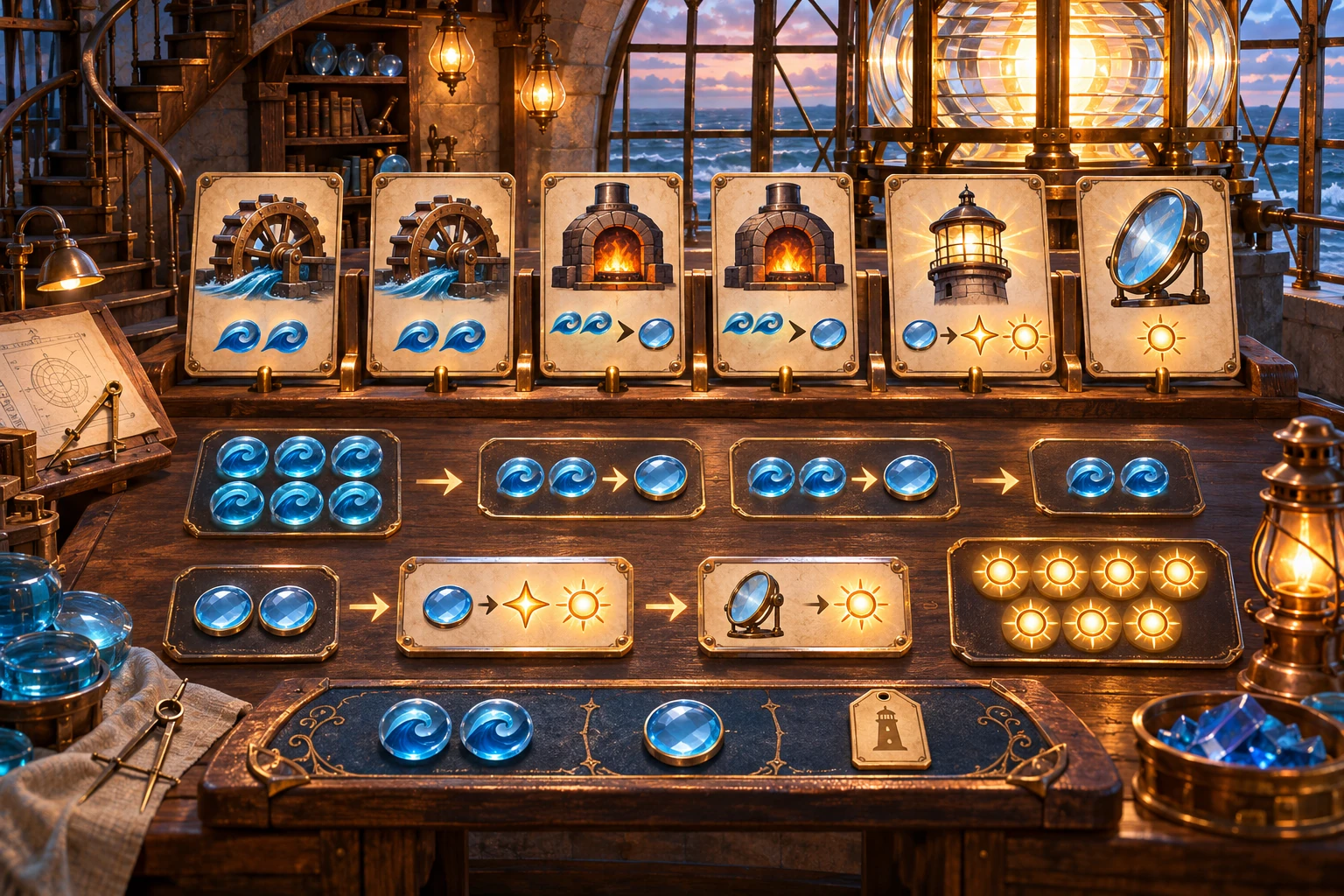
Windglass Workshop is an original fictional design about restoring a lighthouse. Its starting tableau contains Clerk, Tidewheel, Furnace, and Beacon. Clerk produces permits, Tidewheel produces current, Furnace converts current into lenses, and Beacon spends a lens to create light. The Mirror upgrade adds one light when a Beacon event occurs. These rules and the route below are hand-resolved teaching material, not a generated game or test result.
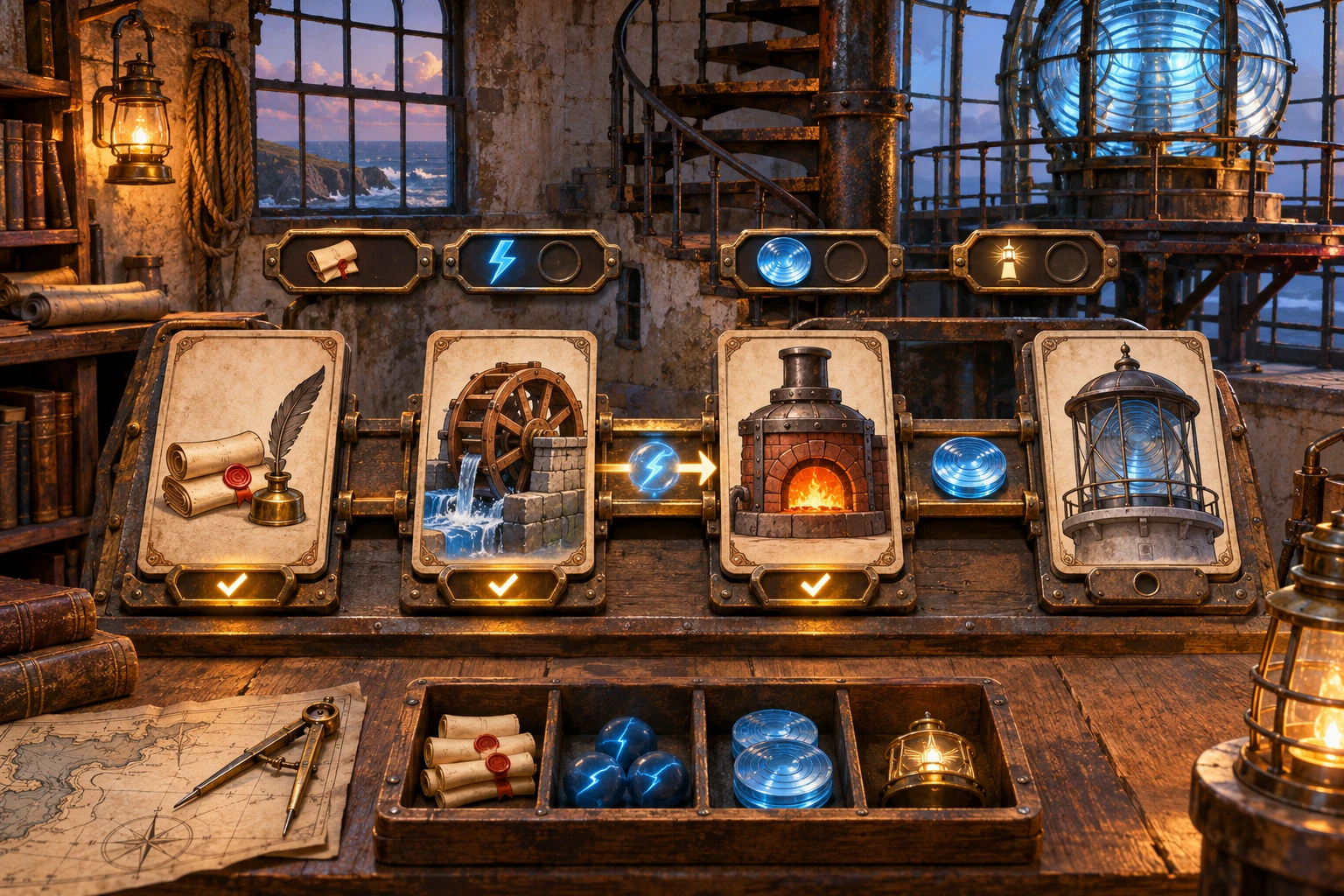
Keep four tracks visible: permits, current, lenses, and light. The initial state is round 1 of 4 with every track at zero. Resolving the starting engine gives one permit, two current, one lens, and then spends the two current at the Furnace; just before the Beacon, current is zero, one lens remains, and light is still zero. This intermediate state lets a player see which card acts next.
Define triggers and timing
List the resolution order so cards cannot activate twice or depend on an unclear timing window. At each round, Clerk produces one permit first; all installed Tidewheels resolve once; each Furnace resolves once from left to right; each Beacon checks for a lens; then Mirror responses resolve for each Beacon event. The market appears only after rounds 1–3. New cards start working next round.
| Card or rule | Condition and effect | Timing to show |
|---|---|---|
| Clerk | Produce 1 permit. | First in each round; unspent permits carry. |
| Tidewheel | Produce 2 current. | Each installed Tidewheel resolves once before Furnaces. |
| Furnace | Spend 2 current to produce 1 lens. If fewer than 2 current remain, do nothing and spend nothing. | Each installed Furnace resolves once, left to right. |
| Beacon | If at least 1 lens is available, spend 1 and emit one beacon_spark event worth 1 light. Otherwise do nothing. | After Furnaces; no lens cost when it cannot fire. |
| Mirror | When a Beacon emits beacon_spark, add 1 light once for that event. It emits no new spark and cannot trigger itself. | After the event; resolve each Mirror response once. |
| Market | Spend 1 permit to install at most one of two public offers. | After rounds 1–3. Unchosen offers expire; a purchased card begins next round. |
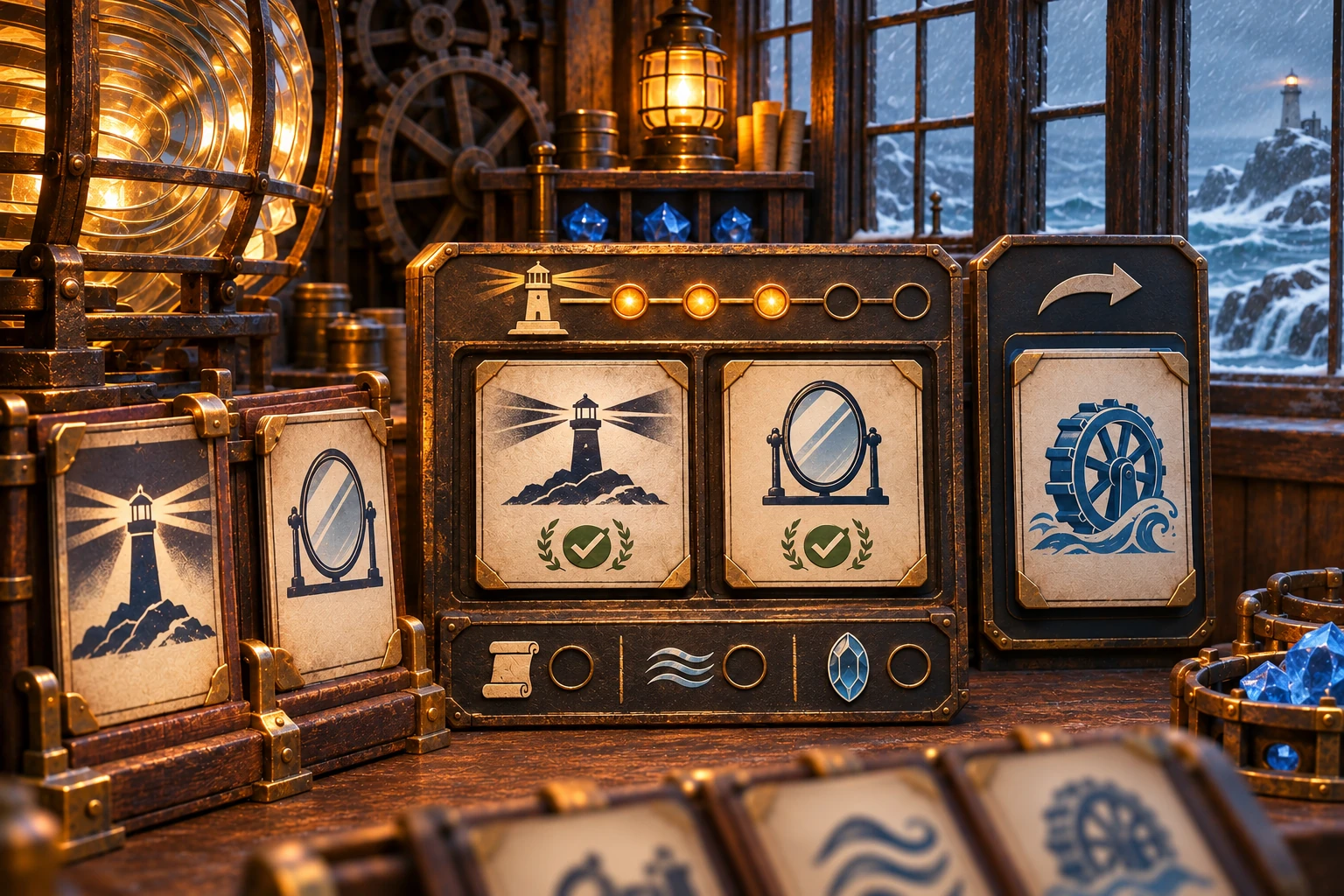
In round two, the Mirror responds only after the Beacon pays its lens and emits the spark. It does not create a second Beacon event. The permit, current, lens, and light tracks show the effect of each step, while the upgrade row shows which cards are already installed and which one is waiting.
Choose upgrades that change later rounds
An upgrade should alter a future decision or output, not retroactively join the current resolution. Windglass offers two cards after each of the first three rounds. Every purchase costs one permit, only one card may be installed per market, and the offer not chosen expires at cleanup. These fixed offers make the paper route reproducible without claiming that the chosen path is optimal.
| After round | Public offer | Example choice | Why it matters later |
|---|---|---|---|
| 1 | Mirror; Second Furnace | Mirror | It adds one light after each later Beacon spark. |
| 2 | Second Tidewheel; Second Furnace | Second Tidewheel | It adds 2 current per round starting in round 3. |
| 3 | Second Furnace; Second Beacon | Second Furnace | It can convert another 2 current starting in round 4. |
Clerk provides exactly one permit each round, so the example can afford one upgrade after each of rounds 1–3. It spends that permit immediately and carries no purchase balance into the next round. The Second Beacon, if selected, follows the same one-lens, one-spark rule as the original; it is simply not part of this trace. Round four checks the score before another market can appear.
Hand-resolve the four-round engine
Use the ledger as an expected-state check, not a substitute for a playtest. Each Furnace resolves once per round, consumes only current that is available at that moment, and produces one lens per two current. Current carries between rounds. An installed Mirror responds only to the Beacon event and adds no extra resource cost.
| Round | Production and trigger resolution | Upgrade | End state: permits / current / lenses / light |
|---|---|---|---|
| Start | Starting state: all tracks are 0; Clerk, Tidewheel, Furnace, and Beacon are installed. | — | 0 / 0 / 0 / 0 |
| 1 | Clerk +1 permit; Tidewheel +2 current; Furnace spends 2 for 1 lens; Beacon spends 1 lens for +1 light. | Buy Mirror for 1 permit. | 0 / 0 / 0 / 1 |
| 2 | Clerk +1; Tidewheel +2 current; Furnace converts 2 current into 1 lens; Beacon +1 light; Mirror +1 light. | Buy Second Tidewheel for 1 permit. | 0 / 0 / 0 / 3 |
| 3 | Clerk +1; two Tidewheels +4 current; Furnace converts 2 into 1 lens, leaving 2 current; Beacon and Mirror add 2 light. | Buy Second Furnace for 1 permit. | 0 / 2 / 0 / 5 |
| 4 | Clerk +1; carried 2 plus two Tidewheels' 4 makes 6 current. Two Furnaces each spend 2 for 1 lens, leaving 2 current. Beacon spends 1 lens for +1 light; Mirror adds +1. | No market before the finish check. | 1 / 2 / 1 / 7 |
The route reaches 7 light at the end of round four with one permit, two current, and one lens remaining. Check the round-four conversion carefully: two Furnaces use four of six current and make two lenses; the Beacon spends one lens, so one lens carries. A route that gives a Furnace a second resolution or makes the Mirror emit another spark would no longer match this engine.
Clarify one trigger in a simulated design pass
Simulated design pass: Imagine a v0 Mirror card that says only “boosts Beacon light.” The wording leaves three decisions open: whether it acts before or after the Beacon pays a lens, whether it can respond more than once, and whether it works in the round when bought. A paper review can identify that missing contract, but it cannot establish how software behaves.
A clearer v1 rule says: when a Beacon spends one lens and emits one beacon_spark, each installed Mirror adds exactly one light after that event; the Mirror does not emit another spark; a card bought from the market becomes active next round. This is an author-created rules clarification based on the fictional design, not a recorded test, player observation, or measured improvement.
Check thresholds and edge cases
After the rules are closed, compare a real build with small test inputs. Record the card, available resources, expected transition, and observed transition. Start a fresh run before each case so carryover from a previous action cannot hide a timing error.
| Case | Expected result | What to inspect |
|---|---|---|
| Furnace has 0 or 1 current | It produces no lens and spends no current. | Resource count stays unchanged; next card still resolves in order. |
| Beacon has no lens | No spark, light, or lens cost. | Mirror does not respond without a Beacon event. |
| Beacon fires with Mirror installed | One lens is spent; Beacon and Mirror add 2 total light. | One event is recorded; there is no second spark or recursive Mirror response. |
| Upgrade bought after resolution | It enters the tableau but has no effect until next round. | Market purchase does not change the completed round's engine result. |
| Round-four target reached | At 7 light, finish immediately before another market. | Outcome and remaining resources match the ledger. |
If an observed state differs, record the first card whose output diverges, the expected value, and the actual value. Then change one rule or interface cue and rerun that case. Add additional cards only after production, conversion, trigger timing, and carryover are all easy to verify.
Take a small rules brief to a creation workspace
The official Free AI Game Maker page describes entering a game idea in plain English, testing a playable first version in the browser, and refining it with follow-up prompts. Before submitting, its guidance asks creators to check the selected AI model, available Koin balance, and displayed generation cost. These are general creation steps; the page does not document Windglass Workshop, its card effects, trigger timing, or whether this exact engine can be built from the prompt.
Use a concise brief to describe the player’s starting tableau, production order, cost thresholds, event response, market timing, and finish check. When a playable result is available, inspect its cards and compare each round with the ledger before adding more content. To start your own small engine-building concept, open the Free AI game maker and review the result and displayed cost before continuing.
Make the next upgrade earn its place
A first engine is easier to improve when every card has one clear input, output, cost, and timing rule. Begin with a short production chain, check the order and thresholds by hand, then compare a real build with that expected route. Add another card only when it changes a future choice or a measurable result.
Does a newly purchased upgrade work immediately?
Not in the Windglass example. A market purchase happens after engine resolution, so the new card starts at the next round. State that timing in the rules and show the card in a pending row or other visible queue. If your design allows an immediate effect, define whether it resolves once in the purchase round or waits until the following turn.
What does a trigger do in an engine-building card game?
A trigger is a named event that allows a specific response. Here, a Beacon that spends one lens emits one beacon_spark; each installed Mirror adds one light after that event and cannot create another spark. Keeping the event separate from its response makes it easier to state what can happen once and what must not recurse.
What happens when a card does not have enough resources?
Define a no-op rule and make it visible. In Windglass, a Furnace with fewer than two current produces no lens and spends no current; a Beacon without a lens produces no spark and costs no lens. The next card still follows the fixed order. This prevents a short resource total from silently creating debt or shifting later effects.
Was Windglass Workshop built or tested?
No. Windglass and its four-round ledger are an original fictional paper design, and the v0-to-v1 Mirror clarification is a simulated design pass. No prompt run, playable build, user observation, or measured improvement is claimed. Use the ledger as an expected-state checklist, then record actual observations only after testing a real implementation.
How many upgrade cards should a first engine use?
Use only enough to show one meaningful future choice. This example starts with four production cards and adds a Mirror, a second Tidewheel, and a second Furnace across three markets. Each upgrade changes a later output or trigger. If a card does not change a decision, resource threshold, or end state, it can wait until the basic chain is understandable.