A drafting card game gives players a small set of visible offers and asks them to take one before the other player does. To make that choice matter, define the market, pick order, card values, and end condition together. This guide builds those rules around Beacon Boroughs, an invented two-player local pass-and-play example. Its three-round route is resolved by hand; no prompt run, playable build, or playtest is claimed. The result is a rule contract you can inspect before asking an AI game maker to turn a concise brief into a first version.
Make the offer worth choosing
Start with a shared row of four face-up cards. Each player takes exactly one card, one after the other. Two cards remain; discard them after both picks, then reveal a new four-card offer. This creates a simple decision: take the card you value now, or leave a different useful card for your opponent.
Beacon Boroughs uses three symbols. A Chart is worth one point, a Crew is worth one, and a Signal is worth two. The sample round-one market is Chart, Signal, Crew, Signal. Player A takes the Chart first. Player B then takes one of the remaining Signals. Crew and the other Signal are discarded when the round closes. The fixed harbor backdrop sets the scene, but no card changes the map.
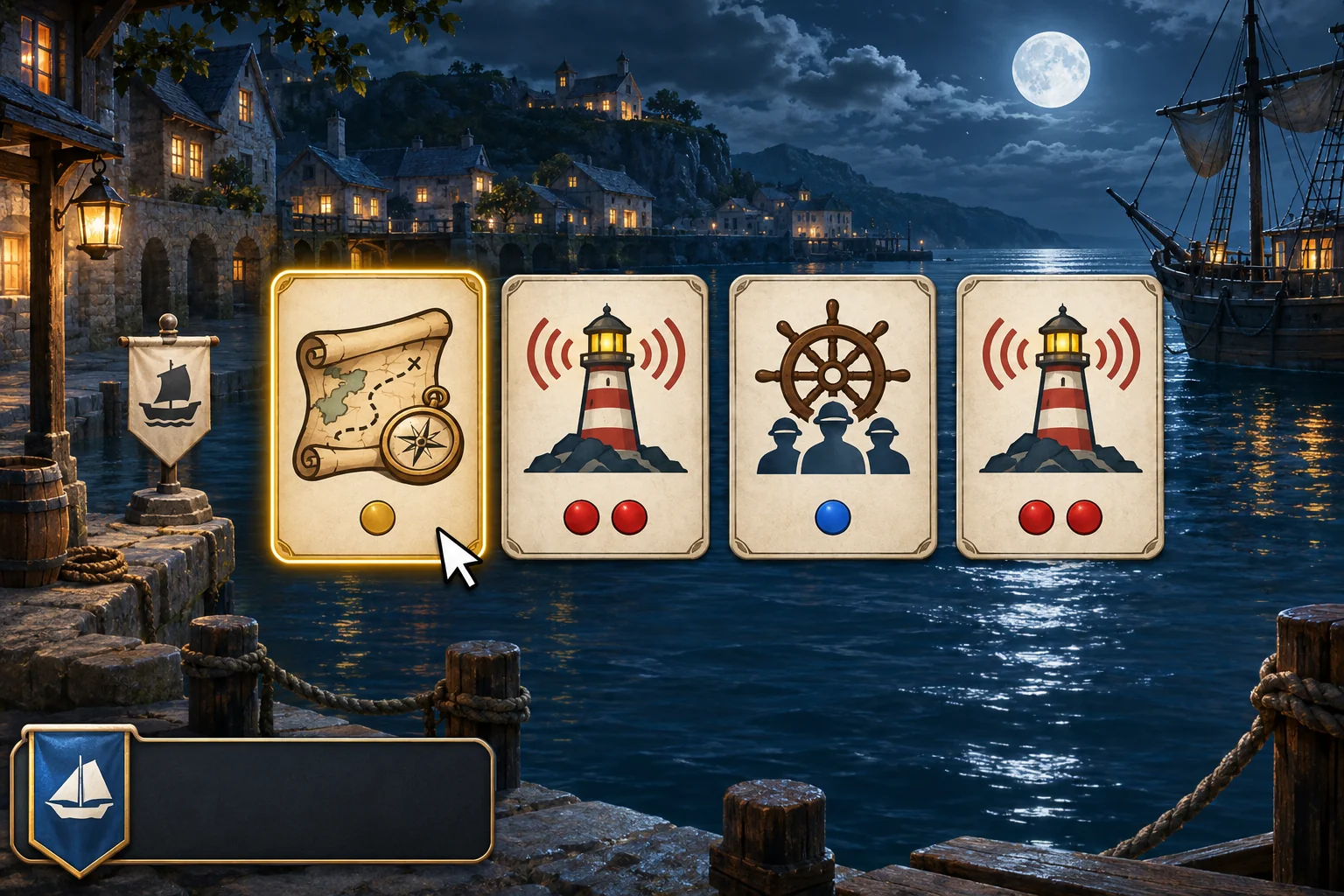
The scene is an illustrative view of the written design. It shows the intended choice and card values, not a screenshot of a generated game or a tested product result.
Set the collection and scoring rules
Give every card a base value, then state exactly what a collection bonus requires. Here, Chart and Crew each score one point, while Signal scores two. At the end of the third round, a player with at least one of every symbol earns one three-point set bonus. Extra copies do not make another set. That one-time rule keeps the scoring easy to check and gives players a reason to consider both immediate value and collection progress.
| Card | Base value | Collection role |
|---|---|---|
| Chart | 1 point | Completes the three-symbol set |
| Crew | 1 point | Completes the three-symbol set |
| Signal | 2 points | Highest base value; also completes the set |
| One of each | +3 once | At least one Chart, one Crew, and one Signal by the end of round three |
This is a design choice, not a balance result. The higher Signal value makes a single Signal attractive, while the set bonus gives a reason to take the lower-value symbols. If you want sets to dominate, raise the bonus only after you have written down how often a player can realistically collect all three types. If you want flexible scoring, keep the bonus smaller or replace it with a visible per-card effect.
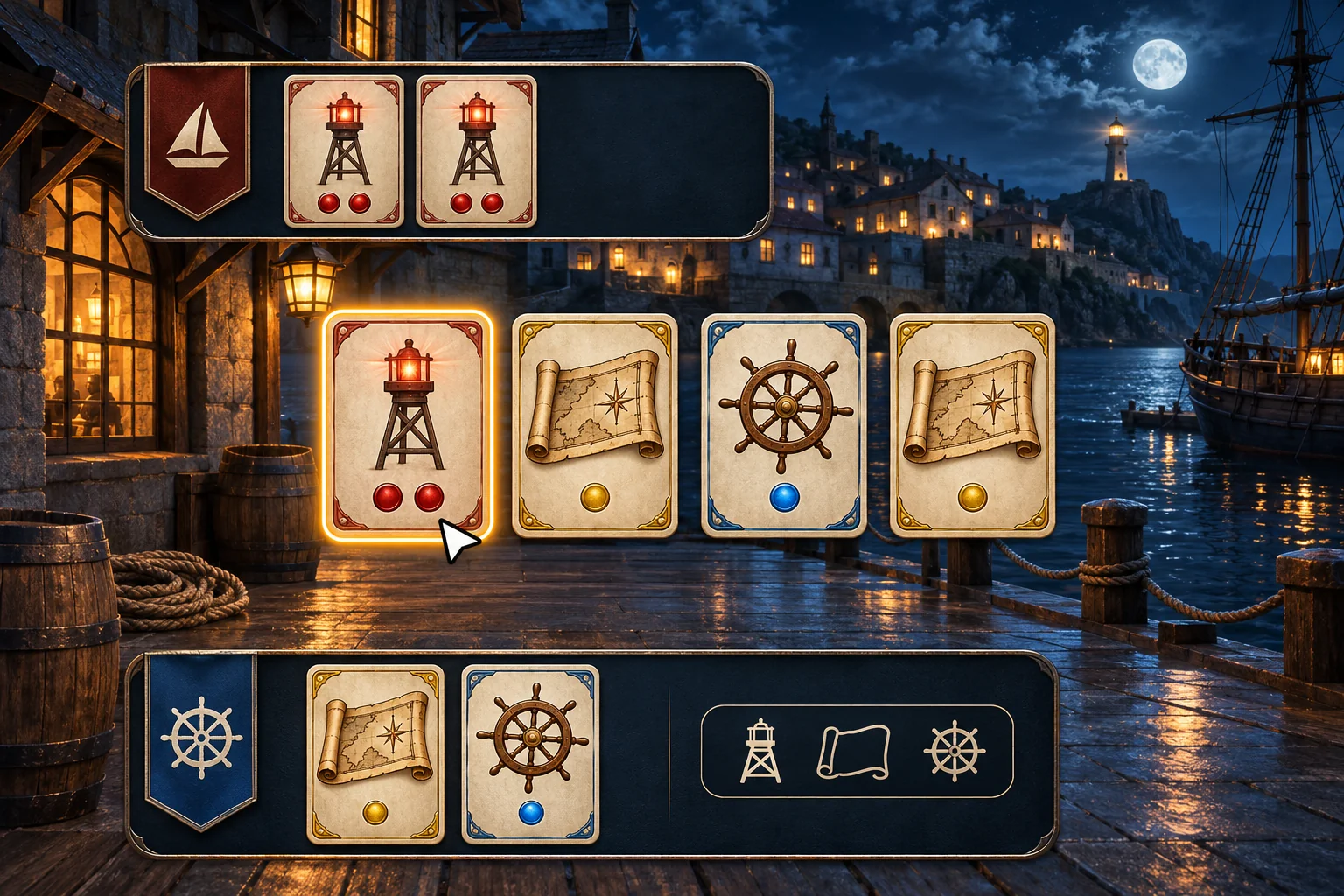
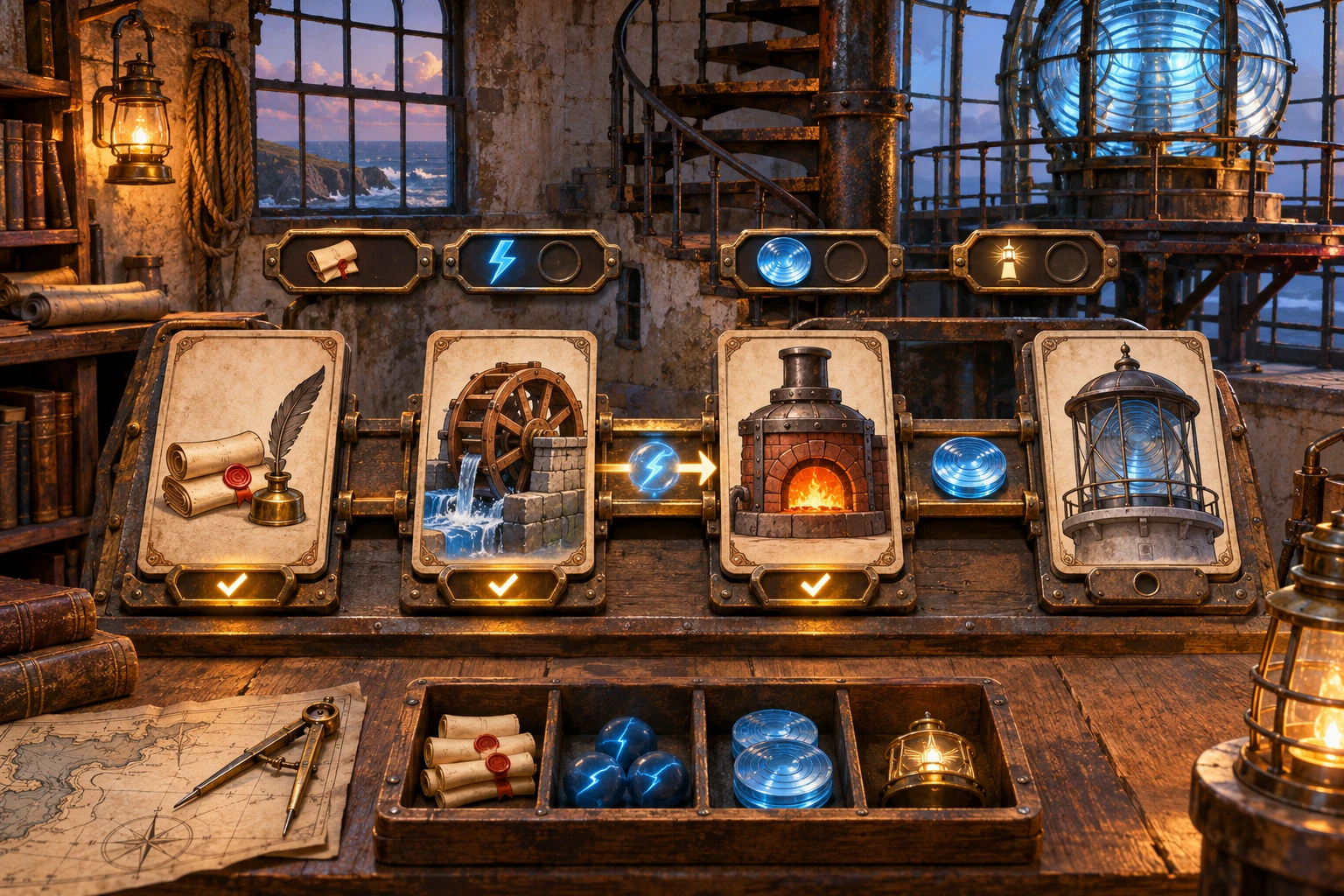
The mechanism view uses the exact third-round offer from the example. A is active, the market reads Signal, Chart, Crew, Chart, and B's two earlier Signals remain in hand. The bonus marker is a preview only; it becomes earned after both players finish the round and final scoring begins.
Write pick order and refill timing
Alternating first pick is easy to implement, but you still need to say what happens after the first card leaves the market. The active picker takes one offer; the other player then chooses from the three remaining. Both cards leave immediately and join their owners' collections. Only after the second pick do the two leftovers disappear and the next four-card row appear.
| Moment | Rule | State to show |
|---|---|---|
| Round opens | Reveal four face-up cards; announce the starting picker. | Four cards in the shared row; no pick has been made. |
| First pick | The starting player takes one card. | That card leaves the row and joins the player's hand. |
| Second pick | The other player takes one of the three remaining cards. | Three cards remain until the second choice is confirmed. |
| Round closes | Discard the two unchosen cards. | Both players gained one card; the old row is empty. |
| Next round | Reveal the next fixed four-card offer and rotate the starter. | Round number and active picker are clear before a choice. |
For three rounds, the start order is A, B, A. This means A receives first pick twice and B once in one match. Do not call that an even split. If you want to rotate the extra first pick across rematches, make the player who started second in the prior match start the next one: the next order becomes B, A, B. This is a transparent rotation rule, not evidence that either order is more balanced.
Play through three sample offers
Before adding card text, resolve one complete route with the actual offers you plan to use. The table below records each market before picking and the two cards left over after both players choose. The players never take the same card: the first pick is removed before the second selection.
| Round | Four-card offer | First pick, then second | Discard after both picks |
|---|---|---|---|
| 1 | Chart, Signal, Crew, Signal | A takes Chart; B takes Signal | Crew, Signal |
| 2 | Signal, Crew, Chart, Crew | B takes Signal; A takes Crew | Chart, Crew |
| 3 | Signal, Chart, Crew, Chart | A takes Signal; B takes Chart | Crew, Chart |
After round one, A holds Chart and B holds Signal. After round two, A has Chart and Crew; B has two Signals. In round three A takes Signal and B takes Chart. The example deliberately keeps the rounds short so you can trace the exact state change instead of relying on a vague claim that the loop “feels strategic.”
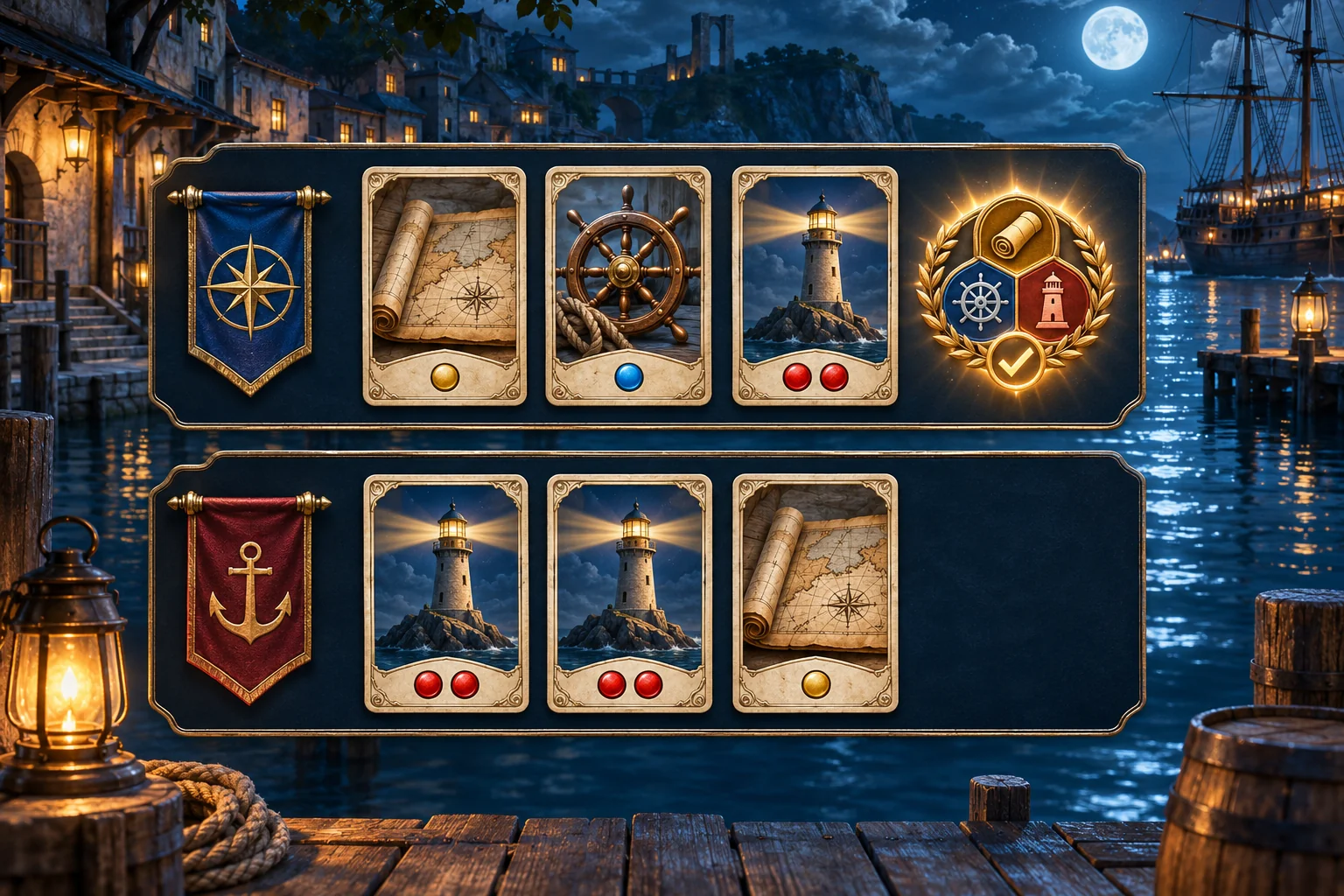
Add the base values before applying the bonus. A has Chart, Crew, and Signal: 1 + 1 + 2 = 4. A owns all three symbols, so add one +3 set bonus for a total of 7. B has Signal, Signal, and Chart: 2 + 2 + 1 = 5. B has no Crew, so B earns no set bonus and finishes with 5. A wins this hand-resolved example; no tie rule is needed for these particular totals, but the game contract still defines ties as shared results.
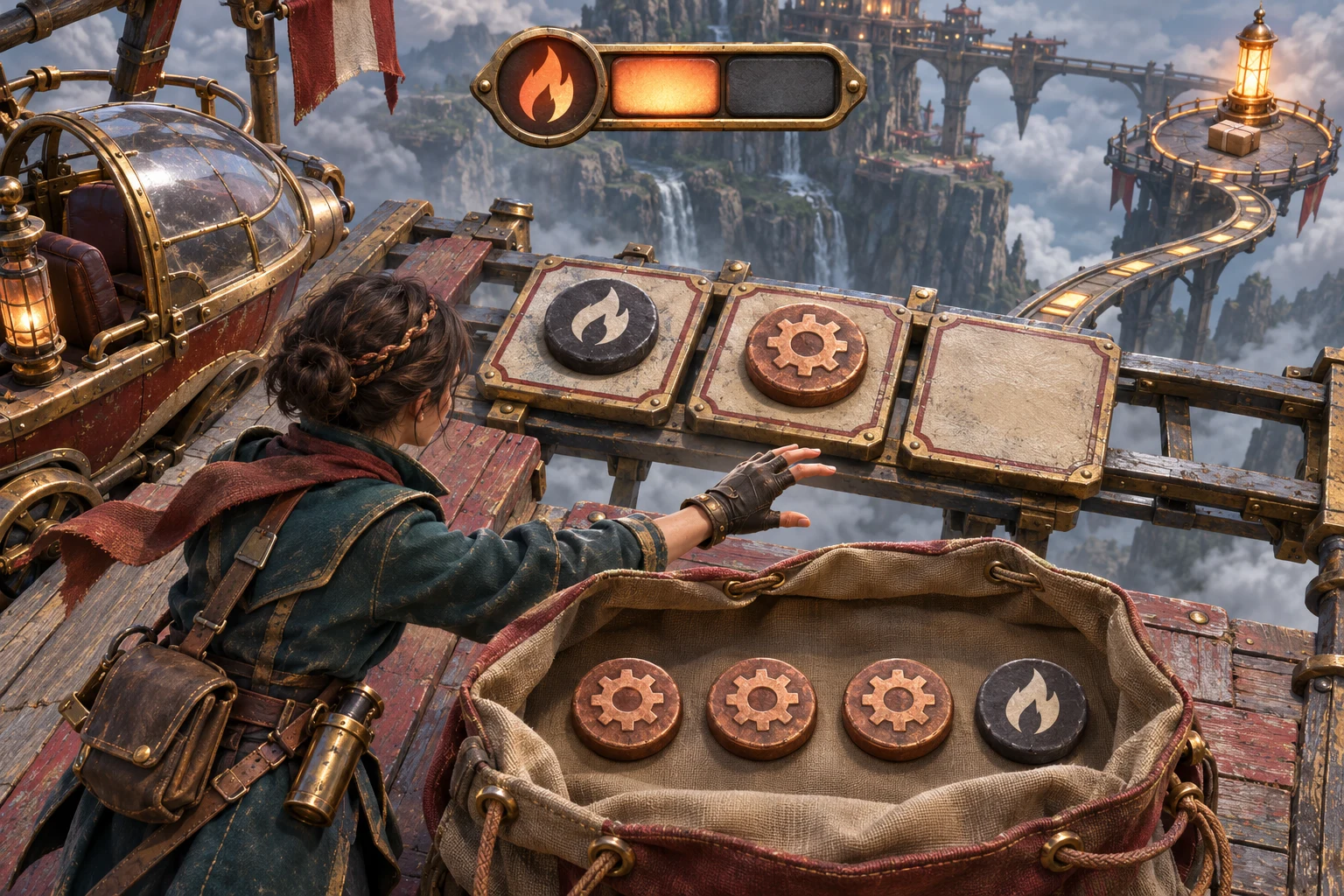
This is a manual route through invented rules, not an observed round of play. The image illustrates the final hands and set marker. It does not show software output, an online example, or a result produced by SEELE.
Clarify the first-picker rule
A small paper review can find missing wording before you write implementation instructions. In version zero of this example, the rule said that each player picks once but did not say who picks first or whether the order changes. That omission leaves two possible round states. The written correction names the start player for each round: A, then B, then A.
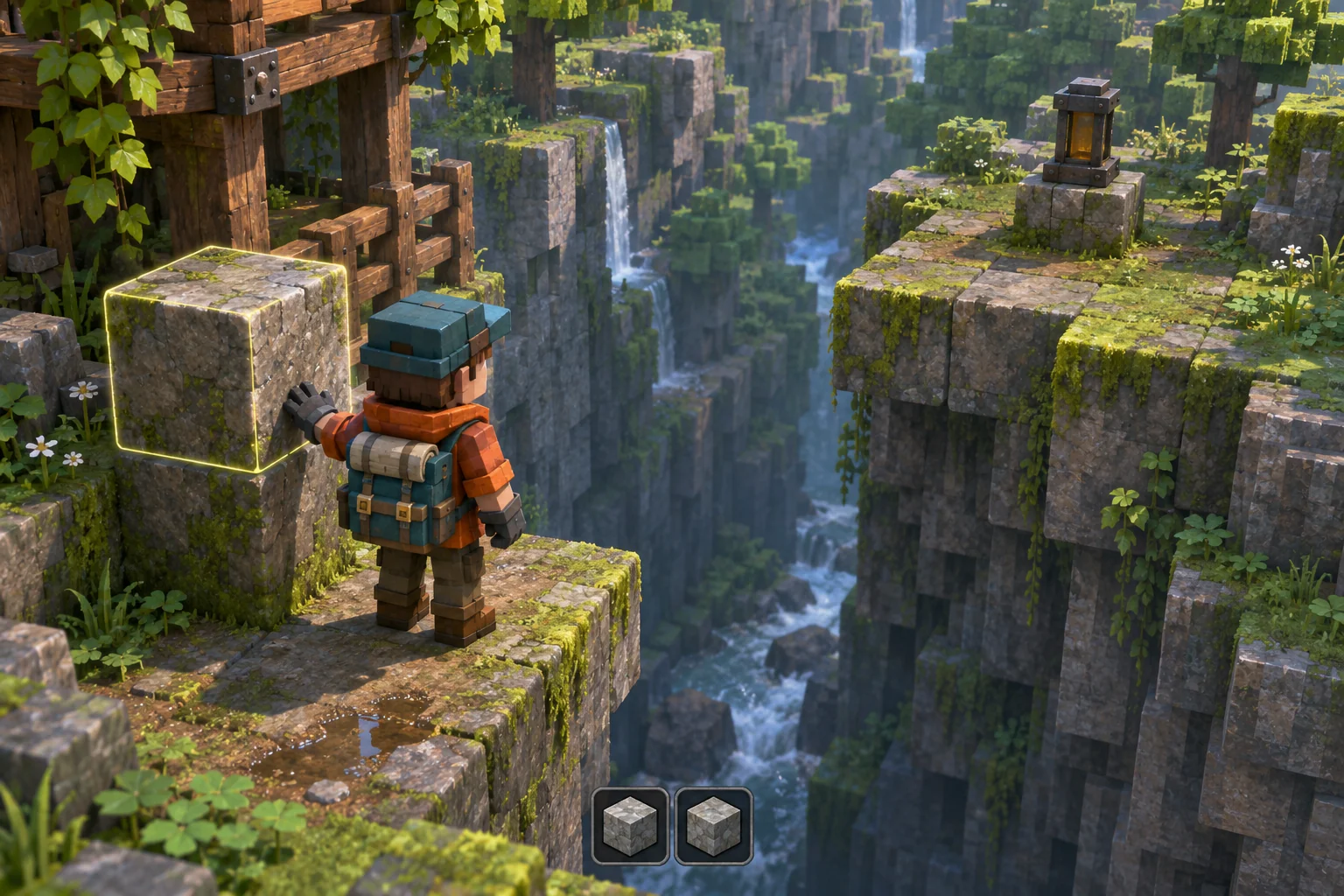
This revision improves rule clarity; it does not show that the order is fair or that players prefer it. A/B/A gives A two first picks in a three-round match. A rematch starting B/A/B rotates that extra first pick to B. The change is a proposed rule based on a hand-resolved example. No real prompt execution, generated build, player session, or measured iteration is claimed.
When you do have a build, keep a real iteration record separate from this paper example. Write down the build version, starting state, exact action, expected result, observed result, and the smallest rule or interface change you made. Repeat the same action after the change before saying it works. A design review can make the prompt more specific, but it cannot substitute for that evidence.
Check edge cases before adding cards
Use a short acceptance list to protect the core loop. It should cover card removal, pick order, end-of-round timing, and the one-time bonus. You can check the written rules by hand now; if you later create a playable version, record actual observed behavior in a separate test note.
| Check | Expected behavior |
|---|---|
| Start each round | Exactly four offers appear, and the correct player is named as first picker. |
| Take the first card | The chosen card leaves the market before the second player acts. |
| Finish both picks | Each player gains exactly one card; the two remaining cards are discarded only after both choices. |
| Rotate the starter | The sequence is A, B, A in one match; a rematch can begin B, A, B. |
| Score duplicates | Each card adds only its printed base value; duplicates do not create extra sets. |
| Score a complete collection | At least one Chart, Crew, and Signal earns exactly one +3 bonus at the end of round three. |
| Resolve a tie or restart | A tie is shared; restarting clears the hands and returns to the round-one offer. |
If a check exposes uncertainty, edit the rule contract before asking an AI tool to create extra effects. In particular, define what happens if a market has duplicate cards, what counts as a complete set, and whether the starter resets or rotates when a new match begins. These are choices for your game, not universal drafting rules.
Use a creation workspace with a small brief
The current SEELE Free AI Game Maker page describes a general workflow: explain an idea in plain English, review a playable 2D or 3D result, and iterate in Workspace. Before submitting, review the selected model, available Koin balance, and displayed generation cost. The page does not document this card market, pass-and-play handling, set scoring, or a Beacon Boroughs build. Treat the following as a request template to adapt and inspect, not a promise that a tool will implement every rule as written.
Make a small browser-playable drafting card game called Beacon Boroughs.
Use a fixed moonlit harbor scene that never changes when a card is picked.
Two local players share a four-card face-up market and each take one card
per round. Player A starts round 1, B starts round 2, and A starts round 3.
After both picks, discard the other two offers and reveal the next row.
Use three card symbols: Chart = 1 point, Crew = 1 point, Signal = 2 points.
At the end of round 3, award +3 once to a player with at least one of each.
Show the active picker, remaining offers, each player's hand, and final totals.
Allow a tie and a restart. Do not add board-changing cards or online play.
Before building, return the state rules and a manual score check for this
offer sequence: (1) Chart, Signal, Crew, Signal; (2) Signal, Crew, Chart, Crew;
(3) Signal, Chart, Crew, Chart. Confirm A=7 and B=5 for the described picks.
Before turning a request into a first build, check the exact audience, first action, and visible result you need. The product page describes a general idea-to-review workflow, but it does not confirm this example's local multiplayer, market timing, card UI, or scoring. Compare any generated state with the rule table and correct mismatches one at a time.
Start with one complete draft loop
Keep the first version small: four visible offers, one pick per player, a written refill rule, and scoring you can add by hand. The Beacon Boroughs sequence shows how to expose a turn-order gap and verify the final totals without pretending that a paper route is a playtest. When you are ready to shape your own idea and review a creation, open the Free AI game maker with a focused brief, then compare the actual result with the rules you intended.
Frequently asked questions
Do players take every card in a drafting round?
No. In this example each player takes one card from the four-card shared offer. After both picks, discard the two unchosen cards and reveal the next row. If your design needs every offer to be selected, add a separate pick phase and recalculate how many cards each player can hold.
How does first pick change between rounds?
Beacon Boroughs uses A, B, A over three rounds, so A receives first pick twice and B once in a match. A rematch can start B, A, B to rotate that extra first pick. This makes the rule explicit; it does not establish measured fairness or player preference.
Do duplicate symbols earn another set bonus?
No. A player earns one +3 bonus at the end of round three only if their hand contains at least one Chart, one Crew, and one Signal. Extra copies still add their printed base value, but they do not create another complete set or another bonus.
What happens if the final scores tie?
The proposed rules treat a tie as a shared result. That is a design choice for this example rather than a universal drafting-game convention. If your game needs a single winner, define a tie-breaker such as most distinct symbols before adding card effects, and include its expected state in the score check.
Was Beacon Boroughs tested?
No. It is an original fictional paper design with a hand-resolved three-round example. No prompt execution, playable build, player session, or empirical iteration is claimed. The proposed images illustrate planned game states; they are not product screenshots. Use the acceptance list as a plan for checking an actual build later.