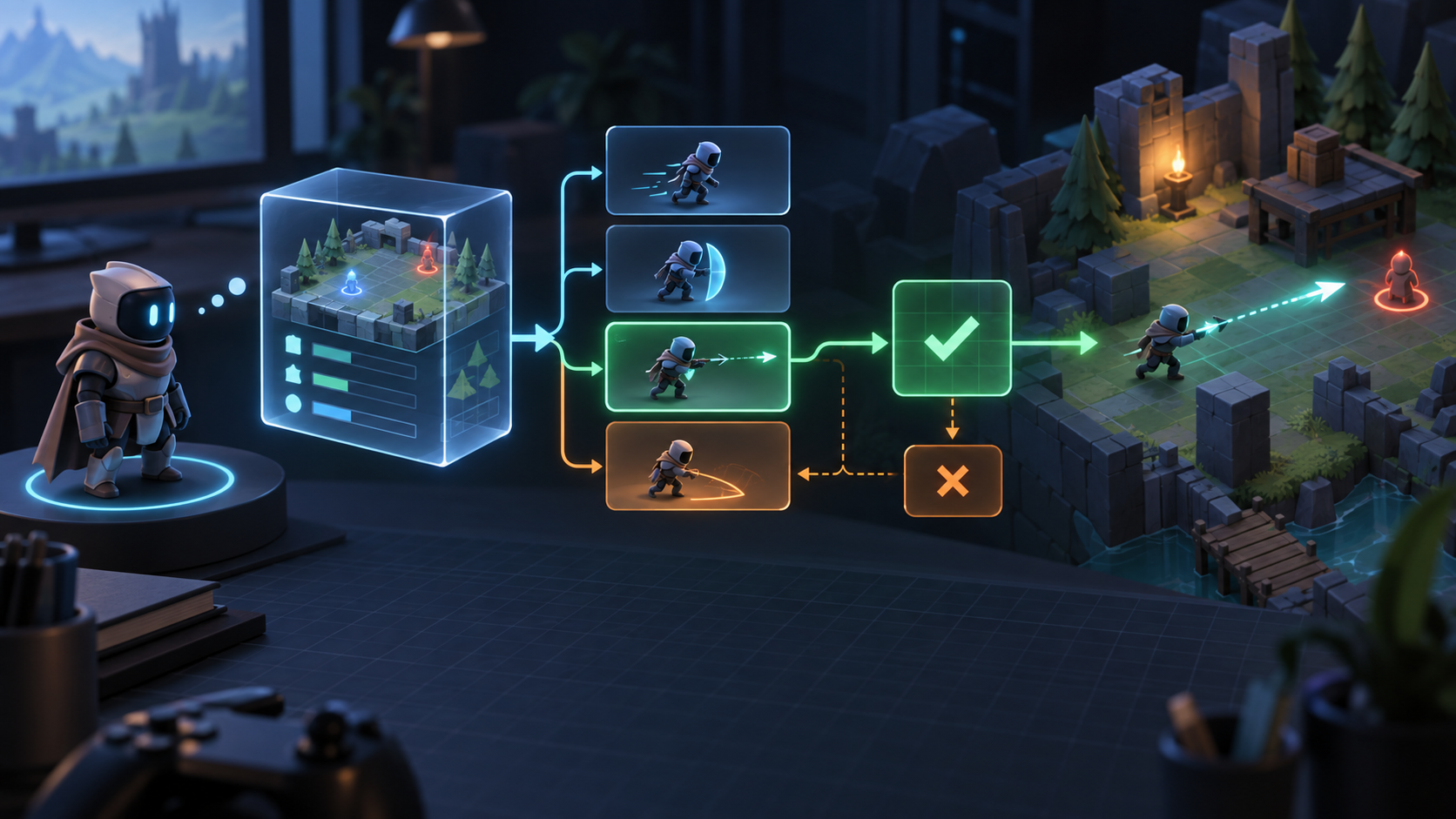
JEV is a real-time decision model for games. It sits between the changing state of a game world and the systems that carry out an action, helping an NPC or agent choose what to do next from a set of legal options. In practical terms, JEV can weigh danger, objectives, resources, allies, and opportunities, then select a tactical action such as attack, retreat, heal, take cover, assist an ally, or investigate a new area.
That definition is intentionally narrower than saying that JEV is a complete game brain. JEV does not replace the game engine, physics, animation, navigation, rendering, dialogue system, or authored rules. Its job is decision selection under changing conditions. This boundary is what makes it useful: the game remains in control of what is possible, while JEV helps determine which possible action best fits the moment.
What is JEV?
JEV can be understood as a tactical decision layer. The game provides a compact snapshot of the current situation and a list of actions the character is allowed to take. JEV evaluates that context and returns a choice, usually with parameters or a target. The game validates the response and executes it through normal gameplay systems.
A useful mental model is observe, filter, evaluate, choose, execute, and observe again. Observation captures relevant facts such as health, visible threats, cover, distance, cooldowns, team roles, and objectives. Filtering removes impossible actions. Evaluation compares the remaining options against the agent's goals and current risks. Choice produces an action, while execution stays inside deterministic game code.
What problem does JEV solve?
Traditional NPC logic works well when the number of conditions is small and predictable. As a game grows, however, decisions become combinations of local facts and competing goals. An NPC may need to protect an objective, avoid exposing a wounded teammate, conserve ammunition, and respond to a new threat at the same time. A long chain of nested conditions or hand-authored transitions can become difficult to balance and even harder to revise.
JEV addresses the selection problem rather than the execution problem. It gives designers a place to express goals and action contracts while allowing the decision policy to respond to a richer state. The result is not unrestricted improvisation. It is a controlled choice from an interface the game defines.
How does JEV relate to game AI?
Game AI is a broad category that includes navigation, perception, planning, animation selection, squad coordination, learning systems, and more. JEV is one component within that category. It is most naturally used for a mid-level or tactical decision layer: high enough to understand goals and trade-offs, but low enough to make a concrete next-action choice.
For example, a game can keep navigation deterministic, use a behavior tree to perform a reload sequence, and use JEV to decide whether reloading is better than taking cover. The systems are complementary. The engine owns truth and execution; JEV contributes context-sensitive selection.
JEV compared with LLMs, behavior trees, and FSMs
LLMs are flexible language models. They are strong at dialogue, narrative interpretation, natural-language planning, and generating text or code. A general LLM is not automatically a good per-tick controller: it may be too slow, difficult to constrain, or inconsistent for a safety-critical action contract. JEV is a game decision layer with a narrower output surface.
Behavior trees represent authored control flow through selectors, sequences, conditions, and tasks. They are excellent for transparent, repeatable execution. JEV can sit above a behavior tree and choose which branch or high-level intent to run, while the tree handles the steps.
Finite-state machines model explicit states and transitions such as patrol, chase, attack, and flee. They are easy to reason about, but transition graphs can become crowded as conditions multiply. JEV can select the next intent while the FSM remains responsible for entering and leaving well-defined execution states.
The practical comparison is not about replacing every existing technique. It is about choosing the smallest system that handles the uncertainty a game actually has.
Typical JEV use cases
- Combat tactics: choose between pressure, retreat, cover, healing, or a coordinated ability.
- Squad coordination: assign an agent to support, flank, revive, guard, or reposition.
- Survival games: trade exploration, crafting, food, shelter, and threat avoidance against time and resources.
- Stealth: decide whether to investigate a sound, hide, search, call for help, or return to a route.
- Reactive encounters: select an encounter response while authored rules preserve fairness and progression.
What JEV does not do
JEV should not be asked to invent physics, bypass permissions, directly mutate arbitrary world state, or control an avatar every rendered frame. It should not be the only source of truth for hit detection, movement validity, economy rules, or multiplayer authority. Those responsibilities belong in game code and engine systems.
A strong integration makes this boundary explicit. The game exposes only the state needed for a decision, lists only legal actions, validates the response, and defines a fallback. That design makes behavior observable and lets teams test the decision layer with recorded scenarios.
When should a game use JEV?
JEV is a good fit when an NPC has several meaningful options, the best option changes with live context, and authored rules alone are becoming expensive to maintain. It is less useful for a fixed animation sequence, a simple patrol route, or a decision that must be identical on every run. Start with one bounded decision, measure latency and quality, and expand only when the contract remains understandable.
For a scenario-focused explanation, read JEV Game AI: Real-Time Tactical Decisions for NPCs. To understand how JEV fits into AI-assisted game creation, see How JEV Helps Generate Games. Developers can follow the implementation walkthrough in the JEV tutorial.
JEV FAQ
Does JEV generate a complete game?
No. JEV focuses on runtime decision selection. Generation models can create assets, code, scenes, or other content, while JEV can make generated NPCs more responsive inside the resulting game.
Is JEV an LLM?
JEV should be treated as a specialized decision capability, not as a general conversational model. The important distinction is the bounded game-state input and legal-action output.
Does JEV replace behavior trees?
Usually not. A behavior tree can execute the action JEV selected, giving the team a transparent and testable way to carry it out.