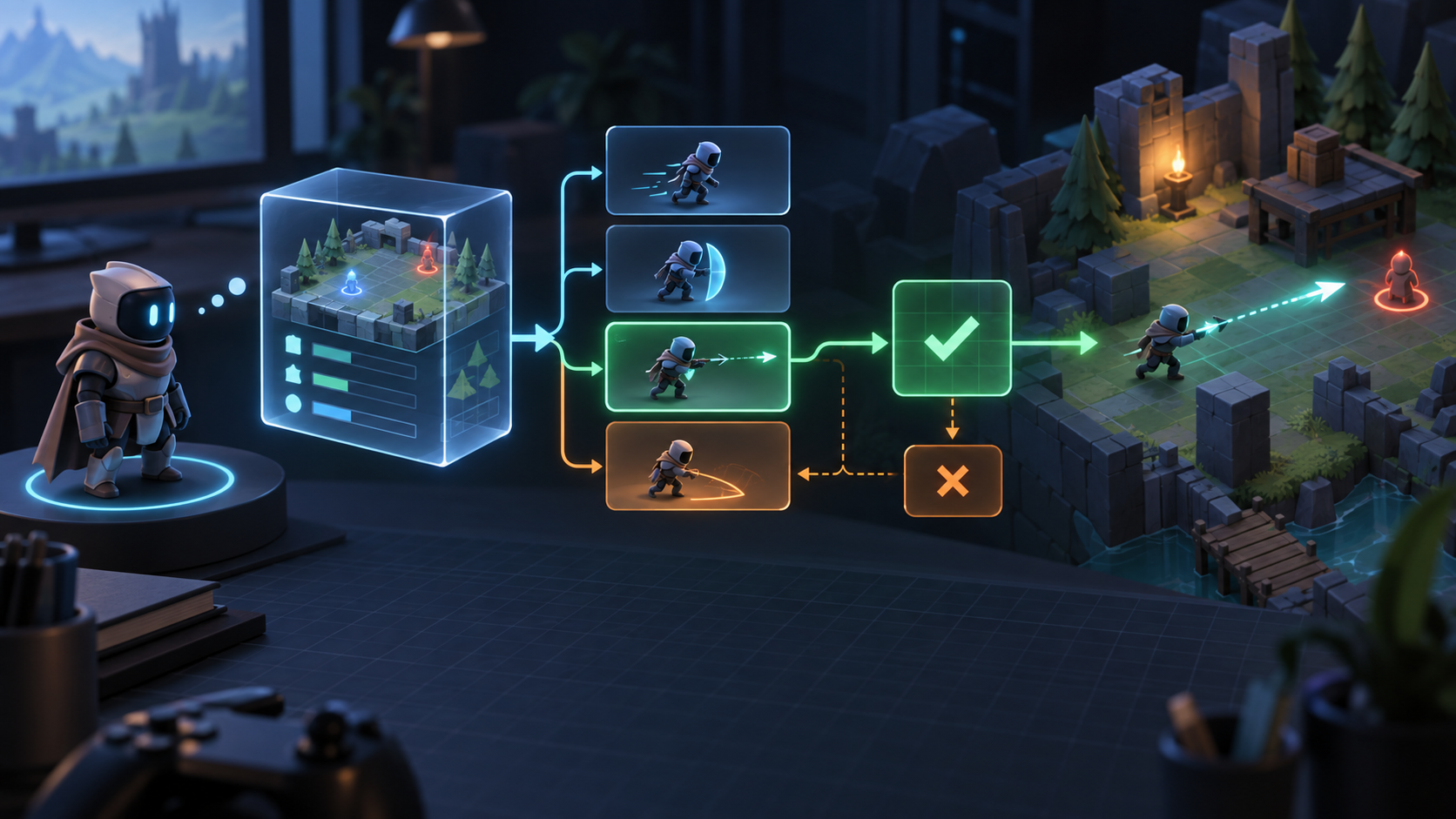
JEV can help make a generated game feel more responsive, but it does not generate an entire game by itself. A complete game combines content, rules, code, assets, simulation, and player-facing systems. JEV contributes to one important part of that stack: choosing a tactical action for an NPC when the game state changes.
This distinction prevents a common category error. Generating a scene, a character model, or a block of gameplay code is different from deciding what a character should do at runtime. The first problem is content creation. The second is bounded decision-making under live constraints.
Can JEV generate a game?
JEV can participate in an AI-assisted game-generation workflow, but it is not a one-click game generator. A generation model may turn a concept into scenes, assets, scripts, or a playable prototype. A language model may help with dialogue, quests, and planning. JEV can then provide a decision contract for NPCs inside the prototype or production game.
The useful outcome is a division of labor. Each system has a clear input, output, and authority boundary. That makes the result easier to test than a single model that is asked to invent the world, write every system, and control every character without constraints.
The four-part division of labor
| Module | Primary responsibility |
|---|---|
| Generation model | Generate scenes, characters, assets, levels, and starter code. |
| LLM | Help with dialogue, narrative, text, design exploration, and longer-horizon planning. |
| JEV | Select real-time tactical actions and targets from the legal options exposed by the game. |
| Game code and engine | Own rules, physics, state authority, networking, navigation, animation, and execution. |
These boundaries are not merely organizational. They determine how a team debugs the game. If an NPC walks through a wall, navigation or collision is the likely owner. If it chooses a poor target from valid options, the decision contract or policy is the place to investigate. If generated code violates an interface, the generation and validation pipeline needs attention.
From a prompt to a playable loop
- Generate a narrow concept: define the genre, player loop, roles, resources, and win or loss conditions.
- Wire the deterministic skeleton: implement state, rules, physics, input, and a small set of actions.
- Define NPC contracts: choose what each role can observe and which actions it may select.
- Add JEV: call it at decision points rather than asking it to replace the loop.
- Simulate and test: replay scenarios, inspect choices, and tune objectives and constraints.
Starting with a narrow loop is important. A generated prototype may contain many attractive systems but little structure for evaluating whether an NPC decision was useful. A small arena with a healer, a defender, and a single objective can reveal more about the quality of the decision layer than a large untestable world.
How JEV gives generated NPCs better judgment
Generated NPCs often have appearance and dialogue before they have a reliable action model. JEV helps by requiring the game to state what the NPC knows, what it wants, and what it is allowed to do. The generated character can have a role-specific action set such as guard, assist, search, retreat, or negotiate. The engine remains responsible for checking preconditions.
This makes personality compatible with reliability. A cautious character can assign more value to cover and survival; an aggressive character can favor pressure; a scout can prioritize information. Those preferences can affect selection without granting arbitrary access to the world.
Why asset generation and decision generation are different
An image or 3D model generator produces a representation that can be reviewed before it enters the game. A runtime decision happens inside a changing system and can affect fairness, pacing, and player trust. That is why decision generation needs state contracts, legal actions, latency budgets, validation, and fallbacks.
The same generated asset can be reused across many scenes, while a decision may need to be recomputed after an enemy moves or an ability is interrupted. Treating both as the same kind of generation leads to the wrong architecture and the wrong quality metrics.
Where JEV fits in AI game development
For a roguelike, JEV can choose how an enemy spends a turn while generated content supplies rooms and encounters. For a squad game, it can select a role-aware response while code handles movement and replication. For a survival game, it can balance exploration, crafting, shelter, and threat avoidance. For a social simulation, it can choose a bounded immediate action while an LLM handles longer dialogue or planning.
In each example, JEV is valuable because the world is already defined enough to expose legal options. It is not a substitute for designing the game loop. It is a way to make that loop more context-sensitive.
How to evaluate the result
- Validity: Does every selected action satisfy current preconditions?
- Quality: Does the action advance the role's objective without obviously wasting resources?
- Fairness: Does the NPC remain challenging without using information the player could not reasonably infer?
- Responsiveness: Does the decision arrive within the game's budget?
- Replayability: Do similar situations produce a useful range of outcomes rather than random noise?
- Debuggability: Can the team reproduce the state, response, and outcome?
A responsible production architecture
Keep the authoritative game state in the engine or server. Build a small state projection for the decision request. Expose a legal-action list with parameters and preconditions. Let JEV return an intent. Validate it against the current state, execute it through an existing command system, and fall back to authored behavior when the request times out or becomes stale.
This architecture leaves room for other AI systems. Generation models can keep improving the content pipeline, and LLMs can support creators and characters, without forcing JEV to become a general-purpose model. To see the decision concept in one place, read What Is JEV?. To build the first integration, follow the JEV tutorial.