Define the Glass Minute loop
A bullet-time prompt needs to say which parts of the world slow down, which remain responsive, and how the player controls that window. “Add cinematic slow motion” describes a mood, but it does not tell a builder how a projectile moves or when ordinary time returns. A small encounter with a visible meter makes those rules easier to specify.
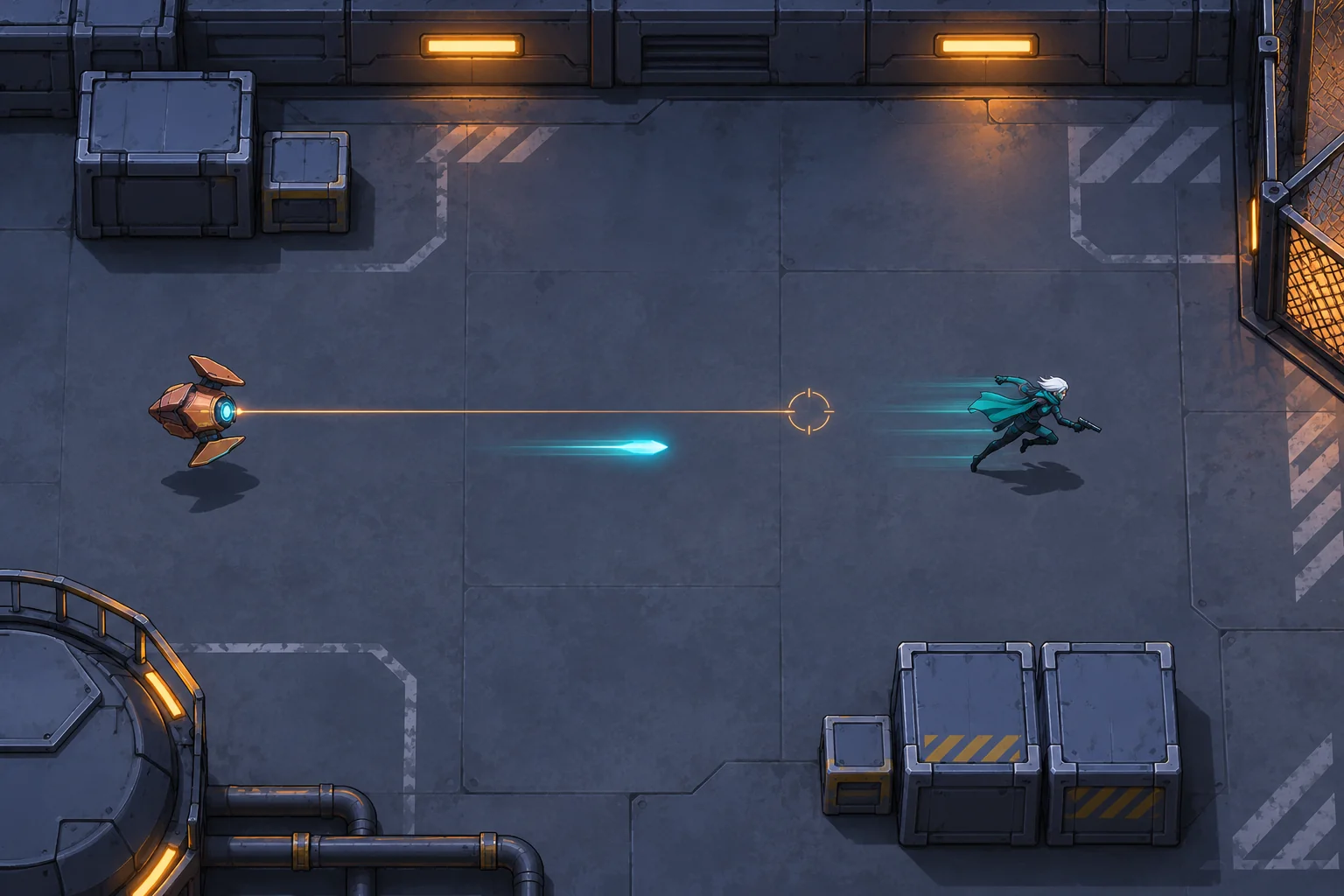
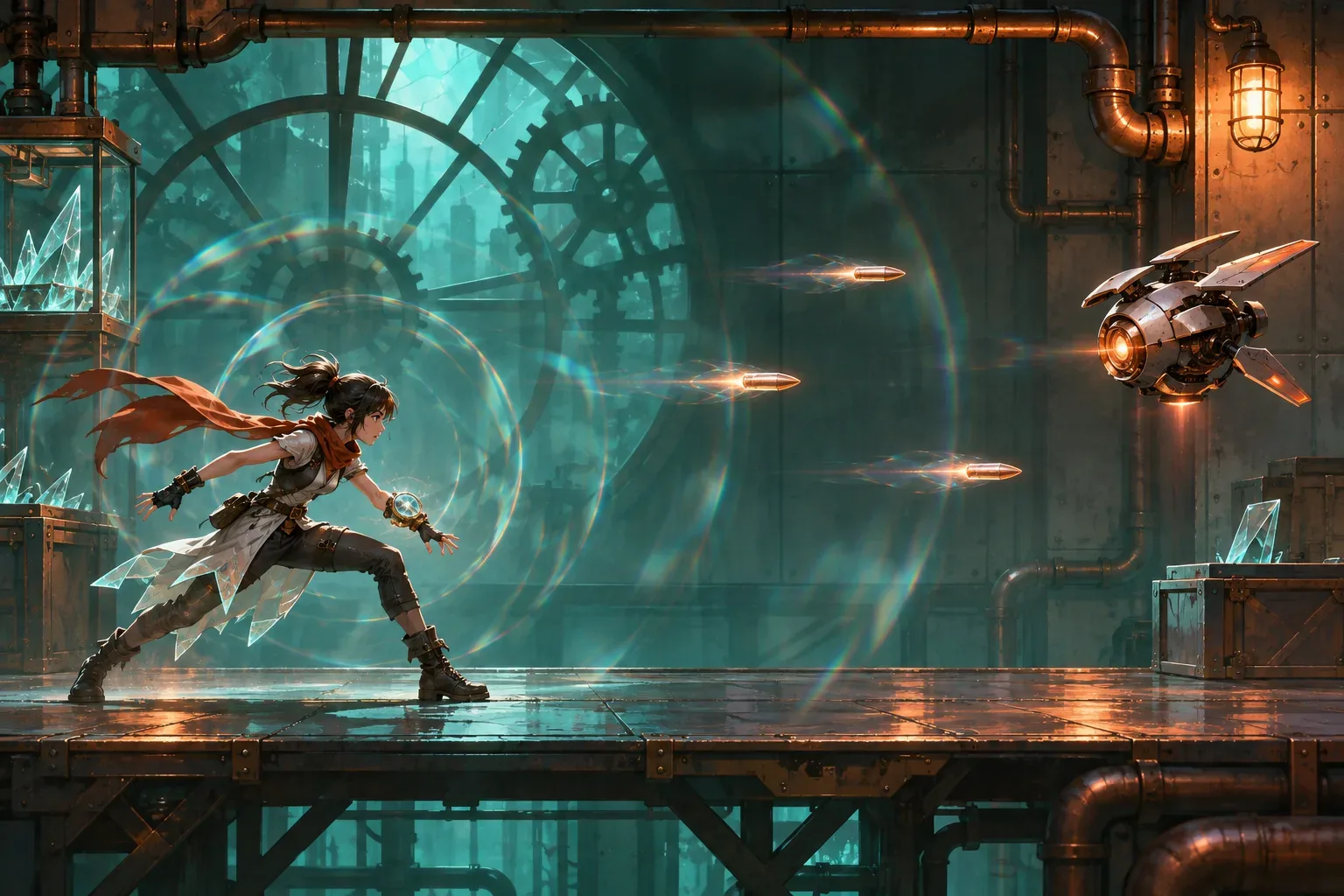
This guide uses Glass Minute, a fictional side-view action room. The player faces one hovering drone and three hostile bolts in a fixed 12-by-8 room. The example is original design material. The prompt drafts have not been run; no playable result, observed behavior or performance claim is included.
The player has three health points. The drone has four. Player shots deal one damage and fire every half second at normal speed. A hostile bolt deals one damage. The encounter ends in a win when the drone reaches zero health, a loss when player health reaches zero, or a timeout at sixty seconds. Restart restores the initial positions and values.
The main distinction from a broad bullet-time tutorial is the relative-speed contract: while Focus is held, the player stays at normal speed while hostile actors and hostile projectiles move at one quarter speed. This makes aiming and dodging legible without claiming a particular game engine feature.
Specify time and focus rules
Use one time scale for each actor class and one consistent reference clock. In Glass Minute, “real second” means elapsed wall-clock seconds displayed by the game timer. While Focus is active, the hero's movement, player-shot cadence and timer remain at 1×. The drone and its hostile bolts move at 0.25×. When Focus is inactive, every actor returns to 1×.
| Element | During Focus | Outside Focus |
|---|---|---|
| Player movement | 1× | 1× |
| Player-shot interval | 0.5 real seconds | 0.5 real seconds |
| Drone and hostile bolts | 0.25× | 1× |
| Room timer | 1× | 1× |
| Focus energy | Drains 20 units/real second | Recharges 10 units/real second |
Focus starts at 100 units and cannot exceed 100 or fall below zero. Holding the input drains the meter continuously; releasing it begins recharge. Reaching zero turns Focus off immediately, after which hostile movement returns to normal speed. This avoids a state where the player can keep the slow effect after exhausting its resource.
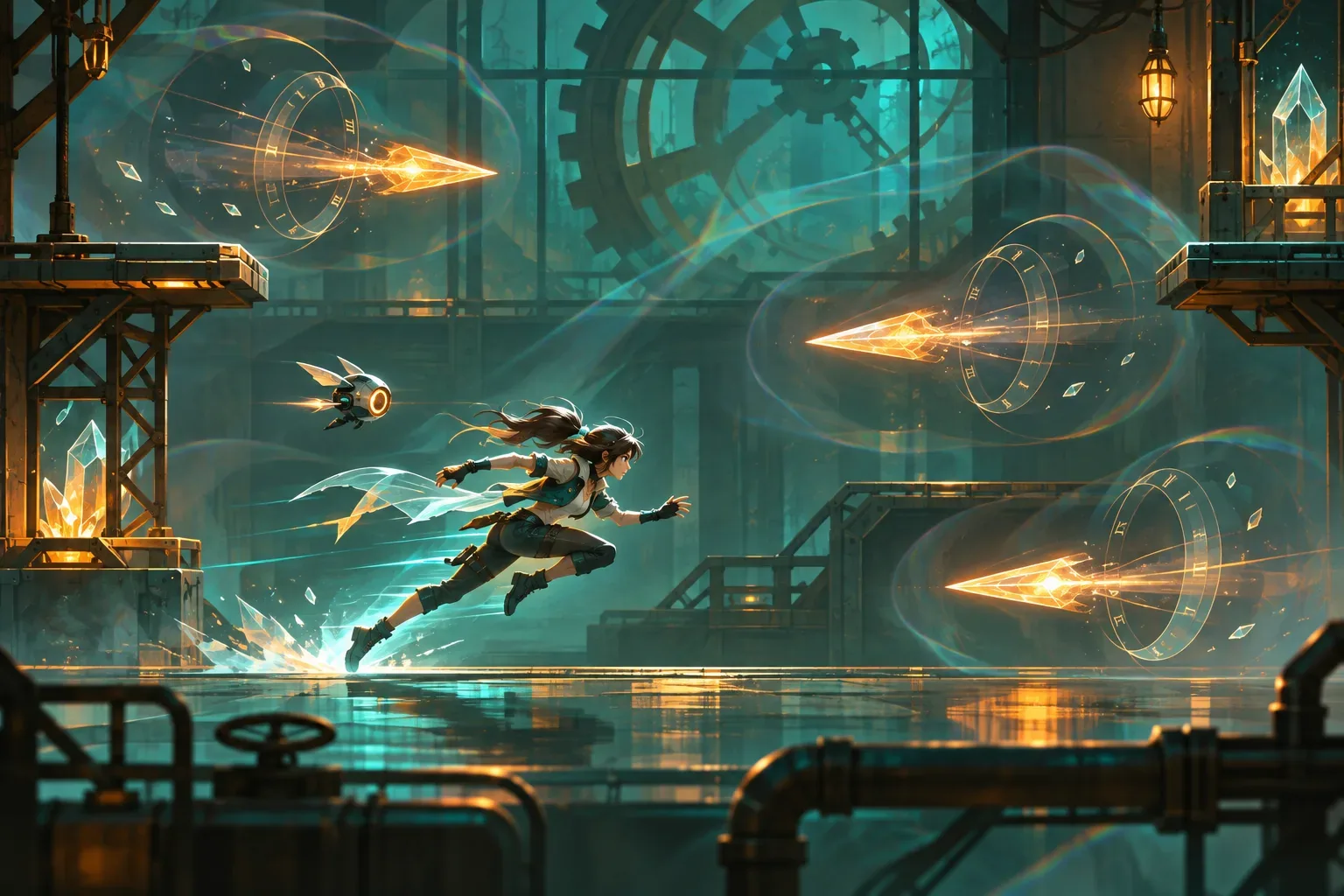
Keep unspecified systems out of the first prompt set. The example does not add a combo meter, upgrade tree, invulnerability window, aim assist, random drops or adaptive difficulty. Those can be separate decisions after the timing loop is defined.
Budget the focus window
The meter creates a simple tradeoff: Focus provides time to read an incoming pattern, but a long hold leaves less resource for later. With a 100-unit starting meter and a drain of 20 units per real second, a full meter can support five uninterrupted seconds. At 10 units of recovery each real second, restoring the full meter from empty takes ten seconds when Focus remains off.
That arithmetic is a design check, not a balance result. It does not prove that five seconds feels fair or that the player can defeat the drone. It only confirms the values have a predictable relationship. If a future build feels too generous or too restrictive, change the rates deliberately and repeat the calculation.
| Focus held | Energy remaining | Interpretation |
|---|---|---|
| 0 s | 100 | Full resource |
| 1 s | 80 | One second spent |
| 3 s | 40 | Two seconds remain at current drain |
| 5 s | 0 | Focus ends and hostile speed returns to 1× |
The player can release Focus earlier and regain energy. For example, after holding for three seconds, 40 units remain. Leaving Focus off for two seconds restores 20 units, so the meter reads 60. The result follows the stated 10-unit-per-second recharge rate. It should not be described as a measured gameplay outcome.
Trace a focus window
Assume a bolt begins 2.5 grid cells from the player and moves directly toward them at one cell per real second outside Focus. The player holds Focus for two seconds. At 0.25×, the bolt covers half a cell in that interval, so 2 cells remain. The player fires four shots during those same two seconds because the cadence is one shot every 0.5 seconds, assuming the player keeps the fire input held.
This is a hand-calculated example from the fictional rates. It does not establish collision timing, hit registration, animation quality or whether a player can react. A build would need to expose timestamps and positions to confirm actual behavior.
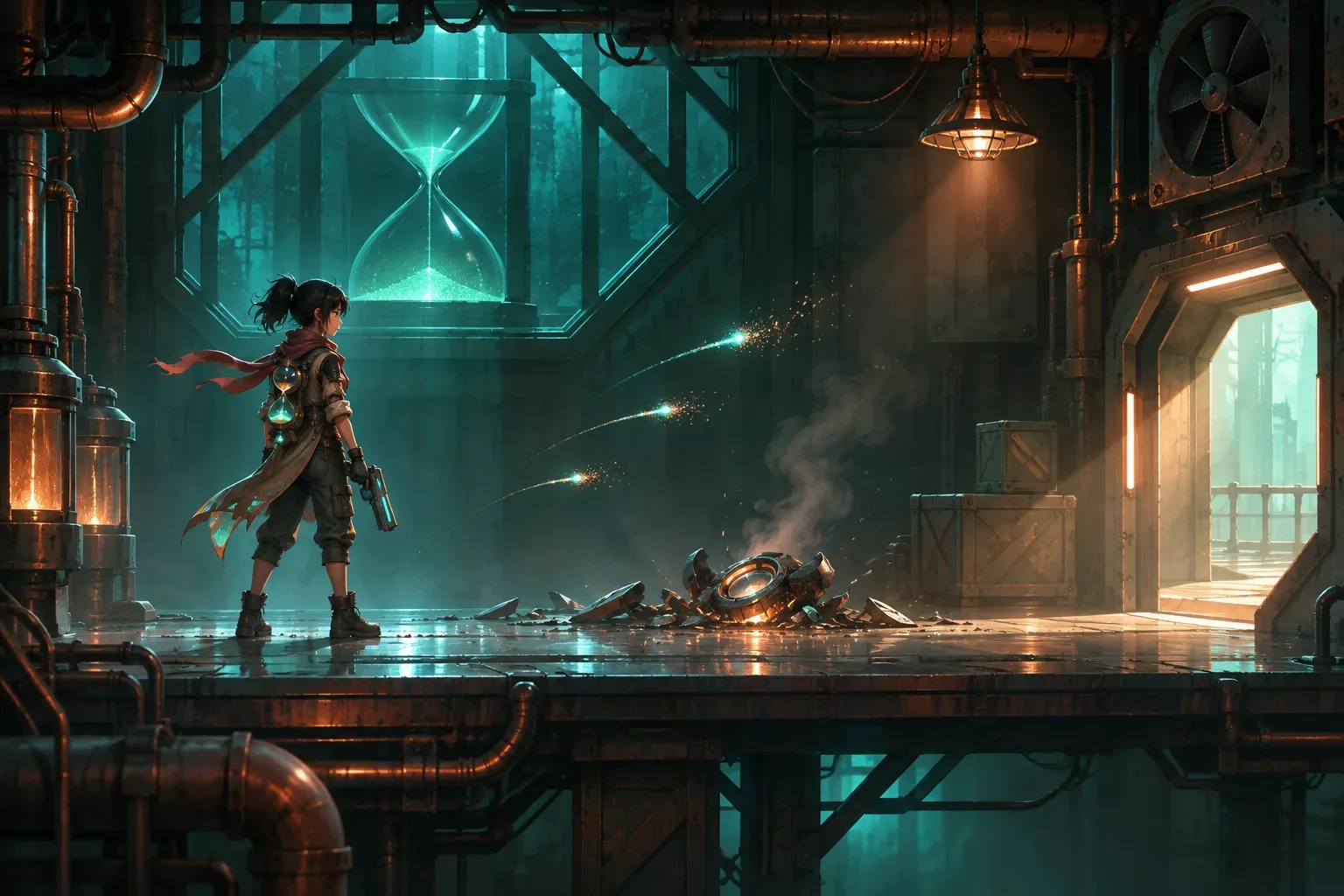
At the end of the two-second focus window, 60 energy remains. If the player releases Focus for two seconds, 20 units recharge and the meter reaches 80. The bolt then returns to one cell per second. The state transition is explicit: meter drain stops, recharge starts, and hostile movement resumes normal speed.
Write future checks around both sides of the transition. Activate Focus at a known timestamp, compare actor movement over equal intervals, release input, and record energy after each second. Repeat at zero energy and after Restart. These are proposed checks, not passed tests.
Write the six prompts
Send one prompt at a time so each change has a narrow acceptance rule. The following drafts specify a prototype in order. They are unrun and should be treated as instructions to evaluate later, not as evidence of a generated game.
Prompt 1: establish the room
Create a side-view action prototype called Glass Minute in one fixed 12-column by 8-row industrial room. Place one player, one drone with 4 health, and three hostile bolts. Player has 3 health. The encounter wins when the drone is defeated, loses at zero player health or 60 seconds. Add Restart to restore all initial values and positions.Prompt 2: set the time scales
Define Focus as a held input. While active, player movement, player-shot cadence and the room timer stay at normal 1x speed. The drone and hostile bolts move at 0.25x speed. Outside Focus, all actors move at 1x. State the reference clock and do not slow the player or timer.Prompt 3: add the resource
Start Focus energy at 100 units. Drain 20 units per real second while Focus is held. Recharge 10 units per real second while it is not held. Clamp energy to 0–100. At zero, immediately end Focus and restore hostile movement to 1x. Show the current energy clearly.Prompt 4: define attacks
Player shots deal 1 damage and fire every 0.5 real seconds while fire is held, regardless of Focus. The drone starts at 4 health. Each hostile bolt deals 1 damage. Keep collision results explicit and do not add critical hits, random damage, upgrades or invulnerability states.Prompt 5: trace one timing window
For a fictional timing trace, a bolt begins 2.5 cells from the player, moving directly toward them at 1 cell per second. Hold Focus for 2 seconds: at 0.25x it travels 0.5 cells; the player fires four times at 0.5-second intervals; 60 energy remains. Then release Focus for 2 seconds and show energy rising to 80 while the bolt returns to 1 cell per second. Label this as arithmetic, not observed gameplay.Prompt 6: prepare checks
For a future build, log real timestamp, Focus input, energy before/after, player position, drone/bolt positions, time scale, shots and health. Check activation, release, exact drain/recharge, zero shutdown, 0.25x and 1x movement, shots during Focus, defeat, timeout and Restart. Do not report a check as passed until inspecting a playable build.SEELE's official page describes a broad workflow of plain-English prompts, a playable first version, browser testing and follow-up refinement. It does not substantiate Glass Minute, its timing values or a generated result. See Free AI game maker for the general workflow context.
Prepare future build checks
Use a fixed log format so later observations can be compared with the same rules. Record real time, focus state, current meter, player coordinates, each hostile coordinate and the active time scale. For each damage event, capture the source and resulting health. Check Restart separately from round completion so the prior run cannot leak state.
| Future check | Expected rule | Evidence to capture |
|---|---|---|
| Focus activation | Hostiles enter 0.25×; player stays 1× | Timestamped positions for equal intervals |
| Resource drain | 20 units per real second | Meter before and after a measured interval |
| Recharge | 10 units per real second, capped at 100 | Meter after Focus release |
| Empty meter | Focus shuts off at zero | Energy and time-scale transition |
| End and reset | Win/loss rules fire; Restart restores state | Drone, health, timer, energy and positions |
A useful prompt makes the expected state observable. If the future build does not expose enough state to check the ratios, improve instrumentation before claiming a timing behavior works. The figures in this guide are fictional concept illustrations rather than a build preview.
Frequently asked questions
What should a bullet-time action game prompt specify?
Define what slows, what keeps normal speed, how focus is activated, how its resource drains and recovers, and which events end the encounter.
Does bullet time slow the player too?
In the fictional Glass Minute example, the player stays at normal speed while enemies and hostile projectiles move at one quarter speed.
How does focus energy recover?
The example drains 20 units per real second while focus is active and restores 10 units per real second while inactive.
Were the prompts tested in a playable game?
No. Glass Minute and its timing trace are fictional design examples; the prompts were not run and no playable result or observed test is included.
What should be checked in a future build?
Check activation timing, the 20-unit drain, 10-unit recovery, zero-energy shutdown, projectile speeds, collision rules and restart state.