Separate stored and at-risk score
A push-your-luck game needs one question to stay legible: what have I secured, and what could I lose if I continue? Prompts often describe the theme and the reward, then leave those two values blurred. Keep them separate from the first line of the brief. A useful small model has a banked score that is protected for this run, an unbanked haul that is still exposed, and a risk measure that changes after every push.
The example in this guide is a fictional concept called Skyhook Salvage. A pilot sends a small airship over a salvage field. Each retrieval brings a crate back to the hold. The crate adds both value and weight. A player can secure the current haul by docking, or attempt one more retrieval and accept the chance that the growing load will capsize the ship.
These rules and all score traces below are authored examples. The six prompts have not been run in a game, and no playable build or observed result is included. The illustrations are concept art, not screenshots. They make the proposed cargo and docking states easier to discuss; they do not prove that a game implements them.
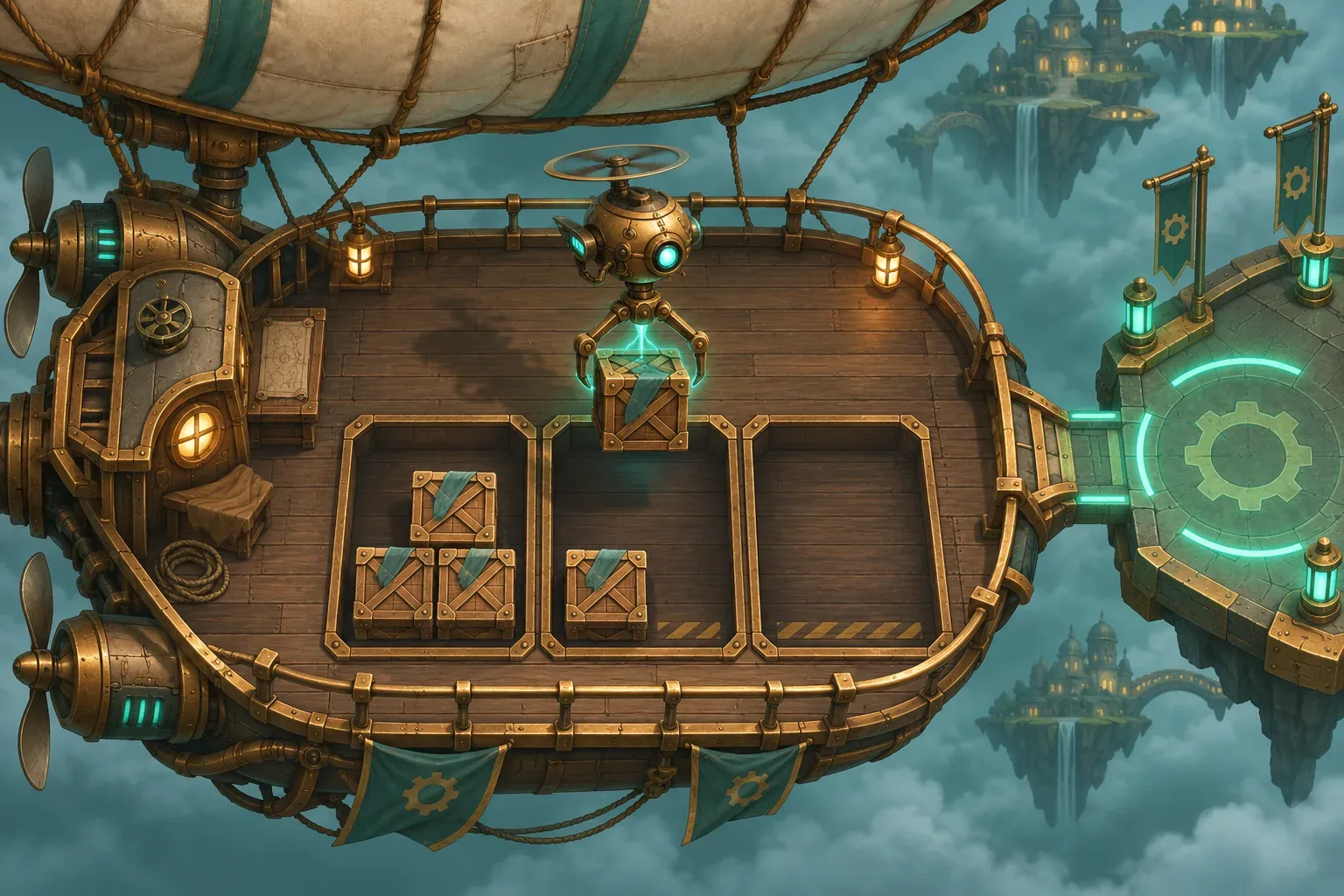
Before writing flavor, name each piece of state and its owner. In this example, the banked score persists through a bust, while the haul and cargo mass describe only the current run. Attempt count resets when a new run starts. Stating those boundaries prevents a common prompt defect: a bust animation plays, but the model has not been told whether the score is erased, saved, or partially transferred.
| State | When it changes | What a bust does |
|---|---|---|
| Banked score | At the start, or when a safe haul is banked | Preserves the amount already secured |
| Unbanked haul | Increases when a crate is retrieved; transfers only on Bank | Clears to zero |
| Hold mass | Increases with each crate in the current load | Clears with the lost cargo |
| Attempt count | Increases once per completed Push | Run ends; Restart resets it |
Make every push a clear state change
A random result should be explainable in one sentence and traceable in a compact table. The fictional die has six equally labeled faces. The prompt maps them to three crate classes; each class has both a point value and a mass value. Keeping value and mass distinct is the mechanic: a valuable crate also occupies more of the hold's capacity.
| Die result | Crate | Haul points added | Mass added |
|---|---|---|---|
| 1–2 | Light crate | +1 | +1 |
| 3–4 | Medium crate | +2 | +2 |
| 5–6 | Heavy crate | +3 | +3 |
These ranges are a design choice, not a balance claim. A prompt should not infer that the game is fair, exciting, or well tuned merely because the table is complete. If a future playable version uses a die, a person still needs to inspect whether the six outcomes map to exactly one crate each and whether the visible state matches the values.
For a push, specify an order of operations. First roll once. Then show the face and crate. Add its points and mass to the current unbanked state, and increase attempts by one. Next check the capacity rule. Only if the result is safe should the player see the choice to Bank or Push again. That ordering matters: if the interface offers Bank before checking overload, it could let the player save a load that the rules say has already busted.
Use visible feedback that follows the same order. A concise result might read: “Medium crate recovered: +2 haul, +2 mass. Current haul 4; hold mass 4 of 6. Bank now or Push again?” This is a suggested message, not a captured game screen. It names the new item, both changes and the choice the player must make.
Write bust and bank rules before the buttons
“The ship is overloaded” is not enough. The prompt must define the threshold, the timing of the check, what is lost, what survives and whether the run continues. Here the hold overloads when cumulative mass reaches 6 or more. It busts immediately after the crate is added. All unbanked points and cargo mass are lost, previously banked score remains, and the run ends. No Bank choice appears after the overload check.
On a safe result, Bank moves the entire unbanked haul into banked score and ends the run. It clears the run's haul and mass from the active state. A result of at least 5 banked points is a Win; a smaller secured amount is a Safe Shortfall. The third safe retrieval automatically banks, so the loop has a defined end even if the player never chooses to stop. A bust ends it immediately. Restart begins a new run at zero.
The distinction between “zero active haul after banking” and “zero score” should be explicit in the game state. The transfer is atomic: add the haul to banked score, then clear the active load, then show the terminal result. If a future implementation clears the haul first, it may accidentally discard the points. A prompt can call out that order as an acceptance condition without pretending it has already been verified.
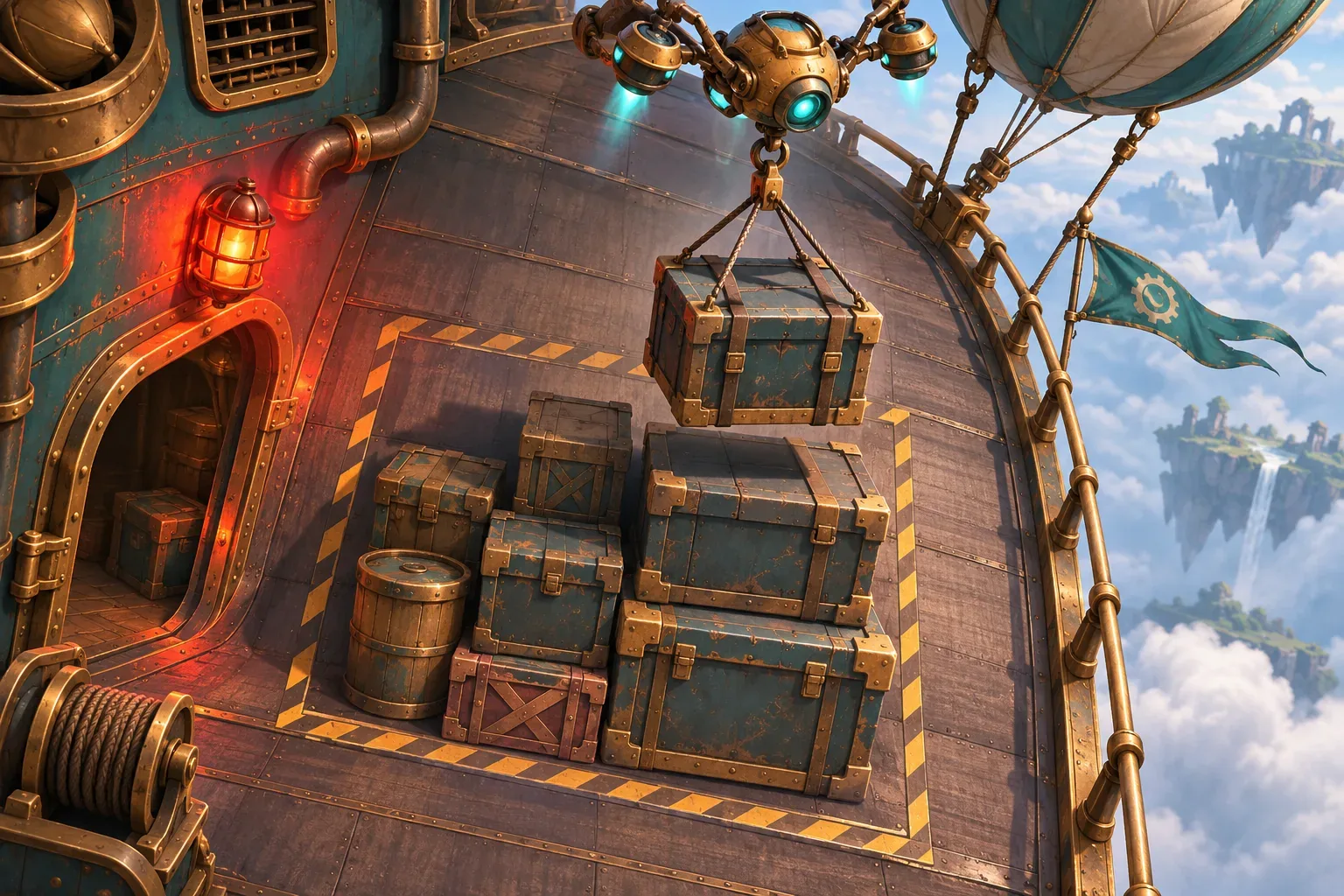
Keep the first version narrow. Do not introduce upgrades, a route map, enemy fire, cargo insurance, or several holds while the central choice is still being defined. Each addition creates another question about what is banked and what can be lost. A small first prototype makes it easier to tell whether the core state transitions are being followed.
Walk through two runs before asking for more systems
Hand traces expose missing rules early. The table below follows two fictional sequences. They are arithmetic walkthroughs of the authored design, not measured probabilities, generator output or results observed in a playable build.
| Roll | Crate | Unbanked haul after result | Hold mass | Resolution |
|---|---|---|---|---|
| 3 | Medium (+2, mass 2) | 2 | 2 / 6 | Safe; Bank or Push |
| 1 | Light (+1, mass 1) | 3 | 3 / 6 | Safe; Bank or Push |
| 4 | Medium (+2, mass 2) | 5 | 5 / 6 | Third safe attempt auto-banks 5; Win |
| 5 | Heavy (+3, mass 3) | 3 | 3 / 6 | Safe; Bank or Push |
| 3 | Medium (+2, mass 2) | 5 | 5 / 6 | Safe; Bank or Push |
| 2 | Light (+1, mass 1) | 6 before bust resolution | 6 / 6 | Immediate Bust; unbanked haul lost |
The safe trace confirms that a third safe result ends the run without requiring a fourth button decision. The bust trace confirms that the capacity test happens after adding the last crate and before any Bank option. If the player had banked after the first two results in that second trace, 5 points would be secured, the run would end, and the goal of 5 would be met. The same rolls produce different consequences because the player stops at a different time.
Those examples give the prompt a concrete target for later inspection. They do not say how often each result occurs in a real game, whether the choice is balanced, or whether players find it enjoyable. Avoid publishing those conclusions until an actual build exists and the relevant behavior has been observed.

Turn the rules into a six-prompt sequence
Work from state to outcome, adding one rule layer at a time. Keep the complete prompt text in the local prompt library; the snippets here show what each stage must accomplish. They are unrun drafts.
- Establish the run. Ask for one player, one airship hold, zero starting values, separate banked and unbanked counters, a goal of 5, and a short run. Exclude extra systems until the stop-or-push loop works.
- Map the die to cargo. State the exact 1–2, 3–4 and 5–6 bands. Give every crate both a point value and a mass value. Ask the game to show the result before offering a decision.
- Resolve overload. Set the threshold to mass 6 or more. Test it immediately after adding a crate. Define the lost unbanked state, protected banked score and terminal Bust result.
- Define Bank and run end. Transfer the haul, clear active load, compare banked score with 5, cap attempts at three and make the third safe retrieval auto-bank. Specify Restart separately.
- Request hand traces. Walk through rolls 3,1,4 and 5,3,2 with current haul, mass, attempt count and terminal outcome after each roll. Label them as authored examples, not observed output.
- Prepare checks for a future build. Ask for logs that expose roll, crate, points, mass, bank action, bust check and terminal state. List each expected behavior as something to inspect later, not as a passed test.
After each step, compare the reply with the source of truth in the rules table. If an answer changes the mass threshold or forgets to preserve banked score, correct that one conflict before adding content or polish. Small revisions make it clearer which instruction caused a later state change.
| Future check | Expected behavior from this design | Evidence to capture later |
|---|---|---|
| Roll mapping | Each face belongs to one crate band; points and mass both update | Roll, crate label, old and new values |
| Safe bank | Haul transfers once; active load clears; run ends | Before/after banked and unbanked values |
| Overload | Mass 6+ busts before another choice; only unbanked haul is lost | Last crate, capacity check and terminal state |
| Run cap | Third safe result auto-banks; attempts cannot reach four | Attempt counter and automatic terminal event |
| Goal | Win at banked score 5 or more; otherwise Safe Shortfall | Banked total and result label |
For general prompt-to-game workflow context, SEELE describes starting from a plain-English idea, generating a playable first version, testing it in a browser and refining it with follow-up prompts on its Free AI game maker page. That page supports a general workflow only. It does not verify Skyhook Salvage, these rules, this prompt sequence or a generated result. Free AI game maker can be a next step for exploring a concept; any resulting game still needs direct review.
Prepare build checks without claiming a test
A careful prompt library separates a design proposal from evidence. Here, the die, crate values, six-threshold overload and three-attempt cap are the rules to request. The two traces are hand calculations against those rules. The images are fictional concept illustrations. None of these items demonstrates a working interface, tested randomness or a finished game.
If the concept is implemented later, inspect one transition at a time. Confirm that each roll appears once, the displayed crate matches the mapping, mass and haul both update, and the bust check occurs before the decision. Then inspect safe banking, the third-attempt cap, the win threshold and Restart. Record the build version and observed state for each check so that a future article can distinguish an intended rule from a confirmed behavior.
There is no claim here that a prompt was submitted or that these checks passed. The package is a local planning article with an unrun prompt set and proposed tests. Its value is the explicit rule contract and traceable examples, which make a later implementation easier to inspect.
Frequently asked questions
What rules should a push-your-luck game prompt define first?
Define the current haul, banked score, what each push adds, the bust condition, what bust removes, how a player banks, and what ends the run.
How can cargo make a push-your-luck game feel riskier?
Let each successful push add cargo mass and points to an unbanked load. Set a clear capacity limit so the chance of overload rises as the hold fills.
What should happen when a push causes a bust?
State exactly what is lost and what is protected. In this example, a capsize removes the unbanked haul, preserves previously banked score, and ends the run.
How long should the first push-your-luck prototype be?
Use a short cap such as three salvage attempts, one cargo table, one overload rule, and one bank decision. Add upgrades or route choices only after those state changes are clear.
Were these push-your-luck prompts tested in a playable build?
No. The Skyhook Salvage rules and roll sequences are fictional planning material. The prompts are unrun drafts and no playable build or measured test results are included.