A card-based survival game turns a small hand into a plan for the day. One card might gather supplies, another improve shelter, and another reduce fatigue. At the end of the day, persistent needs resolve whether the player acted or not. The order matters: a resource card should not accidentally satisfy upkeep twice.
The cards, resources, threats, and outcomes here are fictional game rules. The prompt examples are unrun drafts; this article does not claim a playable build or real survival advice.

Define the day and resource loop
Write down one day before asking for a long survival campaign. A small loop could be: draw three action cards, choose one, resolve its effect, advance the day, consume daily needs, then check shelter and fatigue. State which values persist and which reset. The hand may change, but food, water, shelter integrity, and fatigue should remain visible until a rule changes them.
Use named resources with clear units. In this fictional example, food and water are day supplies, materials are used to improve a shelter, and fatigue is a simple pressure track. These labels exist only for the game exercise. They do not describe what a person should carry or consume in a real emergency.
| State | Example representation | When it changes |
|---|---|---|
| Hand | Three action cards | Draw at the start of a day; played card leaves hand |
| Food and water | Integer supply counts | Cards add or spend; upkeep subtracts once per day |
| Materials | Integer stock | Gathering adds; construction spends |
| Shelter | Integrity from 0 to 3 | Fortify raises it; a fictional hazard may lower it |
| Fatigue | Track from 0 to 3 | Rest lowers it; strenuous actions may raise it |
Make card effects and needs explicit
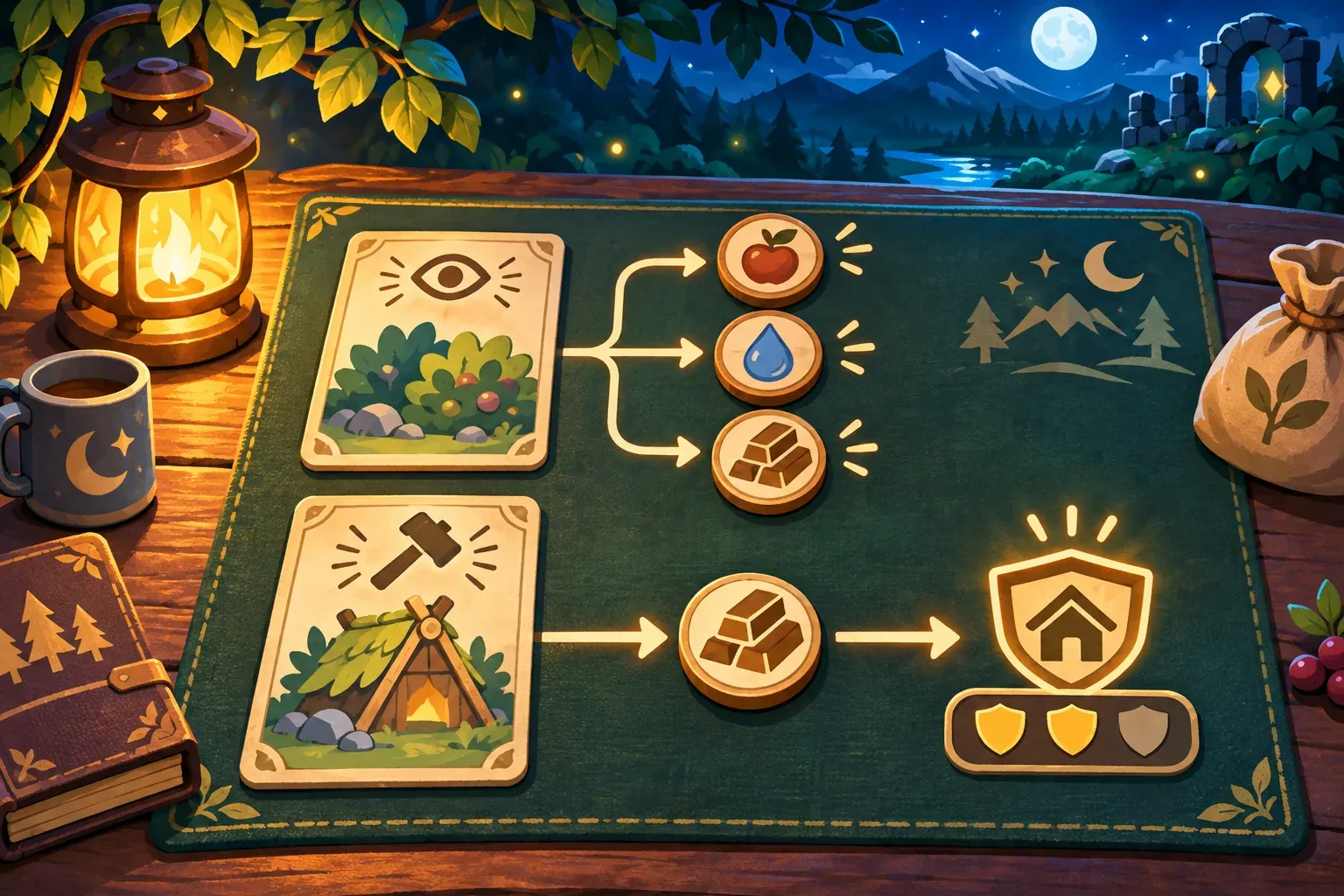
Write each card with a cost, effect, and timing. “Search” might add two food and one material at no cost. “Fortify” spends one material to raise shelter integrity by one, up to three. “Rest” could lower fatigue but consume a food unit. If the player cannot pay a cost, keep the card unavailable and explain the missing resource.
Keep the daily upkeep outside the card resolution. A fixed day-end step subtracts one food and one water exactly once, whether the player searched, fortified, or rested. Put that boundary in the rules and show the before-and-after resource panel. That prevents a card effect from bypassing or duplicating the needs check.
A card record can be simple enough to audit:
{
  "cardId": "fortify",
  "cost": { "material": 1 },
  "effect": { "shelterIntegrity": 1 },
  "limit": { "shelterIntegrityMax": 3 },
  "timing": "before_day_end"
}
Keep resource updates atomic: validate the cost, subtract it once, apply the effect, then refresh the display. If the card fails validation, no partial cost should be spent.
Trace a two-day fictional path
Start with 4 food, 3 water, 1 material, shelter integrity 1 out of 3, and fatigue 1. On Day 1, the player plays Search, adding 2 food and 1 material, then upkeep removes 1 food and 1 water. On Day 2, Fortify spends 1 material and raises shelter integrity by 1; the same upkeep runs again.
| Step | Food | Water | Material | Shelter | Fatigue |
|---|---|---|---|---|---|
| Start | 4 | 3 | 1 | 1/3 | 1 |
| Day 1 — Search | 6 | 3 | 2 | 1/3 | 1 |
| Day 1 — upkeep | 5 | 2 | 2 | 1/3 | 1 |
| Day 2 — Fortify | 5 | 2 | 1 | 2/3 | 1 |
| Day 2 — upkeep | 4 | 1 | 1 | 2/3 | 1 |
This is a hand calculation across two turns for fictional mechanics, not a tested game or real survival plan. It gives you an acceptance case: Search is followed by one upkeep, then Fortify is followed by one upkeep. A second test should skip Search and check that upkeep can reduce supplies to zero without going negative.
Record prompt runs and failure cases
Stage prompts so the tool has a stable rule set before adding events. First ask for the day loop and state panel. Next add three action cards. Then ask for upkeep and shelter integrity. Finish with an interface pass that preserves every value.
Create a compact fictional card-based survival game prototype with a three-card hand and one action per day. Track food, water, material, shelter integrity from 0 to 3, and fatigue from 0 to 3. Start with 4 food, 3 water, 1 material, shelter 1/3, fatigue 1. Search costs 0 and adds 2 food plus 1 material. Fortify spends 1 material and adds 1 shelter integrity up to 3. At day end, subtract 1 food and 1 water exactly once. Show state before and after each step. Use fictional mechanics only; do not present them as real emergency advice. Do not add combat, crafting trees, or random events yet.These templates are unrun. When you use them, record the exact prompt, tool, date, output version, and correction. A text mockup can show the intended state panel, but it does not prove that card costs or day-end upkeep work in a playable build.
SEELE's official AI Game Maker page describes creating from text, testing a browser-playable first result, and iterating. That is general product context; the prompts here have not been run and no specific outcome is claimed.
- Card-use check: one action card resolves per day and leaves the hand once.
- Cost check: Fortify cannot spend material below zero.
- Upkeep check: food and water decrease once at the day boundary.
- Limit check: shelter integrity never exceeds 3.
- Failure check: an unavailable card explains its missing cost without partially changing state.
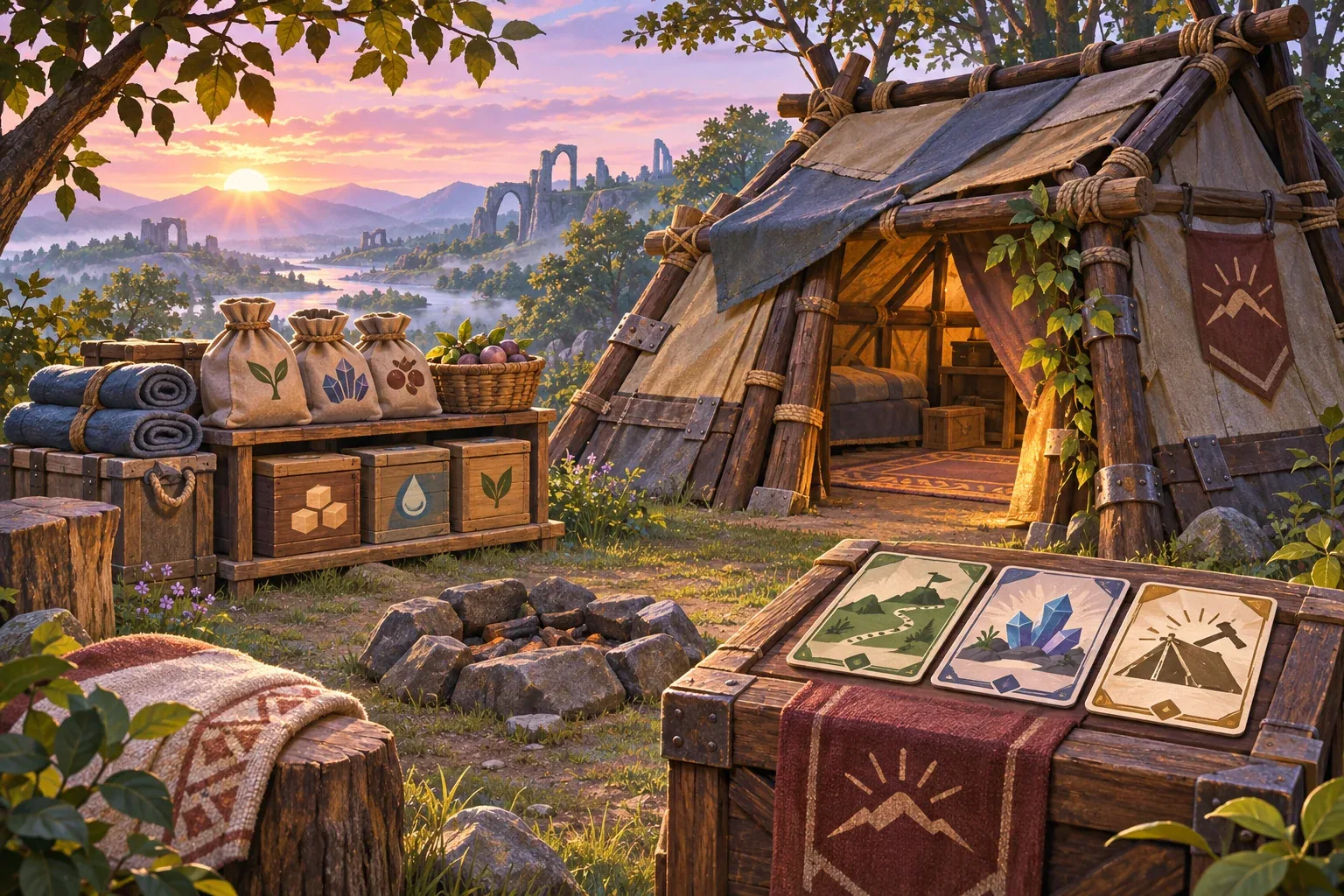
After the first loop is understandable, add one event card or hazard. Make it change one state and provide a response the player can plan for. Keep the same day-end rule so you can compare the new event with the baseline.
Card-based survival prompt FAQs
How many resources should I track first?
Choose a few that support different decisions, such as supplies, building material, shelter state, and fatigue. Give each a clear unit and a visible way to change.
Should daily needs be handled by a card?
Not necessarily. A fixed day-end step can resolve upkeep once, while cards let the player influence what is available beforehand. Keep the timing visible.
How do I prevent negative resources?
Validate a card's cost before resolving it. If the player cannot pay, keep the card unavailable and explain the missing amount without applying a partial effect.
Are the example supplies real survival advice?
No. The cards and resource values are fictional game mechanics. They should not be used as real emergency or preparedness guidance.
Can I call these prompts tested?
Only after running them and inspecting the result. The examples here are unrun drafts, and no playable game is claimed.
Make your own card-based survival game
Start with one day, a small hand, and persistent needs that resolve in a fixed order. Then add the next card that creates a meaningful choice. For a general game-creation starting point, explore the SEELE AI Game Maker and adapt this unrun draft sequence to your own fictional prototype.