A card-battling RPG can make a character role visible through the choices in its deck. A Sentinel might protect the party and finish a weakened enemy, while another role could lean on status effects or fast attacks. Before adding a long campaign, define one small encounter with enough rules to explain why a card is useful.
The hero, cards, enemy, values, and outcome below are fictional design examples. The prompt sequence is an unrun draft; no playable build or tested result is claimed.
Define one role and a turn
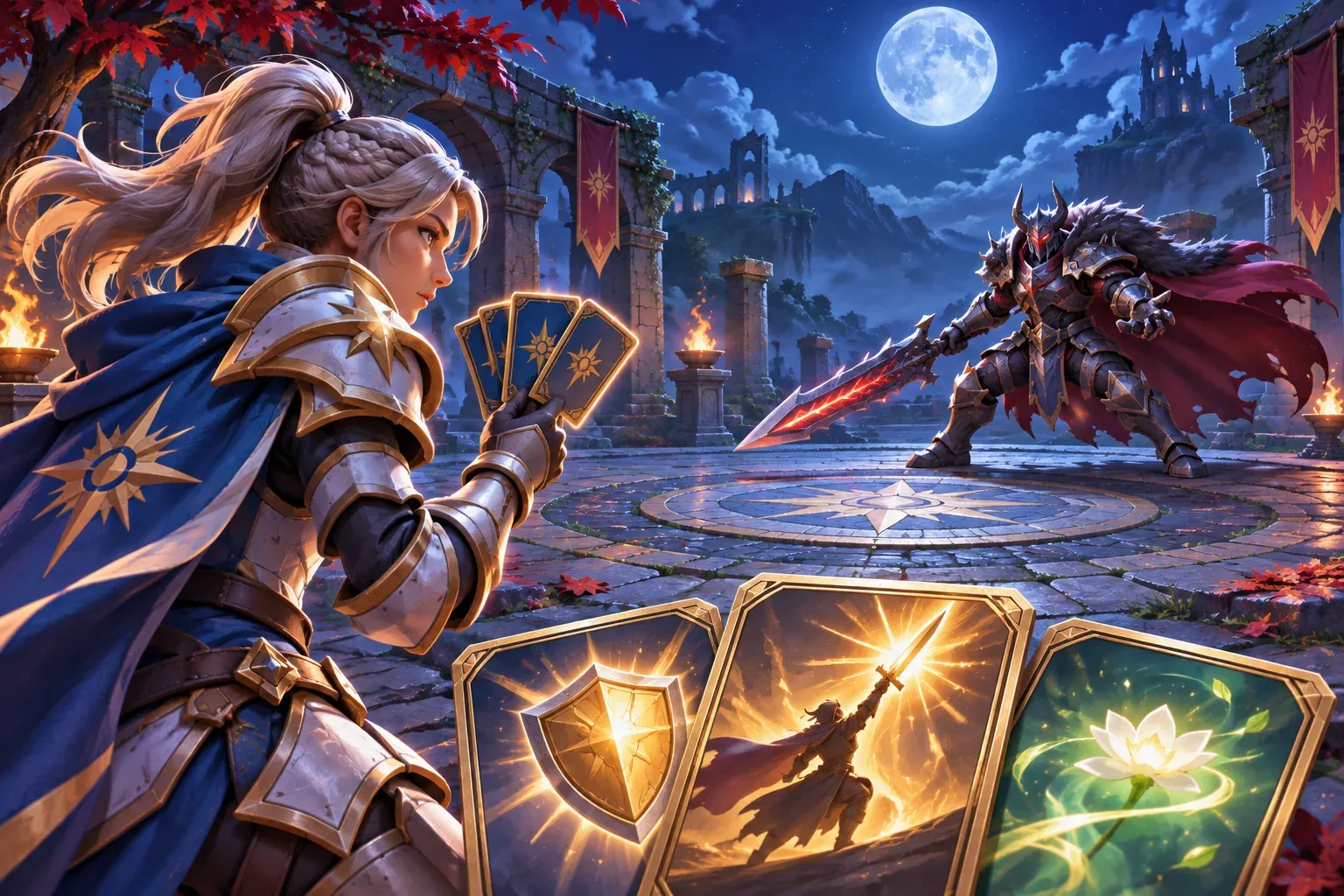
Keep the first version narrow. Give the player one character, one enemy, and a small deck. For this example, the Sentinel starts with 10 HP and refreshes to 3 energy at the start of every turn. The Ash Knight begins at 8 HP and shows an intent to deal 5 damage. The enemy acts after the player finishes the turn, unless it has already been defeated.
State the order in plain language: draw three cards from the top of the deck, refresh energy, play any affordable cards, then resolve the enemy's visible intent. Played cards move to the discard pile. At the next turn, draw from the remaining deck; reshuffle the discard pile only when the draw pile is empty. A small tutorial deck can make the opening two turns predictable enough to inspect.
| Rule | Fictional starting value | Design question |
|---|---|---|
| Player health | 10 HP | What happens at zero? |
| Turn energy | 3 per player turn | When does it refresh? |
| Enemy health | 8 HP | Does defeat cancel its action? |
| Enemy intent | 5 damage | Can the player see it before acting? |
| Deck draw | 3 cards per turn | What happens when the deck empties? |
Role identity should show up in tactical choices. The Sentinel's Brace card reduces incoming damage; a later Guardian might protect allies, while a Duelist might trade defense for tempo. Start with one role so you can test the turn model before adding class-specific keywords, equipment, status effects, or progression.
Make cards and enemy intent auditable
Every card needs a cost, a precise effect, and a timing rule. Jab costs 1 energy and deals 3 damage. Brace costs 1 energy and grants 4 block until the enemy response resolves. Patch costs 1 energy and restores 2 HP, capped at the player's maximum of 10. At the start of the turn, energy returns to 3; unused energy does not carry forward.
Validate a card before changing state. If the player has less energy than a card costs, the card stays unavailable and no partial effect is applied. If the target is already defeated, damage should not continue to a nonexistent enemy unless a separate rule says so. State whether a heal can exceed the health cap and whether block expires after one enemy response.
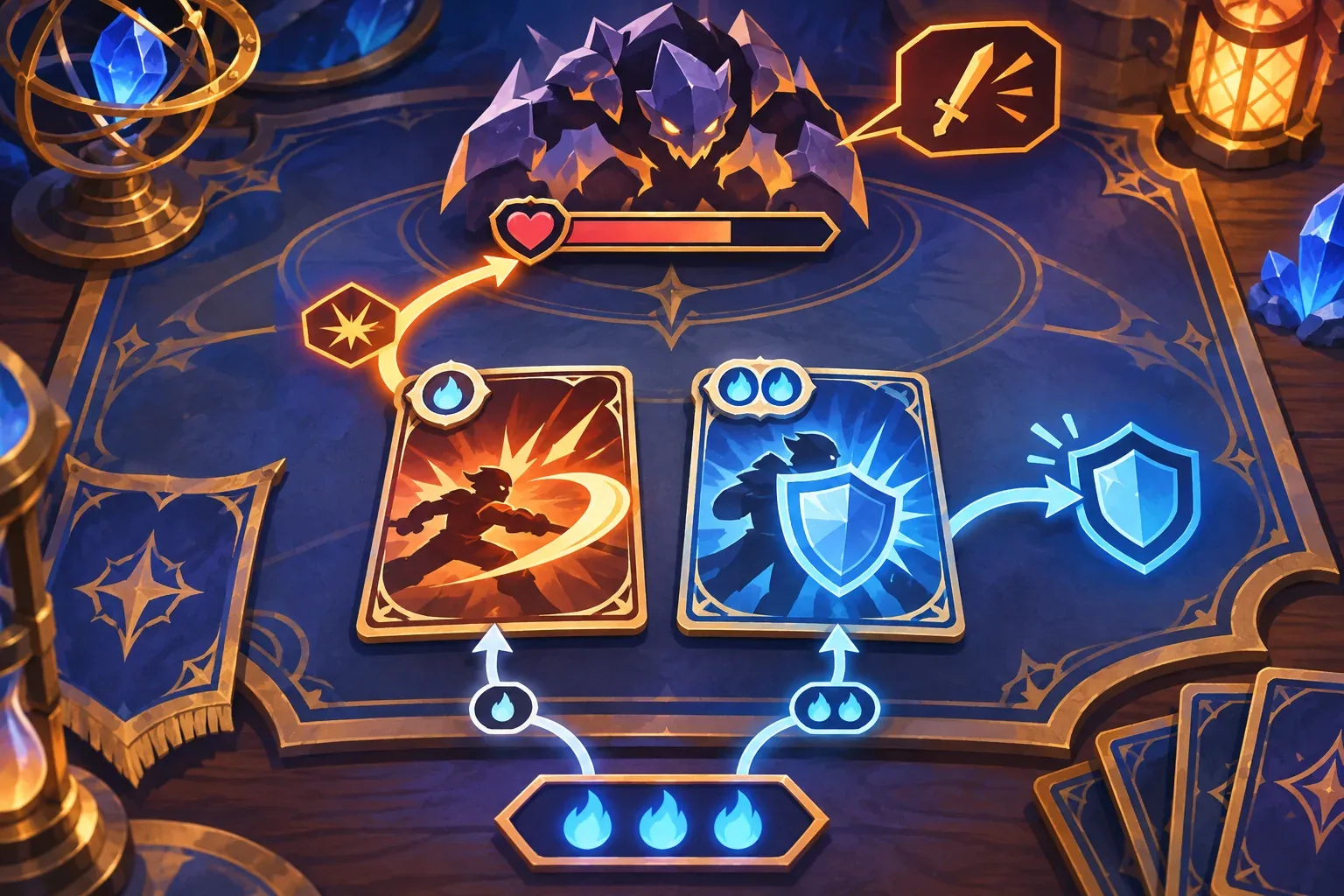
A compact card record might look like this:
{
  "cardId": "brace",
  "cost": { "energy": 1 },
  "effect": { "block": 4 },
  "duration": "until_enemy_response",
  "target": "self"
}
Keep the combat resolver in a consistent order: check card availability, pay its cost once, apply the effect, update the display, and then move to the next chosen card. When the player is done, resolve the enemy intent against current block, subtract any remaining damage from HP, and clear temporary block. If enemy HP reached zero during the player phase, skip the response.
Trace a two-turn encounter
Use a fixed six-card tutorial order: Jab, Jab, Brace, Patch, Jab, Brace. Draw the top three cards at the start of each turn. On Turn 1, the player has 3 energy and plays both Jabs and Brace, spending all 3. The two Jabs deal 6 damage, leaving the Ash Knight at 2 HP. Brace adds 4 block. The enemy's 5-damage intent then removes 4 block and deals 1 damage, taking the Sentinel from 10 to 9 HP.
| Turn step | Player HP | Energy | Enemy HP | Block | Result |
|---|---|---|---|---|---|
| Start | 10 | 3 | 8 | 0 | Draw Jab, Jab, Brace |
| Turn 1 — cards | 10 | 0 | 2 | 4 | Two Jabs and Brace resolve |
| Turn 1 — intent | 9 | 0 | 2 | 0 | Four blocked; one damage gets through |
| Turn 2 — draw and refresh | 9 | 3 | 2 | 0 | Draw Patch, Jab, Brace |
| Turn 2 — Patch | 10 | 2 | 2 | 0 | Heal 2, capped at 10 |
| Turn 2 — Jab | 10 | 1 | 0 | 0 | Defeat the enemy; skip its response |
This is a hand-calculated example, not a playtest. Treat it as an acceptance case for the rules: costs subtract once, block absorbs damage before HP, healing respects the cap, and a defeated enemy does not act. A second case should start with only 1 energy and attempt a 2-energy card; confirm that the card is unavailable and all state remains unchanged.
Stage prompts and test the rules
Build a prompt sequence in layers. Start with the encounter and turn order, then add the role-specific cards, enemy intent, and display. Ask for one change at a time. If the first output alters energy timing or gives the enemy an action after defeat, correct that before adding rewards or a larger campaign.
Create a compact fictional card-battling RPG encounter. The Sentinel has 10 HP and refreshes to 3 energy at the start of each turn. Use a six-card tutorial deck in this exact order: Jab, Jab, Brace, Patch, Jab, Brace. Draw three cards each turn. Jab costs 1 energy and deals 3 damage. Brace costs 1 and gives 4 block until the enemy response. Patch costs 1 and heals 2 up to 10 HP. The Ash Knight starts at 8 HP and shows an intent of 5 damage. Resolve player cards before enemy intent; if the enemy reaches 0 HP, skip its response. Validate all costs before applying effects. Show state after each card and each turn. Do not add random outcomes or progression yet.The templates are unrun drafts. When you use them, record the exact prompt, tool, date, output version, and correction. A text-only state panel can help inspect intended rules, but it does not prove that costs, damage, block, or victory work in a playable game.
SEELE's official AI Game Maker page describes creating a game from text, testing a playable result in a browser, and iterating with follow-up prompts. This is general product context only; the prompt sequence here has not been run and no card-battling result is claimed.
- Cost check: a card cannot spend more energy than remains.
- Order check: the player phase always precedes the enemy response.
- Defense check: block absorbs damage before HP and expires after the response.
- Cap check: healing never raises HP above 10.
- Defeat check: an enemy at zero HP does not act.

Once the single encounter is readable, add one new class card or one enemy intent pattern. Keep the same timing rules and rerun the cost and defeat checks. That gives each new mechanic a clear comparison against the baseline.
Card-battling RPG prompt FAQs
How many cards should the first deck contain?
Use enough cards to test a complete turn or two without obscuring the rules. A small ordered tutorial deck can make early checks repeatable before random draws are introduced.
How do class decks communicate character roles?
Give each role a different tactical tradeoff. A defensive role might prevent damage, while an aggressive role might spend energy to finish a threatened enemy quickly.
Should enemy attacks be visible before the player acts?
A visible intent makes the next decision legible. Define when the intent resolves and what happens if the enemy is defeated first.
How can I prevent card costs from applying partially?
Check the full cost before changing state. If the player cannot pay, keep the card unavailable and leave energy, health, and targets unchanged.
Are the prompts and encounter tested?
No. The prompts are drafts and the encounter is a hand-calculated fictional example. No playable output or successful run is claimed.
Make your own card-battling RPG
Start with one role, a small ordered deck, and one enemy whose intent is easy to read. Keep costs and turn timing explicit, then test each new card against the same encounter. For general game-creation context, explore the SEELE AI Game Maker and adapt this unrun draft sequence to your own fictional prototype.