Make crafting change what the player can do
Crafting can support an RPG adventure when the recipe changes the route, opens a choice, or helps the player reach a goal. It feels disconnected when the player collects materials and makes items that the quest never uses. A useful AI prompt therefore describes the adventure objective and recipe loop together.
This guide uses a fictional first slice: gather an amber reed and a sparkstone, combine them at a field bench into a flare kit, then use the kit at a dim beacon to reveal a safe ridge path. The recipe has two inputs, one output, and one state change. The example is hand-designed planning material. Its prompts are unrun drafts; no playable build, test, or observed result is included.
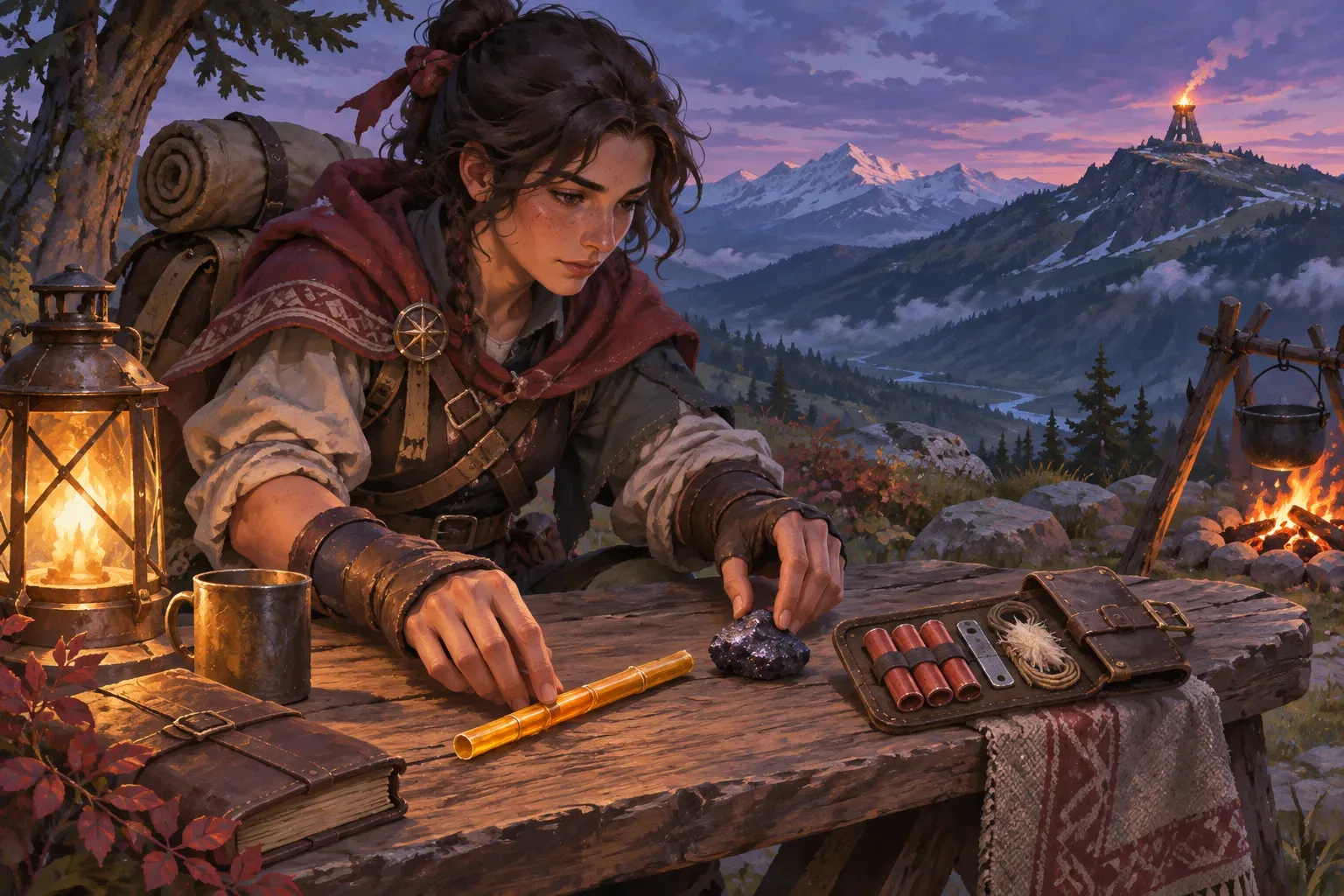
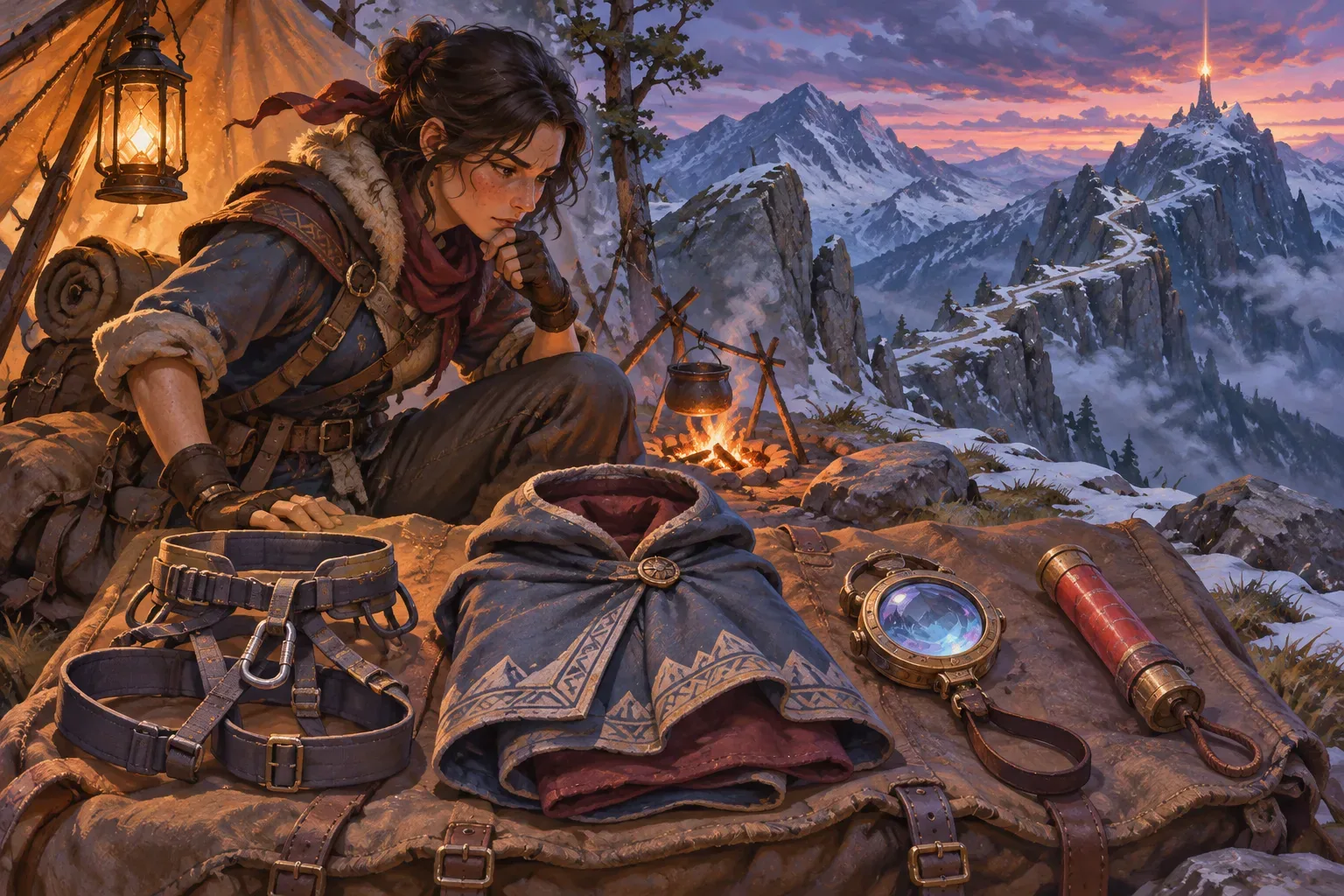
Begin with a small design contract: the player reaches a beacon, but a dark pass hides the safe route. One ingredient grows along the shore and the other sits on a nearby cave shelf. A field bench sits between them. Crafting one flare kit reveals the ridge path. This gives each material a known source, gives the recipe a purpose, and gives the output a visible consequence.
Keep the first milestone intentionally narrow. It has no item rarity, durability, crafting skill tree, random yield, quality tier, or inventory weight. Those systems can be added later if they support the game’s core loop. In the first prompt, every resource should have a name, source, quantity, and role.
Write inventory and recipe rules before adding more items
Separate the item record from the recipe record. An item describes what it is and where it can be collected. A recipe describes its required inputs, station, consumption rule, output, and effect on the quest.
{
  "id": "flare_kit",
  "station": "field_bench",
  "inputs": [
    {"itemId": "amber_reed", "quantity": 1},
    {"itemId": "sparkstone", "quantity": 1}
  ],
  "consumeInputs": true,
  "output": {"itemId": "flare_kit", "quantity": 1},
  "unlockRequirement": "none"
}
For this example, inventory begins empty. The shoreline patch gives one amber reed. The cave shelf gives one sparkstone. Crafting consumes exactly one of each and creates exactly one flare kit. There is no alternative recipe and no extra material unless the design document adds it explicitly.
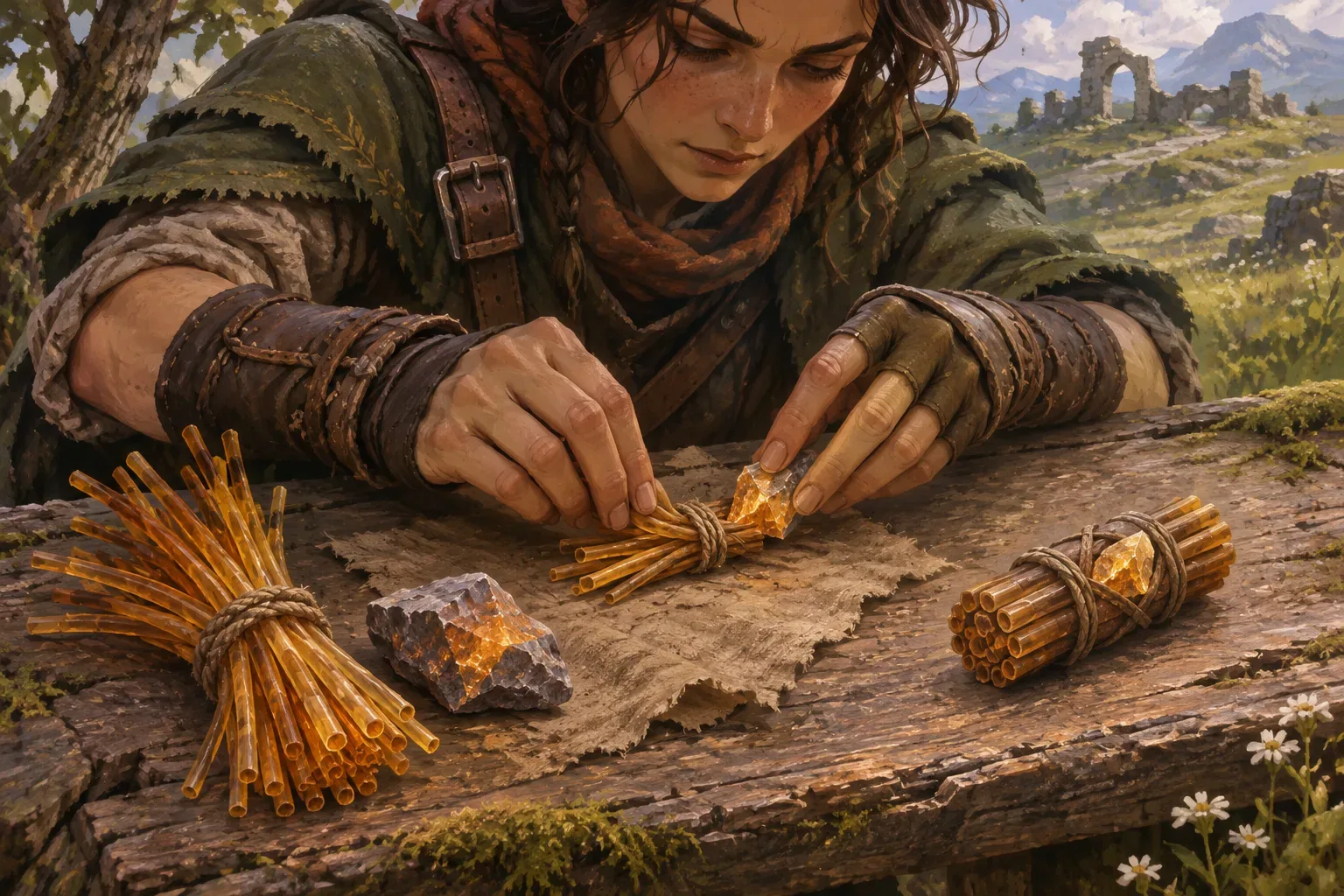
Decide how the player learns the recipe. For this milestone, `flare_kit` is known from the beginning, so the player can inspect it before collecting anything. A missing ingredient message names the item and points to its location. If the player tries to craft at the wrong station, the recipe remains unprocessed and no ingredients are removed.
State the crafting order too. First check that the station is correct and the inventory has enough of each input. If both checks pass, consume the ingredients, add the output item, and show a confirmation. A failed recipe check must not partially consume one ingredient. That small rule avoids a confusing state in which the reed disappears even though the kit was not made.
Build the prompts in stages
Split a larger request into four small prompts. First establish the route and objective. Next define item and recipe data. Then connect the crafted output to progression. Finally ask for checks of success and failure behavior. This order makes it easier to spot missing ingredients, stations, or state transitions.
Keep all item IDs consistent. Use `amber_reed`, `sparkstone`, `flare_kit`, and `ridgePathRevealed` throughout. Ask the builder to list every item in the prototype and identify where it is acquired. If an item appears in a recipe but not in the route, the mismatch becomes visible before the world expands.
One prompt can ask for a compact state table:
| Moment | Amber reed | Sparkstone | Flare kit | Ridge path |
|---|---|---|---|---|
| At the start | 0 | 0 | 0 | Hidden |
| After gathering both | 1 | 1 | 0 | Hidden |
| After crafting | 0 | 0 | 1 | Hidden |
| After using flare kit at beacon | 0 | 0 | 0 | Revealed |
This table is an expected design trace. It does not show an observed build. Keep those labels separate so a prompt’s predicted answer cannot be mistaken for a real test.
Check both the recipe and its progression effect
A focused acceptance checklist can cover the core loop without requiring dozens of recipes:
- The player can collect one amber reed at the named shoreline patch.
- The player can collect one sparkstone from the named cave shelf.
- The field bench crafts one flare kit only when both inputs are present.
- A successful craft consumes exactly one of each input and adds one kit.
- An incorrect station or missing input leaves inventory unchanged and explains the problem.
- Using the kit at the dim beacon consumes it and sets `ridgePathRevealed=true`.
- The revealed path remains available after leaving and returning to the beacon.

Run one expected trace from an empty inventory, then list the observations a future playtest should capture. If the craft succeeds but does not reveal the route, the output item and quest state are not connected. If the path reveals without consuming the kit, that may be correct or a bug; the specification above says it is consumed, so the observed result can be compared against a clear rule.
Only add a second recipe after this loop works as intended. A repair kit, potion, or key can be useful later, but every extra item needs a source, a recipe, an inventory rule, and a reason to exist in the adventure. A short item list is easier to audit for duplicated outputs, impossible ingredients, and recipes that do not affect player choices.
SEELE’s official AI RPG Maker page recommends starting from a character goal, playable scene, quest objective, and a consequential choice, then keeping the route focused and checking consistency. That general RPG guidance does not confirm a crafting feature or validate the recipe here. Explore the AI RPG Maker when you are ready to develop a focused RPG idea and compare its actual behavior with your rules.
The prompts in this package have not been submitted to a game-building system. The recipe, item quantities, and route result are fictional planning assumptions—not a real game, product demonstration, or tested outcome.
FAQ
How do I prompt an AI to make a crafting RPG?
Describe the adventure goal, inventory rules, recipe ingredients, crafting location, output, and how the crafted item changes the route. Ask for one short quest and acceptance checks.
What should a crafting recipe record include?
Give it a stable ID, input items and quantities, crafting station, output item, whether ingredients are consumed, and any unlock requirement or quest effect.
How many recipes should a first crafting RPG prototype have?
Use only enough recipes to test the progression loop. One recipe that turns gathered materials into a useful quest tool can reveal whether crafting connects to the adventure.
How can I prevent crafting prompts from inventing items?
List the allowed items, quantities, recipes, and acquisition sources, then tell the builder to flag missing materials or assumptions instead of adding them silently.
Were these crafting RPG prompts tested in a playable game?
No. The crafting loop and quest are fictional planning material. The prompts are unrun drafts and no playable build or test result is included.