Start by naming the draft method
“Make a drafting card game” does not tell a builder how cards move. Players might choose from a shared market, take turns in a fixed order, or select privately and pass hands. Those systems create different timing and interface needs, so the first prompt should say exactly which one the prototype uses.
This guide focuses on simultaneous pick-and-pass drafting. Two players each hold three cards. They secretly choose one, reveal together, keep the selected card, and pass the unchosen cards to the other player. They repeat until both hands are empty, then score. The fictional example is called Tidelight Reserve and uses shell, reed, and tide cards. The prompts are unrun drafts; the card rules and sample score are hand-calculated, not tested in a playable game.

Write the phase sequence as a fixed list: deal hands, choose one card face down, reveal choices together, place each selected card in front of its owner, pass the remaining hand, and start the next pick. After the third pick, stop passing and score the collected cards. There is no shared offer row and no first-picker rule in this first milestone.
Use consistent words for each stage. “Hand” means cards a player may choose from. “Drafted set” means cards already selected and kept. “Passed hand” means the cards left after a pick. Avoid switching between “discard,” “pass,” and “market” unless those are separate actions with separate rules.
Specify card data and scoring before expanding the deck
Keep the card pool small and give every card a stable ID and one scoring category. Tidelight Reserve has three kinds:
- Shell: 1 point per card.
- Reed: 1 point per card.
- Tide: 2 points per card.
There are no card text effects, set bonuses, swaps, or hidden information beyond each player’s current hand. A tie is a shared result. These limits make the first scoring check easy to calculate and let the draft choice itself carry the strategic weight.
{
  "id": "tide_01",
  "category": "tide",
  "points": 2,
  "effectTiming": "end_of_draft",
  "textEffect": null
}
For a larger game, the same record could add a trigger or target, but keep those fields out until the core hand movement is clear. Decide whether duplicate cards are allowed and how they are distinguished. Here, card IDs are unique even when two cards share the same category and point value.
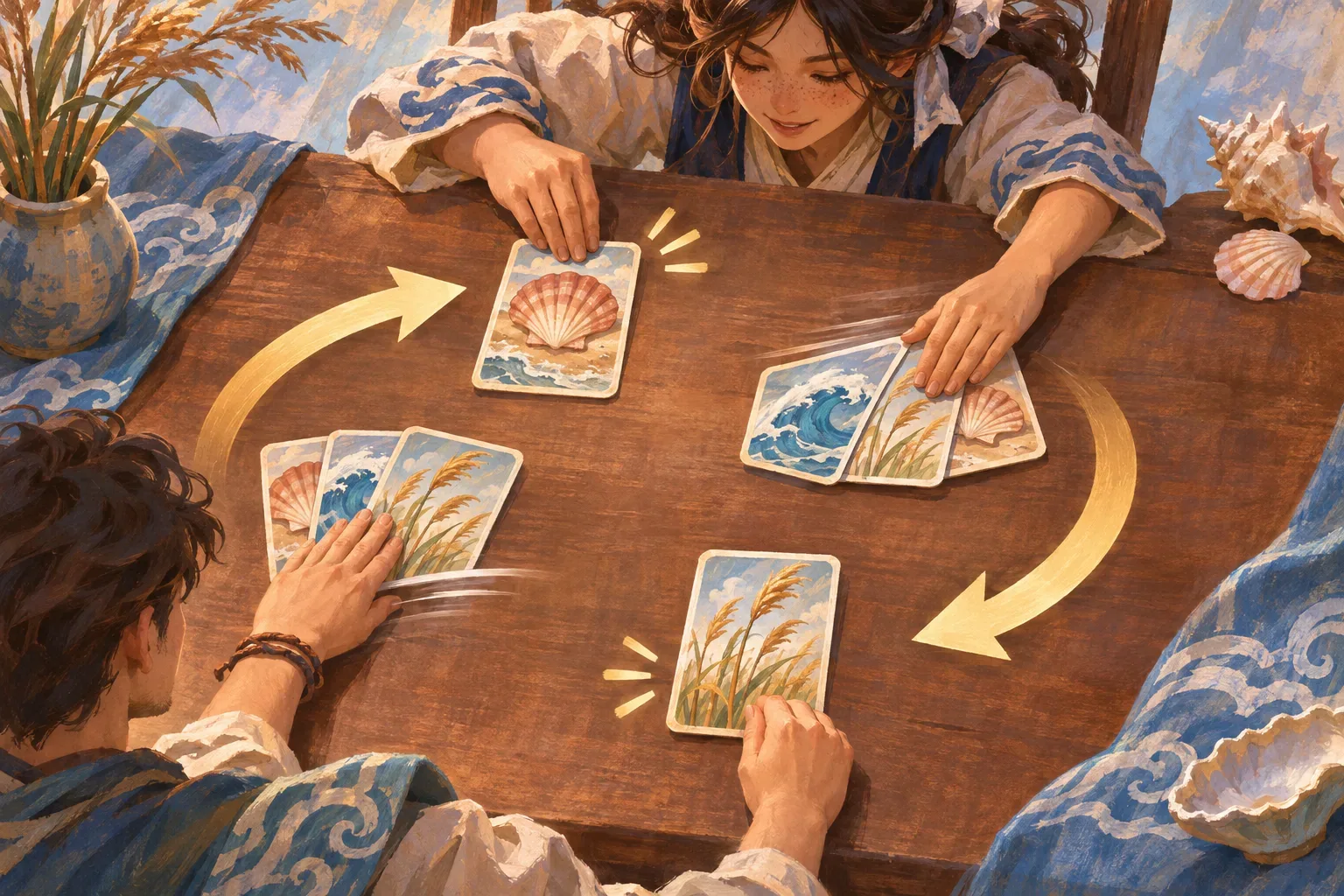
Ask the prompt to store each player’s hand separately and preserve the order of cards as they pass. If both picks reveal at the same time, neither player should see the other’s selected card before locking their own choice. That small timing rule prevents an implementation from accidentally turning a simultaneous draft into alternating turns.
Write prompts for hand flow and state updates
Build the prompt sequence in layers: define the rules and card records, implement the pick-and-pass phase, add scoring, then request a fixed trace. Each prompt should reuse the same card IDs and phase names. Ask for state before and after every pick so a mistaken pass is easy to spot.
At each selection, remove exactly one card from each hand and add that card to its owner’s drafted set. Then pass every remaining card to the opponent. Never pass a selected card, and never discard an unselected card before the third pick. Once the final card is selected, there is no hand left to pass.
Use a compact state model:
roundPick: 1, 2, or 3.handAandhandB: the current private hands.draftedAanddraftedB: cards each player has kept.revealedPicks: the two cards selected for the current step.scoreAandscoreB: calculated only after all three picks.
Do not update points during a pick if the design says scoring happens at the end. Keeping a clear resolution point means that effects added in a later design pass have one predictable place to occur.
Hand-trace a fixed three-pick example
Begin with Player A holding Shell, Tide, Tide, and Player B holding Reed, Reed, Shell. In pick one, A keeps Shell and B keeps Reed. They pass the remaining two cards. A receives Reed and Shell; B receives Tide and Tide.
In pick two, A keeps Shell and passes Reed. B keeps Tide and passes the other Tide. In pick three, A keeps the received Tide and B keeps the received Reed. The final drafted sets are A: Shell, Shell, Tide; B: Reed, Reed, Tide. At one point per Shell or Reed and two per Tide, each player scores four points, so the stated tie rule gives a shared result.
| Pick | A chooses | B chooses | Cards passed |
|---|---|---|---|
| 1 | Shell | Reed | A passes Tide, Tide; B passes Reed, Shell |
| 2 | Shell | Tide | A passes Reed; B passes Tide |
| 3 | Tide | Reed | No cards remain |

This trace is a rules example, not a reported match. Keep expected and observed outcomes in different columns. If a later build gives Player A the Reed or forgets to pass the final card, record the mismatch and correct the implementation or prompt before adding more card effects.
Turn the rules into focused acceptance checks
Check the draft loop at its boundaries as well as on the happy path:
- Each player sees only their own hand before locking a simultaneous pick.
- Exactly one card is selected from each hand per pick.
- Both chosen cards are revealed together and added to the correct drafted set.
- All and only the unchosen cards pass to the other player.
- After three picks, both hands are empty and the drafted sets each contain three cards.
- Scoring happens once after the final pick; equal totals produce the defined shared result.
Also decide what the first milestone does not do: there is no reshuffle, tie-breaker, draft pool refill, card text, or player-order bonus. If the game later adds any of these systems, write a separate prompt and add a regression trace. A small complete pass-and-score loop is more useful than a large card list with unclear timing.
SEELE’s official AI Game Maker page describes creating a playable game from a text prompt, testing it in a browser, and refining it with follow-up prompts. That is general workflow context; it does not validate this drafting design or claim a drafting-specific capability. Explore the AI Game Maker when you are ready to develop your own game idea and compare the actual result with the rules you intended.
The prompt sequence here has not been run. Tidelight Reserve, its cards, and the four-point tie are fictional design material, not a generated game or measured balance result.
FAQ
How do I prompt an AI to make a drafting card game?
Define the draft method, hand size, pick timing, pass direction, card data, round end, and scoring. Then ask for a fixed sample round and explicit state checks.
What should a card-drafting prompt specify first?
Say whether players draft from a shared market or pass hands, whether picks are simultaneous or ordered, and when unchosen cards move or leave play.
How do I keep drafted card effects consistent?
Use a card record with a stable ID, category, points or effect, timing, and any target. Resolve all effects at one named phase and document exceptions.
How many cards should the first drafting prototype use?
Use a small fixed deck that can complete a round and show the scoring rule. Expand the card pool only after the pick, pass, and resolution sequence is clear.
Were these drafting card game prompts run in a playable game?
No. The rules and sample card flow are fictional planning material. The prompts are unrun drafts and no playable build or test result is included.