A dice-building roguelike makes probability part of the player's equipment. Each die carries a small set of faces, and a run can change those faces over time. The interesting choice is not only what number appears; it is whether to keep a useful result, reroll a weak one, or modify the pool before the next encounter.
The dice, rules, values, and combat below are fictional design examples. The prompt templates are unrun drafts; this article does not claim a playable build or tested result.
Define the dice and turn order
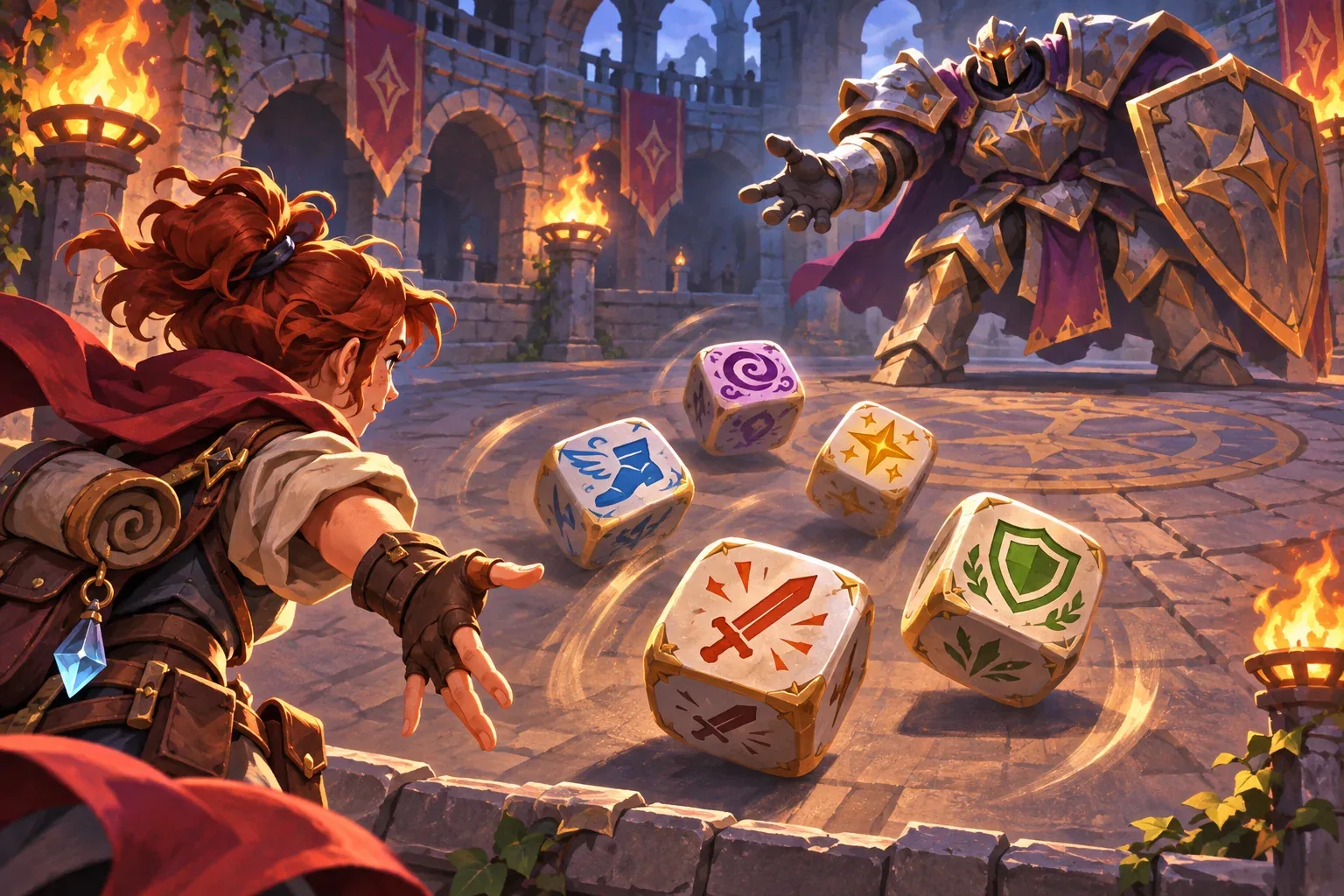
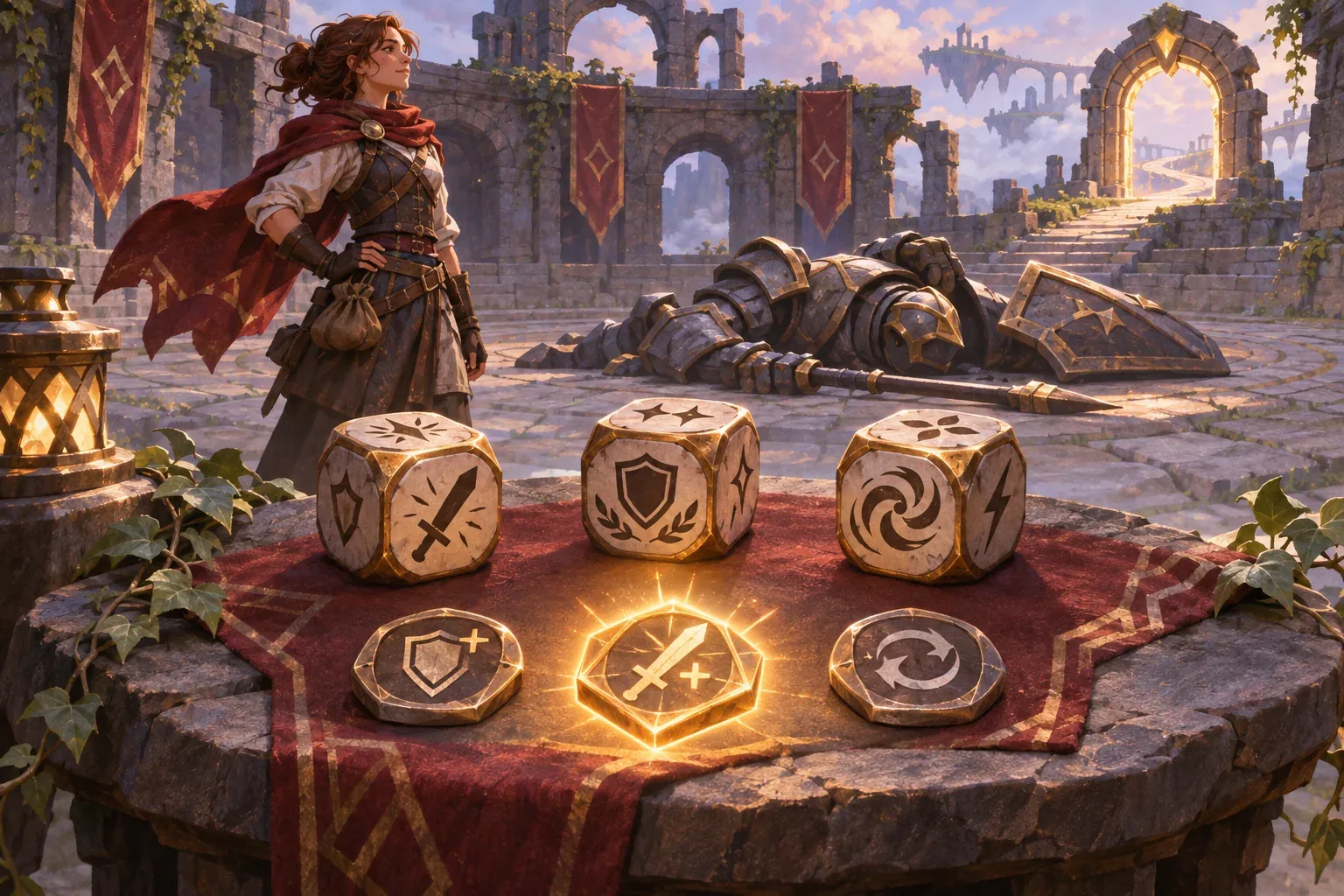
Start with three custom six-sided dice. Ember has two Strike 2 faces, one Guard 1, and three blank faces. Ward has two Guard 2 faces, one Strike 1, and three blanks. Echo has two Strike 1 faces, one Guard 1, and three blanks. These symbols give each die a different profile without requiring a large item list.
At the start of a round, roll all three dice. The player may lock any result and reroll at most one die once. Then resolve all Strike and Guard results together. Strike reduces the enemy's HP; Guard creates temporary block that lasts through the next enemy response. After the response, clear block and begin the next round. Make this sequence stable before adding status effects or extra rerolls.
| Die | Faces | Role in the pool |
|---|---|---|
| Ember | Strike 2 × 2; Guard 1 × 1; blank × 3 | Reliable damage with a small defensive option |
| Ward | Guard 2 × 2; Strike 1 × 1; blank × 3 | Defense first, with one low-damage face |
| Echo | Strike 1 × 2; Guard 1 × 1; blank × 3 | Flexible but modest outcomes |
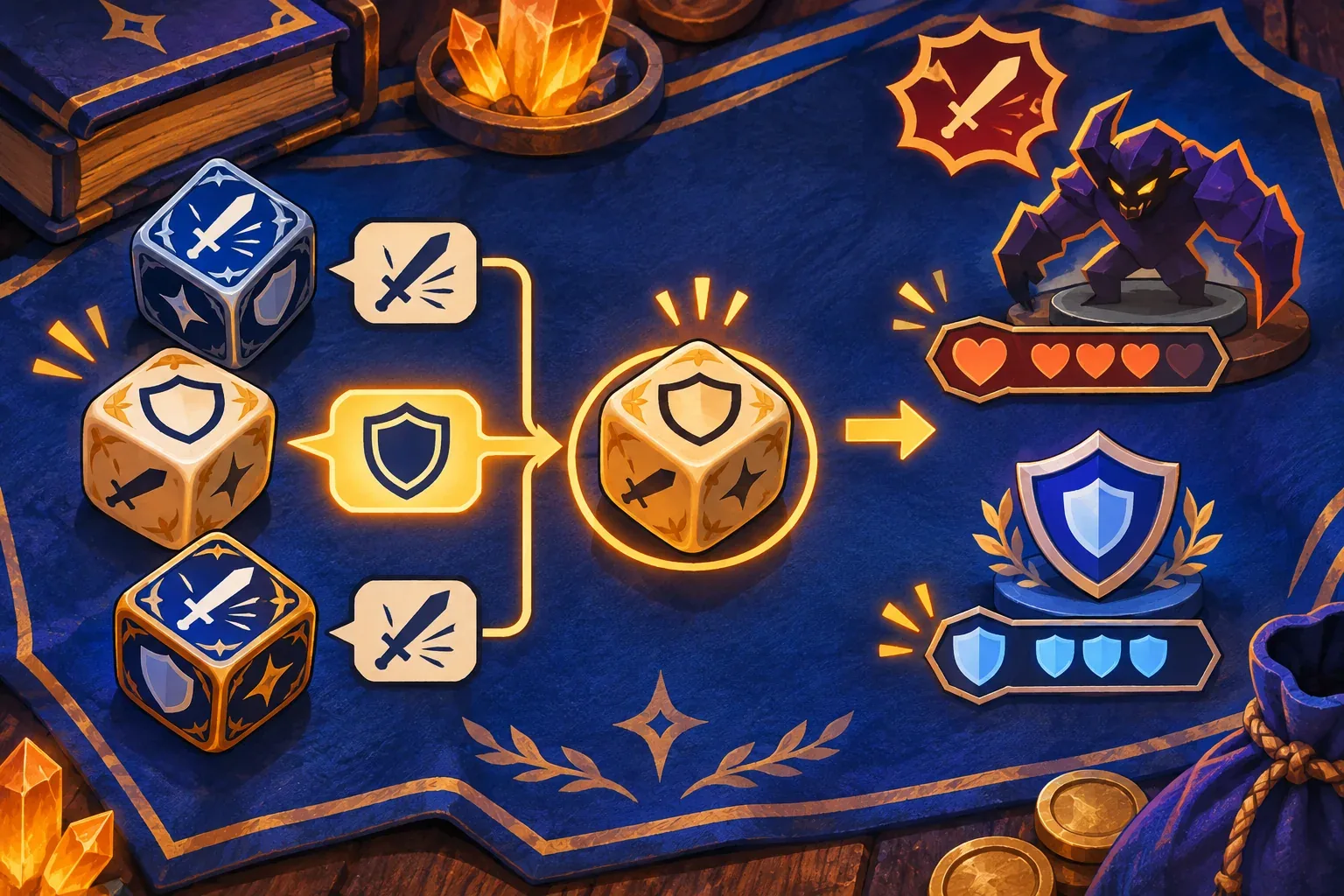
Write the rules with consistent terms. A blank face does nothing. A reroll replaces the die's current result; it does not add a second result. Guard values add together, then reduce the next attack, with any remaining damage applied to player HP. If the enemy reaches zero HP during the player's resolution step, end the fight before the enemy intent triggers.
Resolve faces and enemy intent
Give one enemy a visible intent value. In the example, the armored Warden starts at 7 HP and shows 4 damage for its next response. The player begins at 8 HP. Intent makes the roll a decision: a Guard face can prevent damage, while Strike can shorten the number of rounds before the enemy gets another attack.
Keep face modification separate from rolling. After an encounter, offer one reward choice: replace one blank face on one die with a defined face, or take a small heal. Show the choice and the persistent change before the next node. For example, changing one Ember blank into Strike 1 makes future rolls more aggressive. Do not silently modify all copies of a face or let an upgrade alter a result already resolved.
An outcome record can be explicit:
{
  "die": "ward",
  "rolledFace": "blank",
  "rerollUsed": true,
  "finalFace": "strike_1",
  "applyWhen": "player_resolution"
}
Before changing state, validate that the die has not already been rerolled this round. Then replace the old face, not add to it. A rejected reroll should leave the result unchanged. These small contracts help prevent duplicate damage or a reroll loop.
Trace a three-round encounter
Use a fictional Warden with 7 HP and a 4-damage intent. The player begins at 8 HP. In Round 1, roll Ember Strike 2, Ward blank, and Echo Guard 1. Keep Ember and Echo; reroll Ward once and get Strike 1. The combined result deals 3 and blocks 1. The Warden falls to 4 HP. Its attack deals 3 after block, reducing the player to 5 HP.
In Round 2, roll Ember Strike 2, Ward Guard 2, and Echo blank. Keep the first two and reroll Echo to Strike 1. The result deals 3 and blocks 2. The Warden falls to 1 HP; the remaining 2 damage lowers player HP from 5 to 3. In Round 3, Ember Strike 2, Ward Guard 2, and Echo Strike 1 deal 3 total. The Warden is defeated before its 4-damage intent resolves, so the player remains at 3 HP.
| Round | Final faces | Enemy HP after Strike | Player HP after intent | Outcome |
|---|---|---|---|---|
| 1 | Strike 2, Strike 1, Guard 1 | 4 | 5 | Block 1; take 3 |
| 2 | Strike 2, Guard 2, Strike 1 | 1 | 3 | Block 2; take 2 |
| 3 | Strike 2, Guard 2, Strike 1 | 0 | 3 | Enemy defeated; skip response |
This trace is a hand calculation, not a playtest or a guaranteed roll sequence. Use it as a state-transition test: one die can be rerolled once, the old result is replaced, block resolves before HP, and a defeated enemy does not act. After a win, a reward can replace one blank Ember face with Strike 1, which persists into later nodes without changing this completed fight.
Stage prompts and upgrades
Ask for the smallest loop first: three dice, one reroll, one enemy intent, and clear state. Then add the face-modification reward and a route choice. If a generated design changes the reroll limit or modifies faces before the player chooses, correct that rule before layering on relics, shops, or elite enemies.
Create a compact fictional dice-building roguelike encounter. The player has 8 HP and three six-sided custom dice: Ember has Strike 2 twice, Guard 1 once, and three blank faces; Ward has Guard 2 twice, Strike 1 once, and three blanks; Echo has Strike 1 twice, Guard 1 once, and three blanks. Each round, roll all three dice, lock chosen results, and reroll at most one die once. Then resolve total Strike against enemy HP and total Guard against a visible 4-damage enemy intent. Guard expires after that response. The enemy has 7 HP and does not act if defeated during player resolution. Show every result and state change. Do not add extra rerolls, random events, or hidden face changes.These prompts are unrun drafts. When you use them in a game builder, save the exact prompt, date, output, and correction. A diagram or text mockup can illustrate the intended flow, but only a real playable output can demonstrate that dice results and upgrade persistence work.
SEELE's official AI Game Maker page describes text-based game creation, browser testing of a playable first version, and follow-up iteration. This is general product context; the prompts in this article have not been run and no dice-building result is claimed.
- Reroll check: one die can be rerolled once per round, and the first result is replaced.
- Damage check: Strike reduces enemy HP and cannot go below zero.
- Defense check: Guard reduces one intent before player HP changes.
- Upgrade check: a selected face change persists to the next node only.
- Defeat check: a defeated enemy does not resolve its intent.
After the baseline encounter is easy to follow, test one new face or one extra reward. Keep a before-and-after record for the die so the player can see what changed and why. That turns each prompt revision into a checkable design decision.
Dice-building roguelike prompt FAQs
How many dice should the first pool use?
Start with a few dice that each contribute a different role. Three is enough to test Strike, Guard, and a reroll decision without making the first encounter hard to inspect.
Should players reroll every blank result?
Set a clear reroll limit. A once-per-round reroll creates a choice between accepting the current result and trying to improve one die.
How do upgrades change a dice-building run?
Define exactly which face changes and when it persists. Replacing one blank face with a named effect is easier to audit than modifying an entire die invisibly.
How do I keep enemy attacks readable?
Display the next intent before the player rolls, then resolve it after Strike and Guard. Skip the intent if the enemy is defeated first.
Are these prompts or results tested?
No. The prompt examples are unrun drafts and the encounter is a fictional hand calculation. No playable game or successful prompt run is claimed.
Make your own dice-building roguelike
Start with three dice, one visible enemy intent, and a single face upgrade. Keep rerolls, damage, and blocking explicit, then use one encounter to inspect each state change. For general game-creation context, explore the SEELE AI Game Maker and adapt this unrun prompt draft to your own prototype.