Introduction
A life-simulation RPG prompt should connect daily activities to character and community change. If the player can garden, talk or visit shops but none of those actions affect relationships, goals or the neighborhood, the activities feel disconnected. A small prototype can show one day and a few understandable progression threads.
This guide uses Riverglass, a fictional lakeside neighborhood where the player chooses how to spend a free afternoon and helps residents prepare a shared event. Its characters, activities and progress values are invented and untested. No game has been generated or playtested for this article.
Define the day loop
Start with the player’s time frame and choices. State how many activities fit into a day, whether the player can skip or pause, and what advances time. Keep the first slice to a small map, a few residents and a short list of actions. Do not begin with a full calendar, large town or many skill trees.
Prompt 1 — core life-sim brief
Design an original life-simulation RPG called Riverglass. The player spends a free afternoon in a small lakeside neighborhood and can choose among a few activities. Define the day loop, time cost, activity list, character interaction, community goal and end-of-day feedback. Let the player pause or skip an activity without losing long-term progress. Keep the first milestone to one neighborhood block and mark all values as untested.
A clear loop lets the player choose an activity, see its result and decide what to do next. If time is limited, show that cost before confirmation. If there is no failure for skipping, say so explicitly so the rules and tone agree.
Give activities different purposes
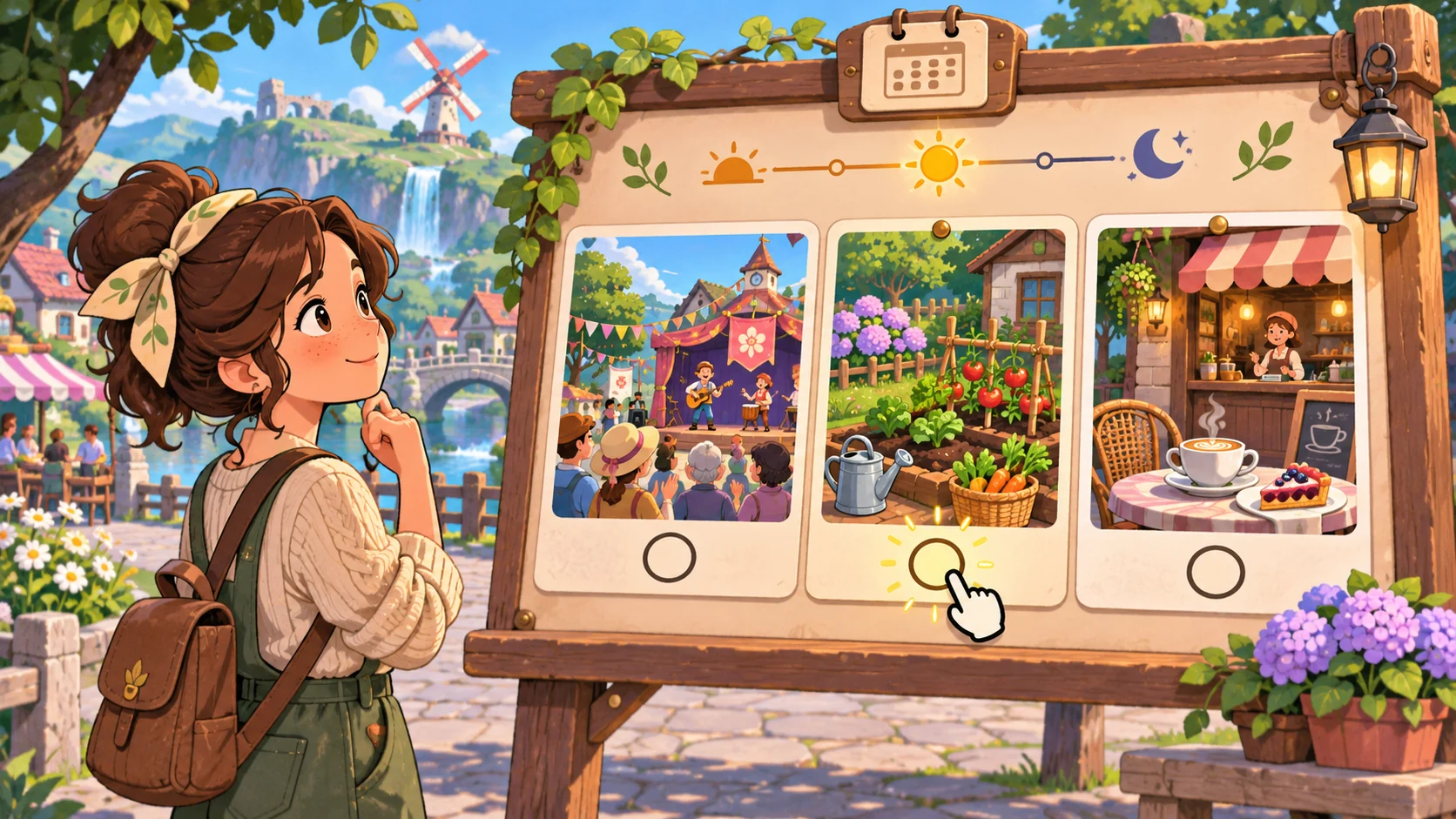
A garden task, a conversation and a community event should not be three ways to fill the same meter. Each activity can serve a distinct purpose: learn about a character, improve a shared space or discover a new part of the neighborhood. Explain how the player sees progress and how an activity can be postponed.
Prompt 2 — activity and daily planner
Create a simple afternoon planner for Riverglass with three activities: visit a community event, tend a fictional garden plot and stop by a cafe. For each, state its time cost, the character or community thread it can advance, and the feedback shown afterward. Let the player choose the order and decline any activity. Do not include hidden deadlines or missed-day penalties.
| Activity | Primary purpose | Visible response |
|---|---|---|
| Community event | Advance a shared neighborhood goal | The common space records a contribution |
| Garden task | Change a small shared environment | A visual stage updates later |
| Cafe visit | Learn a resident’s interest | Dialogue reflects the conversation |
These are fictional systems, not claims about real community programs. The prototype should show which thread changed and why.
Make character progression understandable
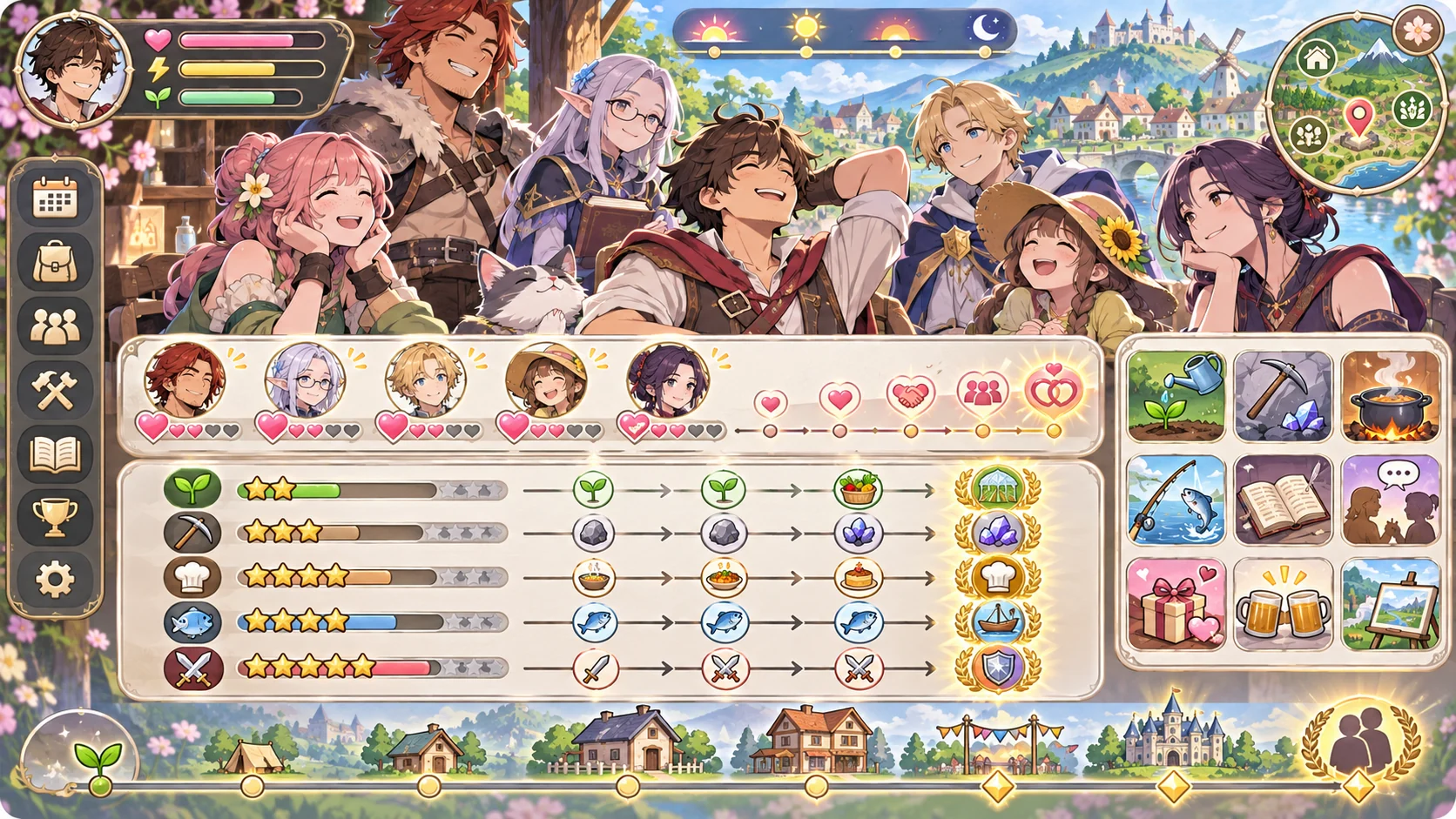
Relationship progression can use remembered conversations, trust or shared events, but the player should not have to guess what advanced it. State what actions matter, what feedback appears and whether relationships can decline. A forgiving first slice can preserve progress and let players revisit conversations without a hidden timer.
Prompt 3 — relationships and gradual growth
Define two original Riverglass residents with different interests and conversation styles. Create one relationship thread for each and one gradual skill or community milestone. For every milestone, list the player action, visible feedback and how progress is preserved after a pause. Avoid daily streaks and irreversible missed content. Treat thresholds as placeholders.
Keep one or two progression paths visible. More systems can be added after the player understands what each activity contributes. A status panel should summarize current goals in plain language, not only show abstract bars.
Let the neighborhood respond over time
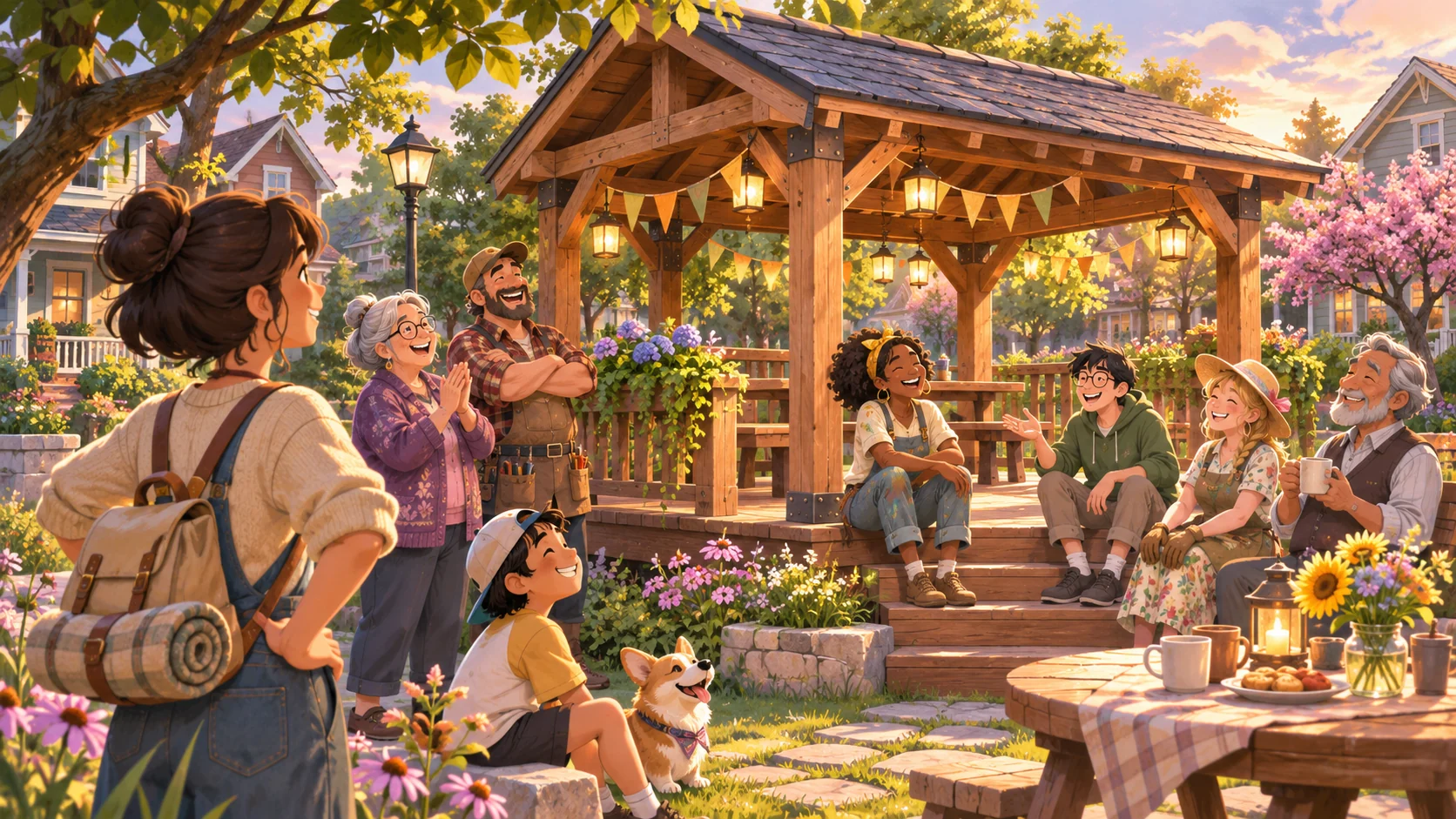
A shared place can give daily actions a visible result. A garden may gain a new stage, a notice board may show completed contributions or a gathering space may change after residents help. Define when those updates happen and what the player can observe. Do not imply that a generated image demonstrates an interactive state change.
Prompt 4 — community progression
Design one shared Riverglass community project that changes in three visible stages. Define what player actions contribute, what neighbors contribute as background flavor and when the next stage appears. Keep the player’s progress available after skipping a day. Show a short update explaining why the space changed. Do not claim the change is implemented until verified in a running build.
Request a focused playable day
Ask for a complete afternoon with one small map, two residents, three activities, a journal, visible relationship or community progress and a reset. Exclude housing decoration, shops, complex crafting, a full calendar and an open-ended economy from the first prototype.
Prompt 5 — prototype build
Build a first playable Riverglass afternoon. Include one neighborhood block, two residents, a daily activity planner, three activity choices, visible time cost, a journal, one relationship thread, one shared community project, pause/resume and end-of-day feedback. Use placeholder visuals and fictional values. At handoff, list working interactions, placeholders and what remains unverified. Do not present a static life-sim interface as playable.
A mock planner does not prove that time advances or relationships update. Open the actual result and verify activity choice, time cost, dialogue response, journal state, community stage, pause and resume. Riverglass was not built or tested for this article.
Fictional afternoon snapshot
This example is hypothetical and untested.
| Field | Fictional planning value |
|---|---|
| Working title | Riverglass |
| Map | One lakeside block with a cafe, garden and pavilion |
| Activity choices | Community event, garden task or cafe conversation |
| Progress threads | One resident relationship and one shared space |
| Recovery | Journal preserves goals when a day is skipped |
| First milestone | One afternoon, two residents and visible end-of-day feedback |
| Excluded | Housing system, full calendar, economy and large skill tree |
Review the output with observed evidence
Check whether an activity changes the state the prompt promised. Mark a visible decoration as visual-only unless an interaction changes it. Ask for a small repair when a resident’s response or shared-space state does not match the action.
Prompt 6 — implementation review
Review the running Riverglass prototype for activity choice, time cost, resident dialogue, relationship state, community project stage, journal persistence, pause/resume and end-of-day summary. Mark each present, missing or unclear from observed interactions. Quote evidence and suggest one focused fix. Do not claim a playtest unless one was conducted.
Conclusion
Life-simulation RPG prompts should connect a small day loop to character relationships and visible community progress. Riverglass illustrates one fictional neighborhood, but its systems remain unbuilt and untested. Request a narrow prototype, inspect the state changes and label anything that remains a mockup.
You can take a defined concept into the Free AI game maker, then compare it with the review checklist above.
FAQ
What should AI prompts for a life-simulation RPG include?
Define the daily loop, activity choices, time costs, character progression, community changes, pause behavior and first-build scope.
How can daily activities feel meaningfully different?
Give each activity a distinct purpose and visible response, such as a new conversation, a community contribution or an environment update.
How should relationship progress be communicated?
State which actions advance it and show the response in dialogue, a journal or a clear status update. Avoid hidden thresholds in the first prototype.
Can a life-sim use missed-day penalties?
It can, but a low-pressure design should make the consequence explicit. If the intent is forgiving play, preserve progress when the player skips a day.
Does an illustrated life-sim interface prove the systems work?
No. Verify activity costs, relationship changes, community stages and pause behavior in the actual output before claiming playability.