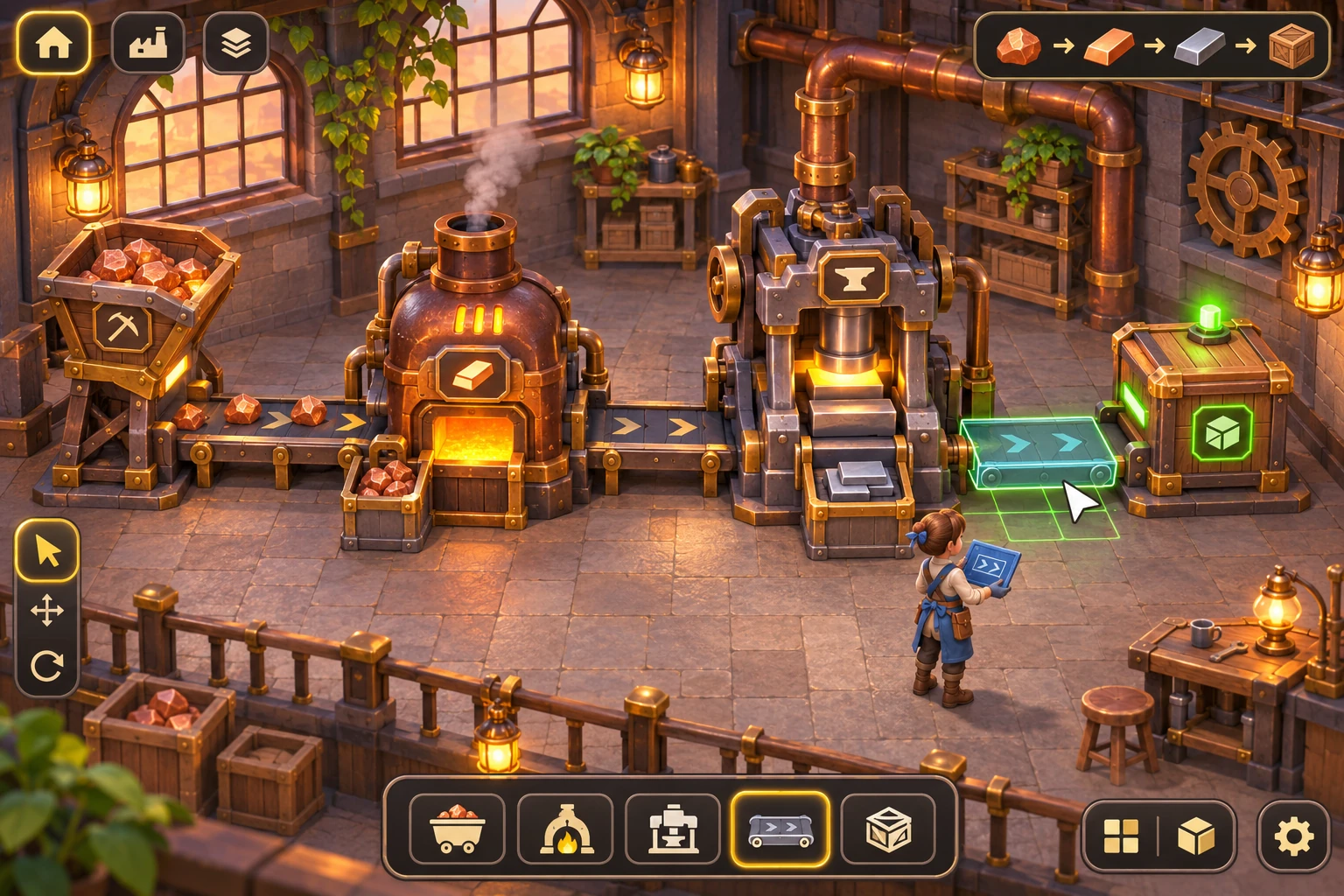
A farming-simulation prompt becomes easier to build when it fixes the day boundary before adding more crops. State what the player can do, when watering takes effect, what happens after a missed day, and when harvested goods become money. This guide turns those decisions into a small, reusable prompt sequence and a five-day crop ledger.
The example, Meadow Ledger, is an original fictional design resolved by hand from its written rules. The prompts below have not been run, and this package contains no playable build or observed crop behavior. Use the ledger as a specification to check against a future implementation, not as a report of a test.
Define one plot and daily actions
Start with a deliberately small state: one empty plot, one Turnip Seed, a watering can, no money, and five days of Spring. Each dawn restores three action points (AP). Planting, watering, and harvesting each cost one AP; leftover AP expires at the end of that day. The aim is to make one complete crop-to-sale loop legible before adding more plants, weather, or villagers.

That boundary gives a prompt concrete inputs and a visible first action. It also prevents an AI request from quietly inventing extra inventory or a larger farm while you are trying to decide how a single seed should work.
| Rule to name | Meadow Ledger contract | What to check |
|---|---|---|
| Starting state | Day 1, one empty active plot, one Turnip Seed, zero coins, empty market bin. | No crop or sale item appears before the player acts. |
| Daily budget | Three AP at dawn; planting, watering, and harvest cost one AP each. | AP resets each morning; unused points expire at day end. |
| Crop stages | The seed begins at stage 0; stage 3 is mature. | Watering does not make a sprout mature immediately. |
| Season boundary | Five Spring days; the day-five sale resolves before the season ends. | A mature crop can still be harvested on the final day. |
A useful first prompt asks for this starting state and action table before requesting art or extra systems. If its answer adds another seed, spends AP on an automatic sale, or omits what happens to unused AP, tighten the contract first.
Specify watering and growth stages
“Water crops to help them grow” leaves a timing gap: does the stage change at the instant of watering, at night, or at the next dawn? Give the game one clear phase order. In Meadow Ledger, watering sets a daily marker. At the next dawn, a non-mature crop that had that marker gains exactly one stage. A missed watering pauses progress without decay. Watering a mature crop has no effect.
| Phase | Rule | Visible state |
|---|---|---|
| Player action | Watering costs 1 AP and marks the planted, non-mature crop as watered today. | The crop stays at its current stage; a water marker appears. |
| Next dawn | If the previous-day marker is present, increase stage by 1, up to stage 3. | The crop advances once and the old marker clears. |
| Missed care | Without the marker, keep the current stage; do not decay or skip ahead. | The same sprout remains available to water later. |
| Mature crop | At stage 3, growth stops; watering does not change the crop. | The mature crop remains available for a harvest action. |
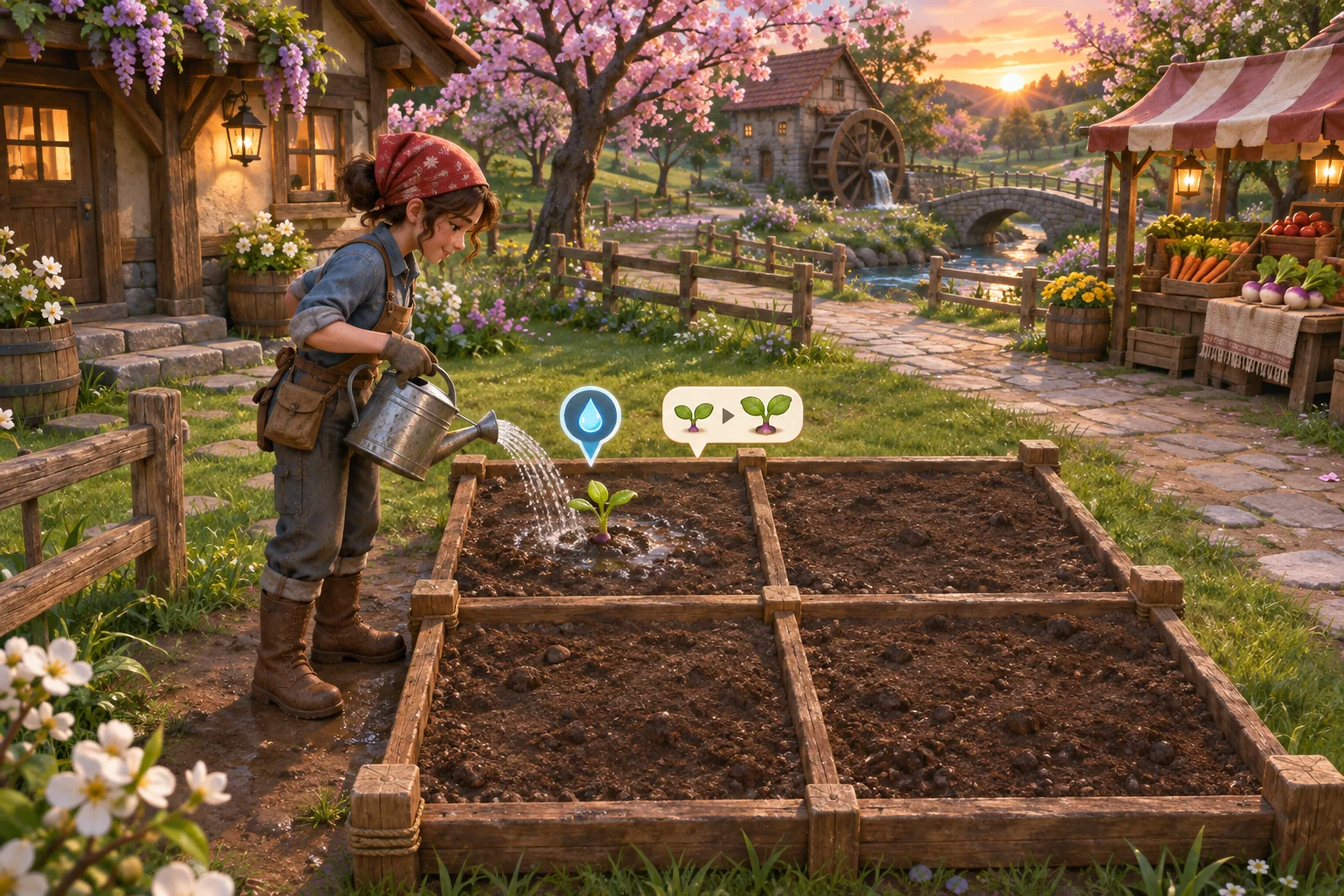
That separation makes an acceptance check possible: plant and water on day 1, then inspect the state at day 2 dawn. It should be stage 1, not stage 2. If the marker remains after dawn, the crop might advance twice on a later day; tell the prompt when to clear it.
Define one planted Turnip with growth stages 0, 1, 2, and 3.
Watering costs 1 of the player's 3 daily action points.
At dawn, a non-mature crop watered during the prior day gains exactly 1 stage.
If it was not watered, it stays at its current stage without decay.
Clear yesterday's water marker after dawn resolves.
At stage 3, mark the crop mature; watering it has no effect.
Return a phase table and a day-1/day-2 state trace. Do not add weather,
fertilizer, extra crops, or instant growth. Check that watering never
changes the stage in the same moment it is performed.
This is an authored prompt template for a future design task. It has not been executed for Meadow Ledger.
Prompt harvest and the day-end sale
Harvest and sale are separate events. Harvesting a mature crop costs one AP, removes the crop from the plot, and places two Turnips in a market bin. The stall automatically sells every Turnip in that bin at day end for two coins apiece. The sale costs no AP. Keeping these steps separate prevents money from appearing as soon as the player harvests.
| When | Action or automatic rule | Result |
|---|---|---|
| Before maturity | Harvest is unavailable until stage 3. | The crop remains in the plot. |
| Player harvest | Spend 1 AP on a mature crop. | Remove the crop and add 2 Turnips to the market bin. |
| Day end | Sell each Turnip for 2 coins; no AP is spent. | Two Turnips yield 4 coins and the bin clears. |
| Spring day 5 | Resolve the ordinary day-end sale before ending the season. | A final-day harvest can still convert to coins. |
The price and yield are design inputs for this fictional exercise, not market data or a claim about a farming game. If you change either value, update the prompt, example ledger, result image, and expected totals together.
Hand-resolve the Turnip cycle
Apply the rules in order instead of relying on a general statement that the crop “takes four days.” Each dawn checks the prior day’s water marker; the player then spends AP; the sale runs at day end. In the on-time route, the seed is planted and watered on day 1, watered after the day-2 and day-3 dawn advances, then harvested after it reaches stage 3 on day 4.
| Day | Dawn and player actions | Day-end state |
|---|---|---|
| 1 | Start with 3 AP. Plant (2 remain), then water (1 remains). The crop begins at stage 0. | Stage 0; marked watered; 0 coins. |
| 2 | Dawn advances to stage 1. Water (2 AP remain). | Stage 1; marked watered; 0 coins. |
| 3 | Dawn advances to stage 2. Water (2 AP remain). | Stage 2; marked watered; 0 coins. |
| 4 | Dawn advances to mature stage 3. Harvest (2 AP remain), adding 2 Turnips to the bin. | Day-end sale pays 2 × 2 = 4 coins; plot and bin are empty. |
| 5 | The regular day-end sale runs before the season boundary. | Spring ends with 4 coins. |
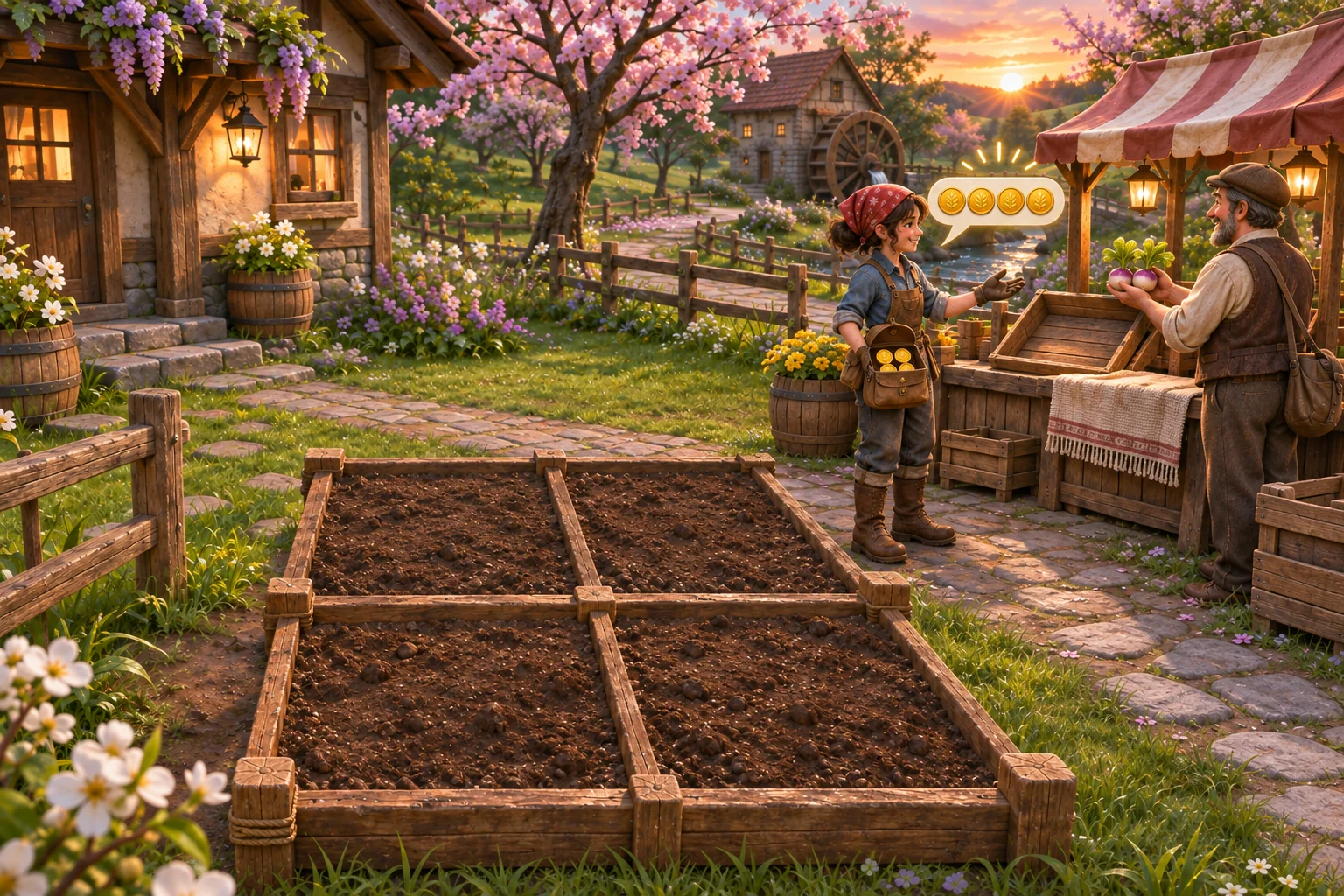
The arithmetic is small on purpose: two harvested Turnips × two coins each = four coins. The image is an authored gameplay concept illustrating that expected state; it is not a product screenshot or evidence that a crop or sale system ran.
Check a missed-water day before expanding
A second route tests what the rules mean when the player skips an action. If day 2 watering is missed, the crop reaches stage 1 at that dawn and stays at stage 1 at day 3 dawn. Watering on days 3 and 4 advances it at the day-4 and day-5 dawns. It reaches stage 3 on day 5, when the player can spend one AP to harvest; the regular day-end sale then pays four coins before Spring ends.
This route checks recovery without adding a hidden penalty. A different game may choose withering, a quality loss, or a time limit, but each choice needs a stated trigger and a visible consequence. Do not mix those alternatives into this first crop contract.
- Skipped care: after no day-2 water, stage remains 1 on day 3; it does not decay or advance.
- Resumed care: watering on days 3 and 4 produces stage 2 on day 4 and stage 3 on day 5.
- Final-day timing: day-5 harvest is available before day-end; sale resolves before the season ends.
- One-time payment: harvesting adds exactly two Turnips; sale clears the bin and adds exactly four coins once.
- Restart: return to day 1, 3 AP, one seed, one empty plot, zero coins, and an empty bin.
These are paper acceptance cases derived from the written rules. A future build should be checked by recording its starting state, action, expected result, and observed result separately. No such build check or player session is claimed here.
Write a staged crop prompt kit
Do not ask one oversized prompt to invent the whole farming game. Separate the rules into prompts whose outputs can be checked in sequence. The following four templates are original and currently unrun. Each asks for a state trace or acceptance checks, not just a description of the intended mood.
- Crop-loop contract: request one five-day Spring, one active empty plot, one seed, three AP at dawn, the three one-AP actions, stage 0 through stage 3, and a day-end market. Ask for a starting-state table and success conditions.
- Dawn and watering: define “watered yesterday means +1 stage at dawn; missed water means pause without decay.” Require the marker-clear timing and restart state, then check day-1 planting and day-2 growth.
- Harvest and sale: require stage-3 harvest only, 1 AP, yield of two Turnips, a market bin, automatic sale for two coins each, and day-5 sale-before-season-end. Ask for day-4 and day-5 payout traces.
- Missed-day acceptance: skip day-2 watering, resume on days 3 and 4, and request the day-3 stage, day-5 maturity, final sale, bin clear, payment count, and restart values.
If a response changes the action cost or phase order, treat that as a proposed design change and recalculate every affected row before accepting it. The contract, tables, and result visual must describe the same version of the rules.
Take the crop brief to a creation workspace
The official Free AI Game Maker page describes entering a game idea in plain English, testing a playable first version in the browser, and refining it with follow-up prompts. Before submitting, its guidance asks creators to check the selected AI model, available Koin balance, and displayed generation cost. These details describe a general creation workflow; they do not establish that a farming simulation, Turnip growth rule, or Meadow Ledger will be generated. Comparing any future output with this written crop contract is this article's recommendation, not a product guarantee.
Carry over the small crop contract, ask for the stage and day-phase rules to be visible, and compare any future result with the day-2 and missed-water traces. If the result grows instantly, advances twice, sells before day end, or loses the crop after a missed day, name that exact mismatch in the next revision request. Keep adding systems only after the one-plot loop can be inspected and corrected.
To shape your own compact farming concept and review a creation workflow, start with the Free AI game maker and bring the action, phase, and expected-state checks with you.
Start with one complete crop loop
A reliable first slice is not a huge field. It is one seed, a stated watering condition, a predictable dawn transition, a harvest action, and a sale boundary you can calculate. Write those rules first, trace both the on-time and missed-water routes, then compare any actual future build against the same states. Meadow Ledger is only a fictional teaching design; the value here is the checkable contract you can adapt for your own game.
Frequently asked questions
What should a farming simulation game prompt define first?
Start with one active plot, one seed, the daily action budget, action costs, phase order, crop stages, and the sale rule. Ask for a starting-state table and one short trace. Keep weather, extra crops, villagers, and upgrades out until you can explain the first crop loop without guessing what happens at dawn or day end.
When should a crop grow after watering?
Choose one explicit transition. Meadow Ledger marks the crop as watered today and increases its stage by one at the next dawn, up to stage 3. The stage does not change at the instant of watering. This timing is an invented rule for the example, not a universal farming-game convention.
What happens if the player misses a watering day?
In this example, growth pauses at the current stage without decay. Watering on later days resumes progress at later dawns, so a missed day 2 still allows maturity on day 5. If your game instead uses withering or a quality penalty, state its trigger, effect, and recovery path explicitly.
How do harvest and crop sales work in the example?
A stage-3 crop can be harvested for 1 AP, which removes it and places two Turnips in the market bin. At day end, each sells for two coins without spending AP. That produces four coins once, and the day-five sale happens before Spring ends. These values are fictional design inputs.
Does this package include a prompt run or playable build?
No. Meadow Ledger and its crop rules are an original fictional design resolved by hand. The prompt templates are unrun, and no playable build, player session, or observed crop behavior is included. The tables and concepts give you states to check in a future implementation; they do not claim that the rules have already worked in software.