Answer first: tie the clue to a catch rule
A fishing-adventure prompt becomes easier to inspect when it connects one place clue to one cast condition, one readable fish response, and one reward for bringing the catch home. Start with a short trip instead of a large species list: tell the player where to go, what depth to cast at, how the hooked fish changes state, and what the catch earns.
Brinebell Cove is an invented teaching example. Its dock, inlet, Lantern Trout, action rules, and Brass rewards are fictional. The four prompt templates below are authored but were not run for this package; the hand-resolved route is a simulation, not a playable build or test result.
The small loop is Dock → Reed Inlet → Dock. A map note points to a Lantern Trout at midwater. One successful delivery buys a local rod upgrade. That gives the prompt a useful spine: a clue sends the player somewhere, a deliberate action starts the fishing state, and a delivered catch pays for a defined next-trip improvement.
Prompt a shoreline route and readable clue
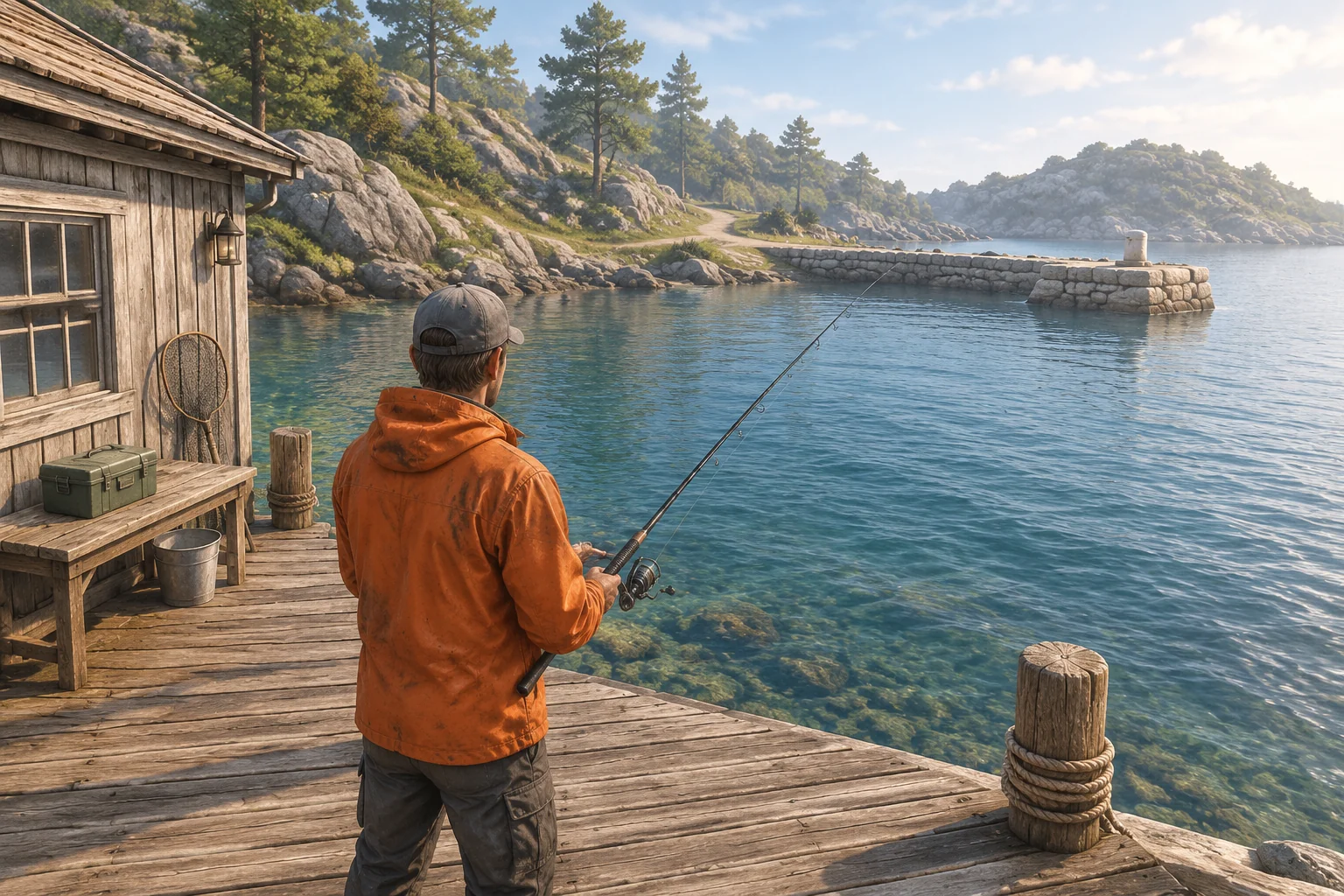
Keep the first map legible. The player starts at Driftwood Dock and sees Reed Inlet along a walkable shoreline. A note names the target and depth, so the clue guides exploration without turning the trip into a hidden-object puzzle. Traveling from either location to the other costs one exploration action; there are no branches or day timer.

Prompt 1: define the trip and its clue
Design a fictional single-player fishing-adventure slice called Brinebell Cove. Start the player at Driftwood Dock with a Wooden Rod, 3 bait, one empty catch slot, 0 Brass tokens, and a map note that points to Lantern Trout at Reed Inlet in midwater. Use only the fixed route Dock to Reed Inlet to Dock. Moving between the dock and inlet costs one exploration action. The goal is to catch one Lantern Trout, return it to the request board, and buy a Reinforced Rod. Keep the route walkable and the location clue visible. Return the starting state, locations, goal, and any rule that still needs a decision. Do not add more fish, route branches, narrative-object puzzles, multiplayer tools, or permanent account progression.Check that the location note names both the inlet and midwater. If a generated plan adds a second destination or makes the clue depend on rearranging objects, remove that scope before writing fishing rules.
Define the cast, bite, and line states
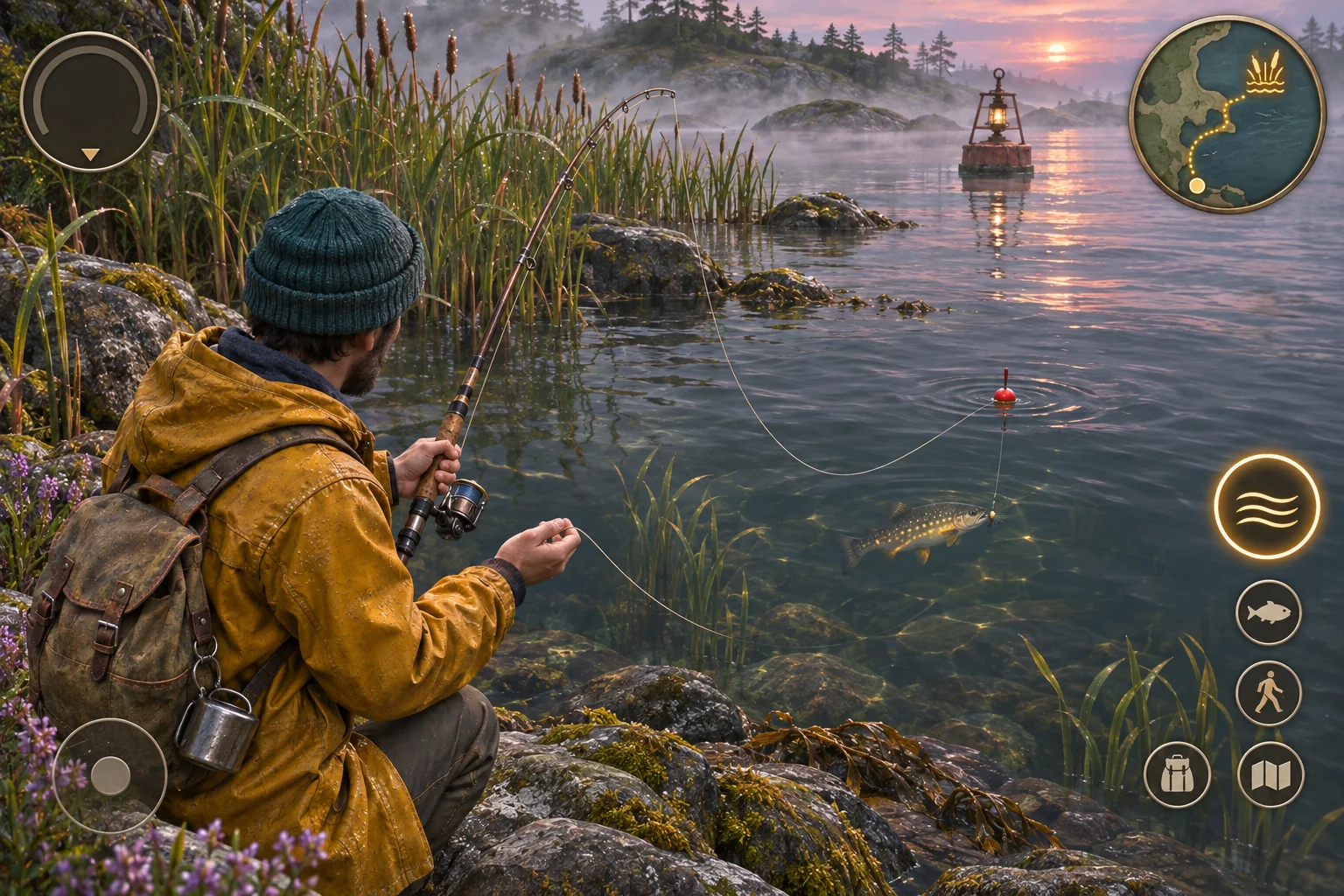
Separate the cost of casting from the condition that produces a bite. Any cast spends one bait. A cast at Reed Inlet and midwater places the float, but the fish does not bite until the player uses one Wait action. A cast at the wrong depth also spends bait, but cannot produce a bite in this slice. There is no random catch roll, so the prompt can be checked against a specific expected state.
When the Lantern Trout bites, start at Pull with catch progress 0/2 and line tension 1. Each fish action resolves before the phase changes. A Slack action during Pull reduces tension by one, to a minimum of zero, and adds no catch progress. A Reel action during Pull adds two tension and no progress. During Rest, Reel adds one progress and lowers tension by one, while Slack lowers tension by one without progress. The Wooden Rod snaps if tension reaches 3. Reaching progress 2/2 lands the fish immediately and ends the minigame.
| Current phase | Player action | State change | Next step |
|---|---|---|---|
| Pull | Slack | Tension −1, floor 0; no progress. | Switch to Rest if the rod holds. |
| Pull | Reel | Tension +2; no progress. | Snap the line if tension reaches 3; otherwise switch to Rest. |
| Rest | Reel | Progress +1; tension −1, floor 0. | Catch immediately at 2/2; otherwise switch to Pull. |
| Rest | Slack | Tension −1, floor 0; no progress. | Switch to Pull. |
Prompt 2: make a cast and bite deterministic
For the Brinebell Cove slice, every cast spends exactly 1 bait. A cast at Reed Inlet at midwater places the float but does not cause an immediate bite; one Wait action at that correct location and depth starts the Lantern Trout bite. A cast at any other depth spends its bait and gets no bite. The bite begins at Pull with progress 0/2 and tension 1. Return the player-visible feedback for a correct cast, wrong-depth cast, and Wait. Do not add random bite chances or return spent bait silently.Prompt 3: specify Pull, Rest, and line failure
Use this exact fish state machine: start at Pull, progress 0/2, tension 1. Resolve the player's action first, then check line failure or catch, then switch Pull to Rest or Rest to Pull only if the minigame is still active. During Pull, Slack lowers tension by 1 to a minimum of 0 and adds no progress; Reel adds 2 tension and no progress. During Rest, Reel adds 1 progress and lowers tension by 1 to a minimum of 0; Slack lowers tension by 1 and adds no progress. The Wooden Rod snaps when tension reaches 3; the fish escapes and the spent bait stays spent. Progress 2/2 lands the fish immediately and ends the minigame. Show the state after each action and identify any rule conflict. Do not add randomness, extra line actions, or a timer.This action order removes a common ambiguity: “the fish alternates” does not say which phase starts or whether the player's choice happens before a phase switch. Here, the first action is always resolved in Pull; only then does a non-terminal state change to Rest. The example is a simulated specification refinement, not an observed software change.
Hand-resolve one safe catch and one failure
Apply the rule table without adding hidden rolls. The safe route spends one bait, then uses Slack in Pull and Reel in Rest twice. Tension remains at zero while progress advances in the two Rest windows. A single Reel during the opening Pull is the contrast case: tension jumps from 1 to 3 and the line snaps before the phase can switch.
| Step | Action and expected feedback | State after action |
|---|---|---|
| Start | Read the note and choose the fixed route. | Dock; rod limit 3; bait 3; slot empty; Brass 0. |
| 1 | Travel to Reed Inlet. | Inlet; clue confirms midwater; bait 3. |
| 2 | Cast at midwater. | Bait 2; float placed; no bite until Wait. |
| 3 | Wait. | Lantern Trout bites; Pull; progress 0/2; tension 1. |
| 4 | Slack during Pull. | Tension 0; progress 0/2; line intact; phase Rest. |
| 5 | Reel during Rest. | Tension 0; progress 1/2; phase Pull. |
| 6 | Slack during Pull. | Tension 0; progress 1/2; phase Rest. |
| 7 | Reel during Rest. | Progress 2/2; fish caught; slot filled; minigame ends. |
| 8 | Return to Dock. | Dock; catch still in slot; Brass 0. |
| 9 | Turn in one trout at the request board. | Slot empty; Brass 2. |
| 10 | Buy the Reinforced Rod. | Rod limit 4; bait 2; Brass 0; ready for another trip. |
The counts are hand-checked: the cast spends one bait, the catch occupies one slot, and the turn-in grants two tokens once. The purchase spends those two tokens once and changes only the rod limit from 3 to 4. Restarting the scenario restores the Wooden Rod, 3 bait, empty slot, 0 tokens, and the same map note. These are authored expected values, not a measured game result.
Reward the catch with a bounded upgrade
Keep delivery and purchase as separate dock actions so the reward has an auditable cause. A turn-in trades one Lantern Trout for two Brass and empties the one-item catch slot. Buying the Reinforced Rod costs two Brass and raises the tension limit from 3 to 4; the example changes no other stat. The upgrade applies to another trip in the current save. It is not a permanent account reward or a cross-run progression system.

Prompt 4: make the reward bounded
At Driftwood Dock, one turn-in action trades the one Lantern Trout in the catch slot for exactly 2 Brass tokens and clears the slot. A separate purchase interaction buys one Reinforced Rod for exactly 2 Brass and raises the line-tension limit from 3 to 4. Do not change bait, catch capacity, or any other stat during purchase. This is a local next-trip upgrade in the current save, not a permanent cross-account reward. Restarting the scenario returns to Dock with the Wooden Rod, 3 bait, empty catch slot, 0 Brass, and the original map note. Return each state before and after turn-in, purchase, and restart so the costs can be checked.The ledger is useful because a visual “upgrade” can hide a double payment or leftover reward. Check the slot and Brass both before and after each dock action; then compare the restart state with the initial loadout.
Check the prompt before adding fish species
Use the authored state table as a future acceptance checklist. If a real build becomes available later, compare each observed result with these expectations and record what action caused a mismatch. Until that happens, these remain planned checks rather than passed tests.
| Check | Expected result | Why it matters |
|---|---|---|
| Wrong depth | Bait is spent; no bite starts. | Prevents a clue from silently becoming a free catch. |
| Correct cast | Float appears; the fish bites only after Wait. | Separates casting from the bite trigger. |
| Opening Pull | Starts at progress 0/2 and tension 1. | Gives the first Reel/Slack choice a known baseline. |
| Pull/Reel | Tension reaches 3; line snaps and bait stays spent. | Confirms failure threshold and terminal order. |
| Safe Rest/Reel | Progress increases by one; catch lands at 2/2. | Checks that progress cannot overshoot or continue after catch. |
| Full catch slot | No second fish can be stored until turn-in clears the slot. | Protects the one-item inventory contract. |
| Repeated turn-in | A cleared slot cannot award Brass a second time. | Prevents duplicate payouts. |
| Restart | Restores the exact original state. | Keeps the upgrade local to the current save and next trip. |
Only after those states are clear should a prompt add another fish, depth, route, or rod. More content multiplies decisions; it does not repair a loop whose cost, phase order, or reward is still ambiguous.
Take the trip brief to a creation workspace
Once the loop fits on one page, use it as input for your own game idea: state the route, first cast, bite condition, and one player-facing result. SEELE's current Free AI game maker page describes a general workflow: explain an idea in plain English, review a playable 2D or 3D result, and iterate in Workspace. Before submitting, it asks creators to review the selected AI model, available Koin balance, and displayed generation cost. Its guidance also includes testing a finished build on target devices before sharing.
Those statements describe a broad creation and review process; they do not establish that Brinebell Cove or its fishing rules have been implemented. If you use a creation workspace for your own idea, inspect the cast trigger and every Pull/Rest transition instead of assuming a detailed prompt guarantees the desired behavior.
Start with a trip you can inspect
A small fishing adventure can start with one visible clue, one meaningful cast, a fish state the player can read, and a reward earned by returning home. Define where the bite begins, how tension changes, what ends the catch, and how the upgrade is paid for. Then compare any future build with the expected values instead of treating a prompt as proof.
Bring your own route and catch rule to a creation workspace when you're ready to shape a first version. Keep the first trip narrow enough that each action and reward can be checked.
Fishing adventure prompt FAQ
What should a fishing adventure prompt define first?
Begin with the trip goal, the location clue, and the condition that starts a bite. Then state what casting costs, which actions the player can take after a bite, and what counts as a catch. A small, explicit loop is easier to reason through than a long list of fish whose locations, reactions, and rewards are not connected.
How does a location clue help the fishing loop?
A useful clue narrows the next decision without replacing it. In the fictional Brinebell example, the map note points to Reed Inlet and midwater, so the player can choose a meaningful destination and cast depth. The clue does not guarantee a catch: the player still spends bait, casts, waits for the bite, and responds to the fish's phase.
What does line tension mean in this example?
Line tension is an invented state value that makes Reel and Slack choices consequential. The Wooden Rod begins at tension 1 with a limit of 3; an opening Reel during Pull raises it to the snap threshold. Slack during Pull lowers tension without progress, while Reel during Rest advances the catch. These are example rules, not a claim about real fishing equipment.
How is the rod upgrade earned?
The player first catches one Lantern Trout and carries it to Driftwood Dock. One turn-in action trades that fish for two Brass and clears the single catch slot. A separate purchase spends both tokens for a Reinforced Rod that raises the fictional tension limit from 3 to 4. The example does not include a permanent account reward or other stat changes.
Were these prompts run, or is there a playable build?
No. The four prompts are author-created templates that were not run for this package, and Brinebell Cove is a fictional, hand-resolved design example. The arithmetic shows what the rules predict; it is not a playtest or measured result. A later real build would need to be checked against the listed states before anyone could describe its behavior as observed.