Start with one shared state model
A grand-strategy prototype can become hard to reason about before the first turn if every system has its own timing and values. Begin with one goal, a small map, and a few shared variables. Then make each action change those same values in a predictable order. A prompt should explain not only what a button does, but when its cost is paid and which later checks read the updated state.
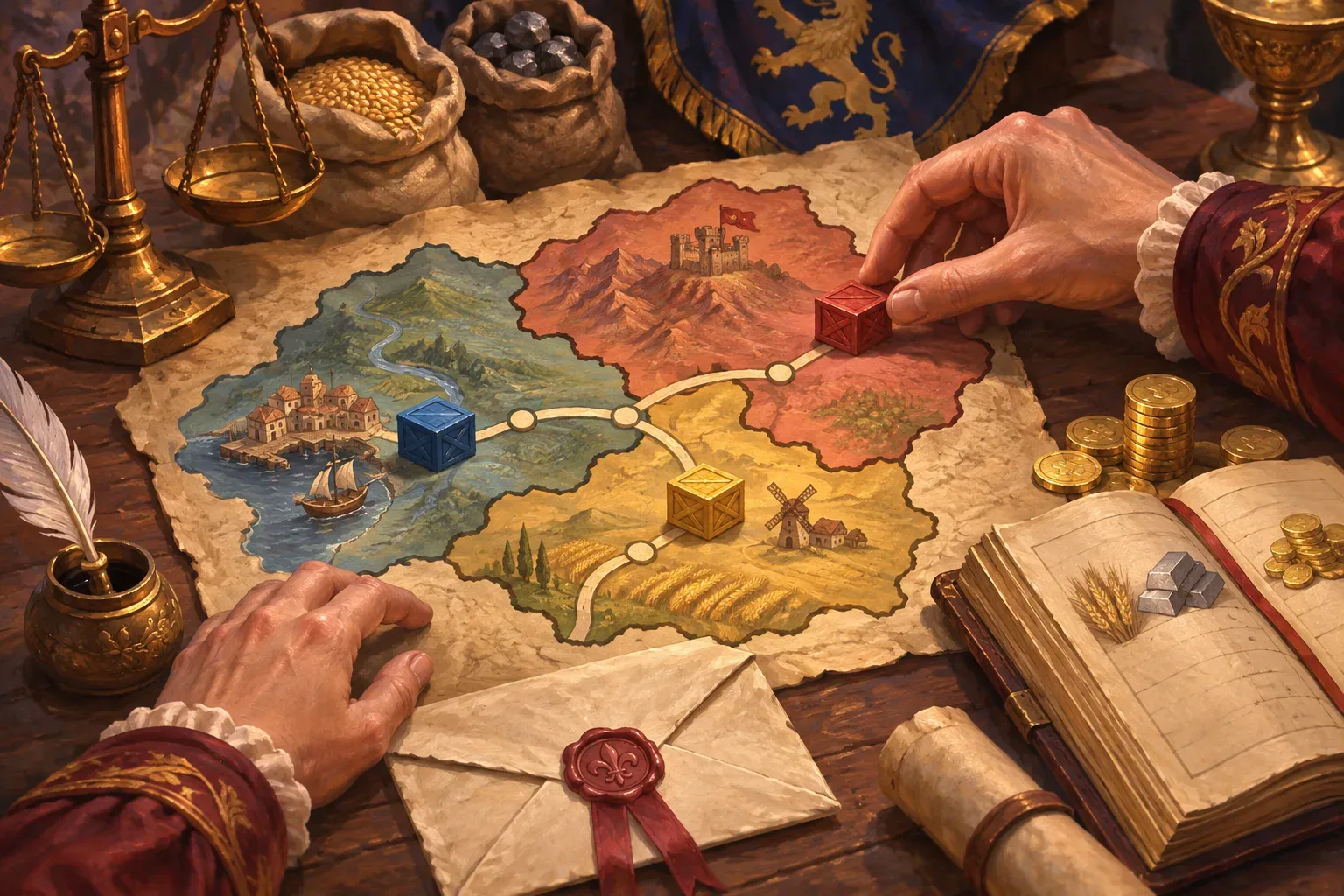
This fictional example uses three provinces: Alder Coast, Iron Vale, and Lantern March. The player starts with Alder Coast, the rival holds Iron Vale, and Lantern March is neutral. The player has three turns to control at least two provinces while keeping legitimacy above zero. Track treasury, legitimacy, supply readiness, and province control. These rules illustrate prompt design only; they are not a tested strategy game.

Small scope matters because strategy games have many interlocking rules. For this first slice, leave battles, research, random events, additional factions, and long-term population growth out. A player should be able to read the map, choose one action, and see how that action changes the next decision. If the basic turn cannot be traced on paper, adding another subsystem will make its failure harder to locate.
Write down the initial state before asking a builder for interface or content. The example starts with treasury 5, legitimacy 4, and supply readiness 2. Provinces also have an owner. These starting values are fictional and selected to make a short trace possible, not to represent historical or balanced values.
Connect political and economic actions to visible costs
Use a compact action set. Tax adds 2 treasury and removes 1 legitimacy. Provision spends 2 treasury and adds 1 supply readiness. Negotiate spends 1 treasury and adds 1 legitimacy if the target province is not controlled by the rival. Keep the exact numbers in a single rules record or table so they do not drift across prompts.
| Action | Cost | Effect | Limit |
|---|---|---|---|
| Tax | None | +2 treasury, −1 legitimacy | One action per turn |
| Provision | 2 treasury | +1 supply readiness | Supply readiness cannot exceed 4 |
| Negotiate | 1 treasury | +1 legitimacy when eligible | Rival-controlled province is ineligible |
One action should not have several hidden interpretations. Tax is not a permanent income increase in this slice; it changes treasury immediately and legitimacy decreases once. Provision affects the shared supply readiness value, not every province independently. Negotiation has both a treasury cost and a political outcome. If the target is controlled by the rival, the action is invalid and no cost or legitimacy change occurs. State invalid-action behavior explicitly.
Give each action a stable ID and record its before-and-after values. That makes it easier to spot whether a generated turn applied the cost twice or used a stale value. Also set sensible minimums and caps. Treasury and legitimacy cannot fall below zero; supply readiness stops at 4. If an action would go below zero, require the game to reject it or explain the chosen failure rule instead of silently creating debt.

Set a fixed turn order
Turn order determines which state later rules see. In this example, queue one player action, then resolve it at the end of the turn. Apply the action’s cost and effect, apply provincial upkeep, resolve the rival’s fixed move, and finally run the control check. Print the relevant values before and after each step. Do not mix the action choice with end-of-turn effects in a single unexplained result.
A province changes control only when supply readiness is at least 2 and the player has negotiated in that province during the current or previous turn. If the rival owns the target, negotiation cannot transfer it. This threshold encourages the player to prepare logistics before attempting to expand, while the turn window prevents a forgotten negotiation flag from lasting forever.
Ask the builder to store a `lastNegotiatedTurn` value by province and a supply readiness value in the shared state. At control check, compare the target province’s flag to the current turn. If the negotiation occurred one turn ago, it remains eligible; if it is older, clear the opportunity. Keep ownership changes separate from legitimacy changes so a failed control check does not accidentally award a province.
For the first prototype, make the rival’s move deterministic. It can hold its current province and reduce the player’s supply readiness by one on Turn 2. Random rival decisions may later add replay value, but deterministic behavior makes the initial acceptance trace reproducible. The prompt should say whether the rival acts before or after the player’s state changes. Here it acts after the player action and upkeep, as listed in the turn order.
Trace a three-turn plan
A short trace shows how systems connect. The player begins with Alder Coast, while the rival controls Iron Vale and Lantern March is neutral. On Turn 1, Tax raises treasury from 5 to 7 and legitimacy falls from 4 to 3. On Turn 2, Provision costs 2 treasury, raises supply readiness from 2 to 3, and the rival’s fixed action lowers it to 2. On Turn 3, Negotiate targets Lantern March, costs 1 treasury, and raises legitimacy by one because the rival does not own that province. At control check, supply is still at least 2 and negotiation is current, so the player reaches the two-province goal.
This is an expected fictional trace calculated from the stated rules, not an observed game result. Show the values at each step rather than only printing “success”:
| Turn | Action | Treasury | Legitimacy | Supply | Control after check |
|---|---|---|---|---|---|
| Start | — | 5 | 4 | 2 | Alder Coast |
| 1 | Tax | 7 | 3 | 2 | Alder Coast |
| 2 | Provision; rival reduces supply by 1 | 5 | 3 | 2 | Alder Coast |
| 3 | Negotiate Lantern March | 4 | 4 | 2 | Alder Coast, Lantern March |
Use the trace as a prompt acceptance target. Ask the builder to output the selected action, action cost, rival action, upkeep, each state variable, province owners, and victory check for all three turns. Then compare an actual run with the expected values. This package does not include that run: the prompts are drafts, and no playable build or test results were provided.
Check state transitions before adding more systems
Build the first pass in layers. Start with the three-province map and initial ownership. Add the shared variables, then implement each action’s cost and effect. Add turn resolution and control checks after the actions work individually. Finally request the trace and edge cases. Reuse province IDs and variable names across every prompt.
- Confirm there are three provinces and the starting owners match the brief.
- Check that the player chooses exactly one action per turn.
- Verify Tax adds 2 treasury and removes 1 legitimacy exactly once.
- Verify Provision spends 2 treasury and adds 1 supply, subject to the cap.
- Reject Negotiation against a rival-controlled province without applying its cost or effect.
- Resolve player action, upkeep, rival move, and control check in the stated order.
- Test zero treasury, zero legitimacy, supply below 2, and an expired negotiation flag.
If an output is wrong, revise the smallest relevant prompt. If Tax adds recurring income, specify that its effect is immediate only. If a control flag persists indefinitely, restate the current-or-previous-turn window. If the rival moves before the player action, quote the explicit resolution order. Keep expected and observed state in separate records when you run the prompts in a builder.
SEELE’s AI RPG Maker overview gives general context for choosing an RPG goal, scene, quest, and consequential player choice. It does not document the fictional economy or province-control rules here. Treat the page as broad prompt-planning context and validate any generated behavior in your own prototype.
FAQ
What should a grand-strategy prototype prompt define first?
Start with one player goal, a small map, a short turn structure, and only a few connected state variables. Explain which actions change those variables and what ends the scenario.
How do I keep political and economic rules connected?
Name the cause-and-effect chain. For example, a tax action changes treasury and legitimacy, while a supply action changes provincial readiness and may affect control at turn end.
How many factions should a first grand-strategy prototype include?
Use one player faction and a small number of neighboring factions or provinces. A limited map makes turn order and state changes easier to trace before diplomacy or expansion grows.
Should every grand-strategy action resolve immediately?
Choose a fixed timing model and use it consistently. This example queues player actions, then resolves upkeep and control checks at turn end so the same inputs produce a traceable result.
Were these grand-strategy prompts tested in a playable build?
No. The state model and scenario are fictional planning material. The prompts are unrun drafts and no playable build or test results are included.