Define a two-crew work loop
A lawn-care business game can include hiring, route planning, equipment, weather, customer ratings, and seasonal contracts. A broad prompt that asks for all of those systems at once often produces a theme without a testable operating loop. Start with a small service area and define what each crew can do in a day, which jobs are available, and how the schedule changes when the weather blocks one type of work.
This fictional example is called Maple & Moss. It has two crews, North and South, and begins with eight coins. Each crew can complete one contract per day. Contracts are tied to neighborhoods, and the player assigns a crew to each job before the workday begins. The first slice covers three days and uses three contract types: mowing, edging, and leaf collection. These rules are illustrative only; the prompts have not been run and there is no playable business simulation in this package.
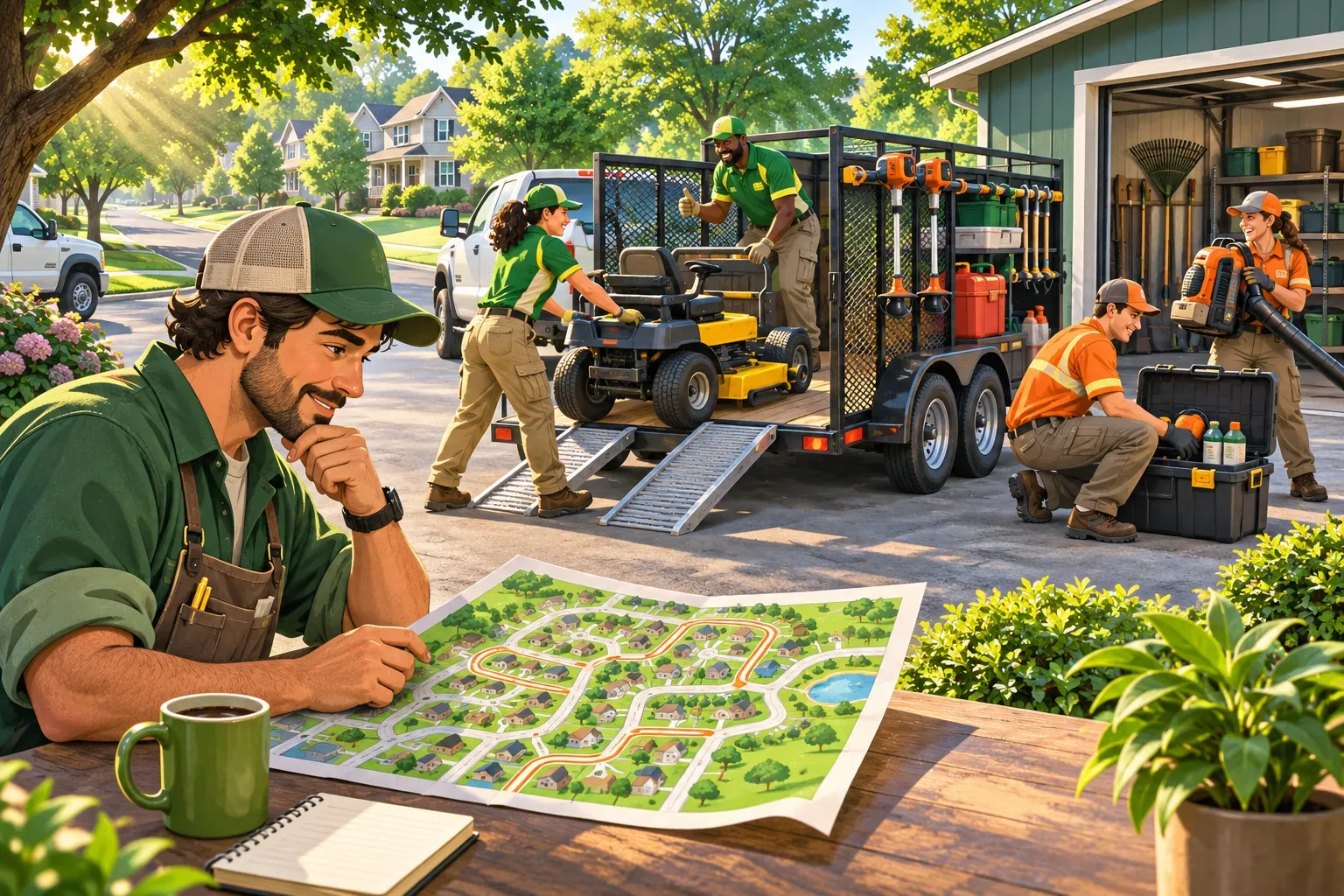
Keep hiring, vehicle maintenance, random customer events, and seasonal demand outside the first milestone. Focus on a dispatch loop: review contracts, assign crews to route locations, check equipment, resolve the day, receive payments, and decide whether to buy an attachment. The player should be able to see why a job is unavailable before committing a crew.
Use stable names for crews, neighborhoods, contract types, and equipment. In the example, Cedar Court has a mow contract, Fern Walk has an edging contract, and Maple Square has a leaf-collection contract. Each completed contract pays a fixed amount and adds one satisfaction point. A fixed ledger makes it easier to inspect the effects of schedule and equipment rules.
Connect contracts to equipment compatibility
Each contract should list its required equipment, payment, and customer effect. Mow Cedar Court requires a mower and pays four coins. Edge Fern Walk requires a trimmer and pays three coins. Collect Maple Leaves requires a collector attachment, pays five coins, and cannot be accepted until the attachment is installed. This equipment change unlocks a service type; it does not increase fuel capacity or simply make all work faster.
The collector attachment costs four coins. It can be installed at the depot between workdays. The player starts with a mower and trimmer but no collector. That means the first day’s ordinary services can fund the upgrade, while leaf collection remains unavailable until the next dispatch. A prompt should show the purchase cost and installation timing before the player chooses whether to spend.
{
  "contractId": "collect_maple_leaves",
  "neighborhood": "maple_square",
  "requiredEquipment": "leaf_collector",
  "payout": 5,
  "satisfactionGain": 1
}
Keep ownership separate from installation. Buying the attachment adds it to the company inventory; installing it at the depot makes it available to a crew on the next workday. If a crew is dispatched before installation, reject the leaf job and leave coins, schedule, and satisfaction unchanged. A clear validation rule is more helpful than a vague “equipment needed” notice after the day has resolved.
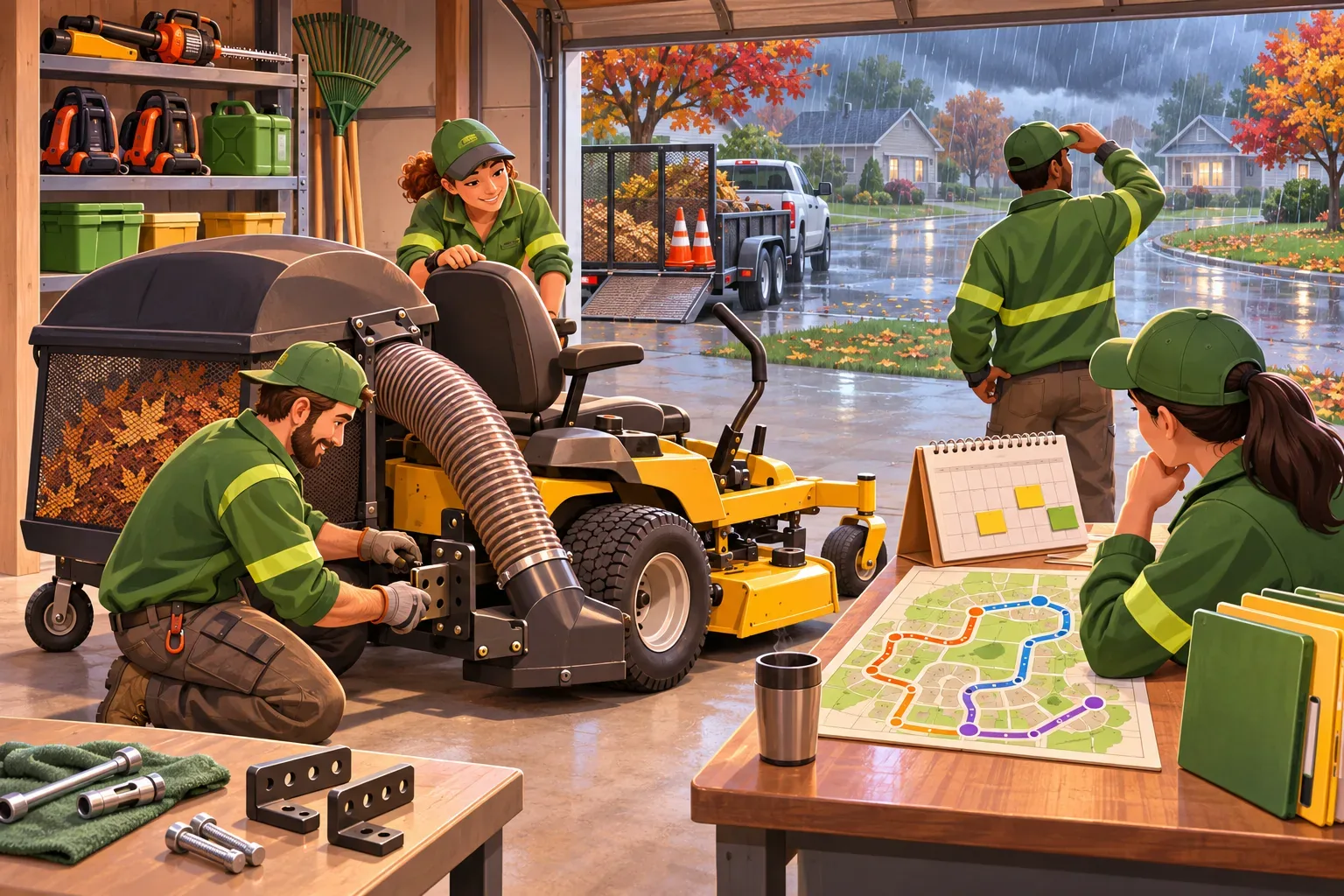
For the first version, give each crew one contract per day and one route location. The route assignment still matters because the neighborhood determines which contract appears in the schedule and whether its equipment requirement is met. Do not let two crews claim the same contract unless the rules explicitly allow shared work. If the player tries to assign the same job twice, preserve one valid assignment and explain the conflict.
Set weather and dispatch rules
Use deterministic weather before adding random forecasts. Day 2 is rainy. Mowing cannot be completed that day, while edging and leaf collection remain allowed. This creates a scheduling decision: both crews can still work if they are assigned compatible contracts, but a mow assignment must be rejected or moved to another day.
Resolve each workday in a fixed order: show forecast, display available contracts, assign crews, validate service/equipment/weather requirements, complete valid contracts, apply payments and satisfaction, then move to the next day. Validate every assignment before changing state. If a job fails validation, it should not consume a route slot, charge a fee, pay the company, or add satisfaction.
Keep the rain rule narrow. It blocks mowing only. It does not cancel edging or leaf collection in this example. If a crew’s job is blocked, the player may reassign that crew to an available contract before the day starts. Do not quietly replace the job after the schedule is locked; that would make the resulting payment difficult to explain.
Trace a three-day schedule
Start with eight coins and no leaf collector. On Day 1, North completes Mow Cedar Court for four coins, and South completes Edge Fern Walk for three. The company now has fifteen coins and two satisfaction points. At the depot, the player buys the collector for four coins; eleven remain. Installation completes before Day 2 dispatch.
Day 2 is rainy. A proposed mow assignment is invalid and changes no state. The player instead sends North to Collect Maple Leaves and South to Edge Fern Walk. Those contracts pay five and three coins, bringing the balance to nineteen and satisfaction to four. On Day 3, North mows Cedar Court and South collects Maple Leaves, adding nine coins and two satisfaction points. The fictional schedule ends with twenty-eight coins and six satisfaction points.
| Day | North crew | South crew | Weather/equipment check | Balance after work |
|---|---|---|---|---|
| Start | — | — | 8 coins; no collector | 8 coins, 0 satisfaction |
| 1 | Mow Cedar Court (+4) | Edge Fern Walk (+3) | Both valid with starting equipment | 15 coins, 2 satisfaction |
| Depot | — | — | Buy/install collector (−4) | 11 coins, 2 satisfaction |
| 2 | Collect Maple Leaves (+5) | Edge Fern Walk (+3) | Rain; both services remain allowed | 19 coins, 4 satisfaction |
| 3 | Mow Cedar Court (+4) | Collect Maple Leaves (+5) | Collector installed; jobs valid | 28 coins, 6 satisfaction |

This is a hand-calculated expectation, not observed gameplay. The prompts remain unrun drafts and no playable build or customer result is included. When you eventually generate a prototype, compare the expected and actual schedule, equipment state, coins, and satisfaction separately. A blocked rainy-day mow should leave all four unchanged.
Turn the loop into prototype checks
Build one system at a time: contract records, crew assignments, equipment validation, deterministic weather, then payments and satisfaction. Reuse the same contract IDs and payment values across prompts. Ask for an event log that lists each crew, route neighborhood, contract, equipment check, completion status, payout, and satisfaction change.
- Confirm each crew can hold at most one contract per day.
- Reject duplicate claims on the same contract unless shared work is explicitly added.
- Reject a leaf contract before collector installation without changing company state.
- Verify the collector costs four coins and becomes usable only after depot installation.
- Confirm Day 2 rain blocks mowing but still allows edging and leaf collection.
- Check that an invalid assignment leaves route slots, money, and satisfaction unchanged.
- Verify fixed contract payments and one satisfaction point per completed job.
- Reconcile the three-day hand ledger to 28 coins and six satisfaction points.
If an output applies rain to every service, narrow the weather prompt to mowing only. If the collector is usable immediately after purchase, restate that installation completes between days. If the payment is applied before validation, make validation the first dispatch step. A targeted change keeps the next output easier to compare with the expected ledger.
SEELE’s Free AI Game Maker page describes using a plain-English prompt to generate a playable first version, test it in a browser, and refine it with follow-up prompts; it also says cost is shown before each generation. The page provides product workflow context only. Maple & Moss was not submitted to the tool, and this article does not claim an AI-generated lawn-care game.
FAQ
What should a lawn-care business game prompt define first?
Start with the service area, crew capacity, available equipment, contract requirements, daily schedule, and what counts as business progress. Keep one short work cycle small enough to trace.
How can routes matter in a lawn-care business game?
Make each crew choose a route with limited job slots or travel time. Grouping nearby contracts should save a defined amount of time, while an overfull route should be rejected or rescheduled.
How should equipment upgrades change available jobs?
Give each upgrade a clear compatibility effect, such as unlocking a service type or improving a specific result. State purchase cost, installation timing, and which jobs remain unavailable without it.
Should weather cancel lawn-care jobs?
Choose a deterministic weather rule for the first prototype. State which service types are blocked, what can still be scheduled, and whether deadlines or customer satisfaction change.
Were these lawn-care business prompts tested in a playable build?
No. The crews, contracts, schedules, and equipment rules are fictional planning material. The prompts are unrun drafts and no playable build or test results are included.