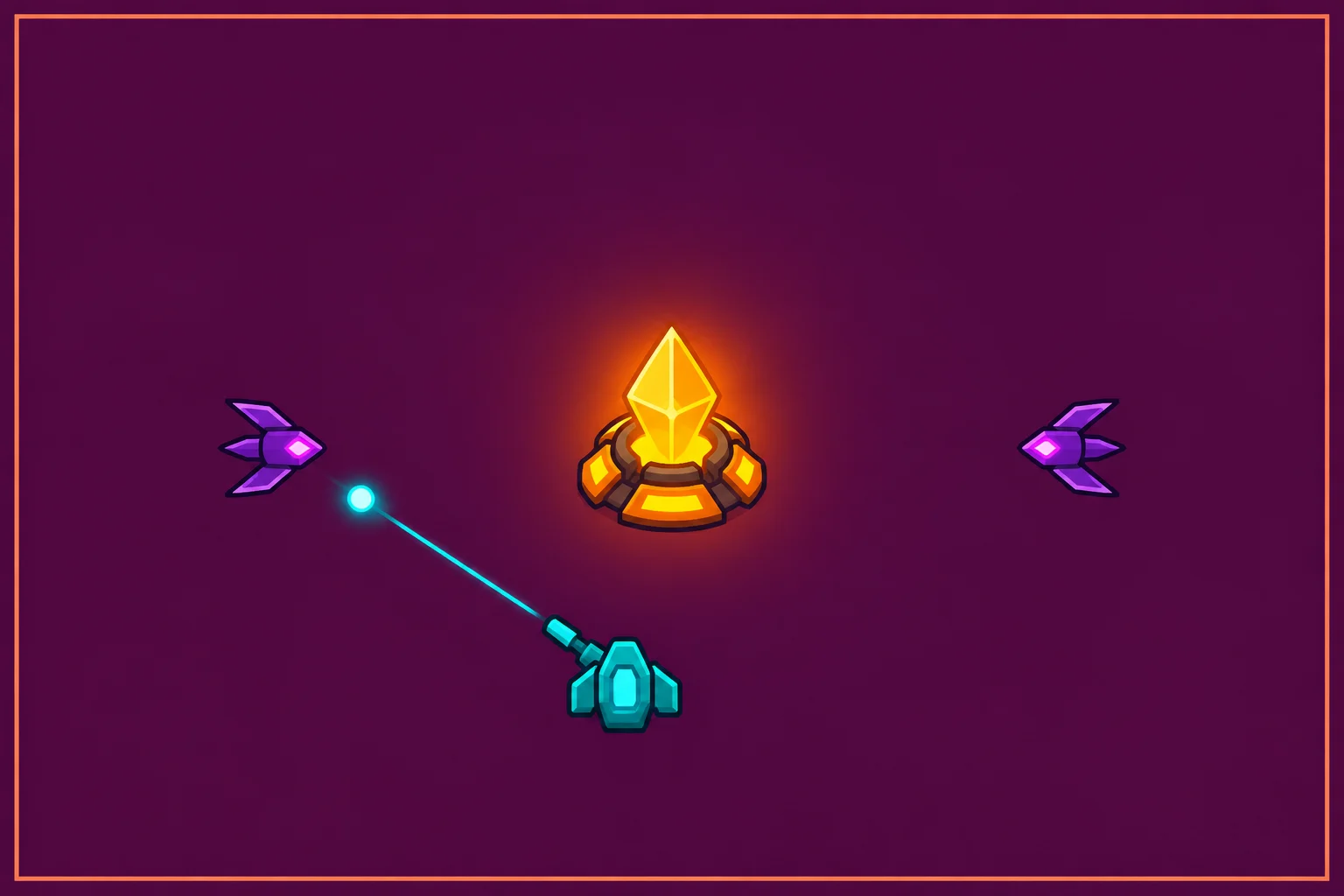
Define the Vector Ring combat loop
A physics combat prompt should describe how a hit changes motion, how mass affects acceleration and when the arena checks for a ring-out. Vector Ring is a fictional one-dimensional arena so the force calculation can be shown without hiding behind a complex ragdoll simulation.
The ring spans x=0 through x=20. The player starts at x=11 with mass 2; the opponent starts at x=14 with mass 1. Both velocities begin at zero. Each beat the player chooses Step, Punch or Brace. Step moves one unit. Punch is legal within three units. Brace cancels the next incoming impulse during that beat.
A Punch applies an impulse of 6 units away from the player. The physics tick adds impulse divided by mass to the target's velocity, advances position by velocity for one second, then multiplies velocity by 0.5 drag. The other fighter remains still unless hit. A ring-out occurs immediately when a position is less than 0 or greater than 20 after movement.
Specify force and movement order
The attack and physics order should be fixed: validate range; apply impulse to target velocity; integrate position for one second; apply drag; check boundaries. Do not check ring-out before movement or before the impulse is applied. A hit on a braced fighter applies no impulse and leaves its velocity unchanged for that beat.
The match ends on the first ring-out. If neither fighter exits after five beats, the result is a draw. Restart returns both fighters to their starting positions with zero velocity. No health points, combos, stage hazards or hidden critical hits are included.
This model is intentionally bounded. It can test whether force, mass and drag agree with a simple trace before a future version adds two-dimensional collision shapes or more combat actions. The example does not claim that the values are balanced or that a real build uses them.
Trace the example
The opponent begins at x14 with zero velocity and mass1. A legal Punch applies impulse +6, so velocity becomes 6 units per second. During the one-second integration the opponent moves to x20. Because ring-out requires a position greater than 20, x20 is still inside. Drag then reduces velocity to 3.
On the next beat, with no additional impulse, the opponent advances to x23, then drag reduces velocity to 1.5. The boundary check now sees x23>20 and awards the ring-out. The second physics step ends the match immediately.
This hand-calculated sequence uses the stated order and values; it is not a playtest. If the arena rule instead treats the boundary itself as outside, the first beat would ring out at x20. The spec must choose one convention and keep it consistent. Here the inclusive legal arena is 0≤x≤20.
Write the six prompts
Use one prompt per design decision so later checks have a clear source of truth. These drafts describe Vector Ring; they have not been run and do not represent a generated playable game.
Prompt 1: place fighters and ring bounds
Create a one-dimensional combat ring from x=0 through x=20. Player starts x11 with mass2; opponent x14 with mass1. Both velocities start at 0. First ring-out wins; after five beats with no ring-out, draw.Prompt 2: define player actions
Player selects Step one unit, Punch within distance3, or Brace. Punch applies impulse6 away from the player to the target. Brace cancels the next incoming impulse for the current beat.Prompt 3: order physics resolution
At each physics tick: validate action, apply impulse, add impulse/mass to velocity, move position by velocity for one second, multiply velocity by 0.5 drag, then check ring-out. Legal arena positions include exactly 0 and 20.Prompt 4: set brace and end states
A braced hit applies no new impulse; any existing velocity still integrates and is reduced by drag. No health, combos or random critical hits. End the match immediately after any position is below 0 or above 20.Prompt 5: make Restart deterministic
Restart restores x11/x14, zero velocities, player action state and five-beat count. Display positions and velocity after every tick.Prompt 6: prepare future checks
For future checks log impulse, mass, velocity before/after, position before/after, drag, brace state and boundary result. Check x=20 vs >20, braced force, second-step drift, range and reset. Do not call checks passed before observing a build.SEELE’s official page describes general plain-English prompting, a playable first version, browser testing and refinement; it does not verify Vector Ring. See Free AI game maker for workflow context only.
Prepare future build checks
Record each physics tick as a calculation table. Test one legal hit, a braced hit, the inclusive boundary at x=20, drift after drag and the next step beyond the ring. These are future checks, not passed tests. Record the before and after state so a later build can be compared with the specification.
| Future check | Expected rule | Evidence to capture |
|---|---|---|
| Impulse | Adds 6/mass to target velocity | Mass, impulse and resulting velocity |
| Integration | Position advances by velocity for one second | Position before/after |
| Drag | Velocity halves after movement | Velocity before/after drag |
| Brace | No new impulse; prior velocity still integrates and drags | Brace state and velocity |
| Ring-out and reset | Only x<0 or x>20 is outside; restart zeros state | Boundary and reset snapshot |
No real game run, browser test or measured result is available for this fictional example. The illustrations are original concept art and are not screenshots.
Frequently asked questions
What should a physics combat game prompt define?
Specify mass, impulse, movement integration, drag, collision order and boundary conditions.
How does mass affect a hit in Vector Ring?
The target gains velocity equal to impulse divided by its mass, so the lighter opponent accelerates more.
Is x=20 outside the arena?
No. Positions 0 and 20 are legal; ring-out occurs only below 0 or above 20.
Were the physics prompts tested in a playable build?
No. Vector Ring and its force trace are fictional calculations, not observed gameplay.
What does Brace do?
Brace adds no impulse to the next incoming hit during that beat; any existing velocity still moves and is reduced by drag.