A railway-management prompt has to describe how trains, track, stations, and passengers constrain one another. “Build a railway with busy stations” leaves the timetable and capacity rules to guesswork. A useful first brief names one route, its travel and dwell times, and the rule that prevents two trains from using the same single-track section at once.
This guide works through a fictional Depot–Pine–Harbor route. It calculates one round trip and a small passenger queue, then turns those rules into staged prompt drafts. The example values are hand calculations for illustration. The prompts have not been run and this package contains no playable game or test result.
Choose one route before building a network
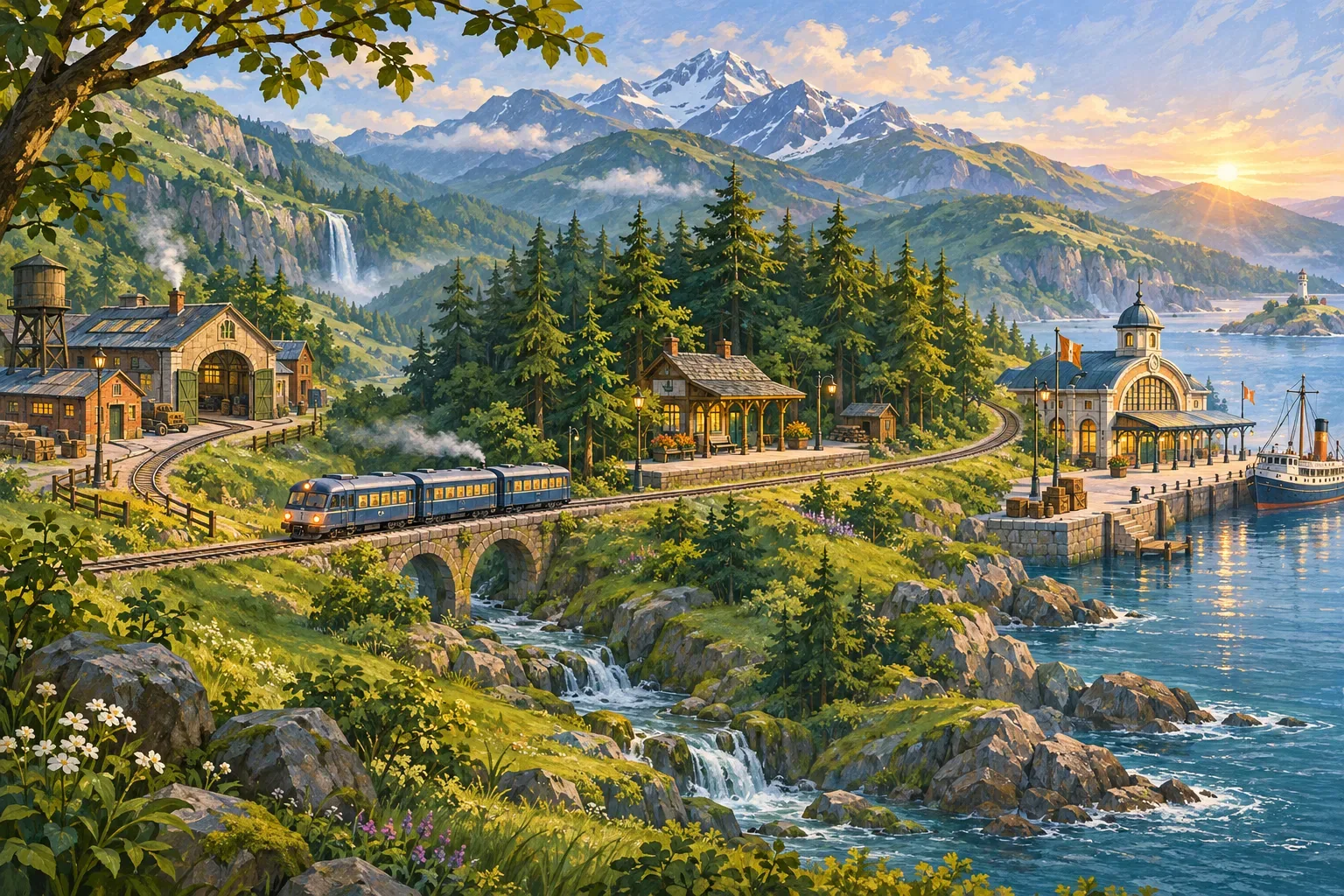
Begin with three stations in order: Depot, Pine, then Harbor. A train leaves Depot, stops at Pine, continues to Harbor, and returns by the same line. For the first prototype, there are no branches, passing loops, random delays, or upgrades. This gives the prompt a clear operating loop and makes conflicts easier to see.
Treat each single-track segment as a reserved block. A train reserves the segment when it enters and releases it when it clears. A second train cannot enter a reserved block. The player should see where a train is, which block it holds, and when it can depart. A blocked train waits at the station instead of quietly overlapping another one.
| Route leg or stop | Fictional duration | Event |
|---|---|---|
| Depot to Pine | 2 minutes | Train occupies the first segment. |
| Pine dwell | 1 minute | Alight and board riders. |
| Pine to Harbor | 3 minutes | Train occupies the second segment. |
| Harbor dwell | 2 minutes | Unload riders and prepare the return. |
| Harbor to Pine | 3 minutes | Train returns on the second segment. |
| Pine dwell | 1 minute | Stop before the final leg. |
| Pine to Depot | 2 minutes | Complete the round trip. |
Keep the first set of rules visible. If the railway uses different segments, different directions, or an additional wait for a block, the schedule changes. Ask the builder to display expected times next to observed times during review. An attractive map cannot tell you whether a train was held by a signal rule that the prompt never specified.
Work out the timetable
Add each leg and dwell in order: 2 + 1 + 3 + 2 + 3 + 1 + 2 = 14 minutes. A train leaving Depot at t=0 returns at t=14. Schedule the next service at t=15, leaving one minute after the first train has cleared the route and returned. In this deliberately simple example, each service follows the same path and the second does not enter the line while the first is still using it.
The one-minute buffer is a design assumption, not a universal railway safety rule. A real simulation may need more time for acceleration, braking, station occupancy, signaling, or route clearance. Ask the prototype to represent those rules explicitly if they are part of the intended game. Do not present this small timetable as real-world operating guidance.
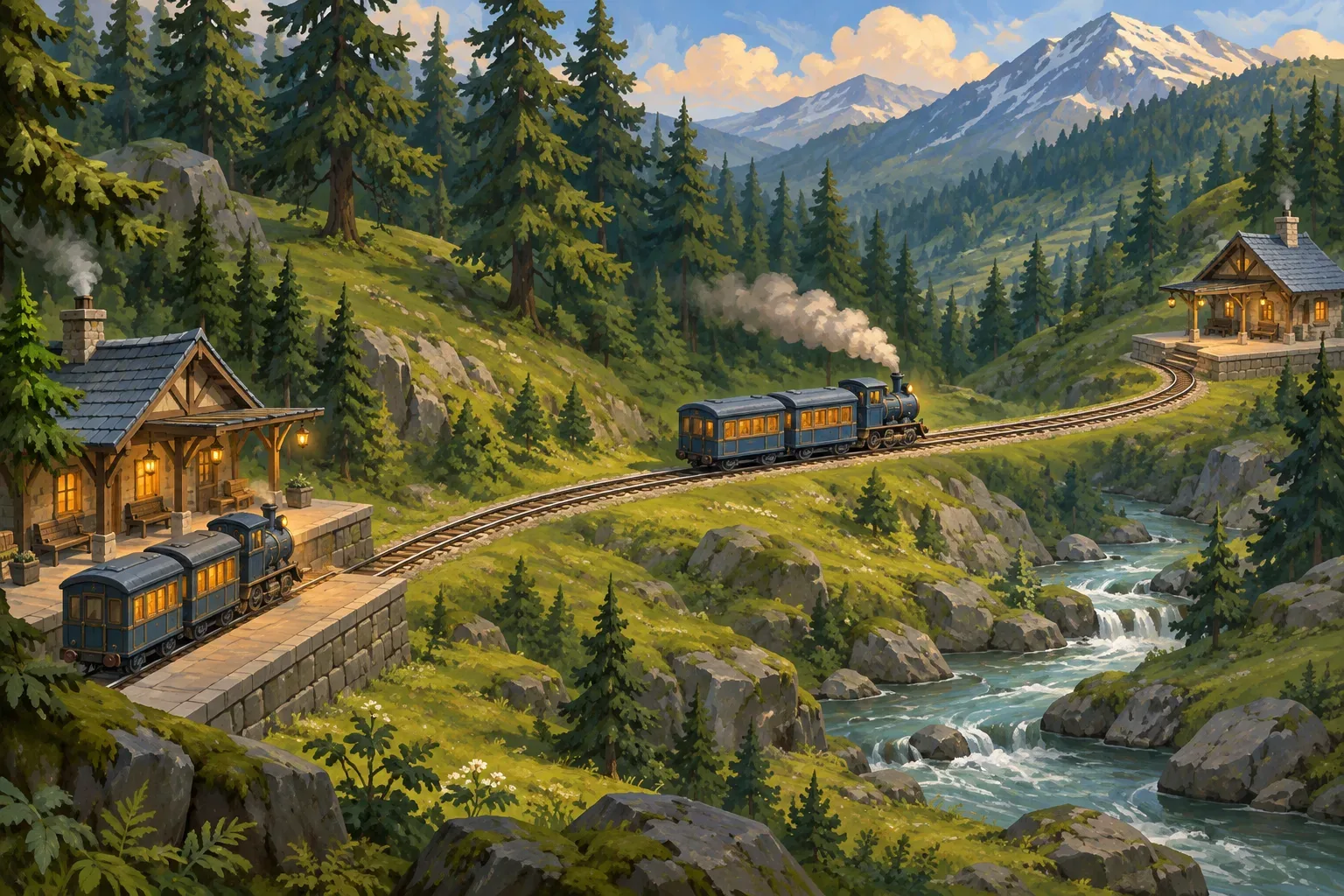
A useful review table might list service, departure, arrival at Pine, departure from Pine, arrival at Harbor, and return time. For the first service, the outbound milestones are t=0 at Depot, t=2 at Pine, t=3 leaving Pine, and t=6 at Harbor. The return is t=8 leaving Harbor, t=11 at Pine, t=12 leaving Pine, and t=14 back at Depot.
That trace also gives you a way to inspect a build one event at a time. If the train reaches Pine at t=3 instead of t=2, check whether the simulation counts the departure tick as a full travel minute. If the next service departs before t=15, inspect block release and the clearance assumption. Record the observed timing as evidence; do not change the expected value after the fact to make a mismatch disappear.
Add passenger capacity
Once the route works, add a 6-seat train and a small queue. At Depot, two passengers want Pine and four want Harbor. All six board. At Pine, the two Pine-bound riders alight, leaving four aboard and two free seats. Three Harbor-bound passengers are waiting, so two can board and one remains on the platform.
When the train reaches Harbor, four original Harbor-bound passengers plus two who boarded at Pine alight. That is six arrivals. The passenger arithmetic ties station behavior to capacity without requiring a city-wide demand model in the first prompt.
| Stop | Before stop | Action | After stop |
|---|---|---|---|
| Depot | 0 aboard; 6 seats | Board 2 for Pine and 4 for Harbor. | 6 aboard; no seats free. |
| Pine | 6 aboard; 3 Harbor riders waiting | 2 Pine riders alight; board 2 Harbor riders. | 6 aboard; 1 Harbor rider still waiting. |
| Harbor | 6 Harbor riders aboard | All 6 alight. | 0 aboard; 6 seats free. |
This is another fictional design calculation rather than observed output. It also gives the designer a visible question to ask: does the game board riders by queue order, destination, or some other rule? State the choice in a later prompt instead of leaving boarding behavior implicit.
Stage the prompts and review the build
The first prompt should create the three stations and one train on a single route. Ask for a clear service clock, station order, current track block, and next arrival. Keep economics and random events out. The first review should establish that the train follows the intended path and that station times are legible.
The second prompt adds travel times, dwell, block reservations, and the t=15 follow-up service. Ask for a timetable view and a conflict message when a block is occupied. Compare the expected t=14 return with the observed time, and verify the second train waits until the stated clearance rule allows entry.
The third prompt adds the 6-seat capacity and destination-specific riders. Ask the interface to show who boards, who alights, how many seats remain, and who waits. Keep the values small enough to compare by hand. A later prompt can add a branch, a second route, or a timetable upgrade after the base loop is understandable.
The fourth prompt adds reset behavior. Reset should put the train at Depot, set the service clock to zero, clear all block reservations, and restore the initial passenger queues. If a train is reset mid-segment, the prompt should say whether the block is released immediately or after a recovery action; otherwise the next service could inherit a hidden reservation.
- Trace each arrival and departure against the stated 14-minute route.
- Confirm the t=15 service begins after the first train returns at t=14.
- Check that a reserved single-track segment blocks another train from entering.
- Verify Pine unloads two riders, boards two of three waiting Harbor riders, and leaves one waiting.
- Reset mid-route and inspect train location, reservations, clock, queue, and capacity.
These are checks to run later, not checks already performed. The source topic asks for executed prompts and a playable result. This local package does not meet that part of the source request: the prompts are unrun drafts, and no railway game build or playtest evidence is included.
SEELE’s AI Game Maker page describes starting from a text prompt, testing an initial playable game in a browser, and refining it with follow-up prompts. That is general product information; it does not verify this route, timetable, or passenger system.
Frequently asked questions
What should an AI prompt for a railway management game include first?
Start with one route, station order, travel times, track occupancy rule, and train capacity. Add more services only after one timetable can be followed and checked.
How do I schedule trains on a single-track railway?
Represent each segment as a reserved block and prevent two trains from occupying the same block at once. Include the dwell time and a clearance buffer when calculating the next departure.
How can a railway prototype show passenger capacity?
Give riders destinations and let station stops unload and board them in a defined order. Compare waiting riders with free seats so the player can see who boards and who remains.
Should I build the whole railway network in the first prompt?
No. One route and one complete service loop expose schedule and capacity rules with fewer moving parts. Branches, signals, upgrades, and more trains can follow as separate prompts.
Are these prompts or railway schedules tested in a playable game?
No. The prompts are unrun drafts and the route, timetable, and passenger counts are fictional design examples. No generated build or playtest result is claimed.