Introduction
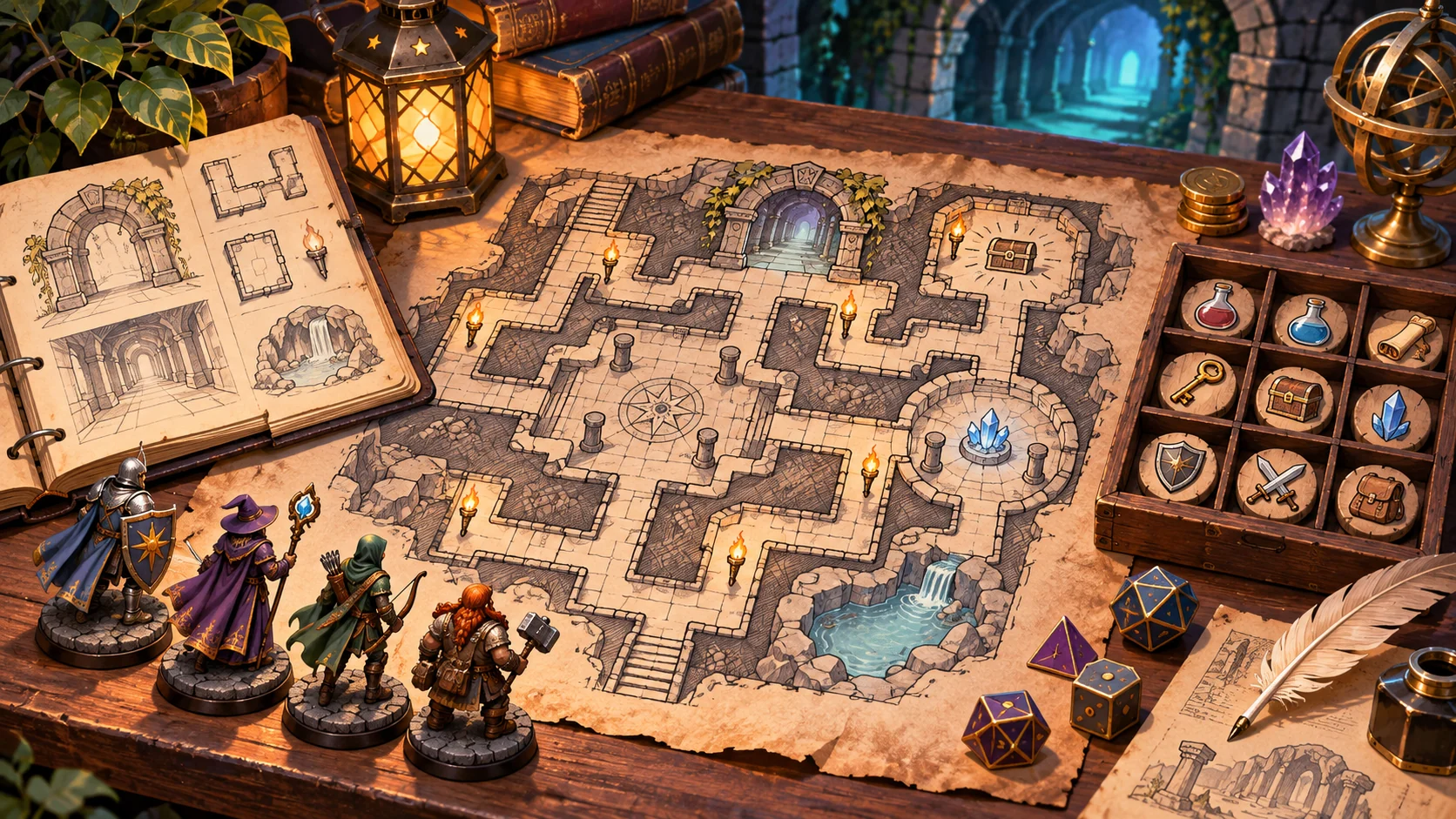
A small-scale 4X game can give players a satisfying strategic arc without a huge map or many factions. The challenge is to connect exploration, settlement growth, resource choices and rival responses into a few turns the player can understand. Start with a compact world, a clear victory condition and a limited number of competing groups.
This guide uses The Shattered Shoals, an invented archipelago shared by three original factions. All territories, resources, leaders and outcomes are fictional placeholders. No playable game, strategy test or balance review was run for this article; the examples are design scaffolding only.
Define the strategic arc
A first scenario should say what the player is trying to achieve, how many turns it covers and what counts as a result. Choose a small map and a limited set of actions. For this guide, the design lens is: explore unknown areas, expand settlements, make choices about limited game resources and respond to neighboring factions. Keep those verbs connected to visible map states instead of scattering them across unrelated menus.
Prompt 1 — compact 4X brief
Design an original small-scale 4X strategy game called The Shattered Shoals. The first scenario uses a compact archipelago, three original factions and a short turn limit. Define the player goal, map reveal, settlement expansion, three abstract resources, research or civic development, diplomacy, non-graphic conflict or avoidance, turn sequence and victory/defeat states. Use invented values and list assumptions. Do not claim that this game has been built or balanced.
A useful brief also defines the scale: how many settlements, map regions and turns fit in the first scenario. If every system needs a separate tutorial, reduce the scope before generating detailed faction trees.
Make exploration and expansion readable
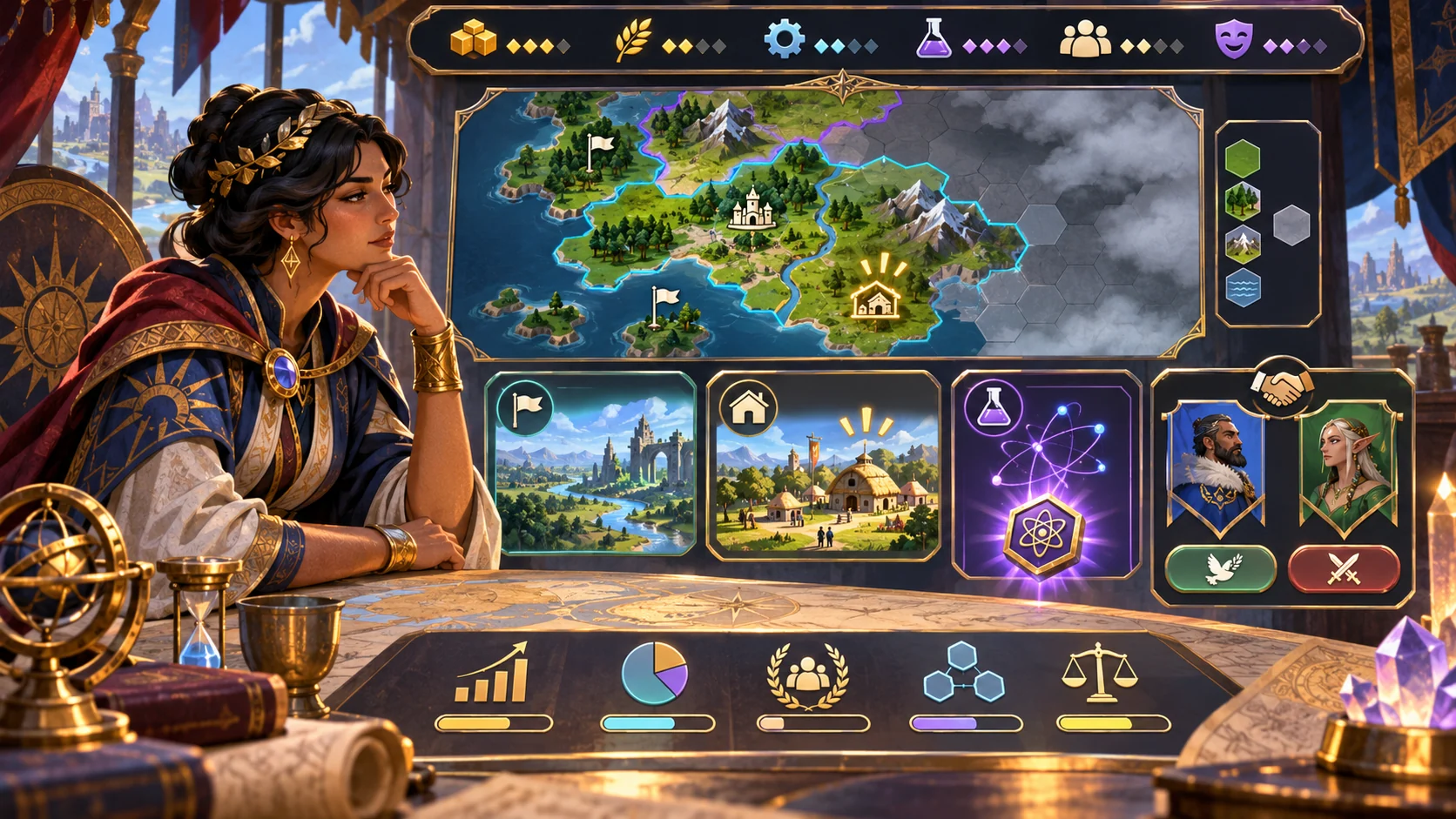
The player needs to distinguish known land, unexplored areas, faction borders and possible settlement sites. Show how an expedition reveals new tiles and what decision is available afterward. Define a settlement’s footprint and the conditions that allow it to grow. Avoid asking for a procedurally endless world when a hand-sized map can demonstrate the main choices.
Prompt 2 — map and settlement rules
Create a compact original archipelago map for The Shattered Shoals with a home settlement, a few unexplored regions, two neighboring factions and several possible expansion sites. Define what each marker means, how a scout action reveals a region, how a new settlement is placed and how borders update. Use a simple legend, original symbols and provisional values. Treat the map as a fictional game board, not a real map or geopolitical reference.
| Map state | Player information | Possible choice | Result to display |
|---|---|---|---|
| Known home region | Settlement and current resource tokens | Develop or dispatch a scout | Turn and resource state update |
| Unexplored tile | Hidden terrain with a reveal marker | Spend a game action to explore | Revealed tile and new choices appear |
| Open expansion site | Available placement marker | Found a fictional settlement | Borders and upkeep state update |
| Neighbor border | Faction color and relation marker | Propose contact or keep distance | Relationship state becomes visible |
These are illustrative game states, not real geography or political recommendations.
Connect resources to development choices
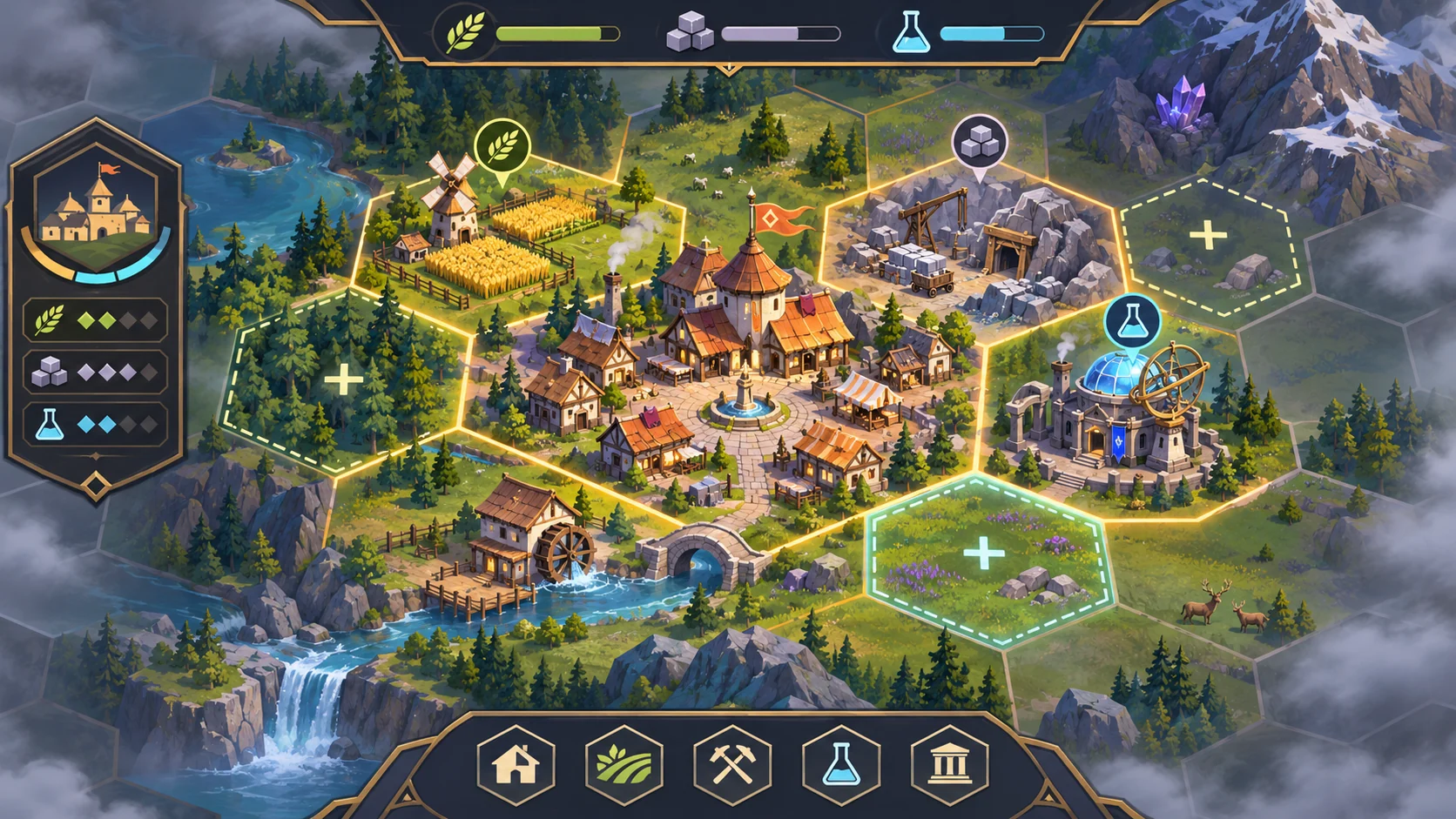
A small game can use a few abstract resources that support distinct decisions. Explain how each resource is gained, spent and shown to the player. A settlement upgrade might improve one game option while consuming a limited token; a research choice might unlock a route or civic action. Keep every amount provisional until the actual system can be played and reviewed.
Prompt 3 — resource and development model
Define three fictional resources for The Shattered Shoals and three settlement improvements. For each, show how the resource is gained or spent, which game option changes and what the player sees before confirming. Make each improvement useful in a different way. Include a clear limit so one strategy is not an automatic choice. Mark all values untested and avoid real economic comparisons.
Prompt 4 — turn and faction response
Write the turn sequence for The Shattered Shoals: player action, settlement update, rival faction response and next-turn summary. Define what happens when the player explores, expands, develops, proposes diplomacy or avoids a conflict. Show rival intent in advance when possible and explain border or relation changes. Use original fictional factions, no graphic violence and placeholder values; do not claim the system is balanced.
A turn summary should identify what changed and what needs attention. If a rival response is uncertain, the game should show the rule that creates uncertainty rather than presenting a random event as a historical or political fact.
Give rivals choices and boundaries
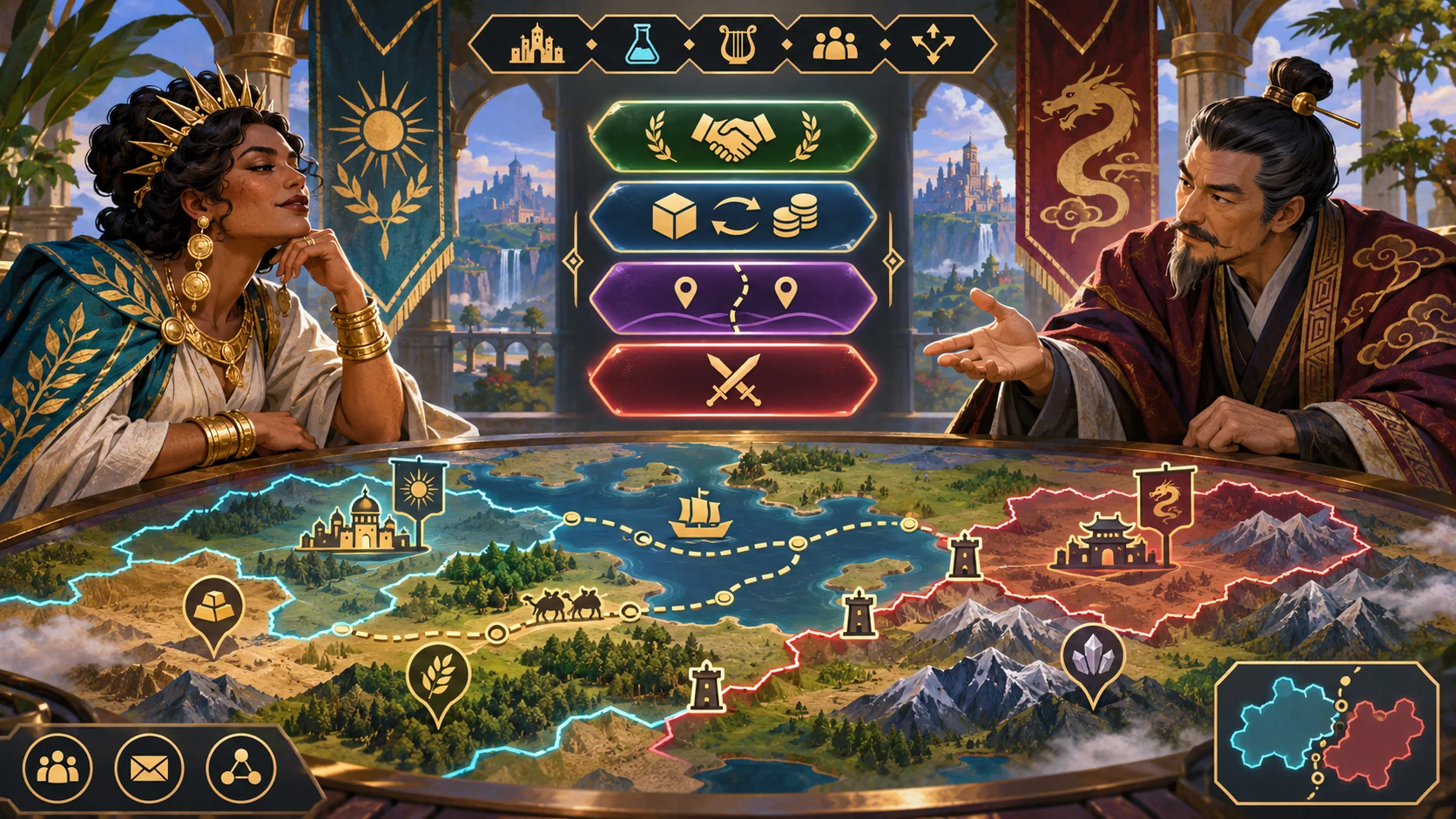
Rival factions help a strategy game feel responsive, but their goals should be understandable. Give each one a small objective, a visible relationship state and a way to respond to player actions. Include a diplomatic option and a non-graphic conflict or avoidance rule. Tell the builder whether rivals can expand, propose a pact or contest a shared region.
Prompt 5 — faction goals and diplomacy
Create two original rival factions for The Shattered Shoals. Give each a short-term game goal, one visible relationship marker, one diplomatic proposal and one response to a contested map region. Define when the player can accept, decline or ignore a proposal and what map or relation state changes. Keep factions fictional, avoid copying real cultures and label all behavior as untested game logic.
Do not use stereotypes or direct stand-ins for real populations. A faction can be distinct through its fictional map goal, resource preference or preferred route rather than through a borrowed culture.
Request a bounded playable slice
A first build can use one compact map, three factions, a short turn sequence, a few explore and settlement actions, three resources, one diplomatic proposal and a visible result. Ask for a fresh scenario and reset. Require the handoff to distinguish working interactions from map art or static menus.
Prompt 6 — first playable build
Build a small Shattered Shoals 4X prototype with a compact map, three original factions, map reveal, one settlement expansion, three abstract resources, three development choices, one diplomatic proposal, rival response, turn summary, victory/defeat state and reset. Make actions update visible map and resource state. Use original placeholder art and provisional values. At handoff, list working interactions, mockups, known gaps and anything not verified. Do not call a static strategy map playable.
To claim the slice works, open it and reveal a tile, found or expand a settlement, spend a resource, respond to a faction and advance the turn. Check the resulting map state and reset. This workflow was not run for this article.
Fictional opening scenario
| Field | Shattered Shoals planning example |
|---|---|
| World | Compact archipelago with a few unexplored tiles |
| Factions | Three original groups with visible goals |
| Resources | Three abstract game tokens |
| Strategic choices | Explore, expand, develop, negotiate or avoid conflict |
| Scenario | Short turn limit and one clear outcome |
| First milestone | Reveal territory and complete one faction interaction |
| Evidence | Fictional plan only; no game or balance test |
This snapshot keeps the design inspectable. It does not establish that the turn system or any strategy is balanced.
Review the map and refine one gap
Check what the player can observe and what the game changes. If a settlement expands but no border or upkeep state updates, note the mismatch. If a rival relationship marker changes without an explained action, the player cannot understand the consequence. Choose one smallest correction before adding more factions, regions or research branches.
Prompt 7 — implementation review
Review the running Shattered Shoals prototype for map reveal, settlement placement, border update, resource gain and spend, development choice, faction relationship state, diplomacy, rival response, turn summary, scenario outcome and reset. Mark each present, missing or unclear based on observed interactions. Record concise evidence and recommend one smallest next change. Label static art and untested values; do not claim strategy balance or playtesting unless performed.
Conclusion
Small-scale 4X prompts should connect a compact map, resource choices, settlement growth and rival responses across a short scenario. The Shattered Shoals is fictional; its factions and values are untested, and no playable game is claimed. Keep the strategic arc small, make state changes visible and verify the running result before describing the prototype.
You can take a scoped concept into the Free AI game maker, then compare the result with the review checklist.
FAQ
What should AI prompts for a small-scale 4X game include?
Define the compact map, exploration, settlement growth, resources, faction goals, diplomacy, turn sequence and a clear scenario outcome.
How can I keep a 4X prototype small?
Use a few map regions, a small number of factions, a short turn limit and only enough resources to demonstrate the main strategic choices.
What should a 4X map communicate?
Show known and unknown regions, settlements, borders, available expansion sites and the next player action with a consistent legend.
How do rival factions stay understandable?
Give each a visible game goal, relation state and response rule, then show how player actions affect those states.
Does a strategy map mockup prove the 4X game works?
No. Verify map reveal, settlement actions, resources, diplomacy, turn progression and scenario outcome in the running build.