Introduction
A telecom tycoon game connects network coverage, capacity, upgrades, customer demand and recurring costs. A broad prompt can produce a busy management dashboard without making the player’s choices understandable. Begin with a small fictional city, a few districts and a short scenario where one network decision changes visible game state.
This guide uses Northstar Networks, an invented game company operating in a fictional city. All subscribers, coverage, capacity and resource values are placeholders. This is not telecommunications, engineering, pricing, investment or business advice, and no playable game was built or tested for this article.
Define the network-management loop
Describe the scenario goal, what the player reviews each turn and how decisions affect the next state. A compact loop can inspect district demand, place or upgrade a fictional tower, allocate abstract capacity, review service indicators and close the month. State how constraints and failure appear without implying real network performance.
Prompt 1 — first network brief
Design a fictional telecom tycoon game called Northstar Networks in an invented city. Scope three districts, a small abstract resource pool and a short planning scenario. Define the player goal, coverage map, capacity, upgrade choices, recurring game costs, service indicators, turn sequence, scenario end and reset. Use fictional placeholder values. List assumptions and untested mechanics; do not provide real telecom, engineering, pricing or investment guidance.
A good brief says which values are visible before a decision and what changes after it. The player should know whether a district is unserved, connected or constrained and which game action can change that state.
Make coverage and network state visible

A map can show fictional districts, tower locations and abstract coverage areas. Use a consistent legend and distinguish an existing connection from a proposed expansion. Avoid real geography, real coverage promises or technical claims. If an area is outside the first scenario, label it unavailable rather than implying the game has modeled it.
Prompt 2 — district map
Create a Northstar Networks game map with three invented districts, a few fictional network sites and simple coverage states. Distinguish connected, planned and unavailable areas with a clear legend. Add a small indicator for abstract capacity and one proposed expansion choice. Use an invented city shape and placeholder values, not a real map or a real-world service estimate.
| District state | Game meaning | Player feedback |
|---|---|---|
| Planned | A possible expansion area | Show the game resource and turn needed |
| Connected | The scenario marks service as available | Distinguish current state from future plans |
| Constrained | Abstract capacity is limited | Explain which upgrade or trade-off can change it |
| Unavailable | Outside this scenario’s playable area | Do not imply a real coverage assessment |
These are fictional interface states, not telecom coverage categories or engineering standards.
Connect capacity, upgrades and resources
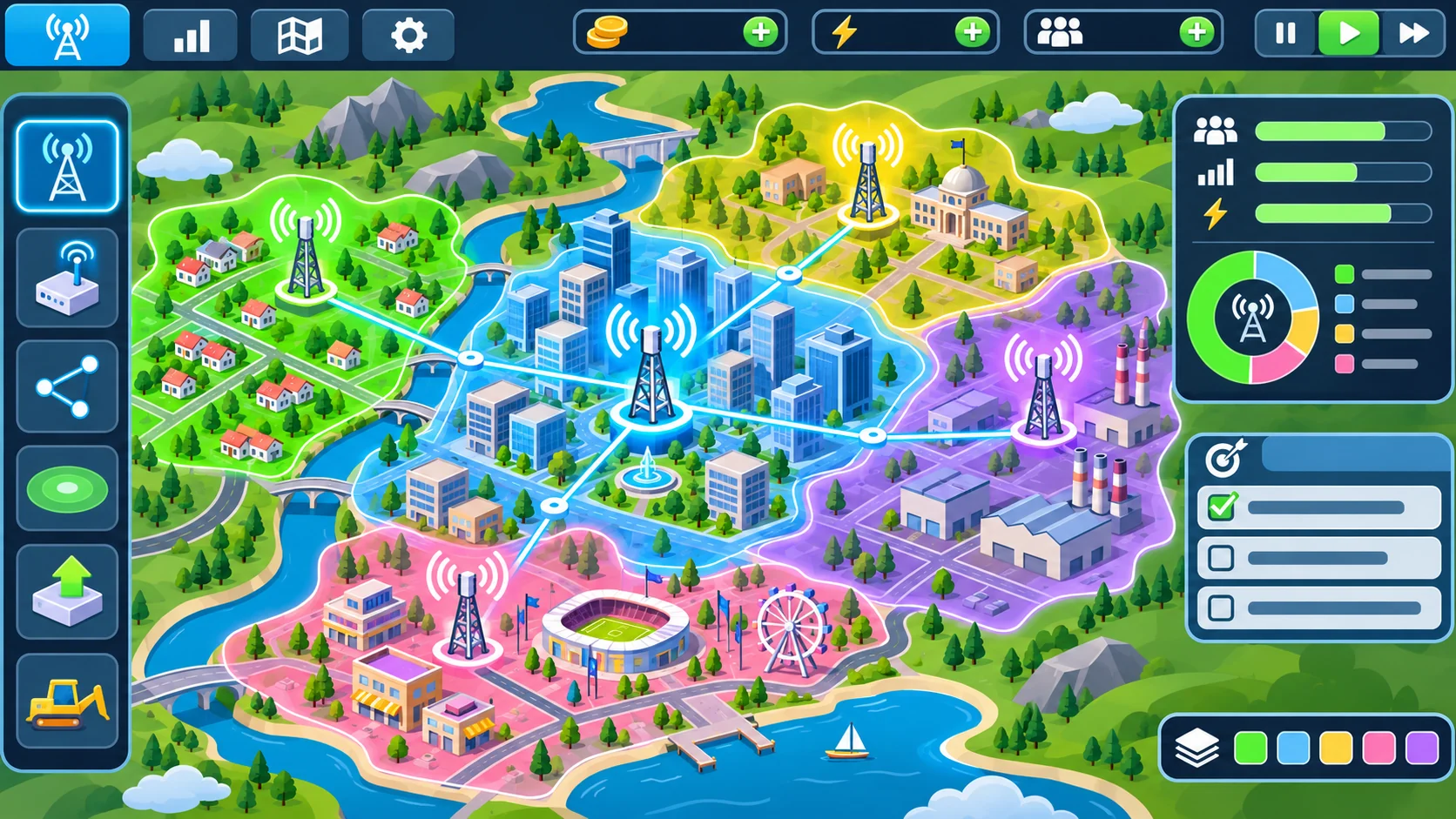
Upgrade choices should have visible costs and effects in game terms. A capacity card might require abstract tokens, consume a turn or trade off with a different district investment. Keep the rule deterministic and show what is not included. Generated numbers should be clearly labeled as provisional, not as network design advice.
Prompt 3 — capacity and upgrade cards
Define three original Northstar Networks upgrades for a fictional management game. For each, show a placeholder resource cost, turn requirement, affected districts and game-only effect on capacity or service state. Include one trade-off and a confirmation step. Label every number provisional; do not derive values from real network engineering or pricing.
An upgrade should not silently change unrelated indicators. If a site increases a game capacity meter, the interface should explain which district it affects and when the change applies.
Make planning turns and demand readable
A short planning calendar can show current resources, the next scenario event and unresolved tasks. Simulated demand should be introduced as a game signal rather than evidence about actual subscribers. Tell the player whether the signal is a fixed scenario input, a random event or a consequence of earlier choices.
Prompt 4 — turn planner
Create a Northstar Networks turn planner with a current month, abstract budget tokens, three district states, one proposed upgrade and a clearly fictional demand event. Explain how the player schedules a decision and when its effect appears. Mark simulated demand as game-only, show the next turn preview and provide a way to inspect why an action is blocked.
A readable planner helps connect a choice to a later result. Keep the event log concise: action, district, resource change and resulting game state.
Tie service indicators to a scenario report
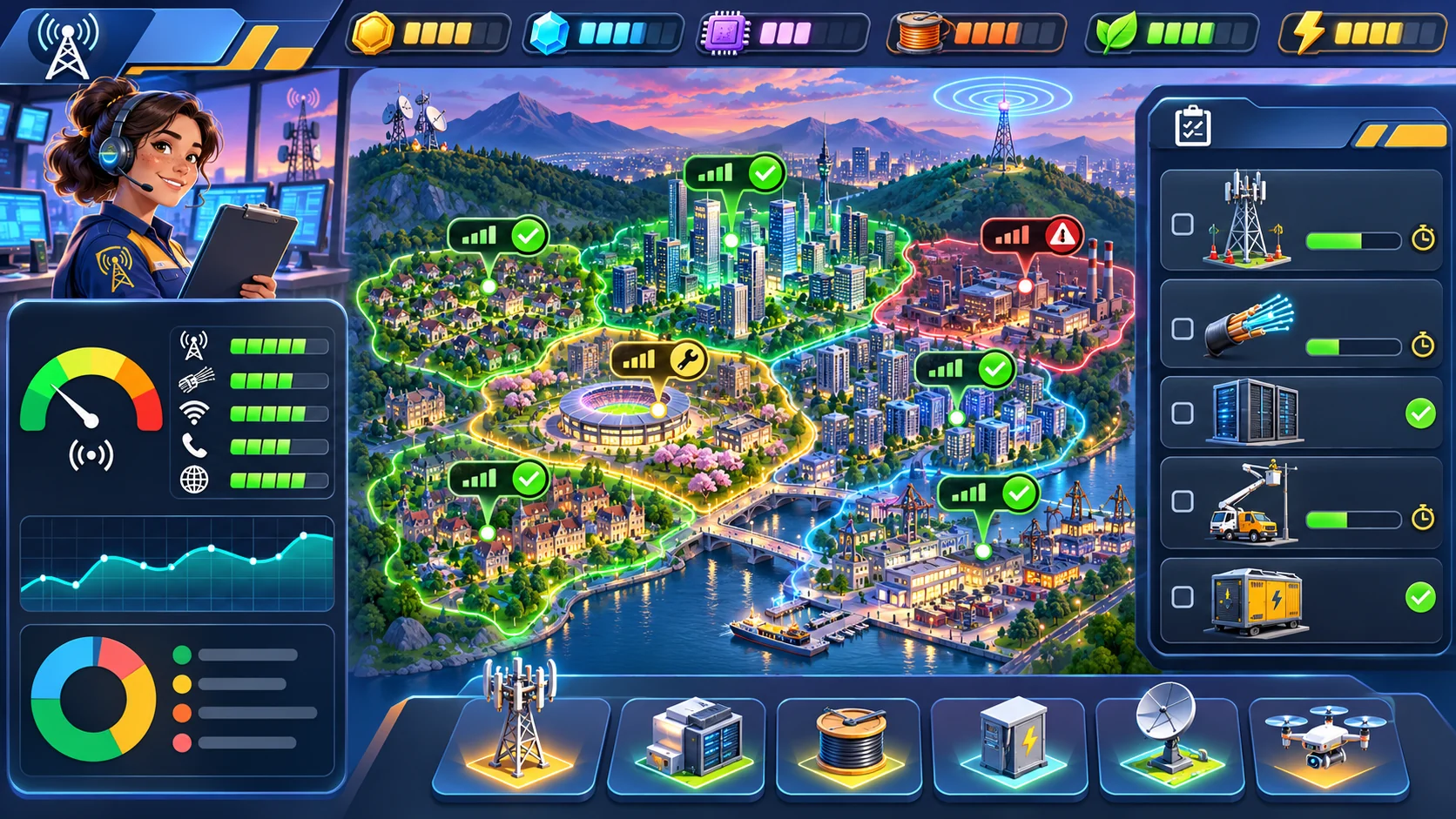
A report can summarize connected districts, capacity constraints, completed upgrades and remaining game resources. Avoid real customer claims, revenue forecasts or service-level promises. If the score is abstract, explain its role in the scenario and allow the player to trace how it changed.
Prompt 5 — end-of-turn report
Build a fictional Northstar Networks report showing district connection states, abstract capacity, completed and pending upgrades, game resources and a short event log. Identify what changed this turn and what carries forward. Use invented placeholder values. Do not label the result as real service quality, customer satisfaction, revenue or network performance.
The report should answer what happened, why it happened and which choice is available next. Use the same district names and resource labels throughout the map, upgrade cards and summary.
Request a small playable management loop
A first build could include three districts, a map, two or three upgrades, abstract resources, a short turn planner, event log, end-of-turn report and reset. Specify which controls must work: select a district, choose an upgrade, confirm its cost, advance the turn, inspect the changed state and reset. Static screens must be labeled as mockups.
Prompt 6 — first playable slice
Build a small fictional Northstar Networks management game with three invented districts, visible connection states, abstract capacity and resource meters, upgrade choices, a turn planner, event log, report, scenario end and reset. Make costs, blocked actions and state changes visible. At handoff, list working interactions, mockups and unverified rules. Do not call static screens playable and do not claim real network accuracy.
After building, test the loop by making an upgrade, advancing a turn, comparing district states and resetting. This article does not claim those interactions were run.
Prompt 7 — observed-output review
Review the running Northstar Networks prototype for district selection, map states, upgrade cost, capacity change, resource update, turn progression, demand event, report, scenario end and reset. Mark each present, missing or unclear based only on observed interactions. Record concise evidence and one smallest next change. Label all placeholders; do not claim telecom accuracy or business value.
Fictional planning snapshot
| Field | Northstar Networks example |
|---|---|
| Map | Three invented districts |
| Decisions | Place or upgrade fictional sites and allocate game resources |
| Indicators | Abstract connection, capacity and task states |
| Main loop | Inspect → plan → confirm → advance → review |
| First milestone | See one decision update the intended game state |
| Evidence | Fictional concept only; no game or network test |
The snapshot describes a bounded game scenario, not a real telecom market or network plan.
Conclusion
Telecom tycoon prompts should connect district coverage, capacity choices, resources and turn reports in a small management loop. Northstar Networks and every value here are fictional; no playable game or network test is claimed. Make choices and state changes visible, then inspect the running build before describing it as playable.
You can take a scoped concept into the Free AI game maker, then compare the result with the review checklist.
FAQ
What should AI prompts for a telecom tycoon game include?
Define districts, coverage states, abstract capacity, upgrades, resources, planning turns, reports and a small first-build scope.
How should a telecom game show network coverage?
Use a fictional map with a legend that separates current, planned, constrained and unavailable game states.
Can generated network capacity values be used for real planning?
No. Treat them as game placeholders; they are not engineering estimates or service commitments.
How can upgrade choices feel clear in a management game?
Show each game cost, affected district, timing and expected state change before the player confirms.
Does a network dashboard mockup prove the telecom tycoon game works?
No. Verify district selection, upgrades, resource changes, turn progression, reporting and reset in the running output.