Record the presentation contract before changing rules
An AI-assisted gameplay change can accidentally replace screens, redraw assets or change controls if the request mixes presentation and logic. Before editing, capture the current screen layout, asset references, typography, sound cues, input mapping and the behavior that must remain. The fictional Tideglass Tiles project has a 6×6 gem board, score HUD and move counter. It has not been supplied or tested; the example demonstrates a workflow only.
Write a presentation contract with explicit boundaries: retain the existing screen hierarchy and positions; keep the same sprite files and hashes; do not alter fonts, colors, button labels, sound or controls. Record screenshots or asset inventory from the real project before work begins. If the project files are unavailable, prepare a request for them instead of inventing current behavior.
State the gameplay change in observable terms. Here, a valid adjacent swap resolves every resulting cascade before another input is accepted. Each step clears all horizontal and vertical runs of at least three, adds ten points per cleared tile, refills empty cells, and repeats until the board is stable. The move counter decreases once for the player's swap, not once per cascade.

Keep cascade resolution in the game model
Implement the rule in a model or resolver that consumes board state and returns cleared cells, score delta and the next board. The view continues to render the same board and HUD from that state. A resolving flag can disable input during animation, but the existing button and visual layout remain unchanged.
Make overlap and ordering explicit. If horizontal and vertical runs cross, count each tile once in that cascade. Score is based on unique cleared tiles. After refill, scan again. Stop only when no qualifying runs remain. Keep the random refill source injectable so future tests can provide a known board without changing the production art.
Ask AI for a narrow diff and list of files before approval. Reject unrelated scene replacements, stylesheet or prefab changes, asset renames and input remapping. Compare the UI tree and asset manifest before and after. A clean game-logic patch should alter only the resolver/model and its data contract unless the existing architecture requires a documented adapter.
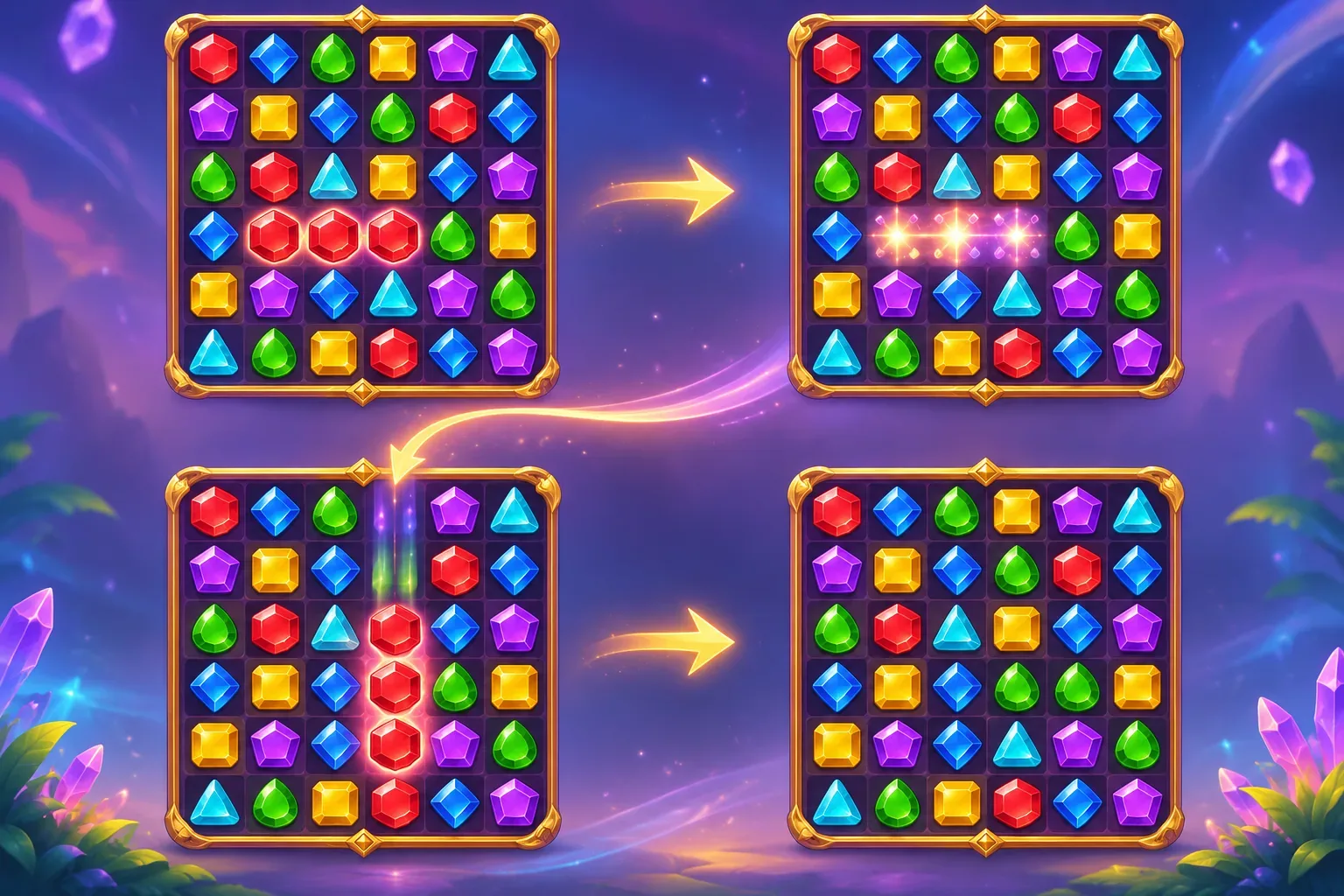
Trace the example
Suppose a valid swap creates one horizontal run of three tiles. The resolver clears those three unique tiles and adds 30 points, then fills the gaps. If the refill creates a vertical run of four, the next cascade clears four unique tiles and adds 40 points.
If a later scan finds no runs, the board becomes stable and the resolving state ends. The move counter has decreased once for the player's original swap. The same grid, sprites, HUD, typography and controls continue to display the result through the existing view.
This is a fictional mechanics trace, not an implementation or observed output. No game source, UI screenshot, art manifest, code diff or test run is available for Tideglass Tiles.
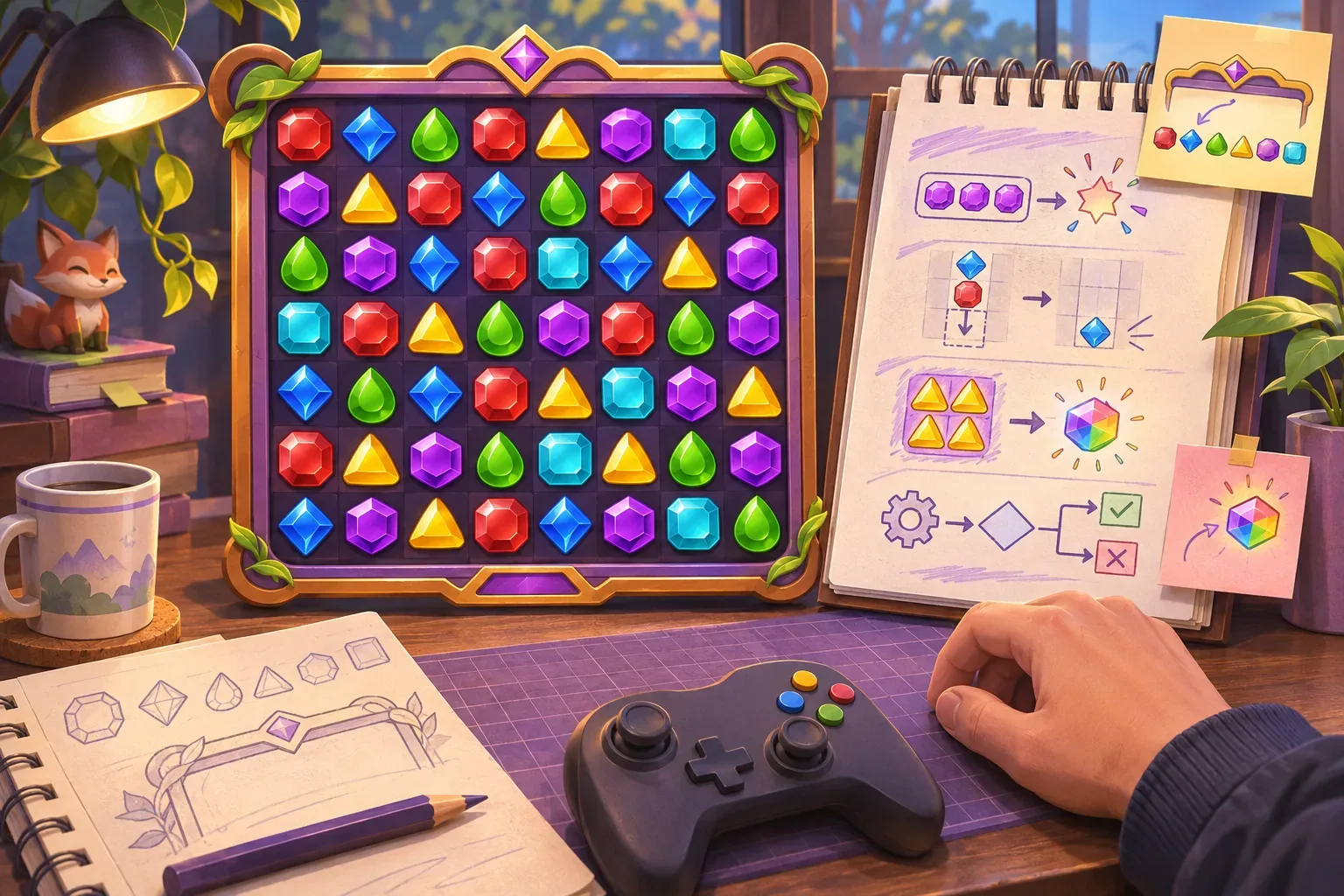
Write the six prompts
Use one prompt per design decision so later checks have a clear source of truth. These drafts describe Tideglass Tiles; they have not been run and do not represent a generated playable game.
Prompt 1: inventory model and presentation
Inspect the supplied game project read-only. Locate board model, swap validation, match detection, cascade resolution, score, move counter, view hierarchy, input mapping and asset references. Cite paths and record current behavior versus unknowns.Prompt 2: set the preserve contract
Write a presentation contract from the supplied project. List UI hierarchy/layout, sprite and audio asset paths, fonts, colors, labels and controls that must remain unchanged. Do not edit presentation files.Prompt 3: define cascade and score rules
Specify a pure cascade resolver: after a valid adjacent swap, find all horizontal/vertical runs of length 3+, deduplicate intersections within a cascade, score 10 per unique tile, refill and repeat until stable. Decrease the player's move counter once per swap.Prompt 4: propose a model-only diff
Propose the smallest model-only code change and identify any required view adapter. Keep the existing screen, UI tree, input bindings, assets, sound and presentation styles untouched; show the diff before making broader changes.Prompt 5: implement behind the existing view
Implement the approved rule behind the current view contract. Keep random refill injectable for deterministic future checks, and return a resolving state so input cannot start another swap before the board stabilizes.Prompt 6: prepare logic and preservation checks
Prepare future checks for invalid swap, one match, crossing matches, cascade refill, score sum, single move decrement, stable completion, and unchanged UI/asset hashes. Do not claim checks passed without a project run.SEELE’s official page describes general plain-English prompting, a playable first version, browser testing and refinement; it does not verify Tideglass Tiles. See Free AI game maker for workflow context only.
Prepare future build checks
A successful logic change must satisfy the rule and preserve the presentation contract. These are future checks; no code or visual regression test ran here. These are future checks, not passed tests. Record the before and after state so a later build can be compared with the specification.
| Future check | Expected rule | Evidence to capture |
|---|---|---|
| Swap and resolution | Only valid adjacent swaps trigger cascades; input waits until stable | Board snapshots and resolving flag |
| Match scoring | Crossing runs count unique tiles once per cascade at 10 points each | Matched cell set and score delta |
| Move counter | One player swap consumes one move regardless of cascade count | Counter before/after |
| Presentation preservation | UI hierarchy, controls and asset references stay unchanged | Before/after tree and asset hashes |
| Regression | Existing sound, typography, labels and screen layout remain intact | Visual and interaction comparison |
No real game run, browser test or measured result is available for this fictional example. The illustrations are original concept art and are not screenshots.
Frequently asked questions
How can AI change game logic without replacing existing art?
Give it a presentation contract, restrict the file scope, ask for a narrow diff and compare asset references and UI structure afterward.
Where should a cascade rule live?
Keep matching, scoring and refill decisions in the board model or resolver, with the existing view rendering the returned state.
How should crossing matches affect score?
The fictional Tideglass Tiles rule deduplicates cells within each cascade and scores each cleared tile once.
Was Tideglass Tiles changed or visually tested?
No. It is a fictional example; no source, code change, build or UI regression test is claimed.
How do I know whether UI and art stayed unchanged?
Compare the real project's view hierarchy, input bindings and asset manifest or hashes before and after the approved patch.