Introduction
A co-op escape-room game needs more than a room full of riddles. The design document must explain what teammates share, how clues move between players, what blocks progress, and how a session ends. An AI-ready game design document (GDD) turns those ideas into a compact specification that a designer or generation tool can interpret without inventing essential rules.
This article provides a reusable template and a fictional example, The Clockwork Archive. Its two players explore a quiet observatory, compare clues, and open a final cabinet by coordinating information. The room, puzzle chain, interface and example values are hypothetical. They have not been built, run or playtested; the sample is a planning artifact, not evidence of a playable game.
Start with the shared play promise
Write one sentence that tells the team what cooperation means in this game. “Two people solve puzzles together” is too broad: it does not tell a builder whether players share one screen, separate information, or take turns. State the session length, player count, communication assumptions and intended ending before listing puzzles.
Template — one-sentence promise
Create a [session length] cooperative escape-room game for [player count]. Players [distinct ways they contribute] to [shared objective]. The experience ends when [clear win condition] or [clear stop condition]. Use [camera and input assumptions]. Keep the first milestone to [one room or puzzle chain].
For The Clockwork Archive, the fictional promise is: “Two players spend one short session in a shared observatory, compare complementary clue cards, and unlock a cabinet by agreeing on a sequence.” This defines a shared screen and one objective. It does not yet decide whether players have identical information; the GDD must make that explicit.
Separate shared and private information
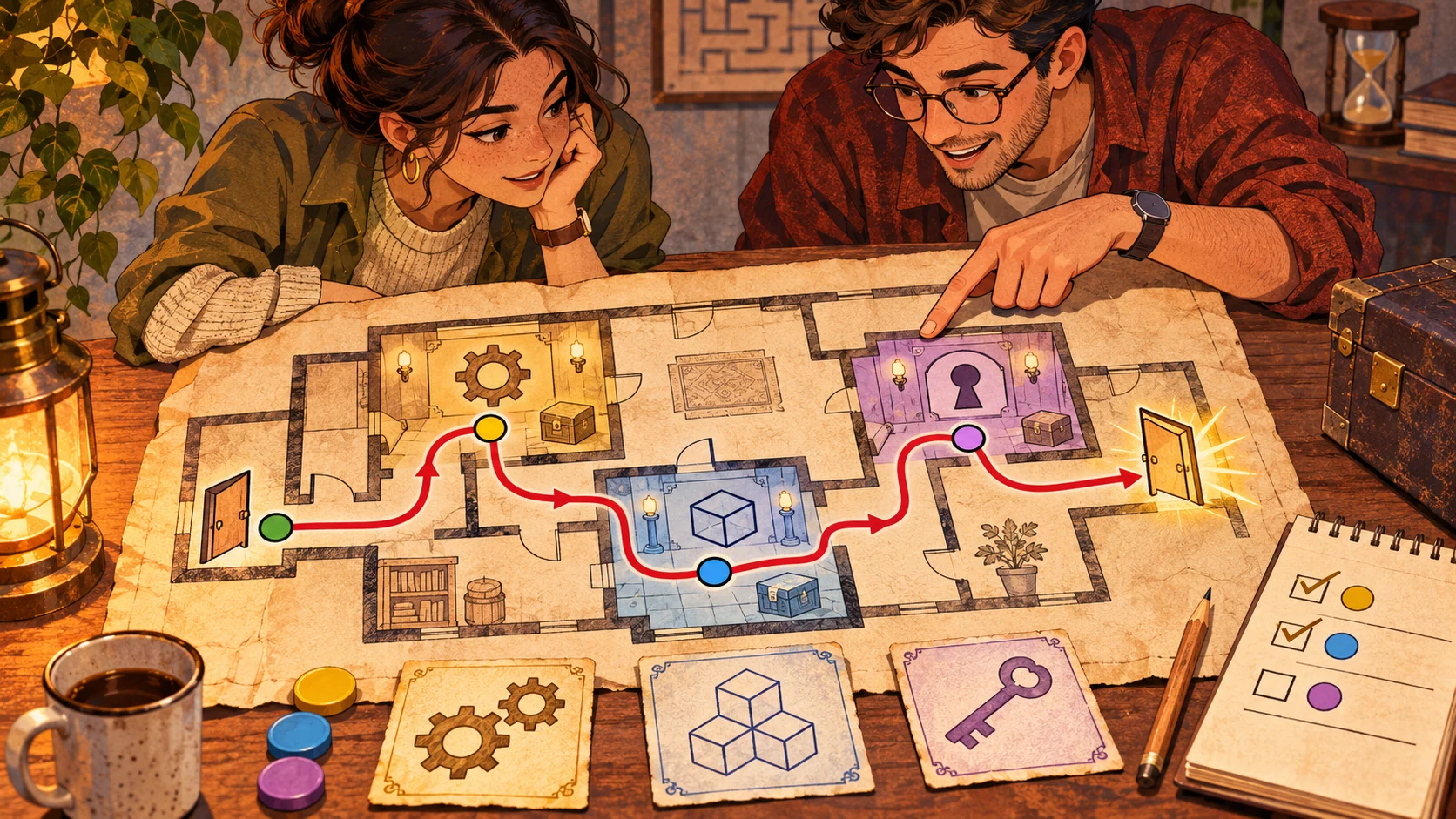
Co-op puzzles become hard to implement when the document uses vague phrases such as “players communicate” or “work together.” List what each player sees, what is common, and which action transfers a clue. If the game uses asymmetric information, ensure every private clue has a purpose and a way to communicate it. Avoid requiring voice chat unless voice is part of the intended experience; offer an in-game alternative such as a selectable clue card.
| Information | Player A | Player B | Shared state |
|---|---|---|---|
| Room map | Full observatory layout | Full observatory layout | Current room and solved stations |
| Clue card | Star chart symbol sequence | Clock dial symbol mapping | Notes and submitted answer |
| Team action | Select a symbol to report | Select a symbol to report | One agreed sequence |
Template — information and communication
For every puzzle, list what each player can see, what is shared, and how a clue can be communicated without leaving the game. Identify whether players act simultaneously or in turns. State what happens when reports conflict. Do not make progress depend on an unstated assumption about external chat.
Map the puzzle chain and its rules
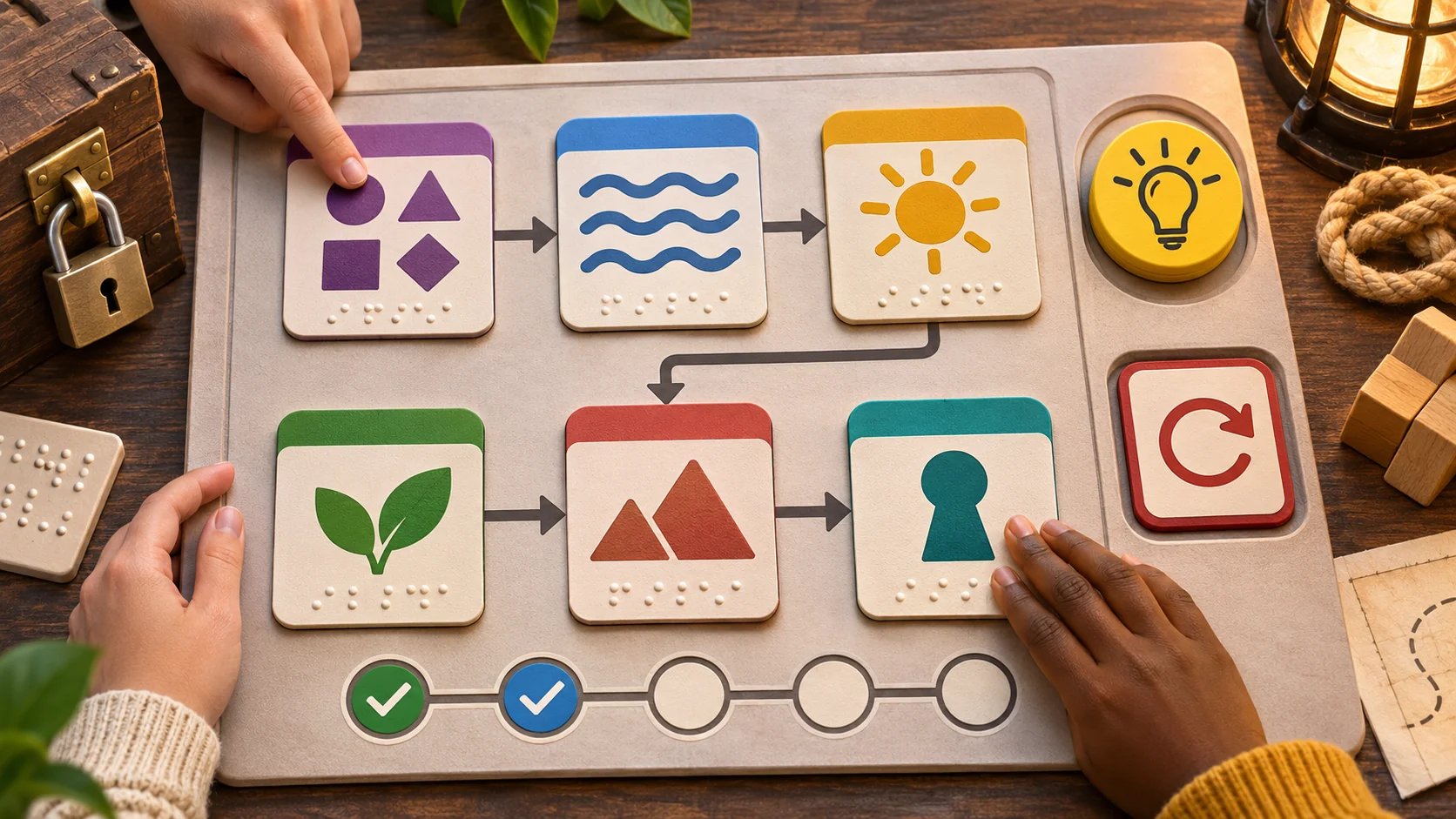
Describe each puzzle as input, player action, visible feedback and resulting state. A sequence diagram or short table helps prevent an AI-generated room from containing attractive props that have no interaction. Keep the first chain small: a clue discovery, a coordination step, and a final state are enough to show the core loop.
| Step | Input | Player action | Feedback | State change |
|---|---|---|---|---|
| Find the chart | Inspect a wall panel | Reveal a symbol sequence | Card appears in shared notes | Chart found |
| Compare clues | Open the clock dial | Combine the chart with a partner's mapping | Selected sequence is previewed | Answer ready |
| Submit | Confirm together | Both players accept the same sequence | Correct or try-again response | Cabinet opens or remains closed |
For each interaction, specify whether an incorrect answer can be retried, whether clues can be revisited, and whether either player can soft-lock the session. Prefer a forgiving first milestone: preserve discovered clues, show a clear response, and provide a reset for the active puzzle. These are design choices for the fictional example, not implemented behavior.
Design for coordination and accessibility
Cooperation should change decisions, not simply require two avatars to stand near the same object. Give teammates useful contributions and make the exchange visible. At the same time, allow players to recover when they miss a clue or need more time. A readable clue log, optional hint ladder, remappable controls and adjustable timer are useful requirements to state before implementation rather than late polish.
Template — cooperative interaction
Make the puzzle require [specific complementary contributions]. Show each player's available action and the shared objective. Provide a non-voice way to share clue information. Keep discovered clues available in a log. Add an optional hint ladder that reveals one nudge at a time, and let the team pause or reset the current puzzle. Do not penalize a player for taking longer to read.
The example can use a no-fail clock: a timer creates atmosphere but does not erase progress. If a later version adds a score or time pressure, document what it changes and provide a relaxed mode. That decision belongs in the rules, not in an implied assumption hidden in art direction.
Specify the first playable milestone
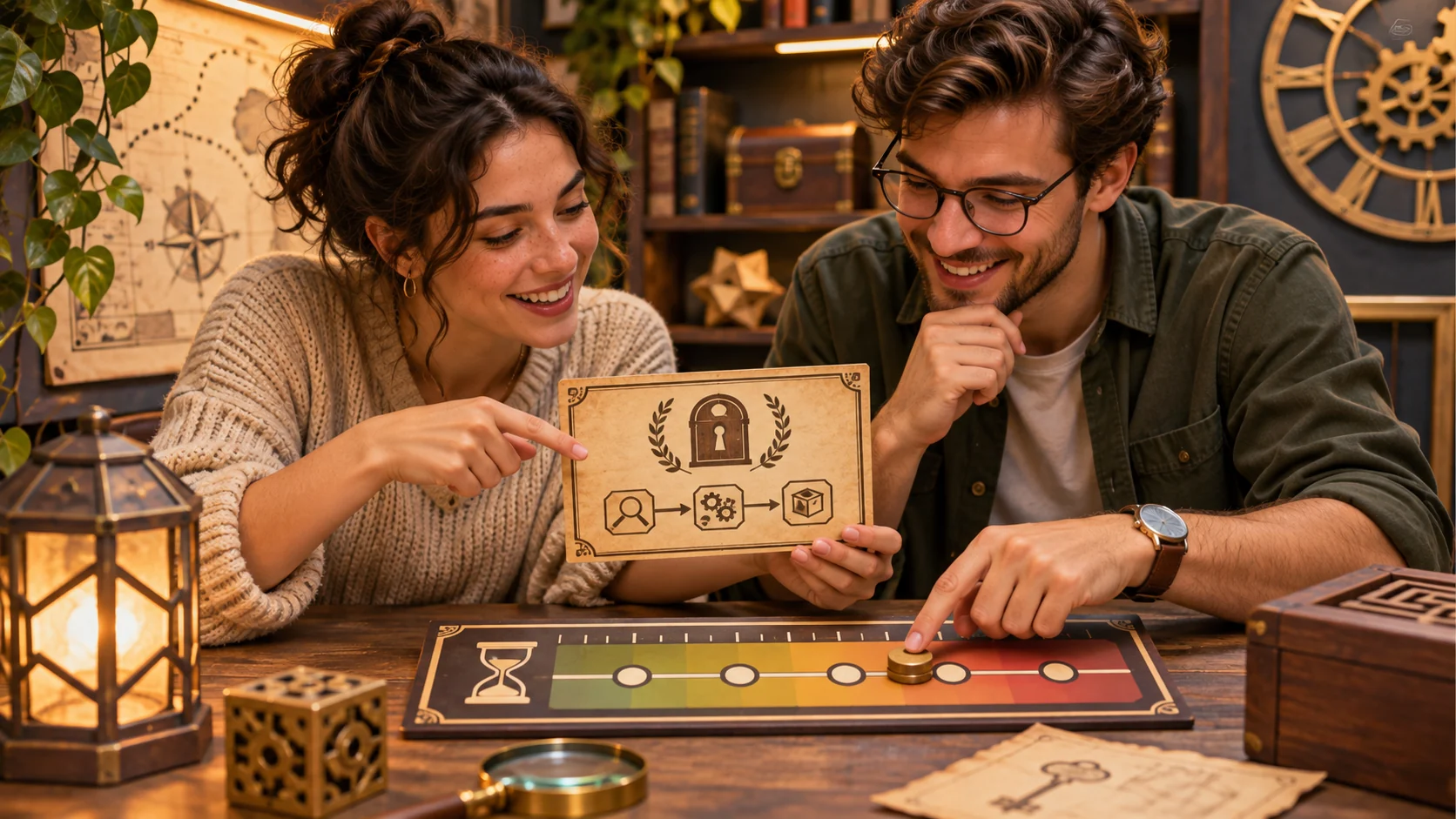
A GDD is more useful when it names what is deliberately out of scope. Request one room, one clue chain, two player roles, a shared notes panel and a complete success/retry loop. Exclude extra rooms, online matchmaking, inventory crafting and multiple endings until the core interaction is clear. Ask the builder to report missing or simulated pieces honestly.
Template — AI build request
Build a first playable prototype from this GDD: one observatory room, two local players, the star-chart and clock-dial clue chain, a shared notes panel, submit/try-again feedback, a cabinet-open ending, an optional hint and a reset. Keep clues readable at the target screen size. Include keyboard navigation and visible focus. Do not add extra rooms or online features. At handoff, list what is interactive, what is a placeholder and what remains unverified. Do not describe a mockup as playable.
A text response, image or clickable-looking mockup does not establish that the interactions work. Open the actual output and verify clue discovery, reporting, answer submission, retry and completion before calling the milestone playable. In this local article package, no such build was run.
Fictional GDD snapshot
The following compact snapshot shows how a filled template might read. All details are invented and untested.
| Field | Fictional planning value |
|---|---|
| Working title | The Clockwork Archive |
| Players and format | Two players, shared screen, local prototype |
| Core loop | Inspect → report clues → agree on sequence → submit → review |
| Win condition | Both players confirm the final sequence and the cabinet opens |
| Recovery | Keep found clues in notes; allow retry, hint and puzzle reset |
| First milestone | One observatory room and one three-step clue chain |
| Excluded | Online matchmaking, additional rooms, inventory economy and timed failure |
Review the document before generating
Use a short review pass to find ambiguity, missing states and scope creep. Ask the reviewer to quote the relevant requirement, then mark it clear, missing or conflicting. A review prompt should not invent test results or silently add mechanics.
Template — GDD review
Review this cooperative escape-room GDD for implementation readiness. Check player count and format; shared/private information; clue communication; puzzle inputs and feedback; incorrect-answer recovery; hints, pause and reset; success condition; accessibility requirements; first milestone scope; and excluded features. For each item, quote the supporting line and mark clear, missing or conflicting. Suggest only the smallest necessary clarification. Do not claim the prototype was built or tested.
A useful revision resolves one concrete ambiguity at a time. For example, “players share clues” can become “either player can add a discovered symbol to shared notes; submitting requires both players to confirm.” That sentence defines the action and completion condition without expanding the scope.
Conclusion
A co-op escape-room GDD should define the shared play promise, information boundaries, clue exchange, puzzle feedback, recovery options and a narrow first milestone. The Clockwork Archive demonstrates one way to fill the template with a two-player observatory puzzle, but its details remain fictional and unexecuted. Use the review prompt to surface missing rules, then verify any generated build before describing it as playable.
You can take a defined concept into the Free AI game maker, then compare the result with the milestone checklist above.
FAQ
What should a co-op escape-room game design document include?
Define player count, shared objective, information each player sees, clue communication, puzzle states, retry and reset behavior, accessibility needs and the first milestone scope.
How do I make escape-room puzzles require cooperation?
Give players complementary information or actions, then specify exactly how they communicate and combine them. Avoid cooperation rules that depend on unstated external chat.
What does AI-ready mean for a game design document?
Use explicit inputs, actions, feedback, state changes and exclusions so a builder has fewer rules to guess. It does not guarantee that the resulting game will work.
How large should the first playable milestone be?
Start with one room and one complete clue chain that demonstrates discovery, coordination, submission and recovery. Add more content after those states are verified.
Can a mockup count as a playable escape-room prototype?
No. A mockup can communicate layout, but interaction claims require opening and checking the actual output. The Clockwork Archive example in this article is a fictional planning snapshot, not a tested prototype.