Introduction
A cooperative zombie-shooter concept can sound clear while leaving essential rules open: do players share supplies, how do they revive a teammate, and what happens when a mission becomes too difficult? An AI-ready game design document (GDD) answers those questions before a builder fills the gaps with invented systems. It connects the shared survival fantasy to a small, verifiable first milestone.
This guide uses Last Light Depot, a fictional two-player scenario about escorting a small group to a temporary shelter. Its characters, district map, resources, threat pacing and sample values are invented. Nothing here describes a real game build or playtest, and the example avoids graphic violence.
Define the cooperative promise
Start with the player count, camera and session goal. Then say what each teammate contributes and how a team succeeds. “Survive together” is a theme, not an implementation rule. A useful promise might be: two players protect a moving group, choose a route through a compact district, and reach a safe zone before a shared supply meter runs out.
Template — shared survival loop
Create a cooperative zombie-shooter game for [player count] in [local/online format]. Players work together to [mission objective] while managing [shared constraint]. Each player contributes through [distinct role or action]. The mission succeeds when [observable goal] and ends early only when [clear failure condition]. Keep the first milestone to [one arena or short mission]. Use non-graphic presentation.
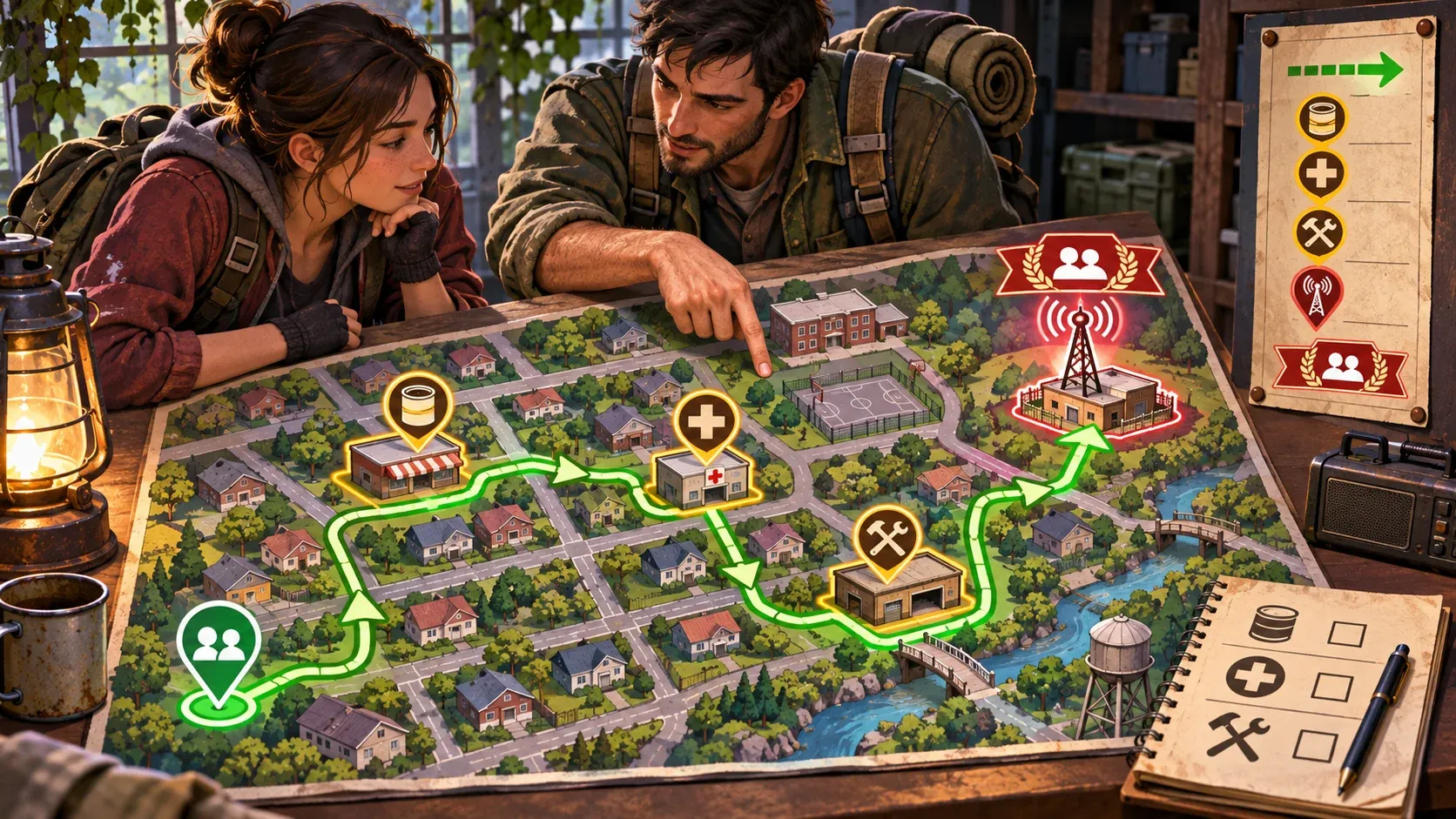
For Last Light Depot, the fictional objective is to move a group from a transit shelter to a nearby depot. Players choose one of two routes, protect the group during three pressure phases and reach the marked exit. The proposal leaves out a campaign, crafting and online matchmaking so the first mission stays focused.
Specify roles, support and shared resources
Co-op roles should offer useful choices without making one player a permanent assistant. Describe each role’s actions and constraints, then identify which resources are personal and which belong to the team. If a player is downed, state how recovery works and what it costs. Write the rules in visible terms: “spend one shared support token to revive” is clearer than “teammates can help.”
| System | Player A | Player B | Team rule |
|---|---|---|---|
| Role focus | Marks a route and calls attention to pickups | Carries a support beacon with limited charges | Either role can complete the objective |
| Ammunition | Personal magazine and reserve display | Personal magazine and reserve display | Shared reserve is visible before pickup |
| Recovery | Can be helped while downed | Can be helped while downed | Teammate spends one support charge to revive |
| Mission progress | Can activate the exit marker | Can activate the exit marker | Both players and the escorted group must reach it |
These are example rules, not balance findings. Let the GDD flag values that need tuning instead of presenting invented numbers as proven difficulty settings.
Make pressure readable and recoverable
Escalating threats work best when the team can see what is changing. State what triggers each phase, what warning appears, and what choice the team can make. A pressure phase might close one route, increase the number of fictional opponents in an area, or ask the team to hold a location briefly. Keep the first prototype to one or two threat changes so the cause and response remain understandable.
Template — threat pacing
Define [number] pressure phases. For each, specify its trigger, visible warning, changed constraint, player response and exit condition. Give players time to understand the warning before the change takes effect. Provide a retreat or recovery option. Do not use surprise damage as the only feedback, and keep presentation non-graphic.
A fictional phase table can say: “At the second checkpoint, a blocked street removes the shortest route; the map marks an alternate path; the team may spend time to take it.” That is a legible tradeoff. The values and pacing still need to be evaluated in a real build before any difficulty claim is made.
Map the mission from entry to exit
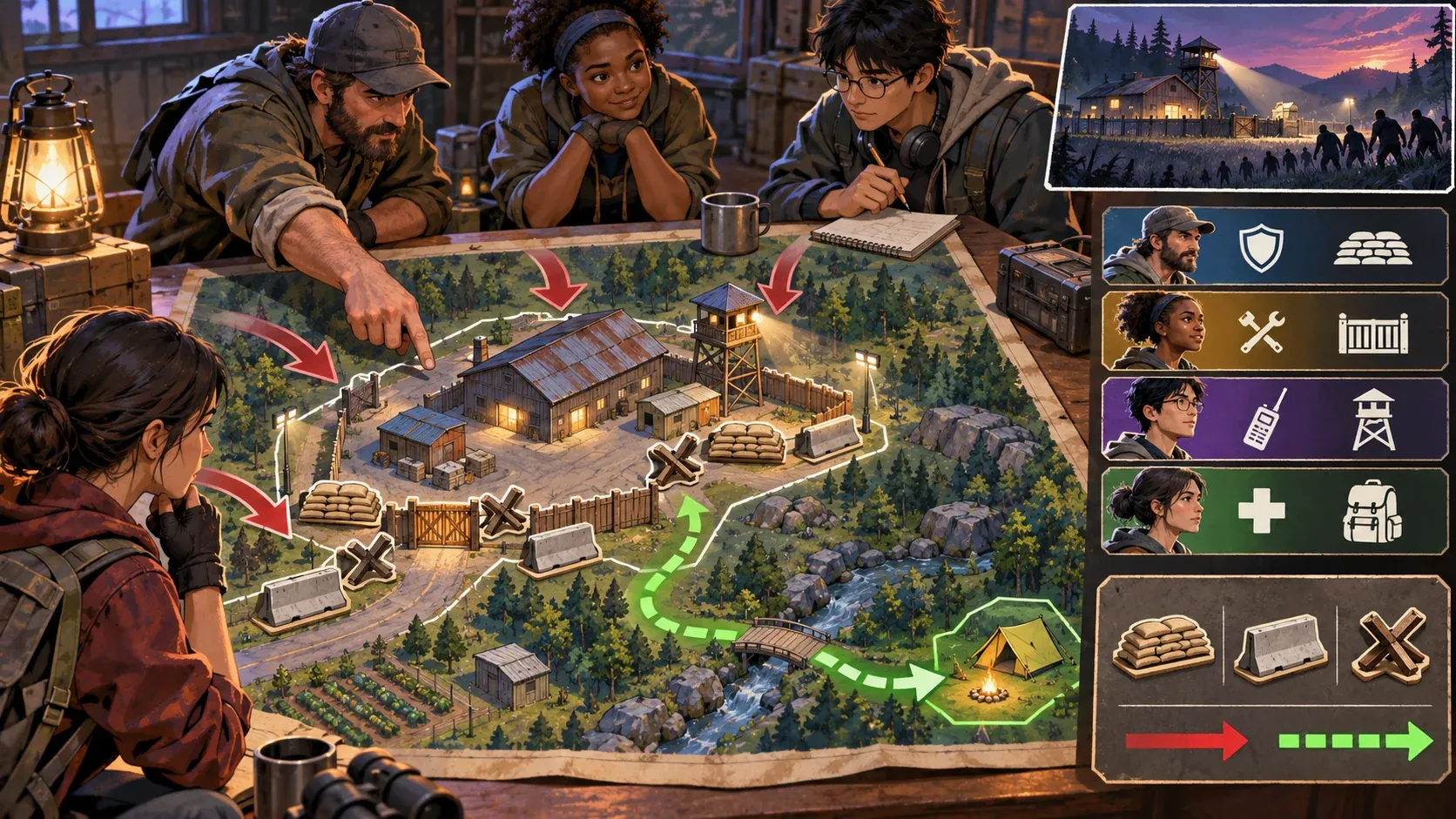
A short mission needs a route, a few meaningful decisions and a visible finish. Describe where the team starts, where optional resources appear, what can change and how the end state is confirmed. Avoid filling the map with props that do not affect play. A route sketch or simple table gives a builder concrete locations without requiring a large world.
| Beat | Team decision | Visible consequence | State to record |
|---|---|---|---|
| Transit shelter | Pick north or east route | One route is shorter; the other passes a supply stop | Route selected |
| Checkpoint | Continue or pause to assist the group | Time and shared support capacity change | Group status updated |
| Depot gate | Spend a beacon or take a longer path | Support reserve or remaining time changes | Gate approach chosen |
| Safe zone | Confirm the whole group arrived | Mission summary appears | Success or incomplete state |
Template — mission map
Outline one compact mission with a starting point, [number] route choices, [number] pressure beats, an optional support resource and a clear exit. For each beat, state the player decision, feedback and updated game state. Include a route reset or retry. Keep areas readable and avoid adding systems outside the first milestone.
Write the first playable milestone

Ask for a complete loop, not a sprawling feature list. A focused milestone could include two local players, one short route, one support resource, readable warnings, a downed/revive state, an escorted group marker and a mission summary. Exclude progression trees, weapons inventories, multiple districts and online systems unless one is essential to the core promise.
Template — AI build request
Build a first playable prototype from this GDD: one compact district mission, two local players, two complementary but equally useful roles, one route choice, three readable pressure beats, a shared support resource, a recoverable downed state, an escorted-group status and a clear safe-zone ending. Use fictional non-graphic opponents and simple placeholder visuals. Include pause, reset and keyboard-accessible controls. At handoff, list which interactions work, which are placeholders and what remains unverified. Do not describe a static mockup as playable.
A prompt can request a build, but it does not prove one exists. Open the actual result and check movement, route choice, resource changes, revive, group progress and ending before calling the milestone playable. No such build was run for this article.
Fictional GDD snapshot
The sample below is a planning illustration only. It is not a balance sheet or test result.
| Field | Fictional planning value |
|---|---|
| Working title | Last Light Depot |
| Format | Two local players; shared mission objective |
| Mission | Escort a small group from a transit shelter to a depot safe zone |
| Core loop | Choose route → respond to pressure → support teammate/group → reach exit |
| Shared constraint | One abstract support beacon with a visible remaining charge |
| Recovery | Downed teammate can be revived by spending the beacon charge |
| First milestone | One district map, two route choices and one complete mission |
| Excluded | Online matchmaking, campaign progression, crafting and graphic injury detail |
Review for ambiguity before generation
Use a review checklist to catch missing conditions and conflicting rules. Require the reviewer to point to the GDD line behind each result. If no rule describes what happens when a teammate leaves, a route closes or the group falls behind, mark it as a question rather than inventing an answer.
Template — readiness review
Review this co-op zombie-shooter GDD for player count and format; role usefulness; personal/shared resources; pressure triggers and warnings; route choices; teammate recovery; escorted-group state; success and failure conditions; accessibility; first milestone scope; and excluded features. For each, quote the supporting line and mark clear, missing or conflicting. Ask a focused question when the document is silent. Do not invent balance results or claim the game was tested.
A practical revision narrows a vague rule. Replace “the team has limited supplies” with “the map displays the team’s remaining support charges before the route choice.” That defines when the information appears and what decision it supports, without asserting that the mechanic has been implemented.
Conclusion
An AI-ready co-op zombie-shooter GDD makes roles, shared resources, pressure warnings, routes, recovery and mission completion explicit. Last Light Depot shows how to frame those systems in one fictional mission while keeping scope and evidence boundaries clear. Use the templates to request a small prototype, then verify the interactions in the actual output before reporting a playable result.
You can take a defined concept into the Free AI game maker, then compare the result with the milestone checklist above.
FAQ
What belongs in a co-op zombie-shooter game design document?
Specify player count, roles, shared and personal resources, threat pacing, mission routes, teammate recovery, win/failure states, accessibility and the first build scope.
How do I design cooperative roles without making one player secondary?
Give both roles useful actions that affect the shared mission, and make sure either player can help complete the objective. State what each role contributes and where the roles can overlap.
How should a game document escalating threats?
For each phase, define its trigger, warning, changed constraint, player response and exit condition. Treat example values as untested until checked in a build.
What should the first playable milestone include?
One short mission that demonstrates movement, a meaningful team choice, a visible resource change, recovery and a clear ending. Keep unrelated progression and online systems out of scope.
Does an AI-ready GDD prove that a game is playable?
No. It gives a builder clearer requirements. A playable claim requires checking the actual output; a static mockup or fictional example is not a test result.