Establish a playable baseline for both roles
Before adding tutorial levels, write down what each player can see, control, and change. In an asymmetric co-op game, the same room may present different information to each partner. Map the shared objective and each role’s inputs so a new rule does not accidentally depend on knowledge available to only one player.

Valve’s Portal 2 listing describes a dedicated two-player campaign with separate chambers and fresh puzzle elements. That supports the co-op puzzle campaign context; the gradual teaching plan here is original. Begin with one existing room and record its completion time, failed interactions, partner handoffs, and points where one player waits without useful information.
Use that baseline to define a small learning sequence. Each level should name one intended discovery, one practice opportunity, and one observable success condition. Keep the original core action intact while you add new rules, so playtesters can tell whether confusion comes from the new mechanic or an unrelated change. The cover illustration shows two viewpoints in a connected chamber.
Introduce each rule through visible examples
A first encounter should make the rule available before demanding mastery. Show a symbol, object, or state change that implies what can happen, then give players a safe chance to try it. The goal is not to explain every answer; it is to let players form a testable hypothesis together.
In the next room, repeat the same interaction with a small variation. If one player sends a signal and the other moves a gate, let them see the result and recover from a wrong attempt. Avoid adding a timer, moving hazard, and new control at the same moment. Those pressures can be layered after the basic exchange is understood. The mechanism graphic lays out a demonstration, practice room, and combined challenge.
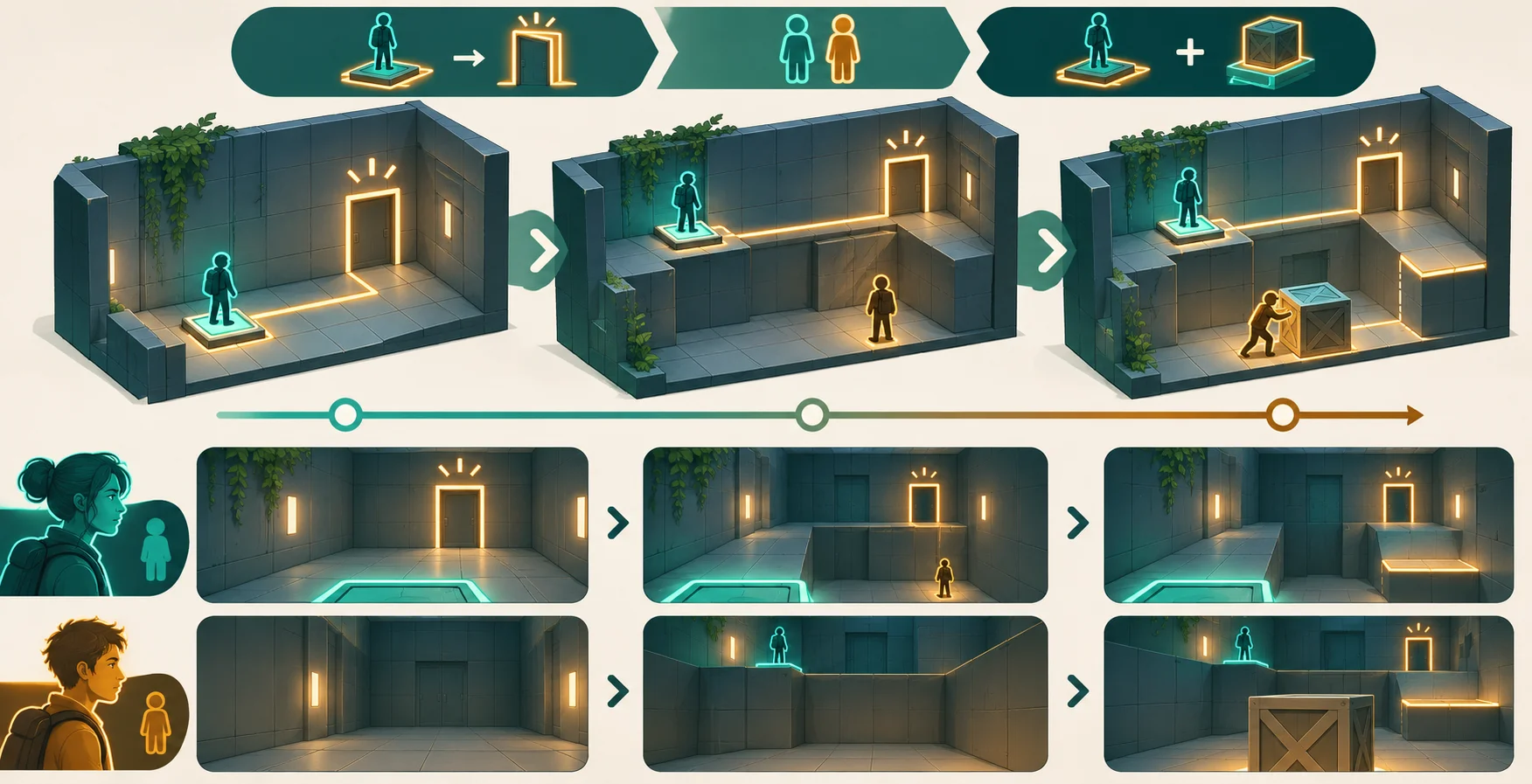
Each partner needs a meaningful action during the lesson. The player with less information can still inspect a clue, ask for a signal, or change the room. Consider optional hints that reveal the next observation rather than simply naming the solution. That keeps communication central while offering a path forward when a pair is stuck.
Combine familiar rules without overloading a level
Once players have practiced a mechanic, use it again in a changed context. A signal used to open a door might now route a moving platform, while the partner handles a familiar switch. Combining rules shows that earlier learning matters and gives the campaign a sense of progression.
Keep the number of simultaneous demands small. A pair should be able to identify which known rule applies, discuss who will act, and recover if timing is wrong. If a level introduces a new rule, let it be the only unfamiliar rule in that room. Later challenges can combine it with established mechanics and add optional mastery goals.
Use different level shapes to test transfer. A rule may work in a mirrored room, under a new spatial arrangement, or after players swap roles. Avoid copying the same puzzle with only a different color. A good variation asks players to recognize the principle and apply it with information they must exchange.
Test comprehension, pacing, and recovery
Observe pairs playing the full sequence without verbal coaching from the designer. Track time to first useful action, incorrect assumptions, hint use, role inactivity, and whether both players can explain the rule after the level. Ask each player separately what they understood; one confident partner can hide that the other never learned the interaction.
Replay the sequence with different experience levels, role swaps, and communication preferences. Test what happens when a clue is skipped, an interaction is repeated, or a player disconnects and rejoins. Hints, restart points, and accessibility options should help a pair recover without silently changing the rule or blocking campaign progress.
Accept the progression when players can identify the rule, practice it, and use it in a later combined room without relying on accidental trial and error. Review the prompt guide for a core playable foundation. SEELE AI can help outline alternate room sequences, but rule implementation, accessibility decisions, and cooperative pacing still need direct playtesting. The outcome image depicts both players applying their learned roles to open the route.

FAQ
How do you teach new rules in an asymmetric co-op game?
Demonstrate one rule in a low-pressure room, give both partners a useful action, then repeat it with a small variation. Add timers, hazards, or combinations only after the pair can explain the basic interaction. Test with pairs who have not seen the design before.
How many mechanics should one level introduce?
For a teaching level, keep one rule unfamiliar and let the rest come from mechanics players already practiced. A room may still be challenging, but players should be able to tell which part is new and what feedback confirms their interpretation.
How can co-op tutorials prevent one player from waiting?
Give each role information and an action that changes the shared puzzle state. Alternate who initiates decisions, and check time spent idle in playtests. A player who only watches or repeats instructions is unlikely to feel like a partner in solving the level.
What should you test in a rule-teaching progression?
Play the entire level sequence with different pairs and role assignments. Track confusion, failed interactions, hint use, idle time, and whether players transfer a rule to a later room. Also test skips, restarts, and recovery from missed clues. Check this again after a role swap and with a pair that has not played together before.