Use a shared objective and bounded team decisions so cooperation changes card play without erasing individual agency. A compact prototype should connect one player action to clear feedback and the next decision before adding more content.
Set the competitive card-game baseline
Begin with the competitive prototype’s turn sequence, deck rules, and player information. Then define one shared objective that gives both players a reason to coordinate. A cooperative mode should change the decision space, not simply remove player-versus-player damage and leave the rest of the game untouched.

The official Across the Obelisk listing describes a co-op roguelite deckbuilder with online groups, party decisions, and coordinated tactical combat. This supports the genre context only; the shared-decision rules proposed here are new design guidance. See the Across the Obelisk official Steam product listing for this context.
Define shared decisions and player roles
Choose decisions that are genuinely shared: which card to upgrade, where to spend a limited team resource, or which route the party takes. Keep private choices where they add identity, such as a player’s deck archetype, but show how those choices affect the team’s plan.
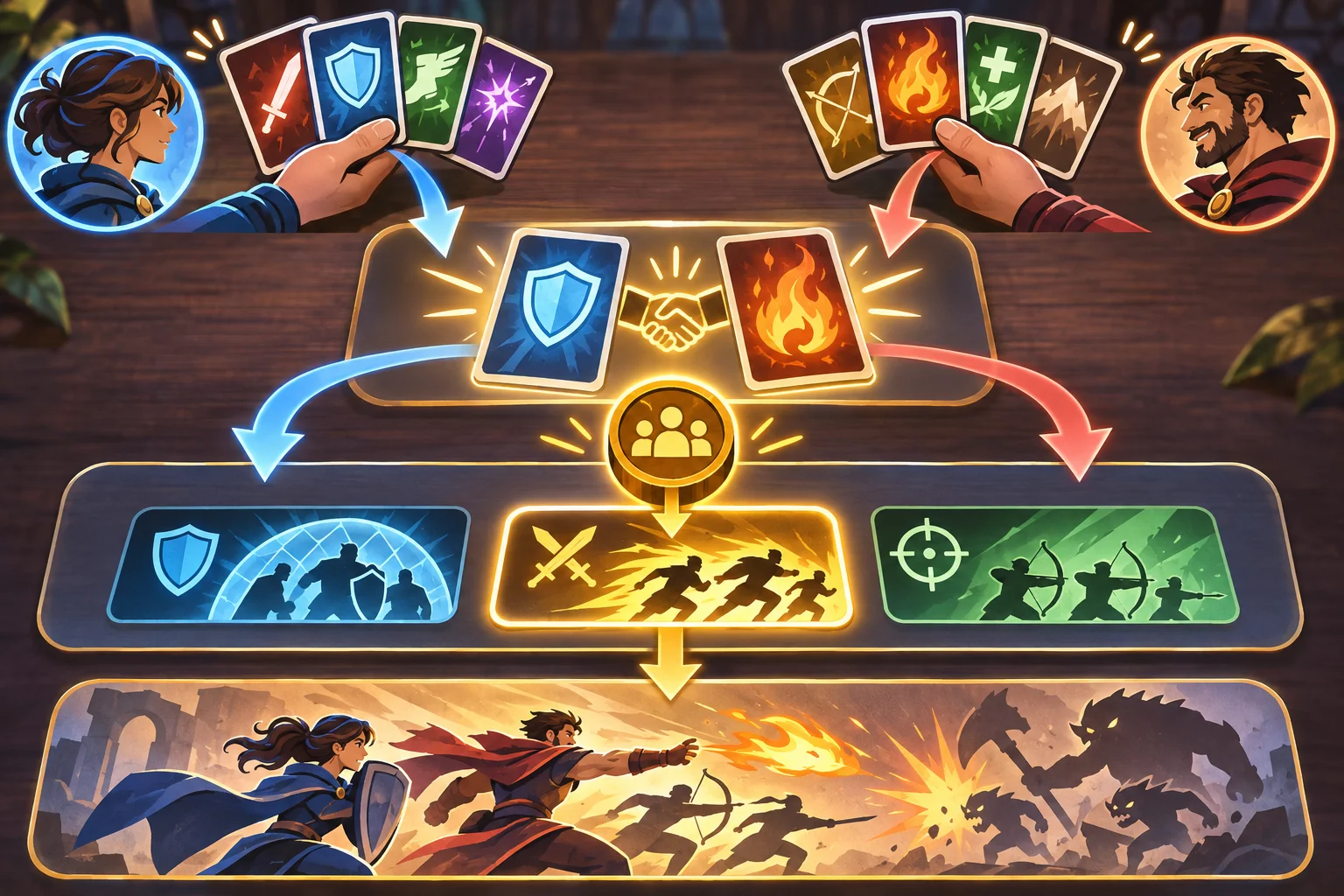
Make turn order and commitment rules explicit. A short proposal phase can let players discuss a plan, followed by a simultaneous or alternating reveal. If players can override one another, explain that rule and provide a way to revisit an accidental choice before the action resolves.
Connect team choices to card play
Connect cooperation to card text and deck construction. Add a few cards that set up a partner’s action, protect a shared resource, or reward complementary timing. Avoid requiring a particular pair of rare cards to make the mode work; the baseline deck should already support at least one team plan.
Use a visible shared resource only when it creates a choice. Show who spent it, what the team gained, and which alternatives are no longer available. Test the same encounter with different deck combinations to catch a mode that only works with a narrow build.
Test cooperation and individual agency
Run a sample battle with two players and record proposals, disagreements, card use, and idle time. Test one plan that succeeds and another that fails so players learn whether the outcome came from their shared decision or random draw. Verify that each partner contributes at least one consequential choice.

A compact acceptance case has distinct decks, one shared objective, one team resource, and two viable plans. Use the a cooperative command-role design guide to compare role ownership and coordination responsibilities. SEELE AI can help brainstorm card interactions; implementation, rules tuning, and co-op playtests remain necessary.
FAQ
How do shared decisions work in a cooperative card game?
Give players a common objective and define which choices require agreement, such as spending a team resource or selecting a route. Each player can retain a distinct deck role. Make the decision order visible, then test whether both players affect the outcome rather than simply taking turns following one person’s plan.
How can deck construction support cooperative choices?
Include a small set of cards that prepare, protect, or amplify a partner’s action, while keeping the basic team strategy available to starter decks. Test multiple deck combinations so a cooperative encounter does not depend on one rare card pair or a fixed party composition.
How do you keep one player from controlling the whole team?
Give both players separate resources or information, and design at least one consequential decision for each. A proposal-and-commit phase, turn limits, or role-specific actions can help. Playtest with pairs and observe who makes each decision instead of assuming the interface alone will create balance.
What should you test in a co-op card-game prototype?
Test a successful and a failed encounter with different deck combinations. Observe whether both players understand the shared objective, discuss a team plan, and make consequential choices. Record idle time, accidental commitments, and cases where one player can dominate every decision.