An asymmetric player role can make a collectible card game prototype feel more expressive, but it can also affect deck construction, card access, turn flow, match balance, and saved data. Start by recording the current rules. Add one visible role choice through a narrow data layer, then compare it against the existing role without changing the shared card pool or resolver by default.

This guide addresses a continuation task in an existing prototype. The roles, cards, ability rules, sample matches, and outcomes are invented. No codebase, build, deck list, or playtest was available. Every test below is a proposed check rather than proof of a real game behavior.
Capture the current deck and match contract
Make a clean commit or duplicate the project before editing. Record how decks are built and validated, how the starting hand is drawn, how turns advance, how card effects resolve, and what gets saved. Note whether the existing prototype already has player classes or role restrictions. If these systems cannot be inspected, state that limitation instead of assuming a standard card-game architecture.
Write down what must stay the same for the original player. That might include legal deck contents, card costs, draw rules, mulligan, effect timing, resource curve, and match win conditions. Use the current game’s implementation as the authority; a guide or generated mockup cannot confirm the project’s exact rule order.
| System | Baseline evidence | Keep intact by default |
|---|---|---|
| Deck construction | Allowed cards, copy limits, validation | Existing legal deck behavior |
| Card catalog | Stable card IDs, costs and effects | Shared card definitions |
| Turn flow | Draw, play, response, end turn | Core resolver and timing |
| Match data | Role, deck, player seat and save keys | Existing prototype compatibility |
Ask AI to inspect only the files provided and produce a small file-by-file plan before code. Require a list of systems it will leave unchanged. If it proposes editing every card to create role identity, ask whether a separate role ability can produce the intended decision with less risk.
Define asymmetry as a bounded decision
A role should change how a player makes a decision, not hide a numerical advantage. Options include a once-per-match choice between two modes, a limited reaction window, a different opening resource, or a visible card-selection option. Define the trigger, target, limit, cost, timing, and counterplay. Avoid “always better” bonuses or effects that bypass the shared turn structure.
In the fictional Glass Orchard prototype, the Archivist can once per match reorder two cards at the bottom of the deck, while the Warden can once per match protect one unit from a single status effect. Both use the same card set and standard turn sequence. These invented abilities illustrate scope only; they are not balance-tested or recommended values.
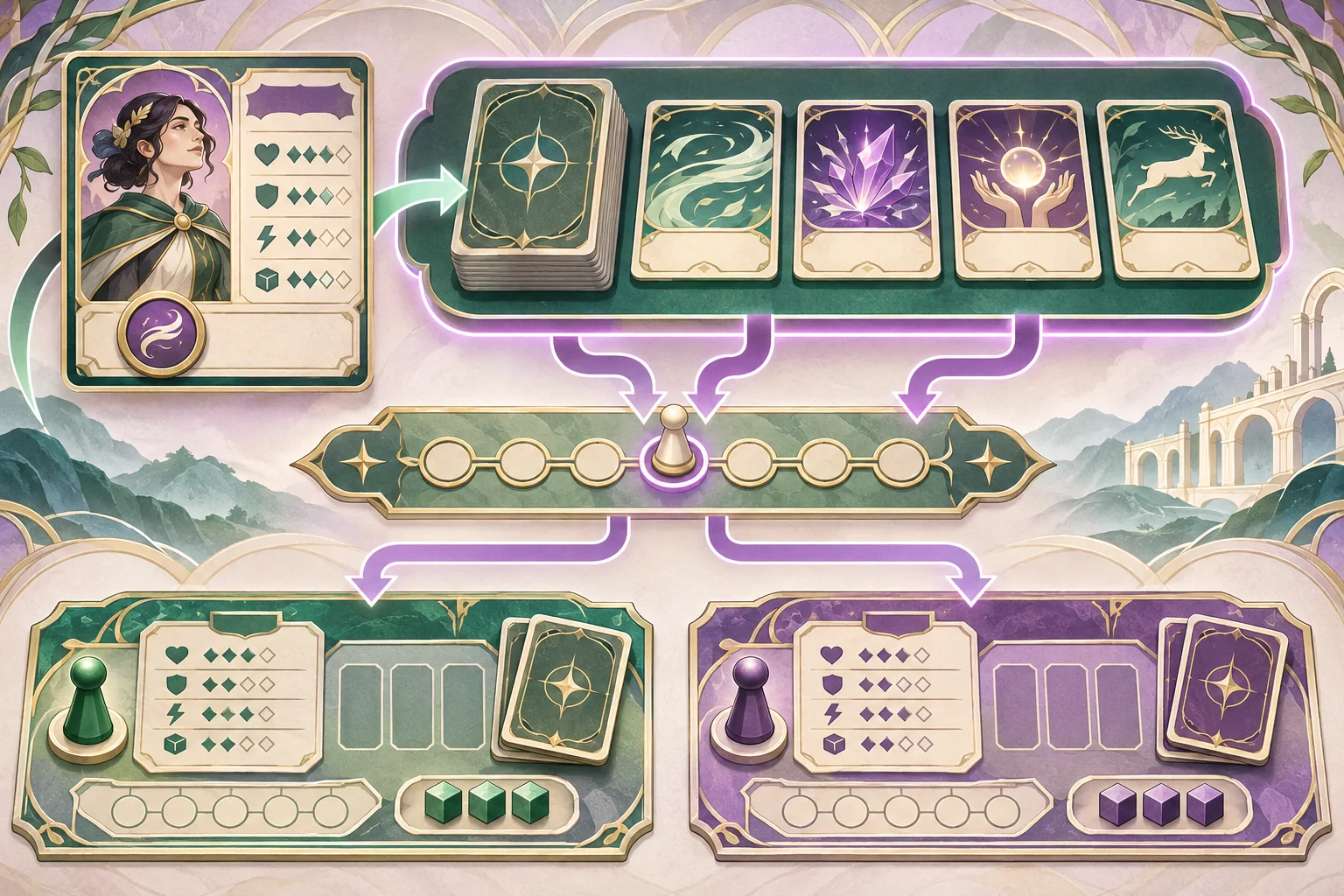
Keep the ability visible to both sides. Players should be able to anticipate when a role can act and what it can affect. If an ability changes deck access, state that before players build a deck. Do not let role choice silently invalidate a deck that was legal under the original prototype.
Separate role configuration from card definitions
Keep role IDs and supported settings separate from the card catalog. The role layer can describe its name, presentation, and allowed ability IDs; the existing game should still resolve the ability through known code paths. Avoid storing executable script fragments in editable role data. Reject unsupported IDs and show a readable error when a saved role uses an ability the current build does not know.
Godot’s stable Resource documentation describes Resource as a serializable engine-specific class that primarily serves as a data container and can be saved to disk. This supports one possible Godot-native way to represent data, not a universal recommendation for a card-game role schema. Use the target project’s existing data convention, whether that is Resources, JSON, or another format.
If the role data is saved or shared, version it only as needed and define fallback behavior for old files. Keep player-facing data declarative and validate it before starting the match. Do not allow an unknown role property to fall through into a card effect or global rules change.
Keep the shared card pool and competitive rules stable
For the first vertical slice, add one role definition and one ability hook to the existing match setup. Keep deck size, copy limit, card list, hand size, draw count, and turn order unchanged unless the product specifically requires a change. If the role must affect construction, create an explicit eligibility rule that the deck validator can explain before matchmaking or play begins.
Make role ownership clear in the match state. The ability should belong to the player who selected it, reset at the documented point, and never be accidentally copied to the opponent. Decide whether it persists through a rematch, save/load, or a new game. If the current prototype has no persistence for roles, do not add broad save migration work as an incidental side effect.
Godot’s RandomNumberGenerator documentation says a given seed produces a reproducible pseudo-random sequence in that engine context. It does not prove the target prototype uses that API or that a whole match reproduces identically across versions. If the project has a random test harness, record the actual generator and version; otherwise use a fixed fixture for repeatable role tests.
Plan the smallest change and its rollback
Ask AI to propose an allowlist such as one role data file, one selection or match-setup surface, one narrow ability handler, and focused tests. Keep card definitions, the shared resolver, existing deck rules, old role, campaign flow, and ranking code outside the change unless project inspection shows a dependency. Require a complete diff and rationale for every modified file.
Save a baseline commit and a copy of any role or deck data before applying the patch. If the ability needs a large resolver refactor, split that work into a separately reviewed task. The new role should be removable by reverting the feature commit without requiring a full database migration or changes to every card.
| Proposed slice | Potential addition | Protected reference |
|---|---|---|
| Role selection | One role ID in match setup | Existing deck selection flow |
| Ability data | One known ability and limit | Card catalog and effect text |
| Resolution | One validated hook at existing timing | Common turn resolver |
| Persistence | Optional role field with fallback | Existing save and deck format |
| Tests | Role swap and limit cases | Original player baseline |
Test roles under equal conditions
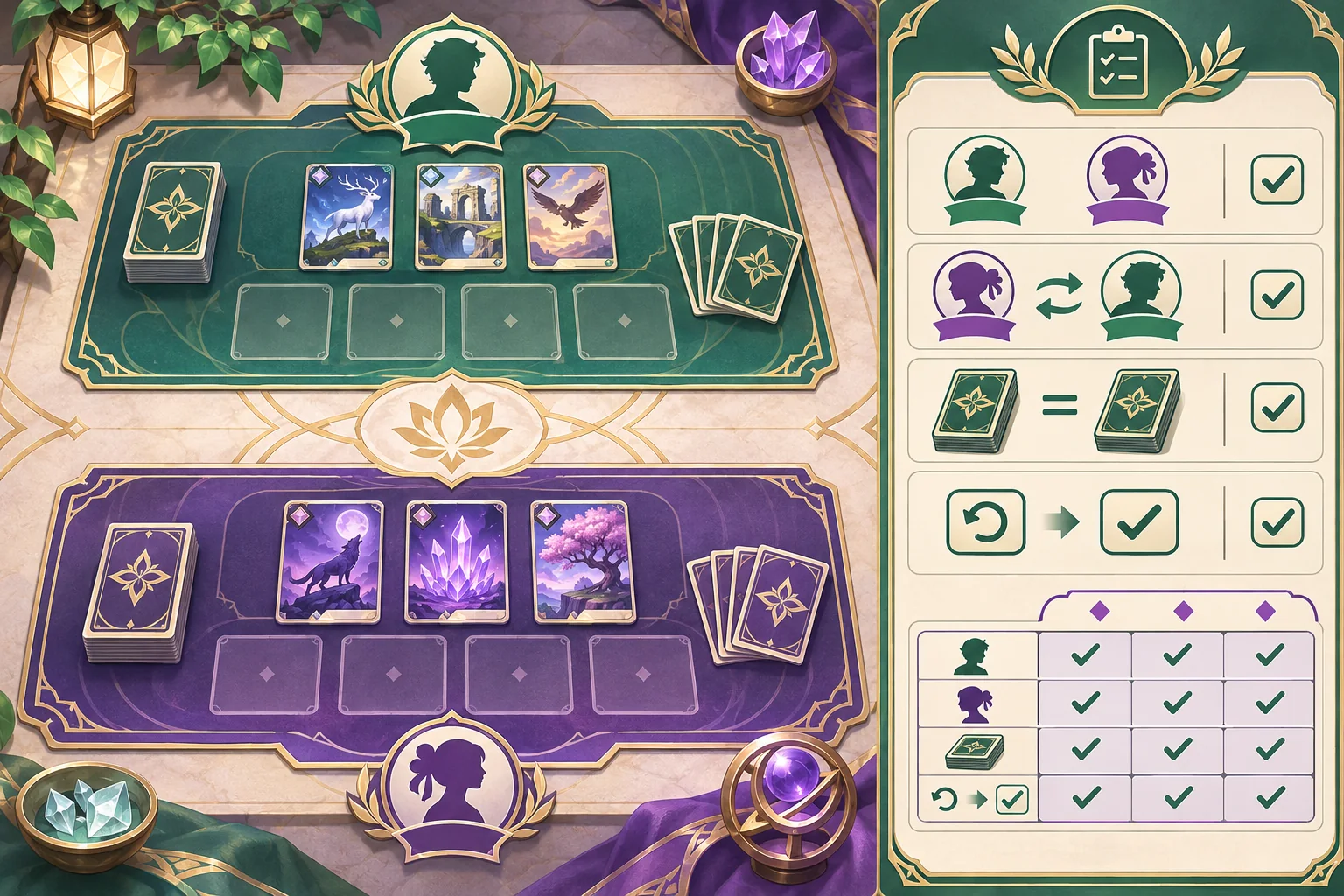
Compare roles using the same deck fixture, card order, match rules, and player seat. Swap which role goes first and which player owns it. Test the ability at its valid timing, after it has been used, against an invalid target, and after a reset. Check that the opponent sees the same public information and that both roles can still use the normal card rules.
| Proposed check | Action | Record |
|---|---|---|
| Original-role regression | Run a known deck with the old role | Build, deck, turn trace and outcome |
| Role swap | Swap roles between player seats | Seat, opening hand and ability timing |
| Ability limit | Attempt a second use in the same match | Expected block and visible feedback |
| Deck validation | Load a deck with restricted cards | Legal/illegal result and explanation |
| Save/load | Open an old match or deck copy | Fallback and preserved data |
| Rollback | Restore baseline commit | Original role remains playable |
This is a test plan, not executed evidence. Record project version, role ID, deck fixture, player seat, random fixture if available, action, expected result, actual result, and any discrepancy. One fabricated match or seeded run does not establish competitive fairness, especially if the target game has hidden draws or opponent-specific effects.
Review clarity and balance separately
Mechanical correctness and competitive balance are separate questions. First verify that the role triggers at the right time and does not break card resolution. Then use real play data or structured playtests to study matchup distribution, interaction, and counterplay. Do not describe an ability as fair or balanced based on a code review, a mock interface, or a small invented example.
To explore a separate collectible-card-game concept, try SEELE AI Game Maker. It is a concept tool, not an existing-project editor.
Frequently asked questions
What makes a player role asymmetric in a card game?
A role should create a distinct, understandable decision through a bounded ability, opening resource, or once-per-match choice. Keep the card pool and turn sequence shared where possible. Avoid hidden rules that make the role stronger without a clear cost, counterplay, or visible explanation.
Should a role change the cards a player can build a deck with?
Only change deck access when the existing game already has a role-based legality system or the feature explicitly requires one. Preserve current deck validation by default. If access changes, state the rule before construction and test old decks, invalid lists, and saved deck data.
How can I test two asymmetric roles fairly?
Use the same card list, match setup, and test conditions while swapping player order and role assignment. Record the ability use and outcome rather than relying on a single win. A planned matrix or invented sample match is not evidence of balance or competitive fairness.
How should role abilities be stored in an existing prototype?
Keep role identifiers and supported values separate from card definitions and the match resolver. Use the data format the project already loads, add a schema version only when compatibility needs it, and reject unknown abilities. Avoid storing executable script text in player-facing role data.
Can AI add a role to my existing collectible card game?
AI can inspect supplied files, outline a limited change, and draft role-swapped regression cases. It cannot verify the prototype or competitive balance without the real project and executed tests. Provide a file allowlist, baseline deck, expected ability rules, and rollback commit, then review the complete diff.
Add a role without destabilizing the shared rules
Record the deck and match baseline, define one visible ability, and keep role data separate from shared cards and turn resolution. Add the role through a narrow patch, test it under equal fixtures with swapped player order, and preserve a clean rollback point. Treat balance and compatibility as unverified until the actual prototype has been tested.