A collectible card game prototype needs two connected decisions: which cards to include in a deck, and how to spend limited resources during a match. Start with a tiny collection and a deterministic opponent. Once deck validation, card effects and victory work, you can explore variety without losing track of the rules.
This guide describes a fictional card game and a proposed AI-assisted build. Its cards and match walkthrough are design examples, not a report of a completed or tested product. The small numbers make each state change easy to check.
Separate the collection from the deck
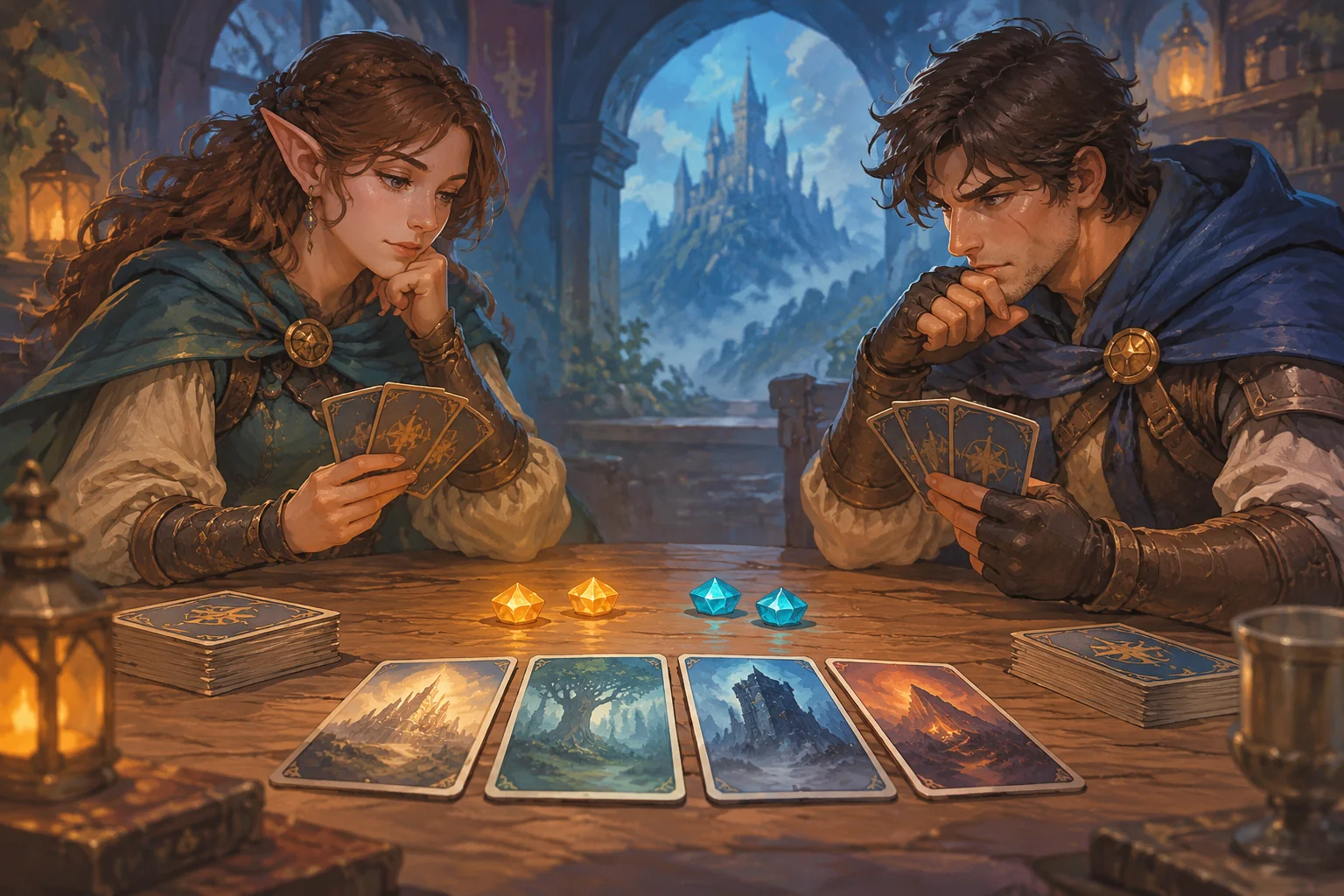
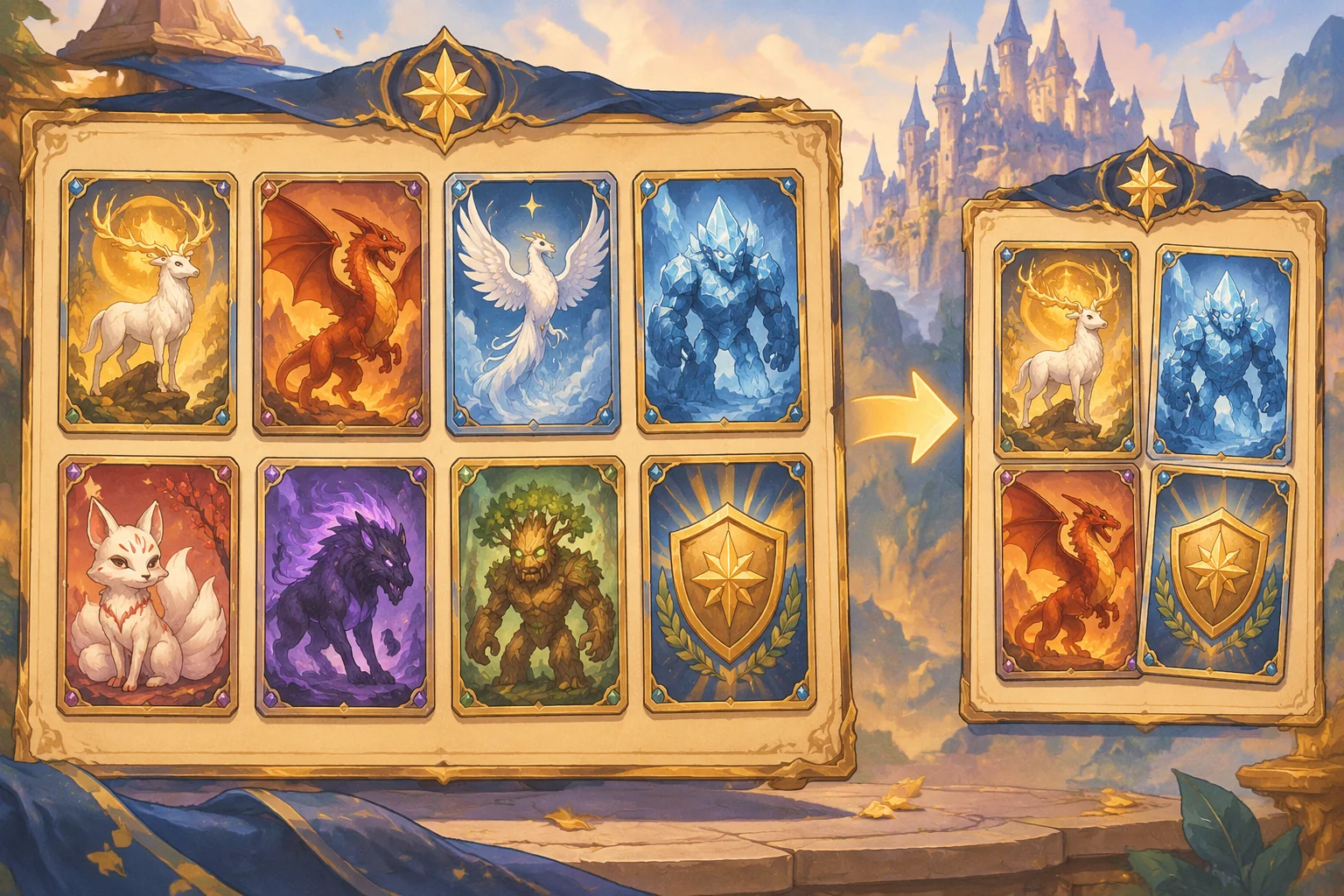
Give the player a collection containing three copies each of three original cards. Before a match, the player chooses exactly six cards, with no more than three copies of any one card. The collection is the set of available cards; the deck is the selected, ordered list used for one match. Selecting a card for the deck does not permanently remove it from the collection.
| Card | Energy cost | Effect in this example |
|---|---|---|
| Ember | 1 | Deal 2 damage to the opponent |
| Ward | 1 | Prevent up to 2 damage from the next opponent attack this turn |
| Comet | 2 | Deal 4 damage to the opponent |
Show the deck count and copy limit while the player chooses. Disable the match-start action until the deck has exactly six legal cards. The constraints create a small choice: more damage cards can end a match quickly, while defense cards give the player another response to incoming damage.
Define the turn before creating card art
Both sides begin with 8 health. The player draws three cards at the start of the match, then draws one at the start of each later player turn if any remain. Refresh the player's energy to 2 at the start of each player turn. Playing a card costs its printed energy and moves it from the hand to a discard pile after its effect resolves.
When the player ends a turn, the opponent makes one attack for 2 damage. Ward protection does not stack: one or more Wards prevent at most 2 damage from that attack, and any unused protection expires immediately afterward. If health reaches zero or less, end the match at once. In particular, an opponent defeated by a card does not attack after that card resolves. An empty deck simply means no card is drawn; it does not cause damage in this prototype.
For reproducible checks, allow the player to set deck order and do not shuffle in this version. That is a testing convenience, not a recommendation for a final competitive release. The opponent uses a fixed response, so this first build can test the loop without claiming to be a balanced match.
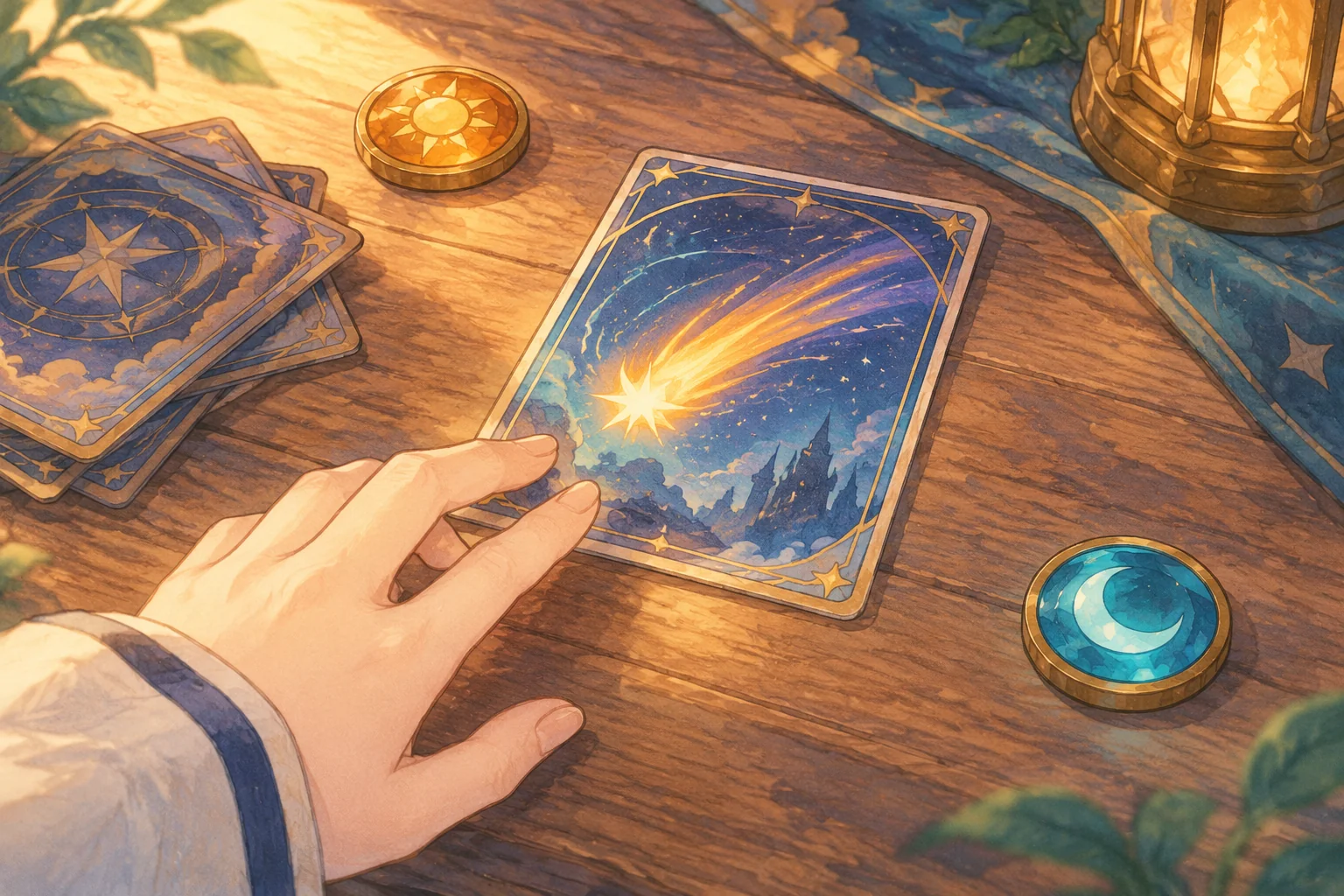
Walk through a legal opening
Try this ordered deck: Comet, Comet, Ember, Ember, Ward, Ward. It has six cards and no more than three copies of any type. The opening hand contains the first three: Comet, Comet and Ember.
| Moment | Action | Result |
|---|---|---|
| Turn one | Spend 2 energy on Comet | Opponent health falls from 8 to 4 |
| End turn one | Opponent attacks for 2 | Player health falls from 8 to 6 |
| Turn two | Play the remaining Comet | Opponent health falls from 4 to 0; victory is immediate |
At the start of turn two the player draws the next Ember and refreshes to 2 energy. The second Comet was already in hand, so it remains available. The opponent makes no second attack because the match ends as soon as its health reaches zero. This walkthrough follows the proposed rules; it is not a playtest result.
Turn the rules into an AI build request
Ask for the data model and transitions as well as the visuals. SEELE's capability catalogue describes game creation from a written idea and a 2D asset workshop for coordinated characters, scenes and interfaces. These are category-level descriptions; they do not establish that this card game, multiplayer or a particular generated interface has been tested.
Create an original single-player collectible card game prototype.
Offer a collection with three copies each of Ember, Ward and Comet.
Let the player choose and order exactly six cards, at most three of a kind.
Start player and opponent at 8 health. Draw three cards at match start,
then one at the start of each later player turn if the deck is not empty.
Set player energy to 2 at the start of each player turn.
Ember costs 1 and deals 2 damage. Ward costs 1 and prevents up to 2 damage
from the next opponent attack this turn. Comet costs 2 and deals 4 damage.
A played card moves from hand to discard; reject a card that costs too much.
Ward protection does not stack; prevent at most 2 damage from that attack.
On end turn, the opponent attacks for 2; apply Ward, then clear unused Ward.
End the match immediately when either health reaches zero or below.
An empty deck means no draw, not damage. No shuffling in this first build.
Show collection, legal deck count, hand, energy, health, discard and result.
Restart the match with the chosen deck in its original order and full health.
Use original card illustrations and names; do not copy an existing game.
Build the deck selector first, then the draw and energy rules, then one card effect at a time. Preserve a working version before adding another effect. If a tool creates a different sequence, explain which state transition is wrong and give it a reproducible deck and action.
Check deck validation and match state
- Deck rules: try five cards, seven cards and four copies of one card. Each deck should be rejected; the six-card example should be accepted.
- Energy: play a 2-energy Comet, then try to play Ember in the same turn. Ember should remain in hand because no energy is left.
- Defense: play Ward, end the turn and check that the next 2-damage attack deals zero. On the following turn, an unused old Ward should not block another attack.
- Victory: follow the two-Comet walkthrough. The opponent should reach zero on the second player turn and should not make another attack.
- Restart: verify full health, original deck order and an empty discard before the new opening hand is drawn. Draw through an empty deck and confirm that no extra damage occurs.
If the game gives the opponent an extra attack after lethal damage, report the exact setup: “The opponent had 4 health; Comet dealt 4. The match should end immediately, but the opponent attacked afterward.” Ask for the health check immediately after card resolution, then repeat the walkthrough and a nonlethal turn.
Plan one hypothetical card iteration
After the basic effects work, consider a new card called Spark Shield: cost 2 energy, deal 1 damage and prevent up to 1 damage from the next opponent attack that turn. It combines a small attack with partial defense, but using all available energy means the player cannot also play Ember in that turn. This is a proposed design choice, not a tested balance result.
Before adding it to the collection, state how many copies exist and whether it follows the same deck limit. Check the timing when its damage defeats the opponent, when the opponent attacks for 2 and when another defense effect is also active. Define how multiple prevention effects combine instead of leaving their order to the implementation.
Frequently asked questions
How large should the first collection be?
A few cards with distinct effects are sufficient to test selection and a complete match. The example uses three types and nine available copies. Expand only when each new effect adds a decision and the existing deck, energy and discard rules behave consistently.
How do I stop an invalid deck from entering a match?
Validate the selected deck against its total size and each card's copy limit before enabling the start action. Explain which rule failed, and validate again when the match starts. Do not rely only on a visual counter that the underlying game can bypass.
Should I shuffle the deck immediately?
Use a known order while checking individual effects so the same actions produce the same state. Later, define how shuffling happens and retain a way to reproduce a match when investigating a bug. Random order can add variety, but it should not make basic rule failures impossible to repeat.
Does a successful example prove the game is balanced?
No. The sample shows how to verify a particular sequence under fixed rules. Balance requires further evaluation across decks and situations, with the assumptions and test method recorded. A predictable first opponent helps isolate state errors; it does not represent a full competitive environment.
Make the deck and the match work together
Start with a small collection, a legal-deck check and one match whose outcome you can calculate. Once selection, energy and card effects agree with the rules, add one card or opponent behavior at a time. Develop your own cards in the SEELE AI Creator Game Maker, then test each rule. For a broader workflow, read how to create a game with AI.