A second business model can make a shopkeeper game feel richer, but it changes what an item means in inventory, how revenue is calculated, and when money is settled. Define those differences before adding a new sales screen so stock, customer demand, and checkout keep one source of truth.

This guide uses an invented direct-retail shop that adds consignment as a second model. No shop system, sale, return, or balance test was performed. Treat the examples as design decisions to verify in the actual project.
State what makes the second model different
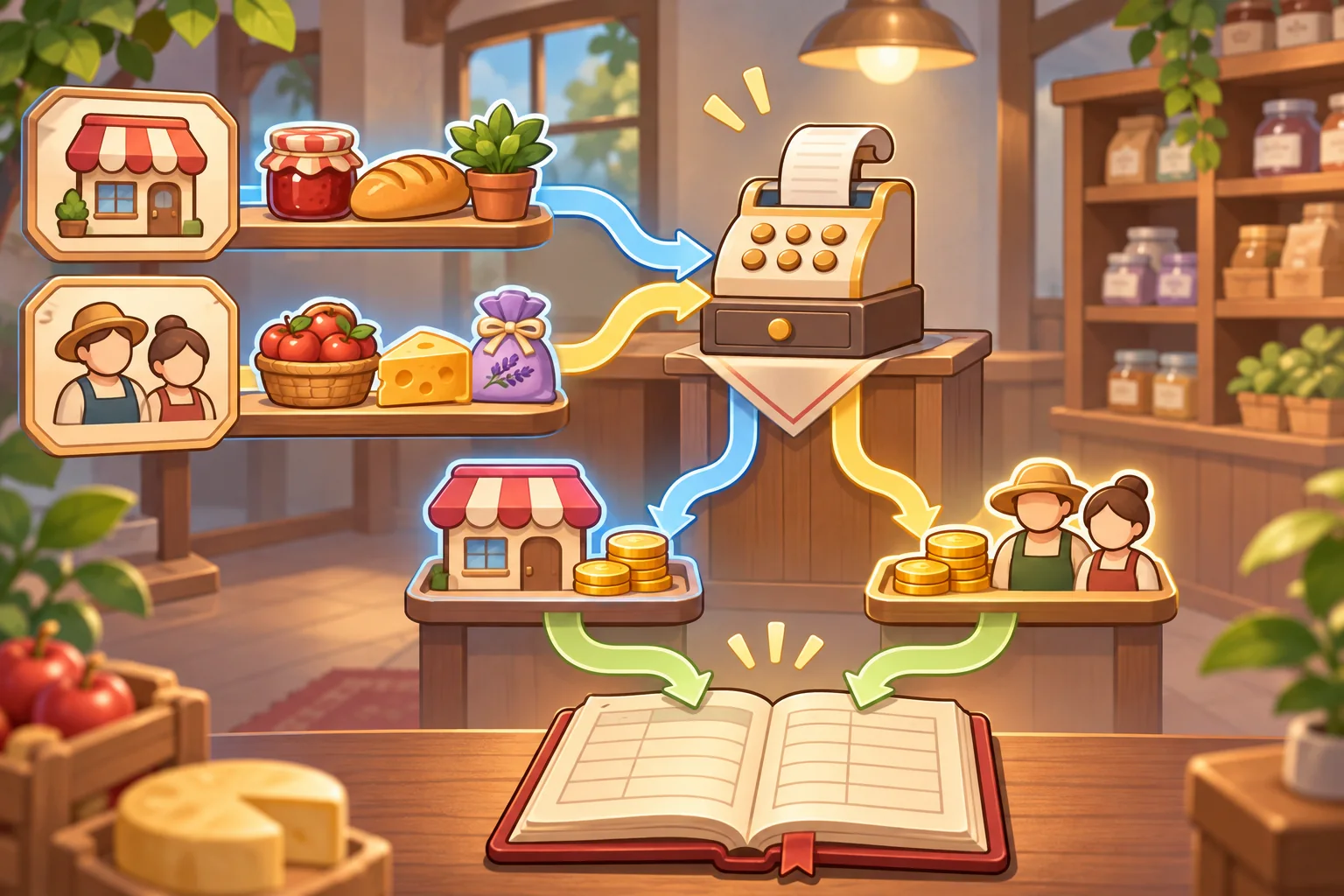
Describe ownership and settlement before editing code. In direct retail, the shop might buy stock and keep the sale amount after its costs. In the fictional consignment model, a supplier retains ownership until a sale, and the shop records a fee or share before settling the remainder later. These are example rules, not statements about every game's economy or real-world accounting.
| Decision | Direct retail example | Consignment example |
|---|---|---|
| Stock ownership | Shop owns the unit before checkout | Supplier owns it until sale |
| Sale record | Gross sale and cost of goods | Gross sale, shop share, supplier amount |
| Inventory removal | Remove on checkout | Remove sold unit and create settlement item |
| Return | Restore stock under shop rules | Reverse sale and settlement under model rules |
Keep each decision explicit. If unsold consignment stock returns to a supplier, define when. If the shop earns a fee, say whether it is fixed or a percentage and how rounding works. If a customer returns an item, the refund and supplier balance must follow a documented rule rather than recalculating from today's price.
Reuse stock and customer systems
Give a stock unit or agreement a stable model ID. The existing inventory system can still count items and expose them to customers, while the model determines ownership and settlement behavior. Avoid storing one quantity in the retail stock and another in the consignment screen; they can drift after checkout or reload.
Let customers browse and purchase through the current demand and checkout path unless the design intentionally introduces a different customer group. If the second model changes price display or availability, state how that value is presented and validate it through the same product catalog. Do not copy demand logic into a separate “consignment customer” component without a clear requirement.
Follow the project's content authoring pipeline for model definitions. Godot's stable documentation describes custom Resources that can be serialized and edited in the Inspector. Unity 6.1 describes ScriptableObject as a data container independent from class instances. These sources support configuration options, not the example's fee rules or a particular inventory architecture.
Keep one checkout and one ledger owner
The checkout should validate the item's current availability, model, price, and quantity. When the sale succeeds, update the stock unit once and send a result to the finance owner. The ledger can then record gross sale, shop share, owed amount, and costs as separate entries. The interface should display the committed result rather than calculate its own balance.
Settlement needs an idempotent boundary too. A week-end event or settlement button should not pay the same supplier twice after a scene reload. Use a stable sale or settlement ID if it fits the project, mark the status once, and test a repeated transition on a disposable save.
Returns and cancellations are often the edge cases that reveal duplicated logic. Decide whether a return restores the unit, reverses the shop share, reopens a supplier amount, or changes the agreement. Apply the same written rule in the customer-facing flow and the ledger. If the current game has no returns, keep that feature out of the first increment.
Separate model configuration from per-sale state
Keep the model definition small: ownership rule, allowed item types, fee policy, and settlement schedule. A sale record should capture the values used at the time of checkout so a later price or fee change does not rewrite a completed transaction. If the project has no agreement system, begin with one fixed rule rather than a broad editor.
This distinction also makes refunds easier to inspect. A return should reference the original sale and reverse the appropriate stock and ledger entries. Do not recalculate an old transaction from current catalog data, because those values may have changed since the customer paid.
Ask AI for a bounded change
Give the assistant a concise contract: add one second sales model; preserve existing retail pricing, customer demand, inventory count, and checkout; use explicit ownership and settlement fields; keep a single ledger owner; list changed files, save migration, and rollback instructions. Ask it to show the data flow before it edits.
Review for duplicate stock records, money written from the UI, sale events that can fire twice, and changes to retail behavior outside the requested feature. Keep one known retail item and one old save as regression fixtures. If the assistant changes a common pricing or demand function, ask why and test retail separately.

Verify sale, return, settlement, and reload
The following is a proposed test plan, not a report about Copper Kettle:
| Case | Action | What to verify |
|---|---|---|
| Retail control | Sell a normal shop-owned item | Existing stock and cash rules are unchanged |
| Second-model sale | Sell one consigned unit | Unit leaves stock and the correct settlement record appears |
| Duplicate checkout | Safely retry a sale event | No duplicate revenue or settlement |
| Return | Return the item if supported | Stock and ledger reverse under the agreed rule |
| Settlement | Close the intended accounting period | Supplier amount settles once |
| Save/reload | Reload after sale and after settlement | Stock, ownership, and totals agree |
Record build version, item ID, model ID, quantity, sale and settlement steps, expected result, and observed result. Compare the same product under the existing retail path. A mock ledger or fictional sale can explain the model; it cannot prove the economy is balanced.
Frequently asked questions
What should I decide before adding a second shop model?
Write down who owns the item before sale, how the shop earns revenue, which costs apply, when settlement happens, and how returns work. Keep the current retail rules as a control path. Keep the retail path as a comparison during each implementation step.
How can a shop support consignment and direct retail together?
Give each item or agreement an explicit model ID and route stock and settlement through one inventory owner. Do not let both models claim the same unit or credit the same checkout twice. Use a stable model ID in both stock and settlement records.
Should a second business model use different customer demand?
Only if the design calls for a different offer or buying behavior. Reuse the current customer and price systems where possible, and expose model-specific demand rules as explicit data instead of duplicating the simulation. Tie each rule to one order ID and one finance commit.
How do I keep the shop ledger consistent?
Commit each checkout or settlement once through the existing finance owner. Record gross sale, shop share, costs, and amount owed separately so a return or reload does not duplicate income. Test reloads around each event that changes the balance. This keeps each sale traceable after a reload.
What should I test after adding a second model?
Test normal retail, one second-model sale, return, settlement, stock count, save/reload, and a repeated checkout event. Record actual results; an example ledger is not evidence of a balanced economy. Save the exact item, model, and settlement case for review. Save the model ID and test platform with that record.
Add a second model without a second source of truth
Keep model-specific ownership and settlement data explicit, then send both sale types through the current checkout and finance systems. Test retail, the new model, returns, and repeated transitions independently. Expand the business rules only after inventory and ledger totals agree in the real build.
For a separate browser-playable prototype idea, try SEELE AI Game Maker. This CTA is for a separate prototype, not an existing shop system extension.