A second playable faction can add fresh tactical decisions to a grid-based game, but asymmetry can also hide a rules rewrite inside new unit data. Keep the shared board, turn order, movement validation, targeting, objectives, and victory conditions in their current systems. Give the faction a clear identity, bounded abilities, and readable counterplay, then test it across maps and player order before calling it balanced.
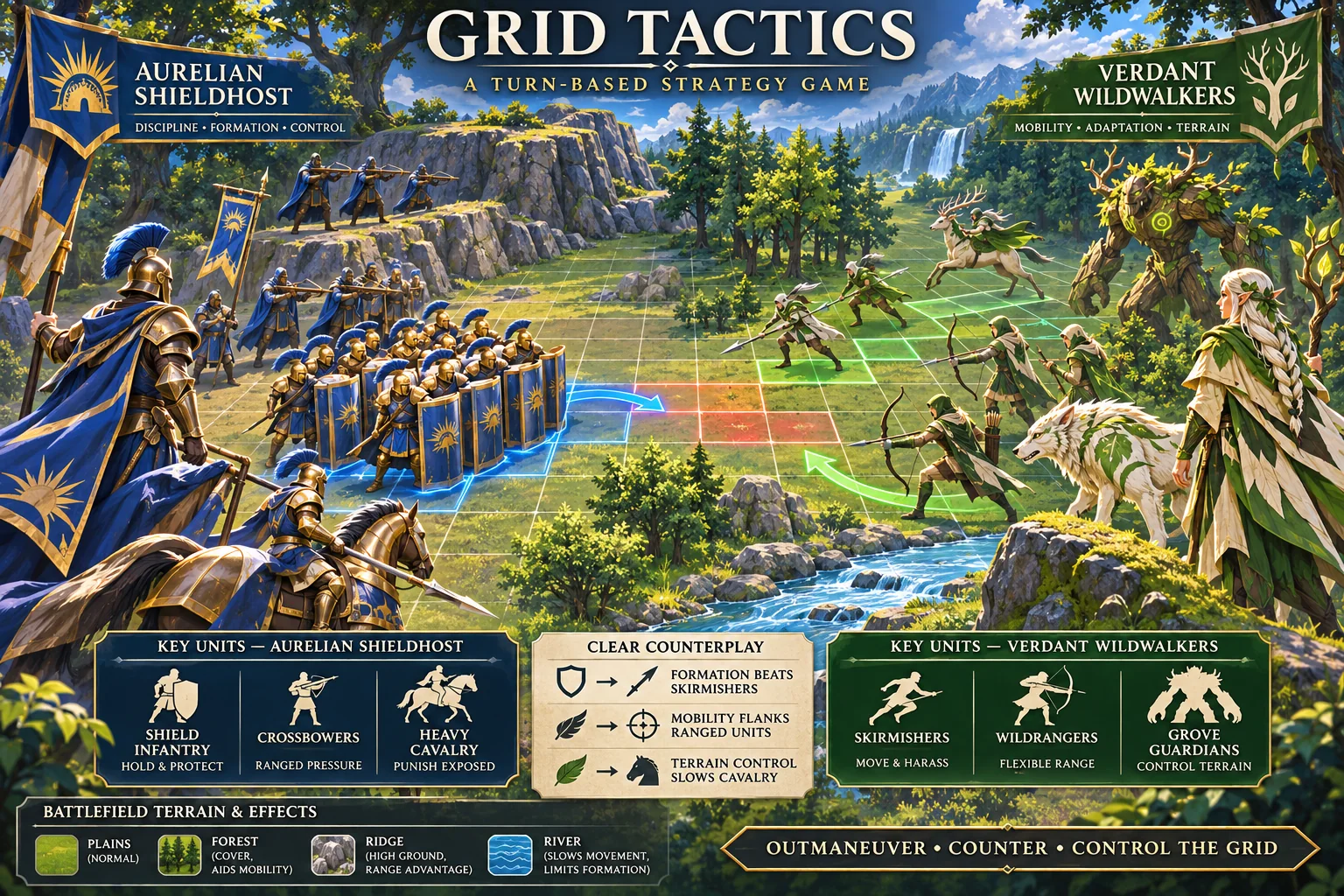
This article proposes a faction expansion for an existing tactics game. Its armies, abilities, maps, and outcomes are invented. No source code, game build, AI match, or balance test was available. The validation plan below is not a report of successful play.
Map the shared grid and turn rules
Trace how a match loads a map, selects a faction, creates units, validates movement, resolves attacks, advances turns, checks objectives, and ends. Identify who owns terrain cost, attack range, line of sight, unit recruitment, resource spend, AI legal actions, replays, and campaign saves. Record a baseline match for the existing faction on more than one map and starting side.
List the invariants the new faction must keep: a unit moves only to legal tiles; actions resolve through the current turn owner; damage and status effects use the existing combat path; capture or victory checks stay shared. If a new faction needs a special exception, make that rule explicit and narrow. Avoid copying the entire movement or turn manager to implement one unit ability.
| Shared system | Baseline | Preserve |
|---|---|---|
| Grid | Coordinates, terrain, occupancy | One legal-move validator |
| Turns | Order, action points, end-turn | Current turn authority |
| Combat | Range, line of sight, damage | Shared resolution and effects |
| Objectives | Capture, hold, survive, score | Common victory conditions |
| AI and saves | Roster, legal actions, match state | Existing selection and serialization |
Give the faction an identity with counterplay
Choose one core tactical idea before adding a full roster. The faction might reposition after a terrain interaction, protect a nearby ally, or trade direct damage for control of a tile. Define the ability’s trigger, range, cost, timing, duration, and interruption. Make the opponent’s response visible. A mechanic with no reliable counter can invalidate the shared objectives even if its raw damage appears modest.
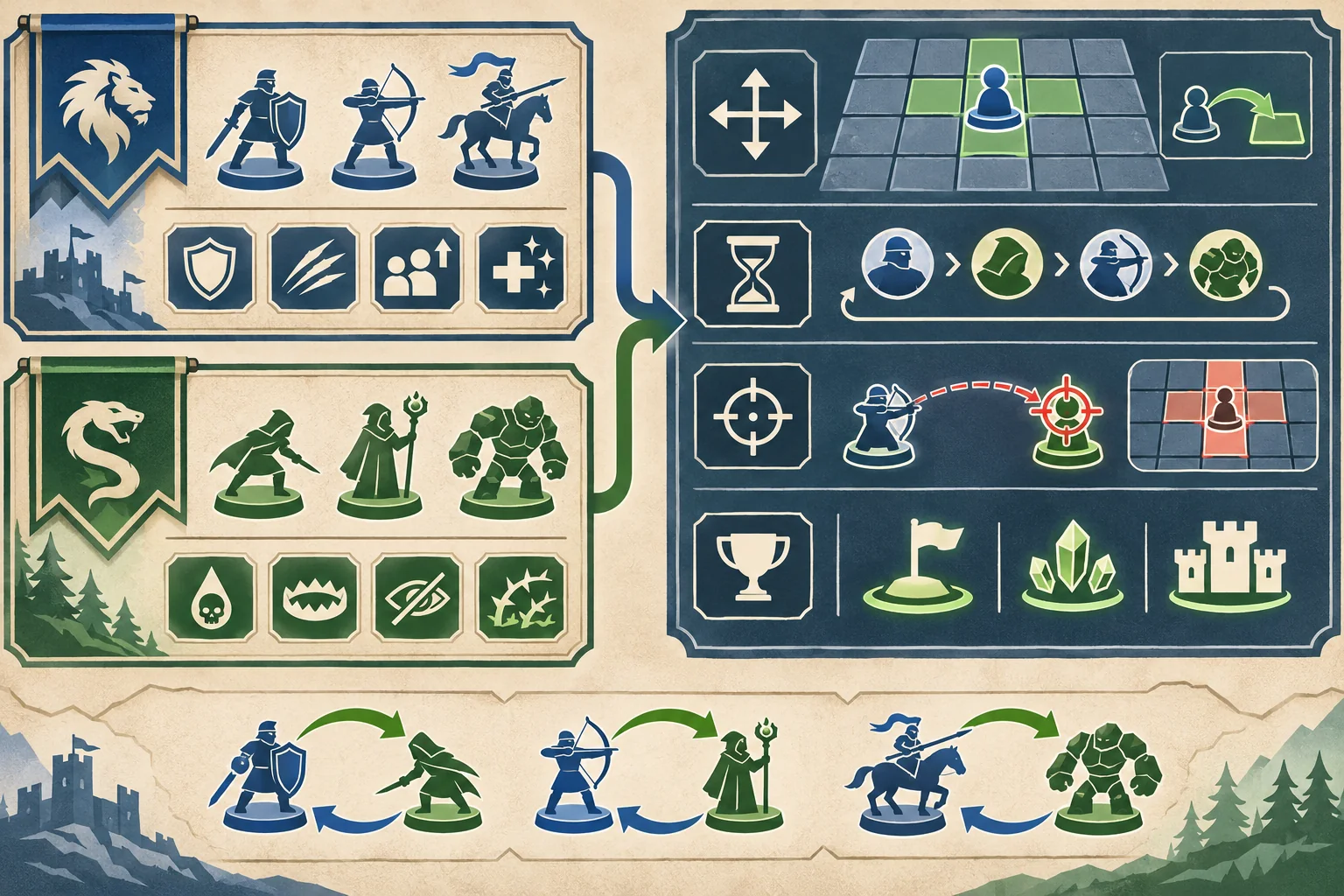
In the fictional Verdant Pact, one unit can root itself to protect a neighboring ally for a turn but cannot move or attack while rooted. An opposing unit can break the formation by contesting the adjacent tile. This mechanic is invented and does not describe a real tactics game. Its purpose is to illustrate a tradeoff with an observable response, not to prescribe specific numbers.
Keep faction identity separate from universal rules. Store faction-specific costs, unit tags, and ability references in the existing data format where possible. Execute effects through the current grid, action, and combat systems. Avoid embedding turn advancement, victory checks, or terrain occupancy inside a faction script; otherwise later patches may produce inconsistent rules.
Use data for identity and shared code for execution
Give each faction and unit a stable ID, display name, role, allowed terrain, movement profile, cost, and ability references. Keep authored values separate from a match’s temporary health, location, cooldown, and status. On faction selection, load the chosen roster through the existing setup flow. Validate required fields before the match begins and provide a clear error for missing assets or unsupported ability types.
If the project uses Godot, its Resource class is documented as a serializable data-container base class that can be saved on disk. That can be relevant if the project already authors units with Resources, but it is not a required faction architecture. Godot’s save tutorial demonstrates one workflow where persistent objects return relevant data for serialization and loading. Neither source defines tactical balance or the correct match-state schema.
Keep match state and campaign unlocks distinct. If the new faction is immediately selectable, the match setup should not require a save migration. If a campaign unlock is needed, store it through the existing progression owner and default old saves safely. Do not change player rosters just because a faction definition has been added.
Keep the AI and tutorial readable
Add the faction to AI evaluation only after its legal actions, cost, and counterplay have been defined. Teach the AI to recognize the same preconditions a player sees, such as a nearby ally or an occupied tile. Test that it does not choose an invalid movement or activate an ability with no valid target. The AI should reason through the current action system, not a special hidden shortcut.
Introduce the mechanic in a controlled scenario. Show the ability’s cost, area, duration, and counter. Let a player see why an action is unavailable. If the faction changes terrain usage, include a map where that choice matters and another where it is not dominant. Make faction selection and match rules visible before players commit.
| Design element | Define | Counterplay question |
|---|---|---|
| Movement | Terrain and range | Can opponents block or contest? |
| Ability | Trigger, cost, duration | Can it be interrupted or avoided? |
| Unit role | Strength and weakness | Which existing unit answers it? |
| Roster | Cost and unlock availability | Can a player adapt composition? |
| Objective | Scoring and victory condition | Does the tactic still require map play? |
Ask AI for a narrow faction slice
Give AI an allowlist for faction data, unit creation, action validation, AI evaluation, and match setup. Ask it to map current owners and propose one signature ability before editing. Require a list of changed files and systems that remain untouched. Review the full diff for duplicated movement code, direct victory-state edits, unbounded stat bonuses, and faction-only bypasses of resource costs.
Use a clean branch and preserve baseline replays or save copies. Keep the new faction optional behind the existing selection surface. If older saves contain faction indices rather than stable IDs, preserve their mapping and migrate a copy before rewriting anything. A rollback should remove the new roster without changing the existing faction or common battle rules.
Test counterplay, maps, and first-player order
Run repeated matchups with the new faction starting first and second. Cover open and blocked terrain, objective types, short and long matches, human opponents, and AI. Record which units were selected, ability use, legal actions, resource spend, objective control, turn count, and result. Tune one value at a time and repeat scenarios with the same setup where possible.
| Proposed check | Action | Evidence |
|---|---|---|
| Legal movement | Move across blocked and special terrain | Allowed tiles and action result |
| Ability cost | Use at and below resource threshold | Spend, cooldown, and effect |
| Counterplay | Contest or interrupt signature setup | Opponent response and resolution |
| Map coverage | Repeat across open and narrow maps | Objective control and composition |
| Turn order | Swap first and second faction | Outcome and early advantage |
| AI | Run AI as both factions | Valid actions and ability timing |
| Old save | Load pre-faction campaign copy | Roster and unlocks preserved |
| Rollback | Restore baseline revision | Original faction rules intact |
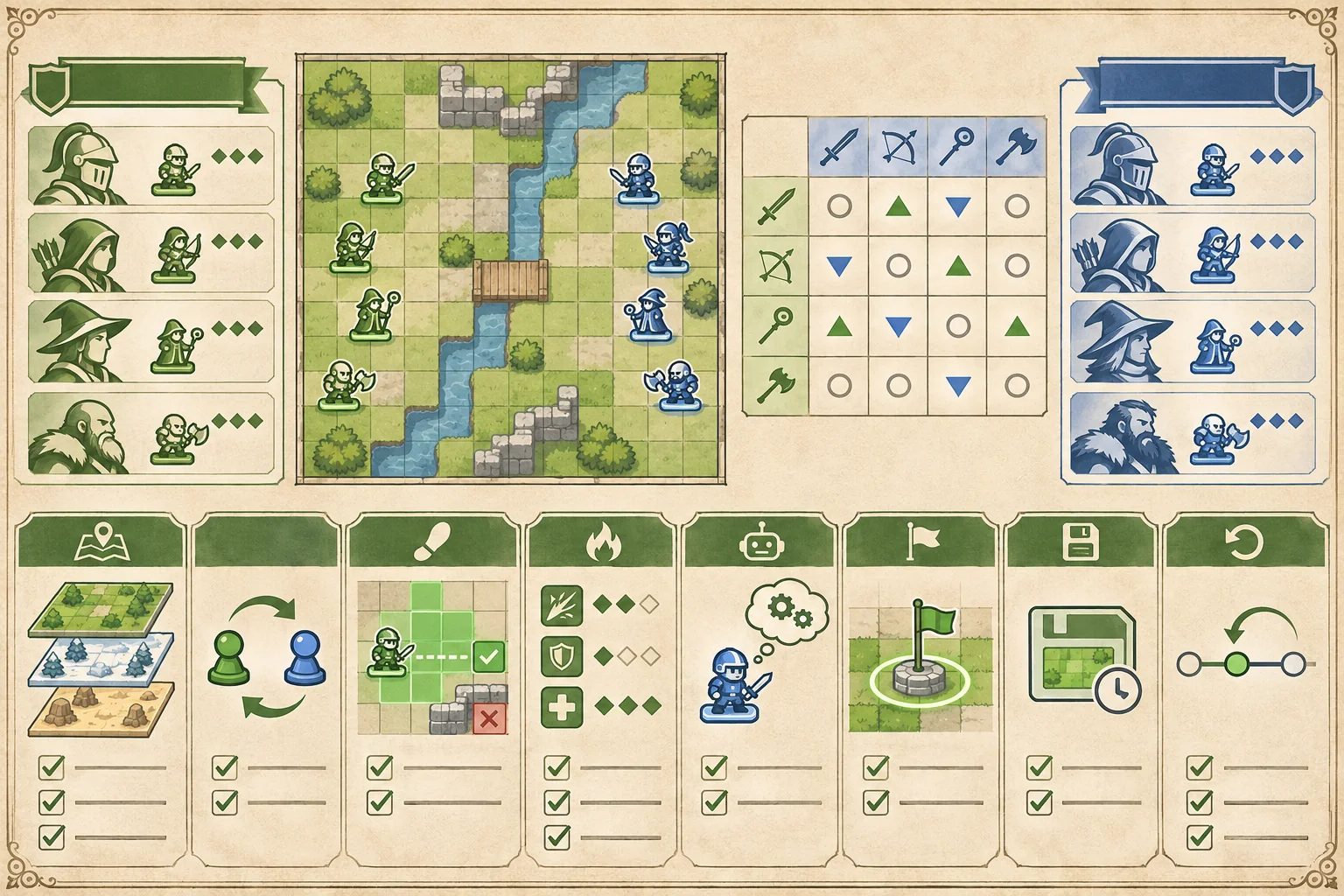
This is a proposed matrix, not an executed balance report. Record build version, map, starting side, faction, roster, player/AI control, settings, ability use, and result. A small collection of matches cannot prove broad fairness. The generated board is an illustration and does not establish that an ability is fun, legible, or balanced.
Make the new faction legible at a glance
Use distinct silhouettes, restrained colors, and clear ability icons, but do not rely on color alone to show allegiance or status. Show movement range, ability target, cost, duration, and counter condition before activation. Keep the battle log understandable so players can tell which rule resolved an attack or status effect.
To explore a separate tactics-game concept, try SEELE AI Game Maker. It is a concept tool, not an editor for an existing project.
Frequently asked questions
What makes a tactics faction asymmetric but fair?
Give the new faction a distinct tactical choice with clear costs and counterplay, while keeping shared turn, movement, objective, and victory rules readable. Compare both sides across multiple maps and starting positions. A unique mechanic should create decisions, not remove the opponent’s ability to respond.
Should faction abilities be data-driven?
Follow the project’s current unit and ability model. Put tunable values and allowed ability references in its existing data format, while keeping execution in the shared combat system. Avoid faction-specific copies of movement or turn logic that can drift from the baseline rules.
How can AI opponents use the new faction?
Add the faction to the existing roster and AI evaluation path only after its legal actions and costs are defined. Test whether AI can recognize the ability’s conditions, avoid invalid moves, and respond to enemy counters. Do not claim the faction works against AI until that behavior is exercised in the target build.
How do I balance an asymmetric faction?
Create repeatable matchups across maps, player order, and representative compositions. Record win/loss, objective control, turn count, ability use, and resource spend, then tune one variable at a time. A small number of anecdotal matches cannot establish fair balance. Keep evaluation criteria and settings consistent, and separate measured outcomes from player preference feedback.
Can AI add a faction to my grid-based tactics game?
AI can inspect unit data, turn flow, targeting, AI evaluation, and save code, propose a bounded faction slice, and draft tests. It cannot verify balance or legal move behavior without the real build and repeated matches. Provide an edit allowlist, baseline scenarios, desired counters, and rollback revision.
Add identity without changing the whole ruleset
Keep movement, turn order, targeting, and victory conditions shared; express faction identity through bounded unit data and abilities with visible counterplay. Test both starting sides, multiple maps, AI, and old saves in repeatable scenarios before expanding the roster. Treat Verdant Pact and its matchup board as fictional design aids, not evidence of fair or functioning gameplay.