Define the case and deduction baseline
Write down the clues players can observe, the theories they may form, and the evidence required to support each conclusion. Separate what the detective knows from what the player suspects. This gives the campaign a stable model for deciding which puzzle outcomes should change later scenes.

The official EVIDENCE listing describes a detective investigation where players connect evidence and theories on a case board, with multiple case outcomes. This supports the deduction context only; the campaign state structure here is original. Start with a short case and document its evidence graph before writing branches.
Identify the central question for each puzzle. It might establish a timeline, connect a witness to a location, or reveal a motive. The cover illustration shows evidence extending from one solved case toward a larger city mystery.
Turn outcomes into explicit campaign states
Store conclusions as named case states instead of inferring them from a scattered set of dialogue flags. Record which clues support the conclusion and whether the detective has enough confidence to act. That makes it possible to explain why a later witness, location, or case file changes.
Use outcomes to alter specific narrative elements: a witness may cooperate, a new lead may appear, or a relationship may shift. Keep the state update visible through a journal note or scene response. Players should be able to connect a changed interaction to the deduction they made.
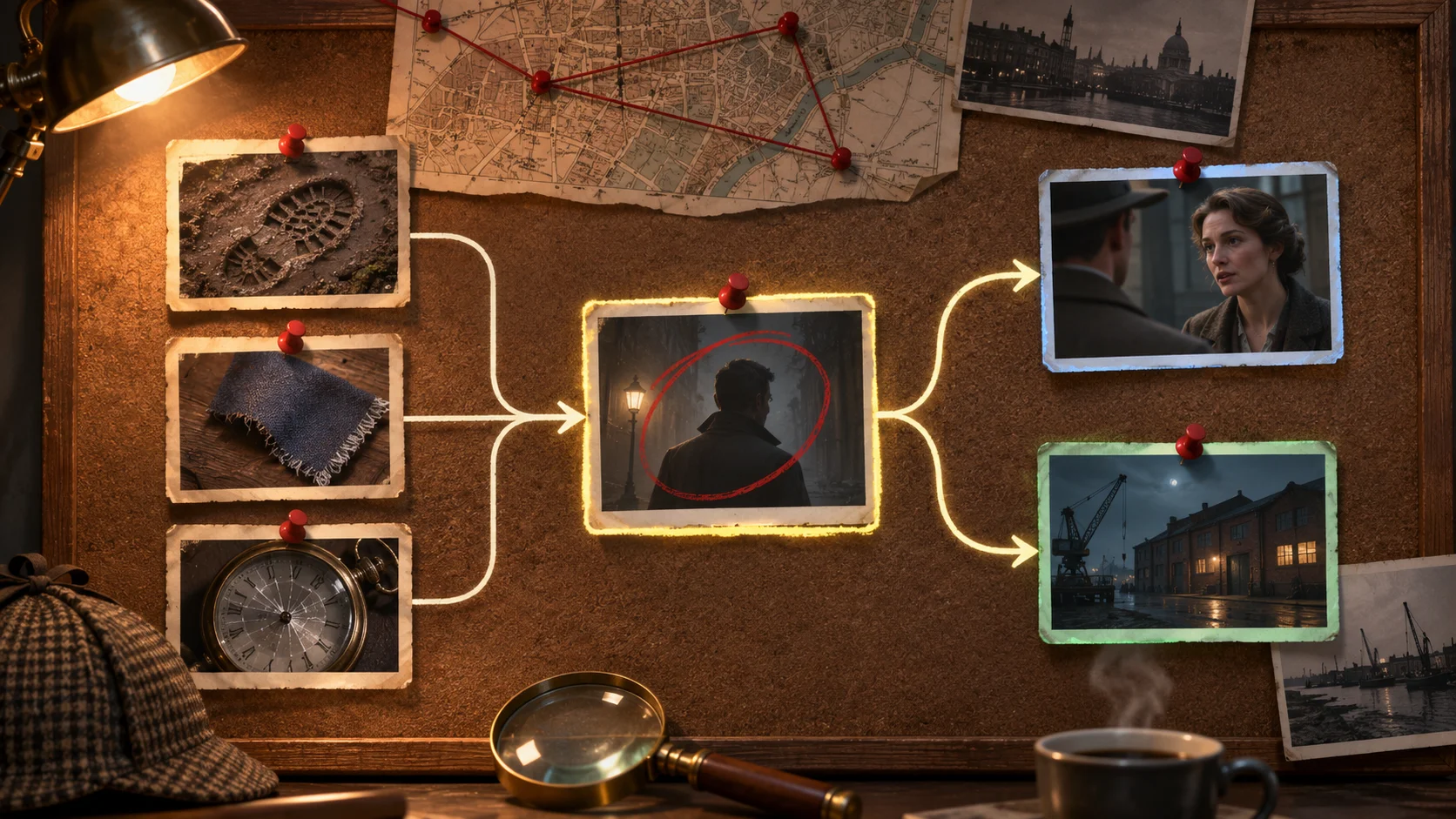
Plan for partial conclusions. A player may identify a person but miss the reason, or reach a plausible theory with weak evidence. Allow the campaign to respond differently without pretending that every case has one perfect answer. The mechanism figure shows clues feeding into a state that changes later scenes.
Plan branches and reconvergence
Draw short branches for the important outcomes, then decide where they can rejoin. A mistaken conclusion could lead to a different interview or a temporary delay while preserving the broader case. Branches can change what the detective learns without requiring an entirely separate campaign for every theory.
Use callbacks when paths reconverge. A returning witness, revised timeline, or changed trust level can acknowledge the player’s earlier reasoning. If the story needs a critical clue before progress can continue, provide a clear investigative route to recover it rather than leaving the player in a dead end.
Test saves and reloads at branch boundaries. Confirm that a conclusion persists, that later dialogue reads the correct state, and that optional clues do not overwrite a stronger deduction. The story should respect the player’s chosen theory while still allowing new evidence to challenge it.
Test evidence and narrative continuity
Replay the case with supported, incomplete, and mistaken conclusions. Track which clues players inspect, what they infer, where they hesitate, and whether a later scene matches their expectation. Ask players to explain their reasoning before the story confirms or disputes it.
Check that the interface distinguishes observation, testimony, and inference. If players cannot tell whether a statement is evidence or a theory, downstream branches may feel arbitrary. Provide a review screen or case notes that show what the detective recorded and which clues support the current conclusion.
Accept the system when later scenes honor the conclusion state, recovery paths remain discoverable, and players can explain why the story changed. See the related co-op narrative guide for managing multiple evidence perspectives. SEELE AI can help outline alternative case branches, but clue logic, narrative voice, and continuity need implementation and playtesting. The outcome image depicts a witness interaction that reflects an earlier deduction.
FAQ
How do you build a detective campaign driven by puzzle outcomes?
Map the case evidence, possible conclusions, and the campaign state each conclusion should set. Connect those states to later scenes or leads, then replay the case with supported, partial, and mistaken deductions to check that the narrative response is understandable.
How should deductions change later story scenes?
Use explicit conclusion states to change specific dialogue, relationships, access, or leads. Show the result through a scene response or case note so players can connect it to their reasoning. Keep states narrow enough to test and maintain. Review the changed scene after saving and reloading the case state.
How can a detective story handle incomplete conclusions?
Represent partial confidence or missing evidence directly. Let the story respond with an alternate interview, delay, or new investigation route rather than falsely treating the theory as confirmed. Make a recovery path available when critical evidence is missing. Review the changed scene after saving and reloading the case state.
What should you test across puzzle outcomes?
Replay correct, incomplete, and mistaken conclusions, then check save and reload behavior. Verify that later dialogue, clues, and relationships match the recorded case state. Ask players to explain why a scene changed and whether the evidence supported that result. Review the changed scene after saving and reloading the case state.