A custom business scenario can make a bookshop management game feel fresh, but it can also touch inventory, customer preferences, pricing, staff routines, progression, and saves. Keep the shop simulation as the authority. Start with a goal the existing game can already measure, add one optional scenario around that state, and test it against ordinary shop play before expanding the feature.

This guide is about continuing an existing bookshop game, not replacing its retail loop. The shop, stock, customer profiles, sales, scenario, and outcomes described below are invented. No project files, build, save, or playtest were available. Treat each proposed check as a plan until it is run in the real project.
Map the store systems before writing a scenario
Make a clean branch or a copy of the project. Trace how a book is ordered, received, placed, discovered, purchased, returned, or marked unavailable. Find where customer preferences live and how the game decides which visitor enters, browses, asks for help, or leaves. Identify the owners of prices, cash, staff actions, day transitions, and persistent progress.
Capture a baseline from an ordinary shop day: starting stock, deliveries, sales, cash, customer satisfaction signals, and any active objectives. If the game already has a challenge or event system, learn how it identifies a goal and records progress. Reuse that path when it fits. A scenario-specific spreadsheet of stock or customer demand may drift from the real shop and create results that cannot be reproduced.
| System | Baseline to record | Protect by default |
|---|---|---|
| Inventory | Book IDs, quantities, deliveries, shelf placement | One authoritative stock count |
| Customers | Preference fields and purchase decisions | Existing profile and choice rules |
| Economy | Prices, costs, cash changes, refunds | Purchase validation and balance |
| Time and staff | Day boundaries, tasks, service actions | Current schedule and action timing |
| Progress and saves | Objective owner, save keys, old-save behavior | Ordinary shop flow and existing data |
Choose a measurable business goal
Prefer one objective backed by data the game already tracks. For example, ask players to curate a seasonal table, serve a segment of customers, maintain enough copies of a featured title, or reach a sales target over several shop days. Define the exact counter, start and end conditions, threshold, and completion event. If the game does not track the needed signal, identify the smallest observable event to add rather than inventing a hidden score.
In the fictional Lantern & Leaf scenario, the owner prepares a rainy-week reading table. The player chooses a few titles, keeps one copy of each available, and serves customers whose preferences match the display. The scenario asks for completed sales and a minimum service signal over three days. Those rules are illustrative; they do not describe a real game’s inventory or customer model.
Separate what the player controls from random demand. A goal should not become impossible because one visitor does not appear. Decide whether an unavailable book pauses progress, counts as a missed opportunity, or triggers a substitution. Make the rule visible before the scenario begins. Avoid changing customer profiles just to force purchases; preferences are part of the shop’s challenge.
Separate scenario definitions from live shop state
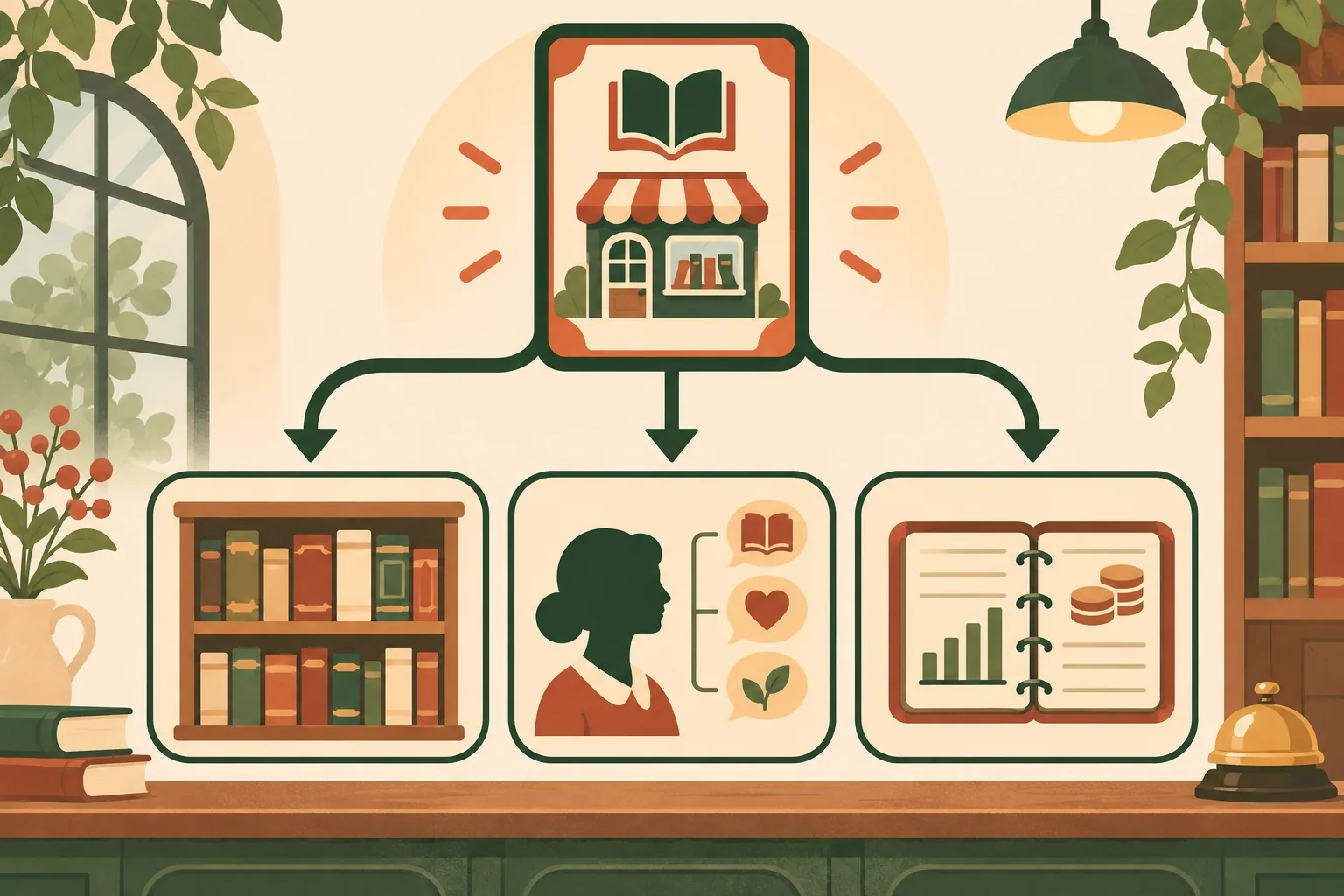
Store authored scenario content separately from the player’s current inventory and cash. A definition may include a stable ID, title, description, prerequisites, allowed days, tracked event, threshold, optional reward, and retry behavior. Progress can store the active scenario ID, counters or stage, completion status, and whether a reward was claimed. Read stock and purchases from the existing shop systems.
If the project uses Godot, its documentation describes Resource as a reusable data container that can be serialized and saved on disk. That is one engine-specific option for authored scenario definitions; it is not a required format, nor does it define a retail scenario schema. Follow the target project’s existing data pattern. Godot’s save tutorial demonstrates serializing selected fields in one workflow, but it does not determine which fields a particular bookshop should persist.
Make completion idempotent: loading a completed scenario must not issue the reward again. Decide what happens if the game closes after the target is met but before the result panel appears. Use the project’s existing transaction or objective owner, and record completion through one clear boundary. For an older save without scenario data, choose a safe default such as “no active scenario.” Test that path on a copy.
Keep stock and customer preferences authoritative
A scenario may focus attention on selected titles, but the inventory system should continue to own quantities, receipts, shelf counts, and purchases. Decide whether “keep three copies available” means in storage, on display, or both. Decide whether a sale advances the goal at checkout or after the day closes. These definitions prevent a common mismatch where the objective panel reports success while the shelf logic reports a shortage.
Customer preference rules should remain intact. If the scenario targets a genre or author, use the existing profile fields and expose enough information for the player to make a decision. Do not have the scenario overwrite profiles, silently discount a title, or turn every customer into a guaranteed sale. If substitutions are allowed, state which attributes need to match and make the customer-facing behavior consistent with the ordinary game.
Reward choices need the same care. Reuse current money, reputation, unlock, or décor systems instead of adding a shadow currency. Make rewards optional if the base game is designed as open-ended management. Confirm that a reward cannot be claimed twice through a reload, repeated event, or duplicated UI action.
| Scenario rule | Define | Keep owned by the existing shop |
|---|---|---|
| Featured stock | Which location and quantity count | Inventory and delivery logic |
| Customer match | Which preference fields qualify | Profile and purchase decisions |
| Sales target | When a sale is counted | Checkout and refund rules |
| Time window | Start, end, and pause conditions | Day and schedule progression |
| Reward | Amount, timing, and claim state | Current economy and unlock owner |
Ask AI for a small, reviewable project change
Give an assistant a file allowlist covering the existing objective, inventory, customer, economy, and save paths. Ask it to summarize current ownership before editing. Then request one scenario definition, one progress listener that consumes a real existing event, a small display surface if needed, and focused tests. Require a plan listing files to change and systems that should remain untouched.
Review the full diff. A proposal that duplicates stock in a scenario manager, hard-codes customer demand, or changes every shop day has widened the scope. Keep the change on a clean branch. If a new save field is needed, make its default explicit and isolate migration from the scenario UI. Record how to revert the branch and how to restore the original save copy.
| Area | Possible narrow change | Stable by default |
|---|---|---|
| Scenario content | One definition in the current data format | Catalog and book IDs |
| Progress | Listen to a current checkout or day event | Inventory and customer decisions |
| Display | One optional progress panel | Ordinary shop navigation |
| Reward | Call the current economy owner once | Prices and cash validation |
| Save | Optional active ID and completion state | Existing inventory and unlock data |
Test the ordinary shop and scenario together
Test more than a successful run. Start from a fresh shop, use an old save without scenario fields, run a scenario with low starting stock, complete one with a matching customer, miss the target, and reload after completion. Confirm ordinary purchasing, refunds, day changes, staff tasks, and free-play mode still behave as before.
| Proposed check | Action | Evidence to capture |
|---|---|---|
| Stock shortage | Sell or remove a featured copy mid-scenario | Inventory count and progress response |
| Preference match | Serve matching and non-matching profiles | Profile fields and counted purchases |
| Day boundary | Finish a day before and after reaching target | Counter reset, completion, and timing |
| Refund | Return a qualifying purchase if supported | Cash, stock, and objective treatment |
| Reward once | Save after success and reload repeatedly | Completion ID and balance deltas |
| Old save | Load a pre-scenario copy | Fallback and preserved shop state |
| Rollback | Restore the baseline revision | Original catalog and shop loop |
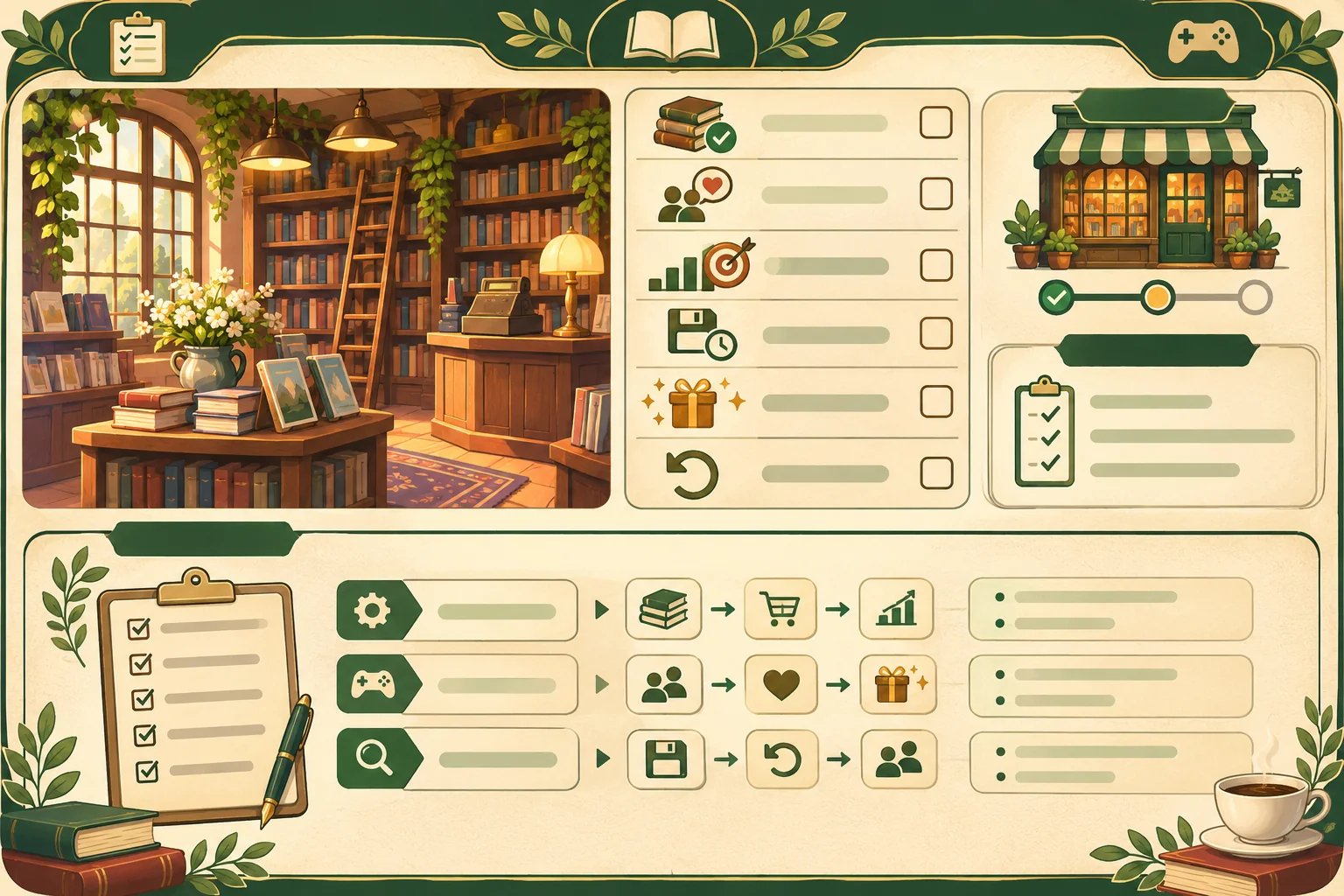
This is a proposed matrix, not a test report. When the actual game is available, record build version, save copy, scenario ID, starting and ending stock, customer event, sales, reward balance, and expected versus actual result. Keep the generated screen as a visual explainer only; it cannot prove balance, preference logic, or compatibility.
Make the challenge feel like running a shop
Explain the goal in the language of store operations. Show which shelf or customer segment matters, how much time remains, and what counts as progress. If inventory can run out, surface that risk early enough to plan a delivery. If a scenario is optional, make the exit clear and preserve the normal shop mode. The challenge should create a useful decision, not punish players for hidden rules.
To explore a separate game concept, try SEELE AI Game Maker. It is a concept tool, not an editor for an existing project.
Frequently asked questions
What makes a useful bookshop management scenario?
Give the scenario a clear business goal that uses systems the game already tracks, such as curating a seasonal shelf, serving a defined customer group, or reaching a sales target without emptying essential stock. State the time window, success condition, reward, and failure or retry rule so players can plan rather than guess.
How can scenarios preserve customer preferences?
Read customer preferences from the existing customer model and treat them as the authority. A scenario can ask players to respond to a preference mix, but should not silently rewrite profiles to make the goal easier. Test ordinary and edge-case customers, including unavailable books, substitutions, and a shelf that runs out.
Should scenario stock be separate from normal inventory?
Keep scenario targets and rules separate from live stock counts, but let the existing inventory system own quantities, reservations, and purchases. Do not create a parallel stock copy that can disagree with the shop. Define whether the goal counts deliveries, shelf placement, or completed sales, then test restocking and save reload.
How can I add scenarios without breaking older saves?
Make new scenario progress optional and give old saves a safe default such as no active scenario. Store stable scenario IDs and completion state through the project’s current save owner. Test a copied pre-change save and a save made during an active scenario before migrating real player data.
Can AI add scenarios to my existing bookshop game?
AI can inspect supplied inventory, customer, economy, and save files, propose a small scenario, and draft focused tests. It cannot confirm the shop balance or preference behavior without the actual project and executed runs. Set an edit allowlist, provide a baseline save, review the full diff, and keep a rollback point.
Add one scenario without rewriting the shop
Use a goal backed by existing inventory, customer, or sales data. Keep scenario definitions separate from live state, send progress through the current objective owner, and preserve ordinary shop play. Test stock shortages, preference matches, refunds, save reload, and reward duplication on copies before expanding the feature. Treat the fictional scenario and interface as design aids, not proof of an implemented feature.