Linking player-built settlements turns a set of local towns into a network, but it also adds identity and reconstruction problems. A road can point to a settlement that was renamed or removed; a shared resource total can hide which town supplied it. Model each settlement as a stable entity, keep local state separate, and represent roads or transfers as explicit links through the project’s existing world system.
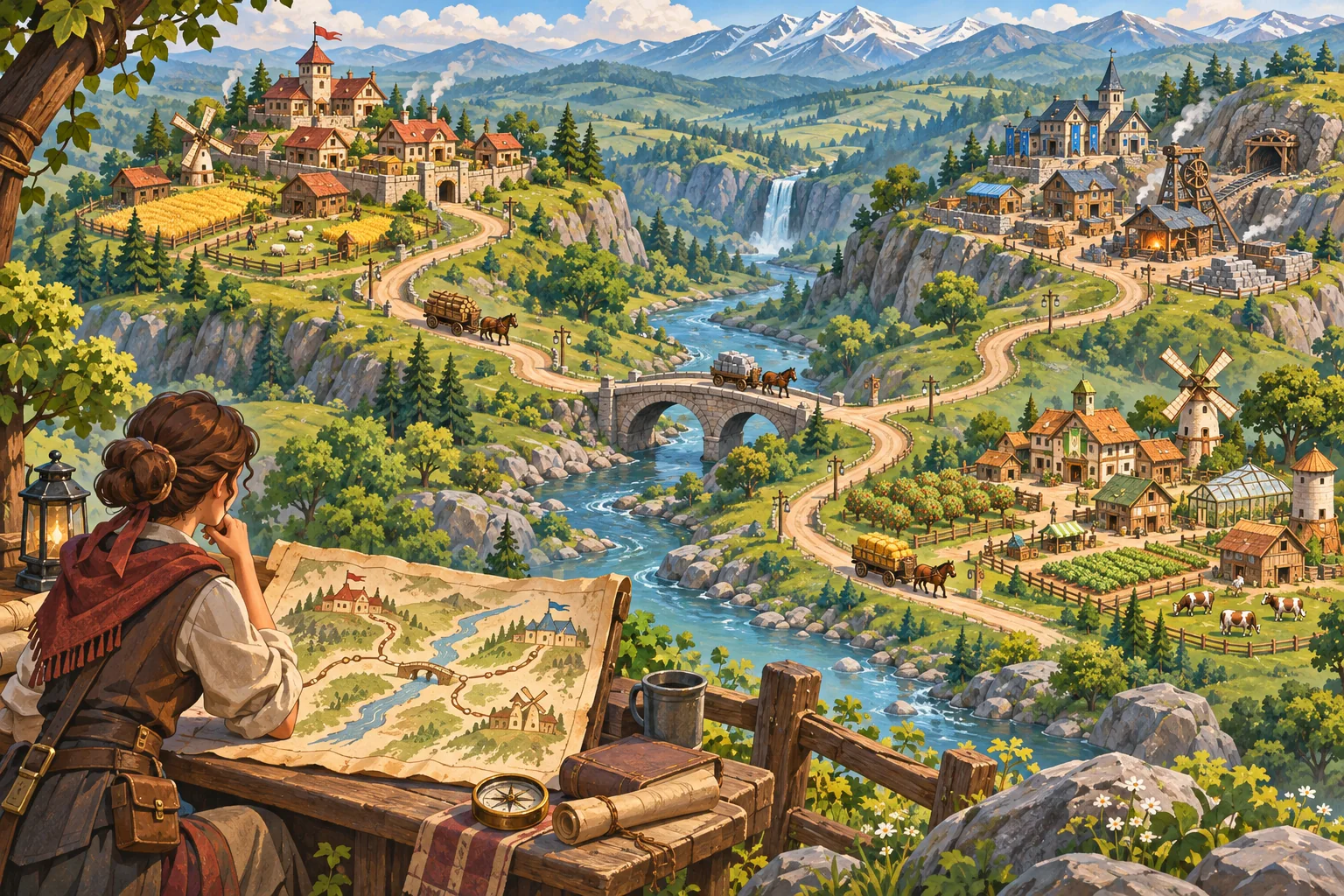
This guide assumes an existing colony-management game with player placement and some world-state model. The towns, routes, bridge, and resources are invented. No codebase, map, or save file was inspected.
Give each settlement a durable identity
Store an ID that remains stable if a player renames or moves a settlement. Keep display name and map position as editable properties, not identifiers. A settlement record might contain a stable key, owner, local inventory, population, and status. The world layer can then find it even if its name changes from “East Farm” to something the player prefers.
| Data | Owner | Question to settle |
|---|---|---|
| Settlement ID | World or colony system | Does it survive rename and movement? |
| Local inventory | Individual settlement | Can goods be consumed locally? |
| Road/bridge link | Network graph | What are valid endpoints and terrain rules? |
| Transfer rule | Economy system | When do resources move and what limits apply? |
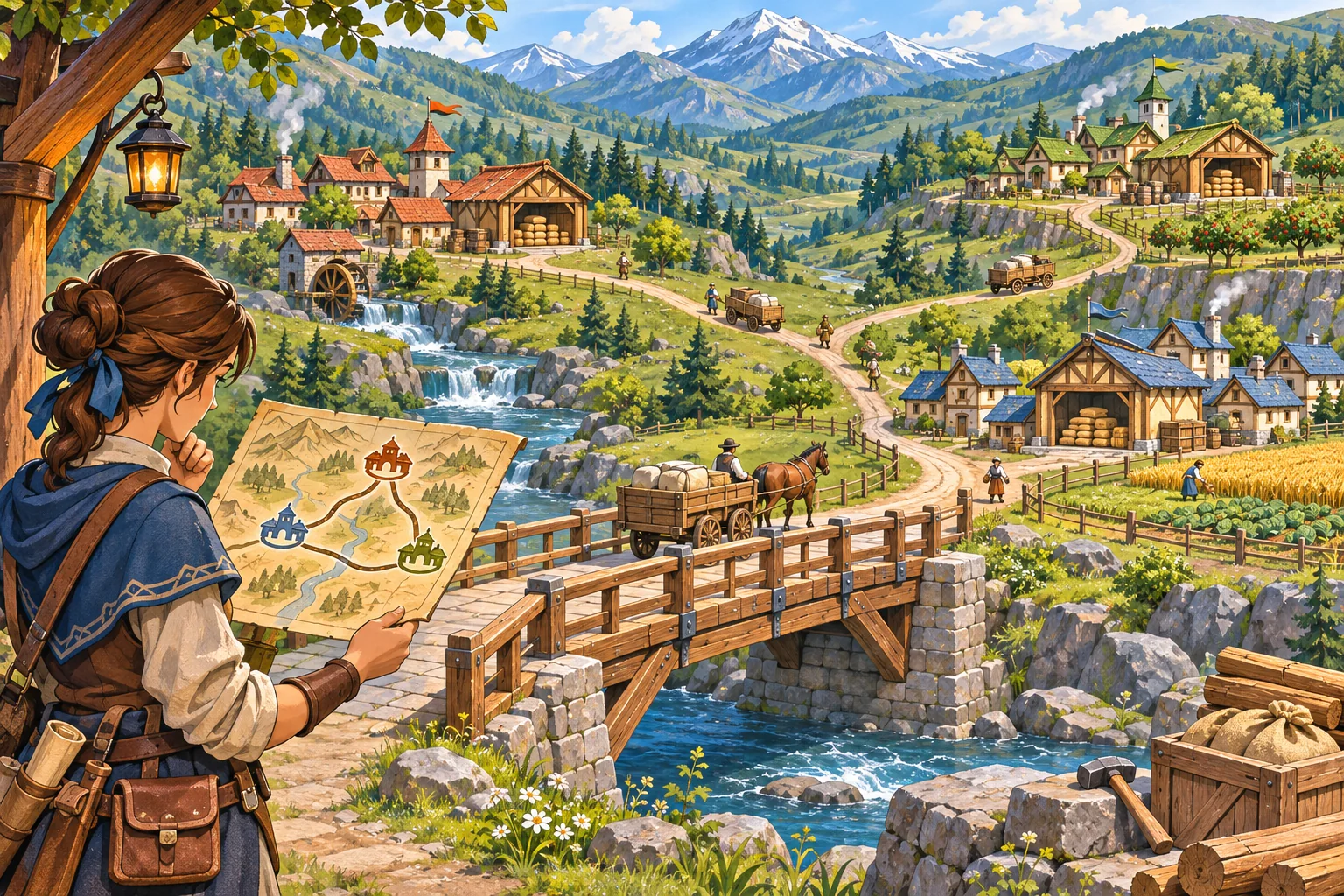
In the fictional Alder Basin example, each town has its own storehouse and a separate link graph. A bridge connects the riverbanks, while road capacity determines whether carts can pass. These are illustrative design choices, not tested mechanics. The same data separation works whether your game allows free placement or uses fixed building plots.
Represent links as a graph, not duplicated town data
A road should reference the IDs at both ends, plus any properties needed by the existing map system. Do not copy full settlement records into each road object. That creates stale duplicate state if a town is removed or moved. Instead, let one world owner resolve link endpoints and determine whether the path is currently usable.
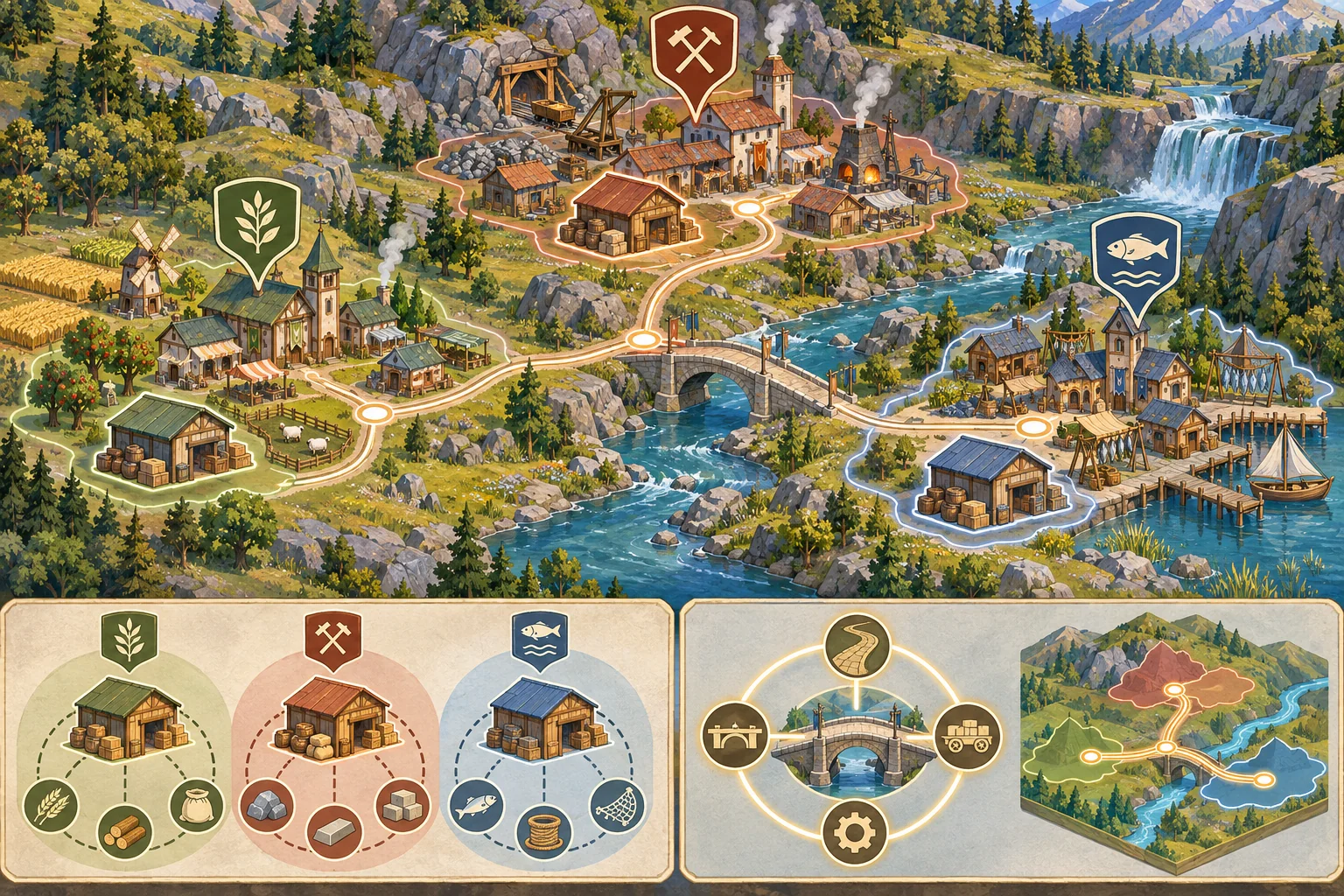
Define what happens when a player edits the network. If a settlement moves, does a road stretch, detach, or require rebuilding? If one endpoint is demolished, is the link removed, marked invalid, or offered for repair? When a bridge becomes unavailable, do transfers pause or reroute? These decisions are easier to communicate when the graph and local inventory are not blended together.
| Network choice | Local control | Player-facing consequence |
|---|---|---|
| Separate stores, manual transfer | High | Player chooses when and where to send goods |
| Separate stores, scheduled carts | Medium | Routes and capacity affect delivery timing |
| Shared pool after connection | Lower | Convenient, but distance matters less |
Pick a transfer rule that supports the game’s intended planning. A shared inventory may simplify management; local stores can make route choices meaningful. Do not implement both as overlapping sources of truth unless the game distinguishes them deliberately.
Connect to the existing world and save owners
Trace how the game currently creates buildings, assigns ownership, rebuilds map objects, and saves the world. Reuse its settlement lifecycle where possible. A second system that creates linked towns can duplicate entities or bypass placement validation. Ask AI to map those paths before editing and request the smallest extension that preserves building IDs, terrain rules, and existing colony progression.
Godot’s stable saving tutorial demonstrates identifying persistent objects and serializing relevant state as one engine-specific workflow. It does not prescribe a colony graph or prove that a particular network format is safe. Follow the project’s own engine and save architecture, and define defaults for saves that predate linked settlements.
Keep migrations explicit. If an old settlement has no ID, assign one deterministically or through a one-time migration rather than generating a new ID every load. If a link points to a missing endpoint, preserve a recoverable record and show a repair path rather than silently creating a ghost town.
Inspect the existing colony entity, placement, road/path, inventory, and save systems before editing. Add stable IDs and explicit links for one player-built settlement pair. Preserve current building placement, terrain rules, local inventories, and existing saves. First list files, state owners, invalid-link cases, migration defaults, and rollback steps. Then propose a minimal patch with tests for rename, move, unlink, missing endpoint, save, and reload. Do not claim the network works until tested in this project.
SEELE’s catalog describes idea-led game creation and playable game categories. It can help explore a separate colony concept or communicate a settlement-network idea. The catalog does not establish that SEELE modifies an existing repository or migrates its world saves.
Rebuild and validate the network
On load, reconstruct each settlement once, then resolve its links against the current set of IDs. Validate that endpoints exist, the path obeys placement rules, and transfer state is not duplicated. If the game rebuilds objects in phases, defer link resolution until both endpoints are available instead of relying on file order.
| Test | Action | Verify |
|---|---|---|
| Rename | Rename a town with two roads | Links still resolve to its stable ID |
| Move | Relocate a settlement | Roads update or enter the documented repair state |
| Unlink | Remove a bridge or road | Transfers pause or reroute as designed |
| Missing endpoint | Load a copied save with a deleted town ID | No ghost entity or silent data loss occurs |
| Reload | Save, quit, and rebuild the map | Each town and link appears exactly once |
| Older save | Load a version without network data | Migration keeps the colony playable |
Record build, map ID, settlement IDs, link IDs, and expected/observed transfer behavior. A mock map is useful for reviewing topology but cannot verify pathfinding, resource delivery, or load order in the real game.
Frequently asked questions
What does a linked settlement system need to track?
Give each player-built settlement a stable ID, local state, and explicit links to neighboring settlements or routes. Keep ownership, inventory, population, and shared network rules clear. Avoid using map display names as IDs because players may rename or move a settlement.
Should linked settlements share one resource inventory?
Only if that is the intended economy. A shared network can transport resources between local stores, while separate inventories make distance and route capacity meaningful. Define when a transfer occurs, what it costs, and what happens if a road or bridge becomes unavailable.
How do I prevent duplicate settlements after loading a save?
Store stable settlement IDs and reconstruct each saved settlement once through the existing world owner. Validate that every link points to a known ID, and handle missing or retired IDs deliberately. Test save, reload, and repeated world reconstruction with a copied file.
Can players connect settlements with roads they build?
That depends on the current game's map, pathfinding, and placement rules. Define valid endpoints, terrain limits, bridge requirements, and removal behavior before exposing road links. A mock network map can explain these rules but cannot prove routes work in the game.
What should I test after linking settlements?
Test adding, renaming, moving, linking, unlinking, saving, and loading several settlements. Check disconnected roads, missing endpoints, resource transfer, and an older save. Record map and settlement IDs with the build so a network issue can be reproduced. Reuse the same map fixture for each pass.
Keep local settlements connected by explicit rules
Give every settlement a stable identity, let one network owner manage the links, and decide whether resources remain local or move under clear route rules. Then test renames, deleted endpoints, rebuilds, and old saves. This keeps player-built towns flexible without letting the network become a second, conflicting world model.
To sketch a separate playable colony concept, try SEELE AI Game Maker. It is for concept exploration, not existing-project integration.