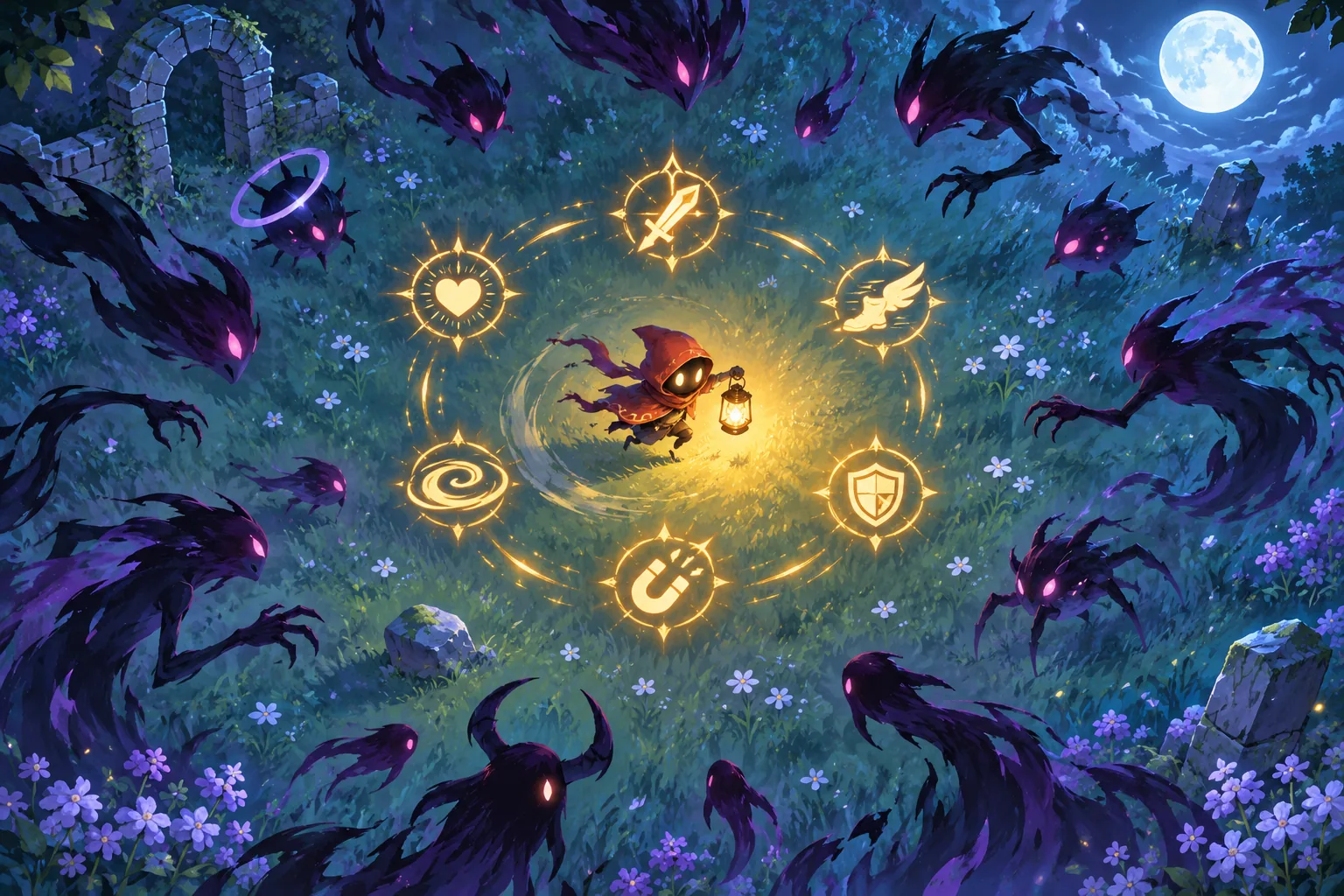
Automatic attacks let players focus on movement and positioning, so each weapon needs a targeting rule they can understand. Vampire Survivors’ official listing describes time-survival action and between-run upgrades bought with collected gold; the automatic attack model below is original guidance for a new game.

Define a clear targeting rule for each weapon
Automatic attacks shift player attention from aiming to movement and positioning. Vampire Survivors’ official Steam listing describes a time-survival game with minimalist gameplay and says gold collected during a run can buy upgrades for future survivors. That public context does not define a weapon system; the targeting rules and examples here are original.
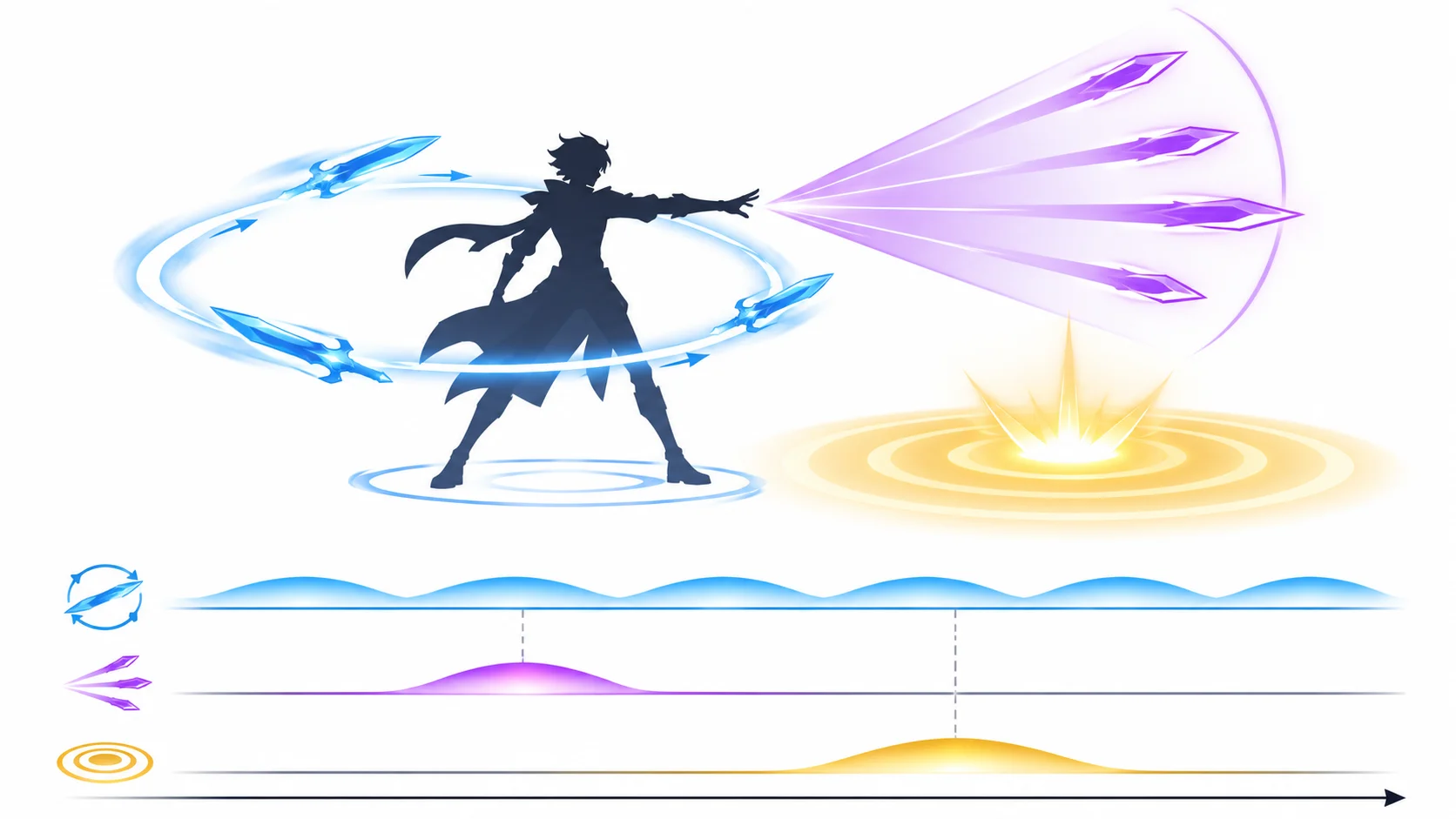
Give every attack a concise behavior contract: what it targets, when it fires, how far it reaches, and what space it affects. A blade might orbit at a fixed radius; a spark might seek the closest threat; a pulse might mark a location near the player and detonate after a short delay. The rule should be learnable from play, not hidden behind a weapon name.
Make attack behavior work with player movement. If a weapon targets the nearest enemy, moving toward a group may redirect it; if it fires forward, the player must face or steer toward a threat. This lets positioning remain active even without a manual attack button. Show enough visual feedback that players understand why an attack connected or missed.
Use attack cadence to create distinct roles
Cadence creates rhythm. A fast low-damage attack can clear nearby threats, while a slower heavy strike can reward route planning and timing. Distinguish weapons through timing, range, area, and target priority rather than giving every option a different visual effect with the same behavior.
Use cooldowns and anticipation consistently. A windup can signal a powerful attack; a brief pause after a burst gives enemies room to approach. If several weapons fire simultaneously, preserve a readable pattern. Avoid bursts that obscure incoming threats or make the player’s movement consequences impossible to see.
Attack roles should complement one another. A close orbit can protect a narrow escape route while a forward shot reaches a distant enemy. Combining them can create a build identity without guaranteeing safety in every direction. Give each weapon a clear weakness, such as limited range or a predictable angle, so the player still chooses where to move.
Keep effects readable as enemy density grows
Dense action can overwhelm the screen when attacks, enemies, damage, and pickups all use bright flashes. Establish a visual hierarchy: player silhouette and threats first, attack path second, reward feedback third. Use consistent shapes and contrast so a dangerous area remains visible during an upgrade burst.
Test the highest enemy density and the strongest weapon combinations together. Watch for overlapping particle effects, frame drops, projectiles lost behind enemies, and attack animations that mask enemy windups. Reduce redundant effects or use a short outline and clear movement arc. More particles do not always make an attack feel stronger.
Performance is also part of readability. If an upgrade multiplies projectiles, profile the worst case and watch input response. Keep attack logic simple enough to remain stable when many enemies are active. Players need to trust that their movement and weapon timing remain responsive even in late-run chaos.
Test upgrades through movement and combat
Build a scenario set with different enemy speeds, sizes, and approach directions. Compare how each automatic weapon behaves when the player moves toward, away from, and across a group. Record damage, target distribution, survival time, and player understanding. Ask players to predict the next attack before it fires.
Upgrade one property at a time during testing. More projectiles can increase damage and clutter at once; a longer duration can also improve coverage and obscure danger. Evaluate those effects separately before combining them. Check both single-weapon and multi-weapon builds so one upgrade does not create a runaway strategy only when paired with a particular item.
Finally, confirm that upgrades support movement rather than replace it. If players can stand still and survive every encounter, enemy pressure or weapon coverage may be too generous. If they cannot tell where to move, improve tells and attack timing. The strongest builds should feel powerful while leaving the player responsible for choosing a route through danger.

Related guide
For another way to build attack encounters around readable enemy behavior, see the guide to isometric combat encounters.
Frequently asked questions
How do you design automatic attacks in a survival game?
Give each weapon a clear targeting rule, attack cadence, range, and effect shape. A weapon might orbit, fire toward the nearest threat, or mark a ground area after a delay. Test how it behaves while the player moves, because movement is a central way to aim and avoid danger.
How can automatic targeting feel predictable?
Use stable priorities such as nearest enemy, closest threat to the player, or a consistent direction. Show the chosen target or attack direction when possible, and keep the rule unchanged across similar weapons. Predictability lets players position themselves to influence what the weapon hits.
How do you keep effects readable in dense combat?
Use distinct silhouettes, colors, and motion patterns for attacks, enemies, and damage feedback. Limit overlapping screen effects and preserve a clear view of the player’s immediate danger zone. Test at the highest expected enemy density and on smaller displays, not only in an empty arena.
How should automatic weapons scale with upgrades?
Improve one understandable property at a time, such as cadence, area, projectile count, or duration. Check how the change affects damage, coverage, screen clutter, and performance. A stronger upgrade should open a new tactical possibility without making movement or enemy signals impossible to read.
Prototype automatic attacks
Use AI to propose targeting rules and enemy-density scenarios, then validate readability and performance in a playable build. Designers should own the attack behavior, upgrade budget, and visual hierarchy. Start a game project with Seele.