Document-comparison games ask players to apply rules consistently while information and workload change. Lucas Pope’s official Papers, Please listing establishes a fictional admission-checkpoint setting. The schema, invented documents, comparison rules, and playtest procedure below are original; they do not reproduce real government forms or the reference game’s specific documents.
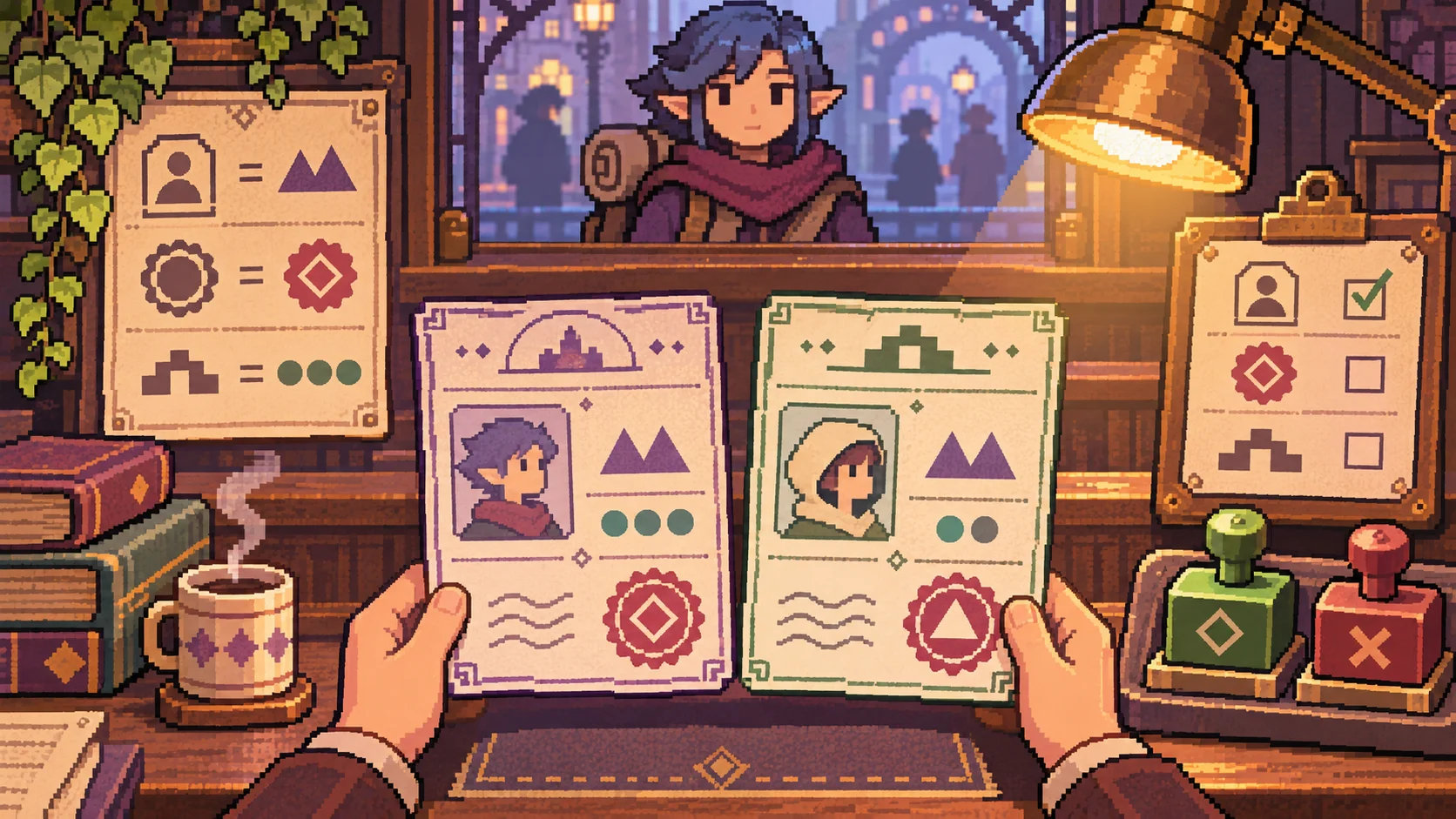
Choose a small set of fields that can disagree
Start with two fictional records that share a few fields: an invented traveler name, a route permit, an issue date, a validity interval, and a colored seal. Store values as structured data rather than trying to infer everything from a picture. The visual document can display those values, but the validation system should compare fields with explicit rules.
Give each field a purpose. A date can determine whether a permit is current; a seal may indicate which office issued it; a route code may need to match an arrival request. If a field never changes the decision, remove it or use it only as decoration. A small set of consequential differences is easier to learn than a page of arbitrary details.
Build a case matrix before adding content. Include a correct record, one required field mismatch, a missing value, and a harmless format variation. This reveals whether the rules produce the decisions you intend. The example values should be fictional and internally consistent.
Compare fields with explicit normalization rules
Normalize equivalent values before checking them. A date might appear as day-month-year on one card and month-day-year on another; convert both to an internal date value first. Trim accidental spaces from a route code if whitespace has no meaning. Preserve differences that do matter, such as a swapped digit or expired date.
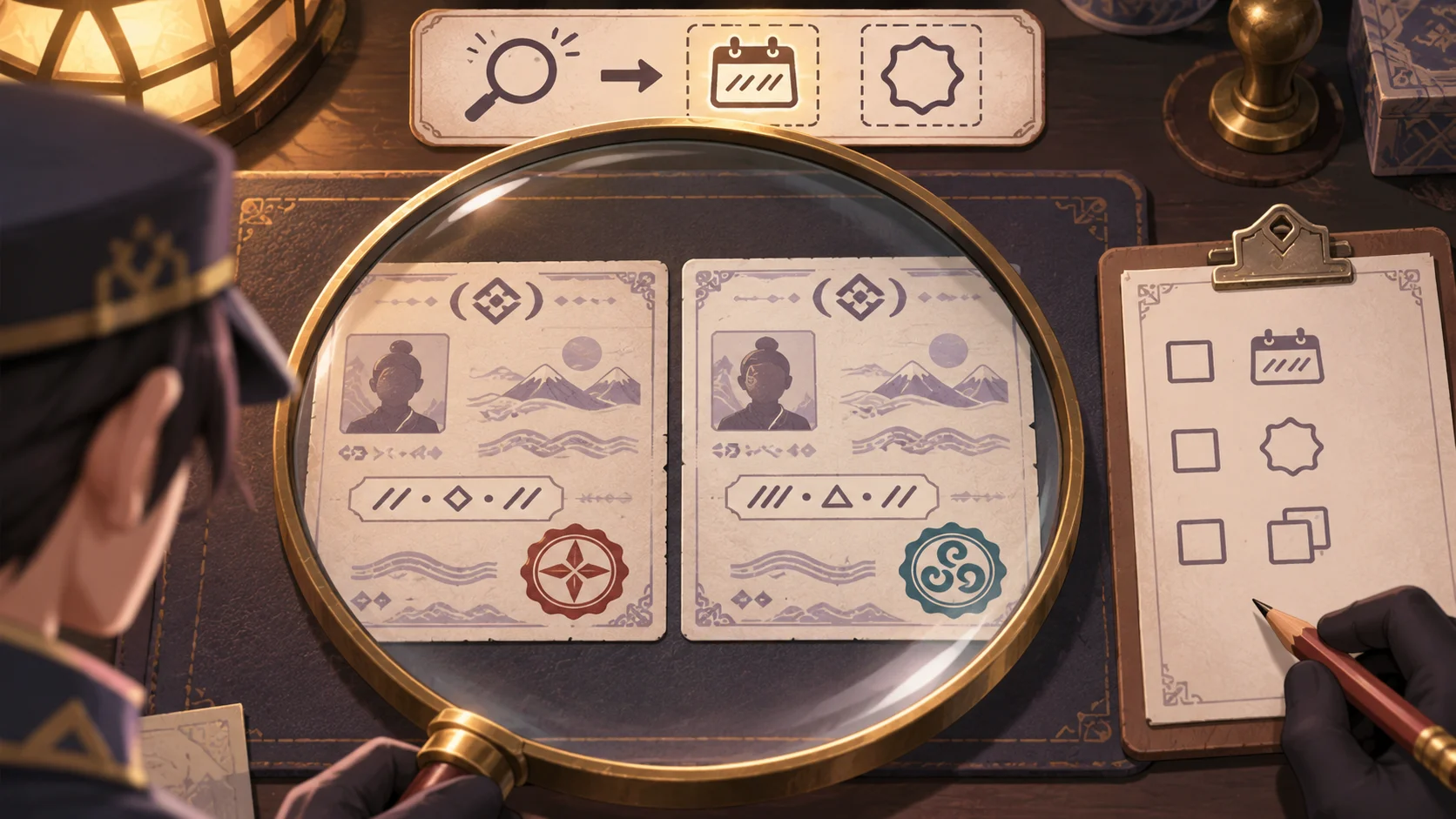
Define exact, tolerant, and optional checks. A serial identifier may require an exact match. A date can be accepted within a specified interval. A secondary mark may be optional unless another field triggers the check. Make these categories visible in the tutorial or rule reference so players know what to inspect.
Use a decision table for edge cases. If two documents disagree on a required date, the case may need correction. If the formats differ but encode the same date, it can pass. If a seal is absent where one is required, the game should identify that missing evidence. A single field should not have different meanings on similar cases without a rule that explains why.
Turn the comparison into a consistent decision
Give players a small set of outcomes, such as accept, reject, or request correction. Link each decision to the evidence. After an action, show which check passed or failed and what the result means. The game can maintain pressure through time or workload, but should not conceal the rule that caused a penalty.
Let evidence arrive in a readable order. A request card might list which fields are required for today’s case. A player can compare the documents, then record the outcome. If the game adds new rules, introduce them one at a time through a safe example before combining them with a timer.
Playtest accuracy, pace, and ethical framing
Test valid cases, clear conflicts, equivalent formatting, and close boundary conditions. Track false approvals and false rejections separately; the player experience differs when the game is too lenient versus too strict. Ask testers to explain why they accepted or rejected each case. If their explanation does not match the intended rule, improve the rule’s presentation.

Keep the setting fictional and avoid mapping suspicion to real nationalities, identities, or protected traits. Challenge can come from changing procedures, limited time, and contradictory records without turning real-world groups into gameplay signals. Use a closed test set while tuning so you can compare accuracy after each revision.
Use SEELE AI to draft an original inspection-game prototype, then verify each document field, comparison, and outcome manually. Do not assume a generated design has a reliable validator. For a broader concept guide, see the original inspection-game guide. Prototype an original inspection game.
FAQ
How do you build document comparison into a game?
Represent each fictional document as structured fields, such as an invented name, date, permit type, and seal. Normalize equivalent formats before comparing, then show which fields agree or conflict. Give players a consistent rule and enough feedback to learn it without relying on hidden exceptions.
Should document fields be matched exactly?
Match fields exactly when the rule says they must be identical, such as a serial code. Normalize harmless differences such as spacing or date order before comparison. For fields that allow a range, define the tolerance visibly and test its boundary cases. Avoid making players guess whether a tiny variation is meaningful.
How can a document-checking game make errors fair?
Use fictional documents, clear rules, and explanations tied to the specific mismatch. Give players time to inspect the required fields and let them learn from an early low-stakes example. Test both false approvals and false rejections, since a system can feel unfair when correct records are treated as suspicious.
What should you measure in a document comparison playtest?
Track comparison accuracy, time per case, fields players inspect, false positives, false negatives, and whether they can explain the decision rule. Include valid records, clear mismatches, equivalent formats, and ambiguous edge cases. Revise one rule or visual signal at a time and replay the same test set.