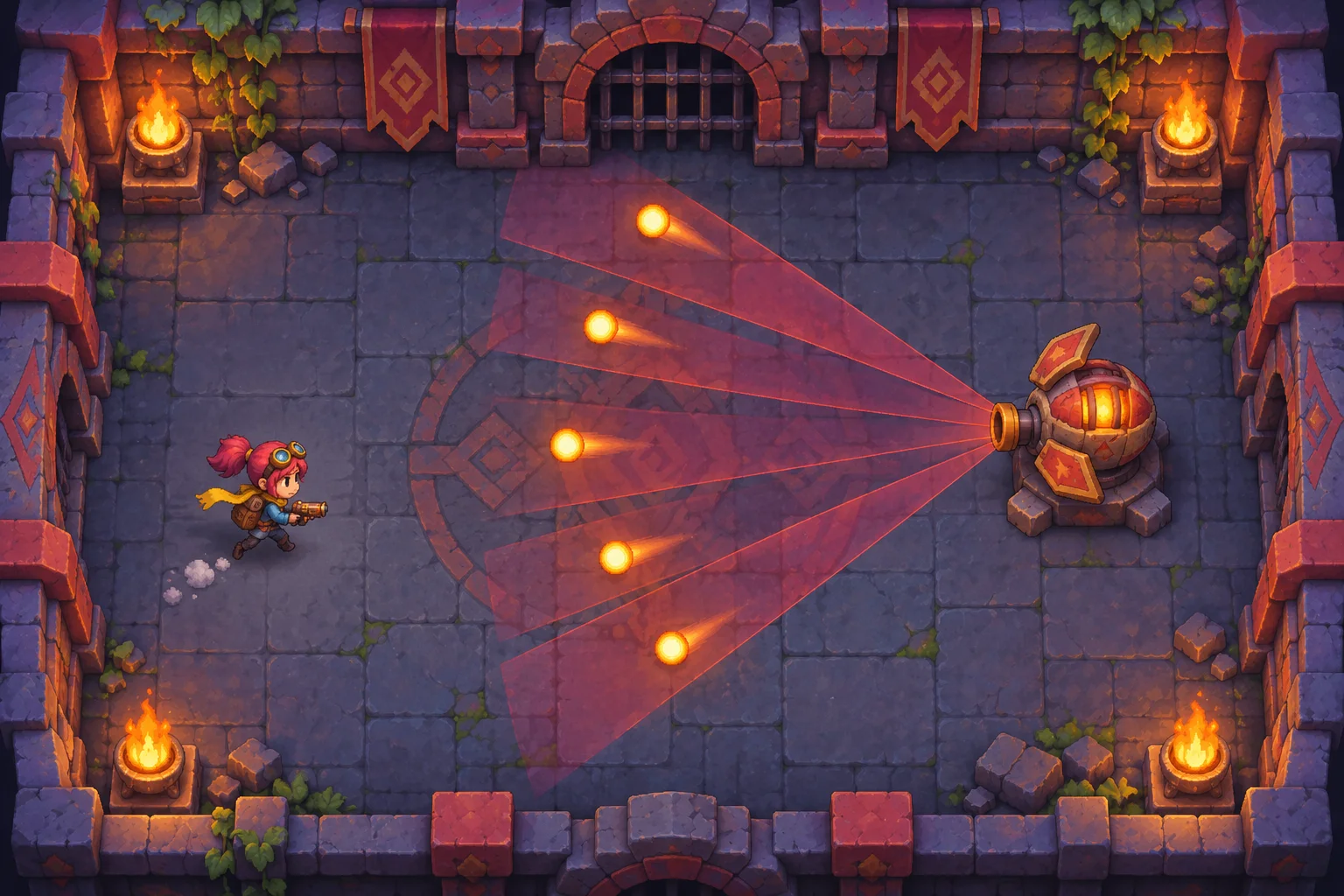
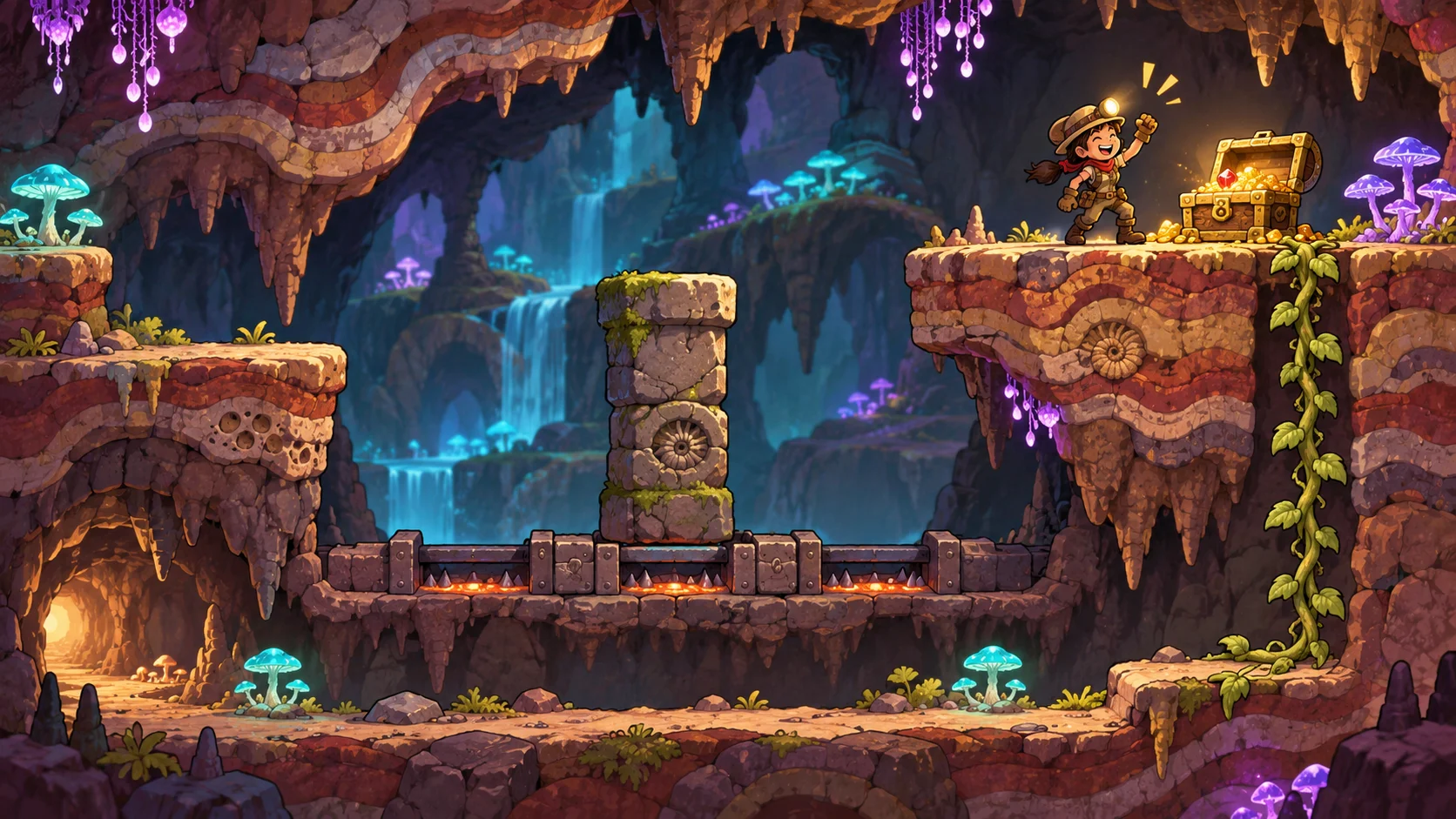
Environmental hazards can make platform movement tense when players can see what triggers danger, how it behaves, and how to respond. Teach each rule before combining it with other threats, then test how procedural spaces affect visibility and escape. Spelunky’s official listing describes randomized, destructible levels containing traps and other dangers; the hazard designs here are original.

Start with one hazard rule at a time
An environmental hazard is a movement rule with consequences. Spelunky’s official Steam listing describes randomized, fully destructible levels that contain dangers, monsters, traps, and treasure. This public context supports the need to consider hazard and level variation, but the specific systems below are original recommendations for another platform roguelike.
Define a hazard in four parts: trigger, tell, active effect, and recovery. A pressure plate can glow when stepped on, raise a spike after a brief delay, and retract once its cycle ends. Players can then learn the timing rather than guessing whether a collision was intended. Keep the first encounter simple and provide a safe place to observe the rule.
Tie hazards to the movement verbs your game already teaches. A gap can test jumping; a swinging obstacle can test timing; a collapsing floor can reward momentum or careful stopping. Avoid introducing a new hazard that requires an unannounced input. If the player must crouch, climb, or redirect an object, teach that action before making it the only response to danger.
Make danger and timing visible
A warning should be visible from the point where the player needs to act. Use shape, motion, sound, light, or environmental traces to signal what is dangerous and when it will activate. Do not rely on a subtle color shift alone. For a timed trap, the tell should be consistent in duration and return in a recognizable pattern.
Measure reaction time from the player’s view. A warning that lasts one second may be enough in an empty room but not while jumping over a gap or reacting to an enemy. Keep the active area clear and make collision boundaries match the visual effect. If the sprite extends far beyond the actual hit region, players may misread a fair escape as a bug.
Offer counterplay that fits the challenge. Players might wait for a cycle, jump over the active area, use a destructible object as cover, or trigger the hazard remotely. Make the safest response discoverable but do not force a single solution when the game promises improvisation. A clean reset after a mistake also helps players learn the rule.

Combine hazards with movement and enemies
Once players understand a hazard alone, combine it with familiar movement or enemy behaviors. A slow enemy near a timed trap may become a tool if the player can bait it. A moving platform can provide a safe route over a floor hazard, while a destructible wall offers a slower alternative. Combinations create new decisions without requiring entirely new mechanics.
Keep interactions consistent. If a falling rock can activate a plate, block a projectile, and harm an enemy, use stable rules wherever possible. A special exception can exist, but it should have a clear cue and should not undermine a learned rule. Show enough of the room that players can anticipate how the parts might interact.
Be careful when multiple threats overlap. An enemy may push the player into a hazard, or an explosion may obscure the warning. Test the combined scene at normal play speed and with different approaches. If the player has no meaningful action after entering the room, reduce the overlap or add a recovery route.
Test fairness across generated layouts
Procedural rooms change the space available for warning and counterplay. Test many layouts for sight lines, approach distance, jump reach, safe waiting space, and alternate routes. Automated checks can reject impossible geometry, but players still need to see the hazard and understand its timing.
Log each hazard activation and collision with the room seed, player speed, camera position, and nearby actors. Review near misses and unexpected deaths manually. Look for patterns: hazards hidden behind foreground objects, escape ledges missing, or enemies that force contact too quickly. Update generation constraints and retest a broad set of seeds after a change.
Finally, compare novice and experienced play. Beginners need a safe first lesson; experienced players may enjoy tighter timing or more complex interactions. Difficulty can grow by combining known rules, but keep the signals stable. A player should be able to learn from a failure and describe what they will try differently next time.
Related guide
For designing incidents that respond to changing player conditions, see the guide to emergent colony incidents.
Frequently asked questions
How do you design environmental hazards in a platformer?
Define the trigger, warning, active effect, and recovery state for each hazard. Teach one rule in a low-risk area, then reuse it in new spatial contexts. Give players a way to read the hazard from the normal camera view and enough control to respond using the game’s established movement verbs.
How can hazards feel dangerous but fair?
Show a consistent tell before the damaging moment, keep collision and timing rules stable, and ensure the player can identify a plausible response. A hazard can still surprise through placement or combination, but it should not change behavior without a cue. Test at different speeds and camera positions.
How should hazards interact with enemies?
Let each hazard affect enemies and players according to the same visible rule unless a deliberate exception is taught. This can create opportunities such as luring an enemy into danger, but avoid interactions that resolve offscreen or without warning. Confirm that enemy movement cannot make an otherwise safe route unavoidable.
How do you test hazards in procedural levels?
Generate many room layouts and check line of sight, approach distance, escape space, and reachable platforms around each hazard. Log near misses and unavoidable hits, then manually review edge cases. A hazard that works in one hand-built room may become unfair when procedural geometry removes its warning or counterplay.
Prototype hazard timing
Use AI to enumerate hazard combinations and procedural test cases, then verify collision, warning, and recovery in the playable build. Designers should own each rule and decide what a fair failure looks like. Start a game project with Seele.