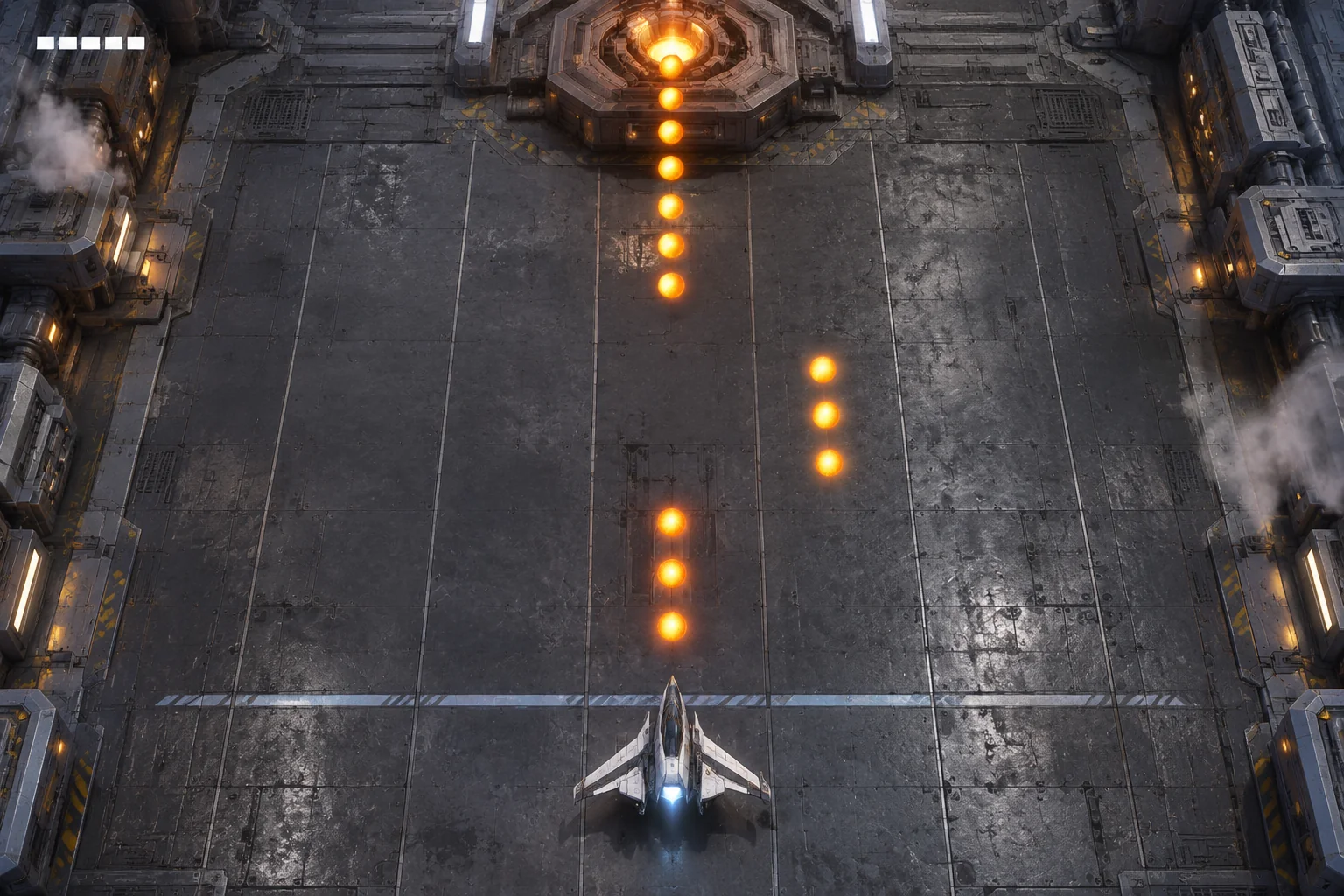
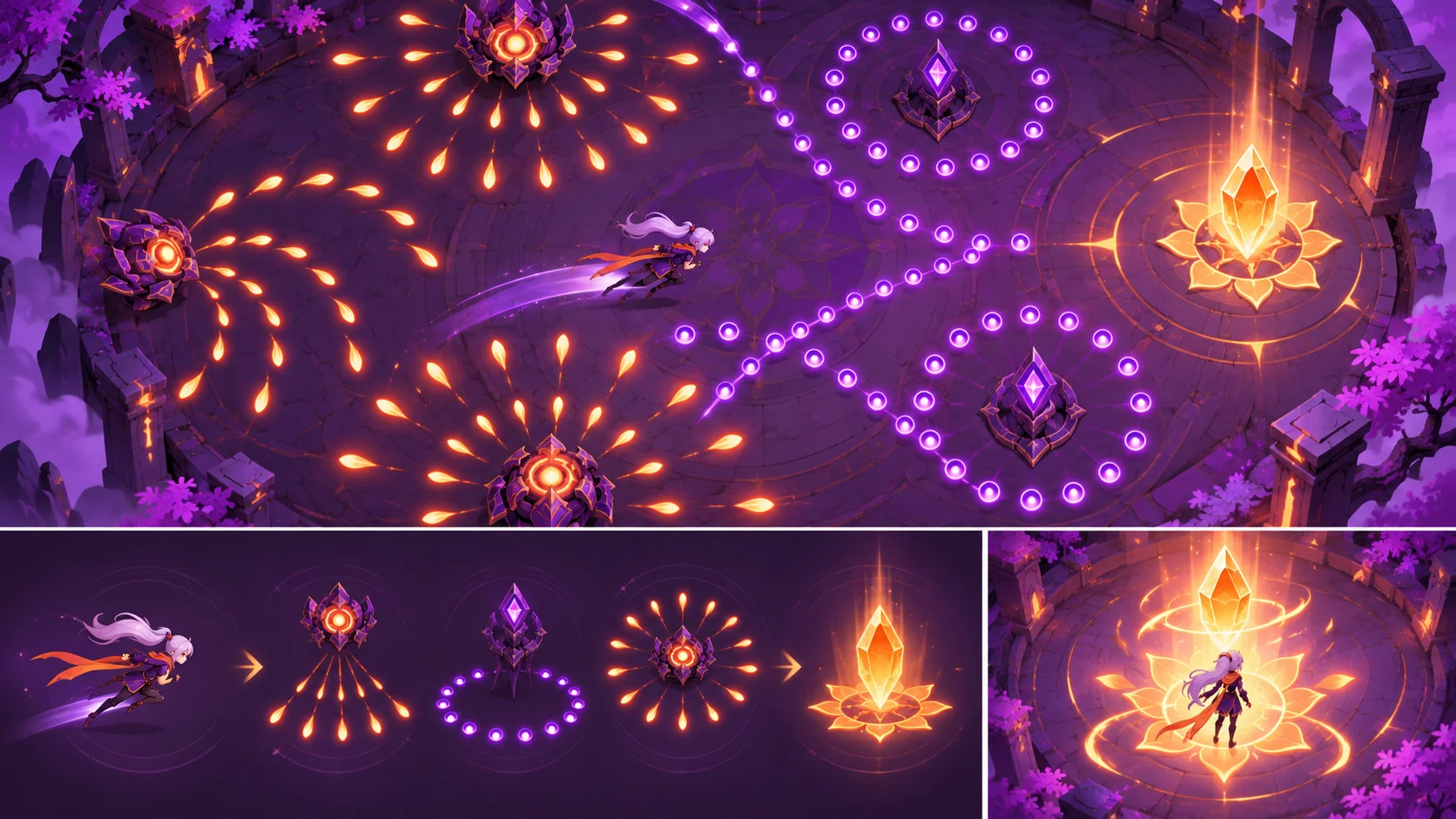
Projectile patterns challenge players through movement, spacing, and timing. Enter the Gungeon’s official Steam listing identifies it as a bullet-hell dungeon crawler and highlights shooting and dodge rolling. The attack shapes and fairness framework in this article are original proposals for another game, not measurements of the reference game.
Start with a readable attack intent
Give each attack a job before choosing its shot count. A turret might test whether the player can move around a slow fan; a close-range creature might deny one nearby tile while leaving the far side open. Name the intended response in your design notes. If a pattern has no clear player answer, simplify its geometry or change the room.
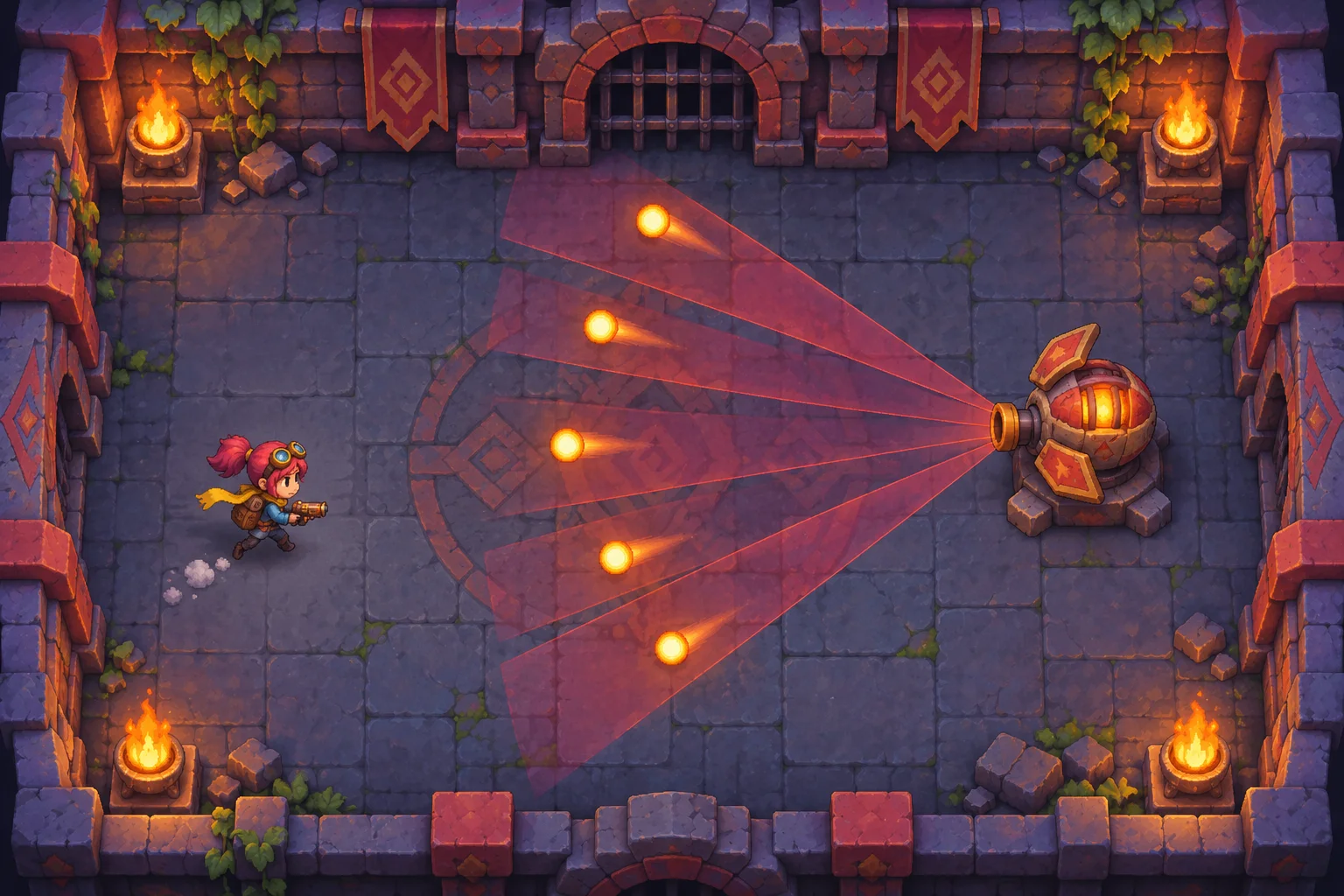
Pair a tell with one pattern family. A raised barrel can signal a aimed volley; a pulsing core might signal a ring; a sweeping arm can forecast a fan across a known angle. Keep the cue long enough for the attack’s speed and the player’s movement options. If every enemy uses the same wind-up, vary pose, sound, or location without changing the meaning of familiar cues.
Separate warning, firing, and recovery. During the warning, show direction or affected area. During the volley, make projectiles visually distinct from floor decoration. During recovery, give the player a moment to act or reposition. This three-part rhythm teaches a pattern through play rather than a text tutorial.
Build patterns from simple rules
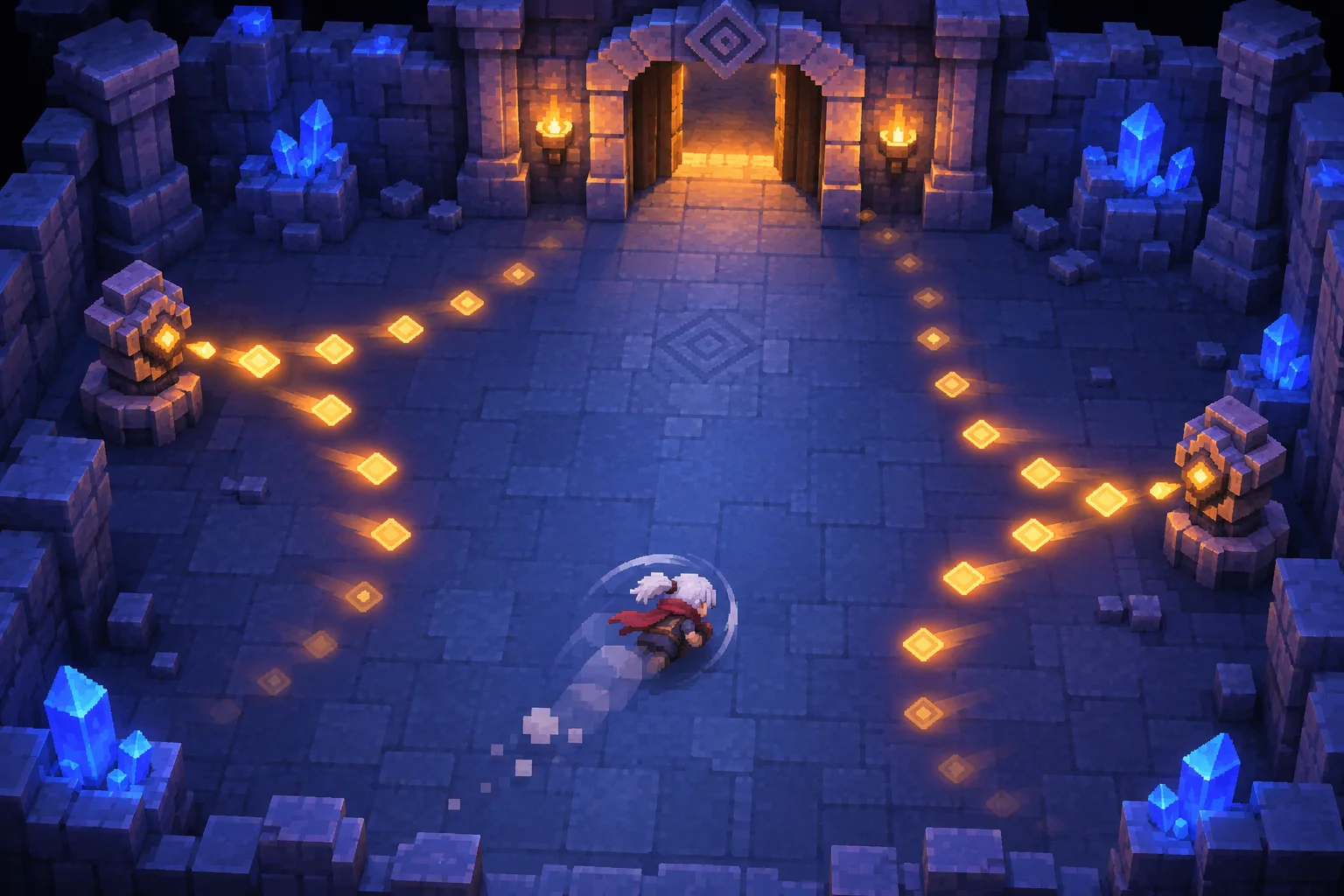
Describe a projectile pattern with a small set of parameters: origin, direction rule, spread angle, shot count, interval, speed, and target choice. An aimed volley uses the player’s position at the moment of firing; a fan fills a defined arc; a ring spreads shots outward. These are general building blocks, not reference-game statistics.
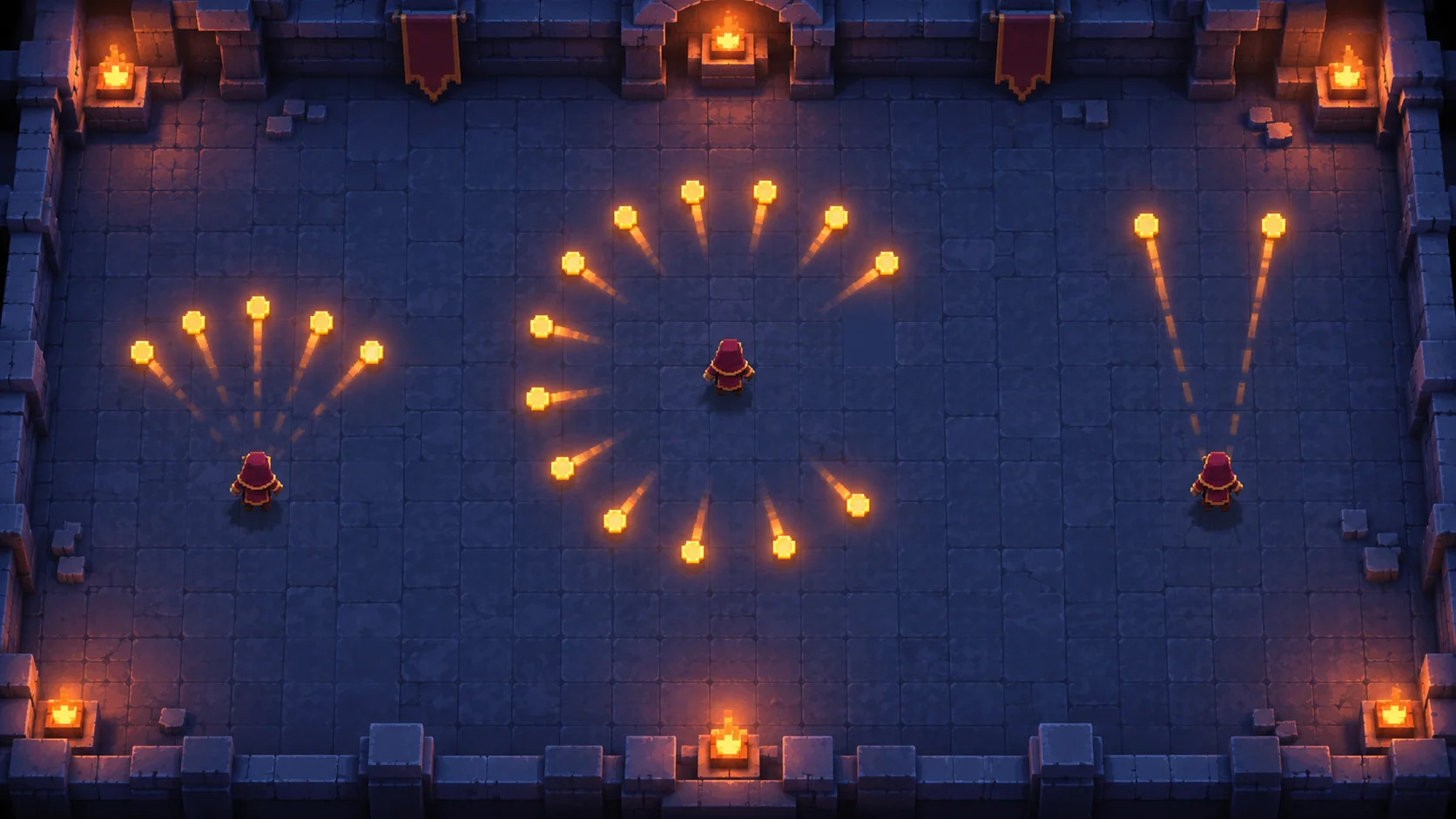
Start with one projectile and a wide response lane. Add density only after the cue and safe route are clear. For a fan, test whether the gaps are large enough for the player hitbox at the firing distance. For a ring, leave a deliberate opening or enough time to move outside its radius. For an aimed pair, use spacing that permits one dodge to clear the full burst.
Avoid changing direction after the tell unless the enemy explicitly tracks the player and that tracking is visible. If shots home, limit the turn rate and give the player a counter-route. Sudden invisible retargeting turns a readable attack into a guess.
Preserve safe movement space
Test the pattern against the whole room, not a blank plane. Walls can close escape lanes, corners can trap a player, and floor hazards can cover the only visible gap. Mark the player’s actual hitbox and simulate the path through time. A gap that looks wide in a still frame may not remain reachable as shots advance.
Check the slowest intended movement speed, a larger accessibility hitbox, and recovery frames after a dodge. If only a perfect dash makes the pattern survivable, teach that requirement before a lethal encounter. Offer a non-color cue when projectile type or danger state depends on color.
Tune, combine, and validate patterns
Tune one pressure dimension at a time: speed, count, spread, warning time, or room size. Record damage events and whether the player recognized the cue. If damage rises after increasing shot count, do not also shorten the warning; changing one variable preserves a useful explanation for the result.
Combine patterns only after each is readable alone. Test overlapping warning zones, effects that obscure the floor, and the transition from one volley to the next. Avoid putting a second attack into every recovery window; players need opportunities to act, not only to react.
Use SEELE AI’s game-studio capability to start from a written action-game idea, then inspect the resulting attack against the pattern spec. Verify firing direction, speed, collision, and the reachable lane in actual playtests. The capability description does not guarantee precise projectile tuning or accessibility behavior.
For a related threat-communication approach, read the enemy-intentions guide. To sketch an original action game, start a prototype.
FAQ
How do you design projectile patterns for a roguelike?
Define where a pattern starts, how it aims, how many shots it emits, and how much time the player has to respond. Pair that geometry with a clear enemy tell and at least one reachable escape lane. Build the first pattern from a simple rule, then add one variation after players can read it.
What makes a projectile attack fair?
The attack should communicate its timing and shape before it becomes dangerous, and the player should have enough movement space to respond. Test the pattern against room edges, slower movement, different hitbox sizes, and a player already recovering from a dodge. Fairness depends on the full encounter, not projectile speed alone.
How can designers vary bullet patterns?
Change one feature at a time: spread angle, shot count, firing interval, aim rule, or the location of a safe gap. Keep the core cue familiar while introducing one new decision. If several properties change together, players may not understand why a previously readable attack became difficult.
How should projectile patterns be tested?
Replay each pattern at normal speed and in slowed observation, then test it in the smallest intended room and with the slowest supported character. Record when the player can first identify the cue, which dodge route works, and whether overlapping shots obscure one another. Adjust one parameter and repeat the same case.