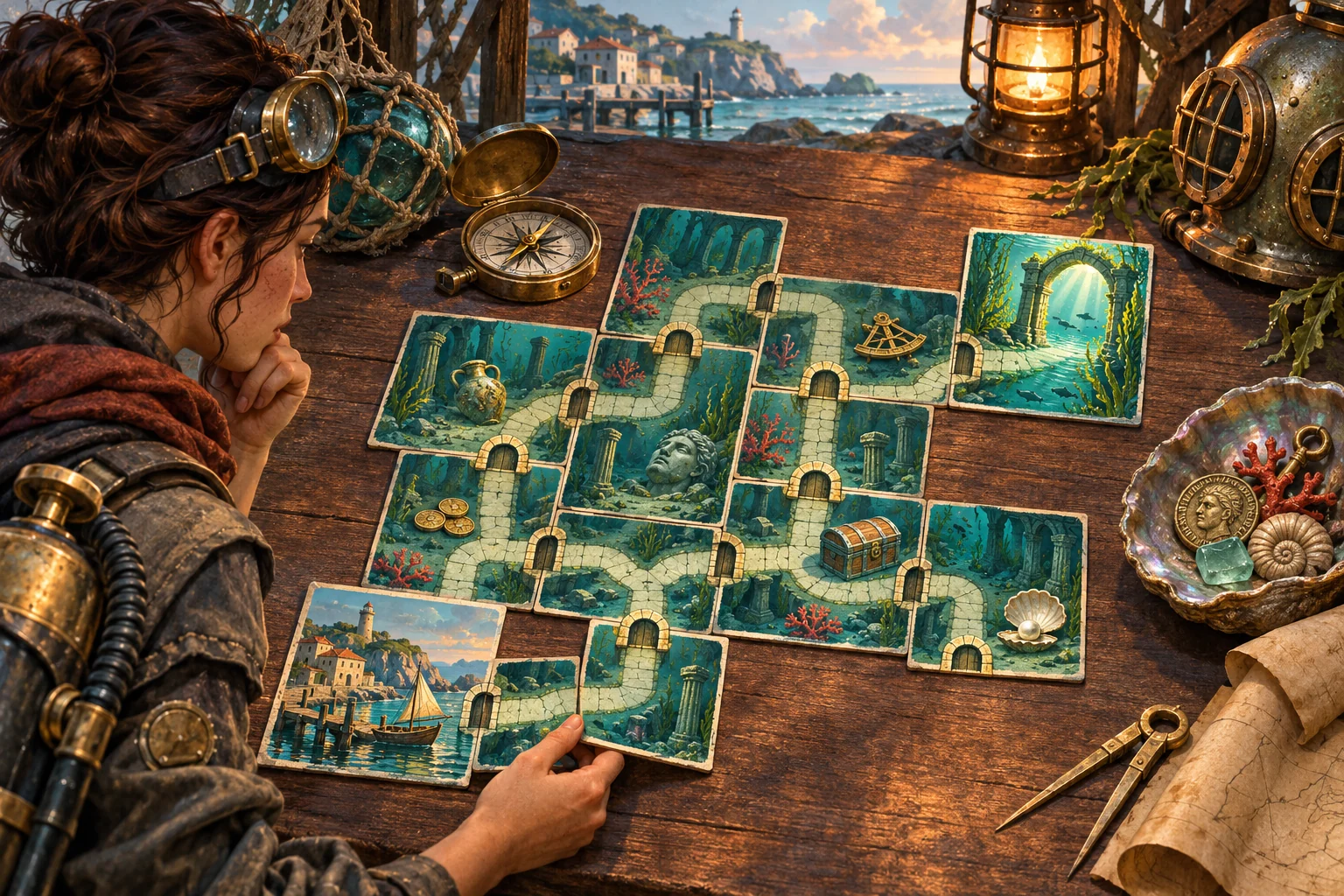
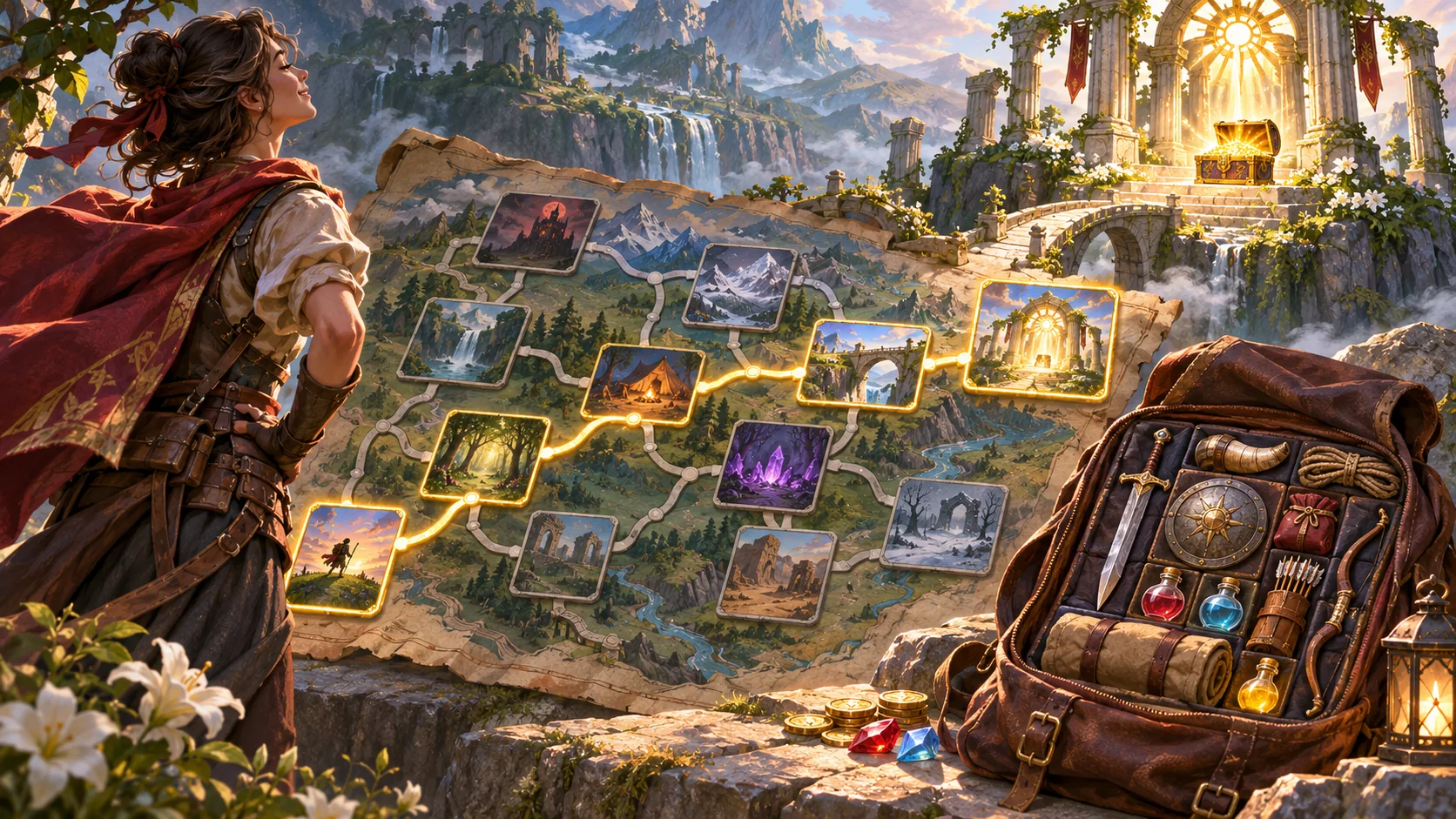
A run can change its own map. In Mossbound, route cards do more than describe a room: each one must connect to an open edge, stays on the map for the rest of the run, and adds a Scout token to the shared bag. The Scout tokens you draw later help place more routes, so a map choice also changes the odds of future turns.
Start at Camp with an east-facing frontier and a four-token bag: two Strides, one Guard and one Scout. On the first turn, drawing Scout, Stride and Guard lets you place a West-East Moss Path, move into the new room and block one hit. Placing the path adds another Scout to the bag. The trace shows how a Fork card later opens a north branch, and why a route with no matching west connector must be rejected without spending a token.
Give route cards matching edges and a lasting place
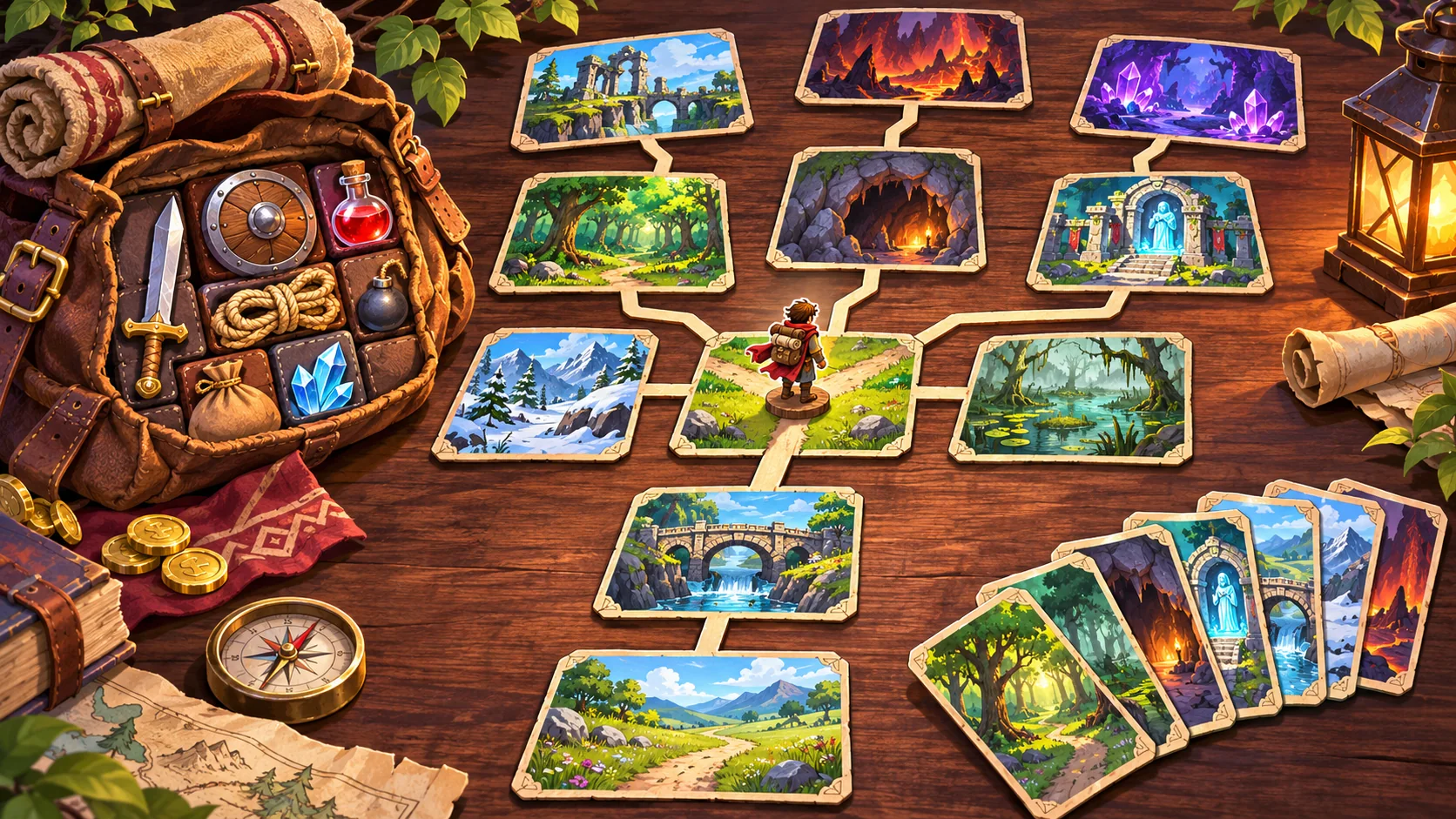
Keep the route deck, hand, shared token bag and laid map as separate but linked state. A Scout lets the player place one route card; the card must match an exposed map edge. Successful placement expands the map and adds one Scout token to the bag, while an invalid orientation changes nothing.
| System | Rule and result |
|---|---|
| Map start | Camp has one open east edge. It cannot be moved or replaced during the run. |
| Draw | Draw three tokens from the shared bag, use each for one action, then return them and shuffle at turn end. |
| Scout action | Spend one Scout to place one route card from hand on an open edge. At least one connector must match the frontier. |
| Route card | A Moss Path has west/east edges; a Fork has west/north/east edges. Rotate before placement, then keep the card on the map. |
| Bag change | Each successfully placed route adds one Scout token permanently for this run. The new token joins the next shuffle. |
| Other tokens | Stride moves one linked room; Guard cancels one incoming hit. Neither token places or rotates a route. |
| Invalid placement | Reject a card with no matching edge and spend no Scout. Do not add its room, exit or bag token. |
Trace two map extensions and a changing token bag
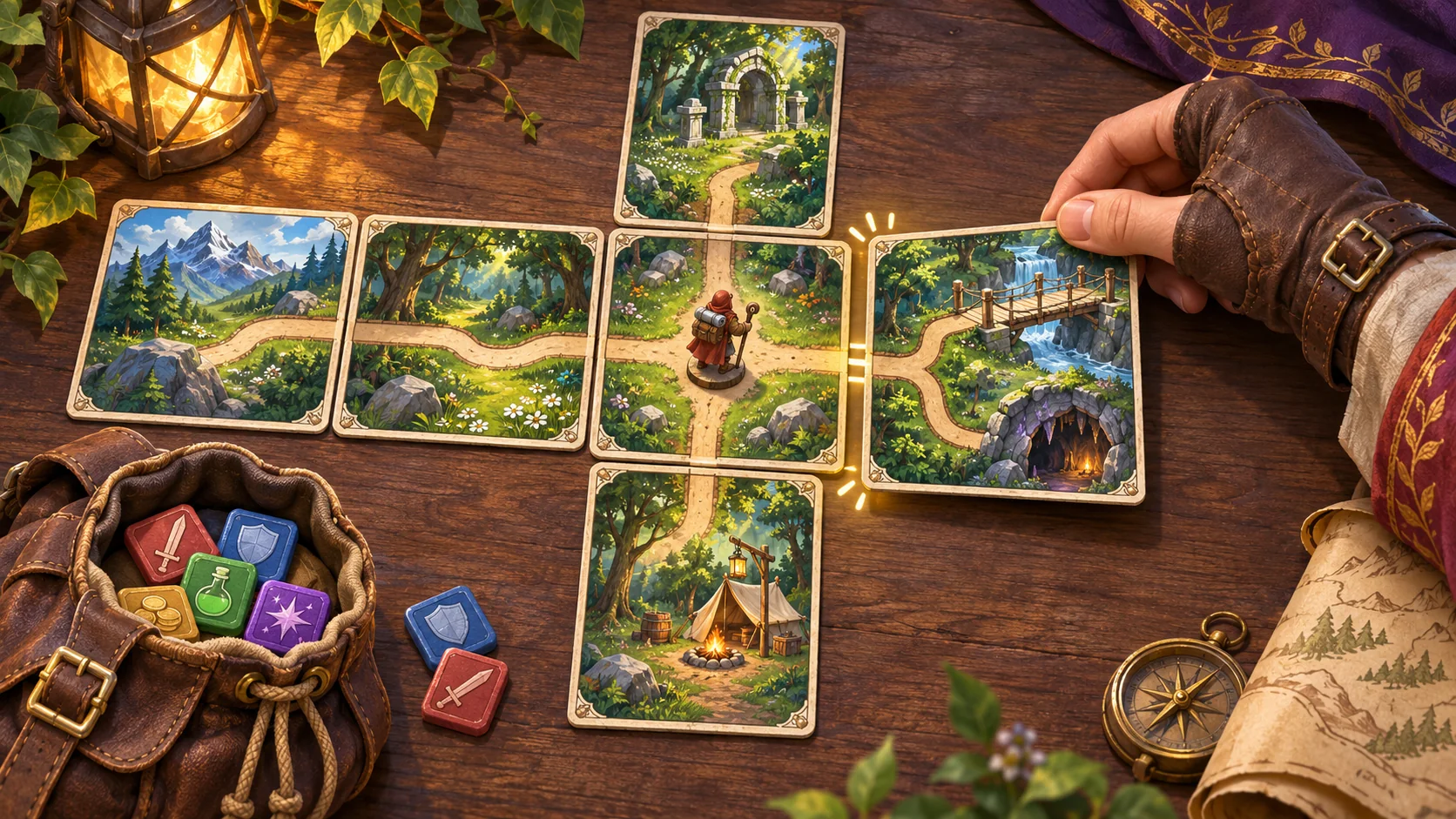
Camp has one exposed east edge. The first draw is Scout, Stride, Guard. Spend Scout to rotate Moss Path so its west edge meets Camp’s east edge; the path remains on the map and adds one Scout. Spend Stride to enter it and Guard to cancel one hit. After returning and shuffling, the bag contains two Strides, one Guard and two Scouts. On turn two, draw Scout, Scout, Stride. Spend one Scout to place the Fork west-to-east, which matches the path’s east edge and opens north and east exits; the bag gains a third Scout. Spend the second Scout on a matching North Camp card at the fork’s north exit, then use Stride to move one connected room. Counterexample: a north-south-only card has no west edge to meet the eastern frontier. Reject it without spending Scout, adding a room or changing the bag. This makes connector checks atomic and keeps route history visible.
| Turn or state | Expected result |
|---|---|
| Start at Camp | Map has one east frontier; bag is Stride×2, Guard×1, Scout×1. |
| Draw Scout, Stride, Guard | Three actions resolve from the same shuffled bag. |
| Place Moss Path | Match its west edge to Camp east; keep the room and add Scout×1 to the bag. |
| Move and defend | Stride enters one linked room; Guard blocks one hit. |
| Next draw Scout, Scout, Stride | Bag now has two Scouts; both drawn Scouts can place route cards. |
| Place Fork then North Camp | Match the Fork west edge, open north/east exits, then match North Camp to north. |
| Try north-south card at east edge | Reject atomically: no Scout, room or token change. |
Ask AI for a small card-built expedition
Keep the prototype small enough to replay by hand. Ask SEELE to expose token counts before and after each shuffle, show every frontier connector, and keep route placement separate from movement and combat.
Create a small run-based bag-building game called Mossbound. Start on an immutable Camp map tile with one open east edge and a shared bag containing two Stride, one Guard and one Scout token. At each turn draw three tokens without replacement, resolve one action per token, return them and shuffle. A Scout token may place one route card from the player's hand onto an exposed map edge only if at least one connector matches. Route cards remain on the map for the rest of the run. Moss Path has west/east connectors; Fork has west/north/east connectors. Every successfully placed route permanently adds one Scout token to the bag for this run. Stride moves one connected room; Guard cancels one incoming hit. Invalid placement changes no state and spends no Scout. Show a deterministic trace: first draw Scout, Stride, Guard places Moss Path at Camp east, then moves and blocks a hit. Next bag is Stride×2, Guard×1, Scout×2. Second draw Scout, Scout, Stride places Fork at the path east and a North Camp card at the new north exit; each successful placement adds one Scout. Show the updated map and bag after each placement. Include a north-south-only card rejected at the east frontier, with no token or map change. Keep all values fictional and easy to audit; do not add hidden draws or real-world claims.Show the connection and draw rules
The map should remain readable after several turns. Mark the current room, all open connector edges, placed route cards and the hand. A route must stay on the map so the player can plan around earlier choices instead of treating a drawn card as a temporary room.
Make the bag change visible in the end-of-turn ledger. Returning drawn tokens before a shuffle avoids accidental loss, while the Scout added by a placed route belongs to the next draw. Show when a route is rejected and confirm that bag, hand and map are unchanged.
A first build can use three room cards, three token types and two encounters. Confirm the Camp east edge connects to the Moss Path west edge and that the Fork exposes north and east exits. Only add rare terrain, token upgrades or longer runs after those checks are clear.
Expand routes after the first loop works
The defining choice is where a route fits and what it contributes to later draws. Once connectors, bag counts and the placement trace agree, add more room shapes and token upgrades without letting a route card bypass the matching-edge rule.
Read Godot Resource documentation.
Read Godot saving-game documentation.
Frequently asked questions
How does a route card change the bag?
Each successful placement adds one Scout token permanently for the current run. Return the tokens drawn that turn, add the Scout, then shuffle. The next draw uses the larger bag, so the map-building action changes future odds as well as the connected rooms.
Can a route card be placed in any orientation?
Rotate it before placement, but at least one edge must match the exposed frontier. A north-south-only card cannot connect to an east-facing opening. Reject that move without spending Scout, adding a room, or changing the bag so the map never contains a broken passage.
Start a local game prototype with SEELE.
Do laid rooms disappear after the turn?
No. A placed route stays on the map for the rest of the run, and its exits remain available until another matching card extends them. Keep the current position and open edges visible so movement can follow connections instead of jumping to a newly drawn room.
Is this a balanced game system?
No. Mossbound and its token counts are a fictional prototype example, not tested difficulty or proven odds. Replay the small trace and adjust bag size, room rewards and encounter pressure before adding more content. Preserve the atomic connector rule when you expand the route deck.