In a push-your-luck map game, each route choice can add a new piece of the world and put the run’s unbanked reward at risk. In fictional solo dive game Saltwake, the player chooses one of two route cards at an open map exit, connects its doorway, collects salvage and resolves its storm icons. The map grows card by card while a return-to-port option remains open.
Cargo is only safe after the diver returns to port. A Tide card from 1 to 6 is drawn after entering each room; if its result is at or below that room’s storm icons, the diver loses one hull. Reaching zero hull ends the run and loses all unbanked cargo. This makes the retreat decision depend on the route already built, current hull and cargo at risk.
Make every route card extend the map and raise a question
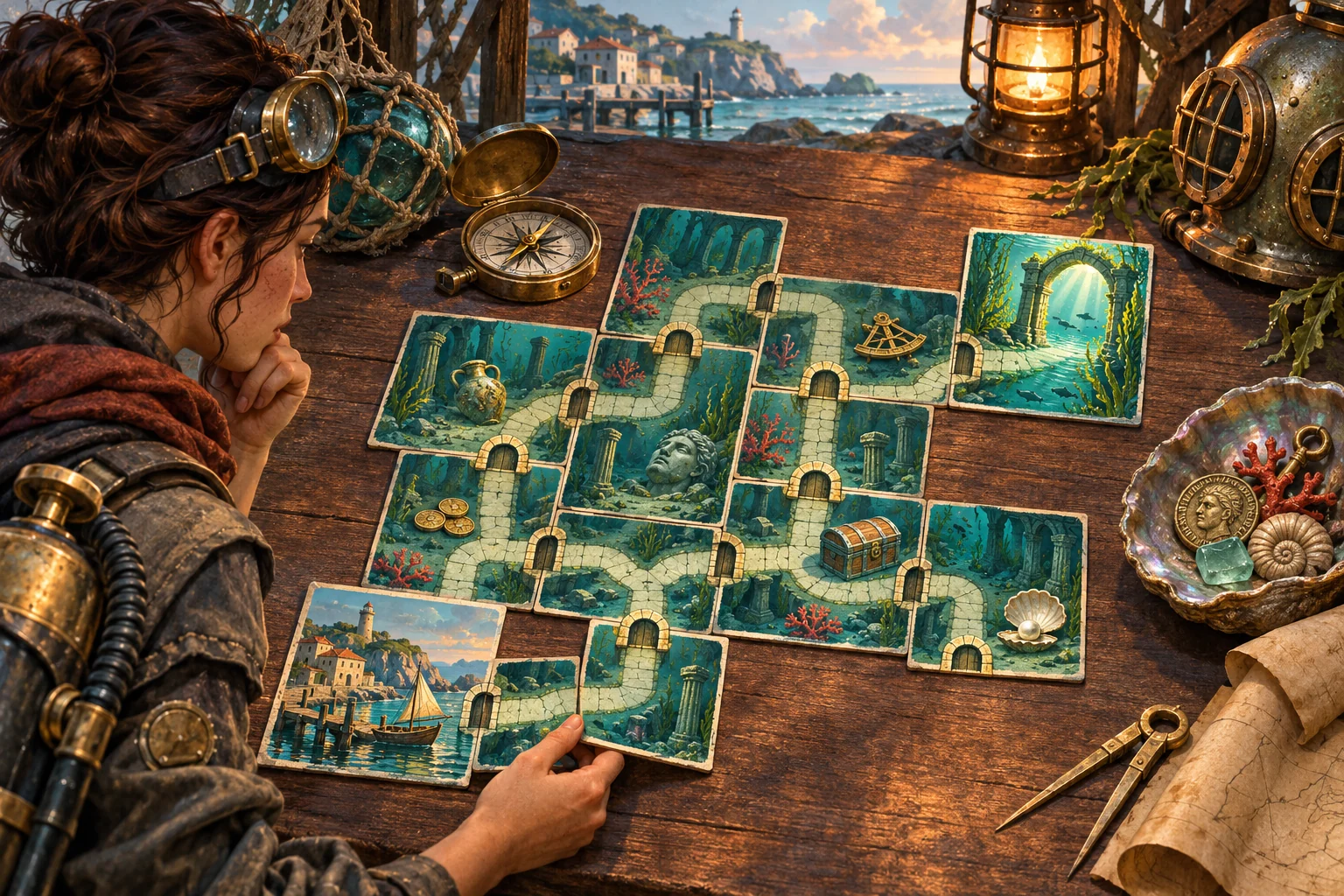
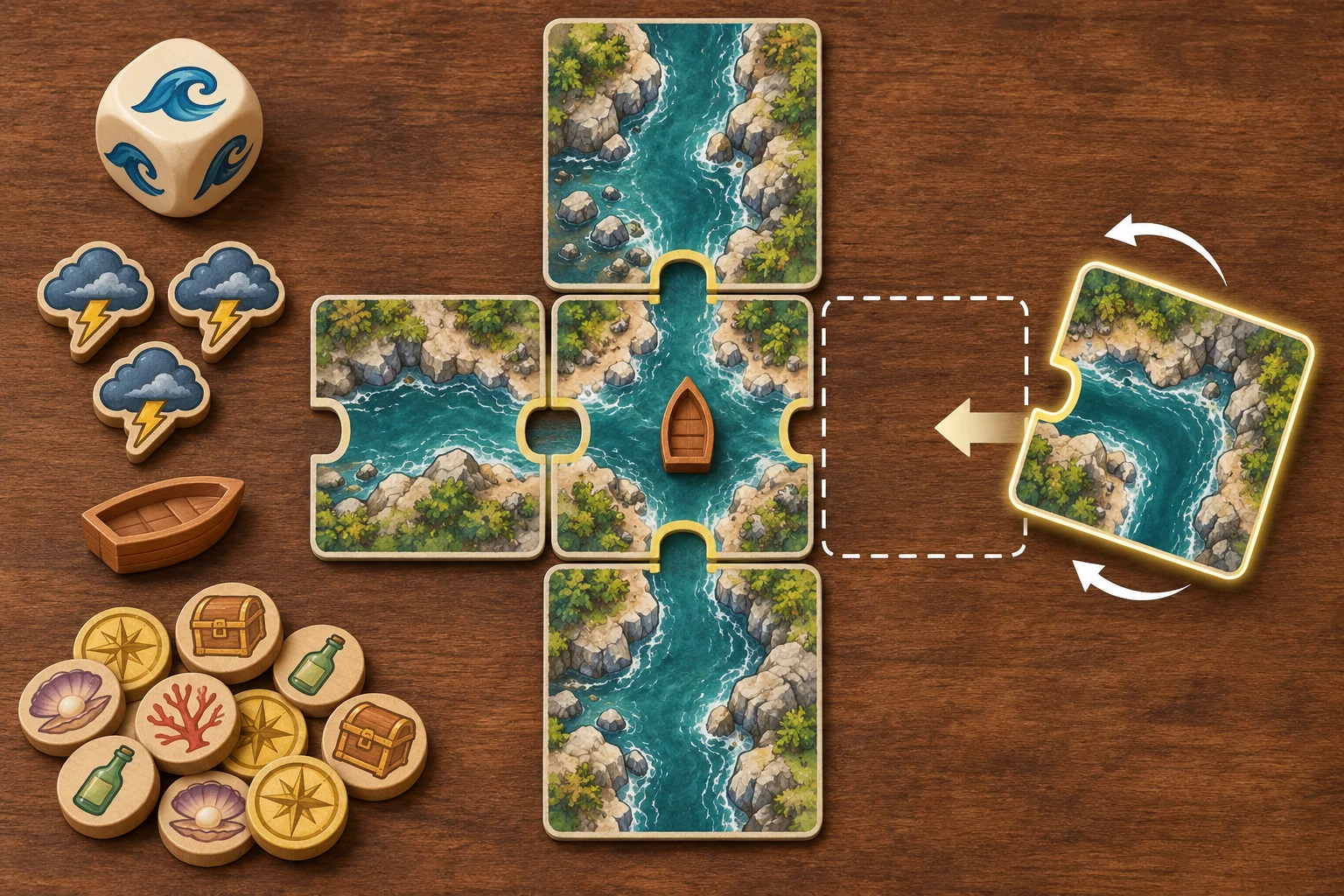
At each open doorway, reveal two route cards. Each card shows its doors, salvage and storm icons. Choose one, rotate it so at least one doorway connects to the map, then place it and resolve its contents. Leave unused doorways as future map exits. The other card is discarded. A route is therefore both a new board space and a risk-reward offer.
After resolving a room, let the player either return to port or continue from any open exit. Returning banks all cargo and ends the dive safely. Continuing reveals a new pair of route cards and exposes the existing haul to another Tide draw. Keep the growing map, hull, cargo and return choice visible together so “one more room” is an informed risk.
Make storm risk and cargo loss easy to preview
Use one short rule for room danger: after entering, draw a Tide value from 1 to 6. If it is no higher than the room’s storm-icon count, lose one hull. A room with zero icons is safe; a room with three icons is dangerous on half the Tide values. Display the threshold before the player confirms entry, and keep hull visible beside unbanked cargo.
Separate collected cargo from banked cargo. Salvage collected during a dive remains at risk until the diver returns to port. At zero hull, end the run and discard the unbanked amount; previously banked cargo remains safe. This makes the push-your-luck decision clear without hiding a penalty in a later screen.
Replay the same dive at the return-or-continue decision
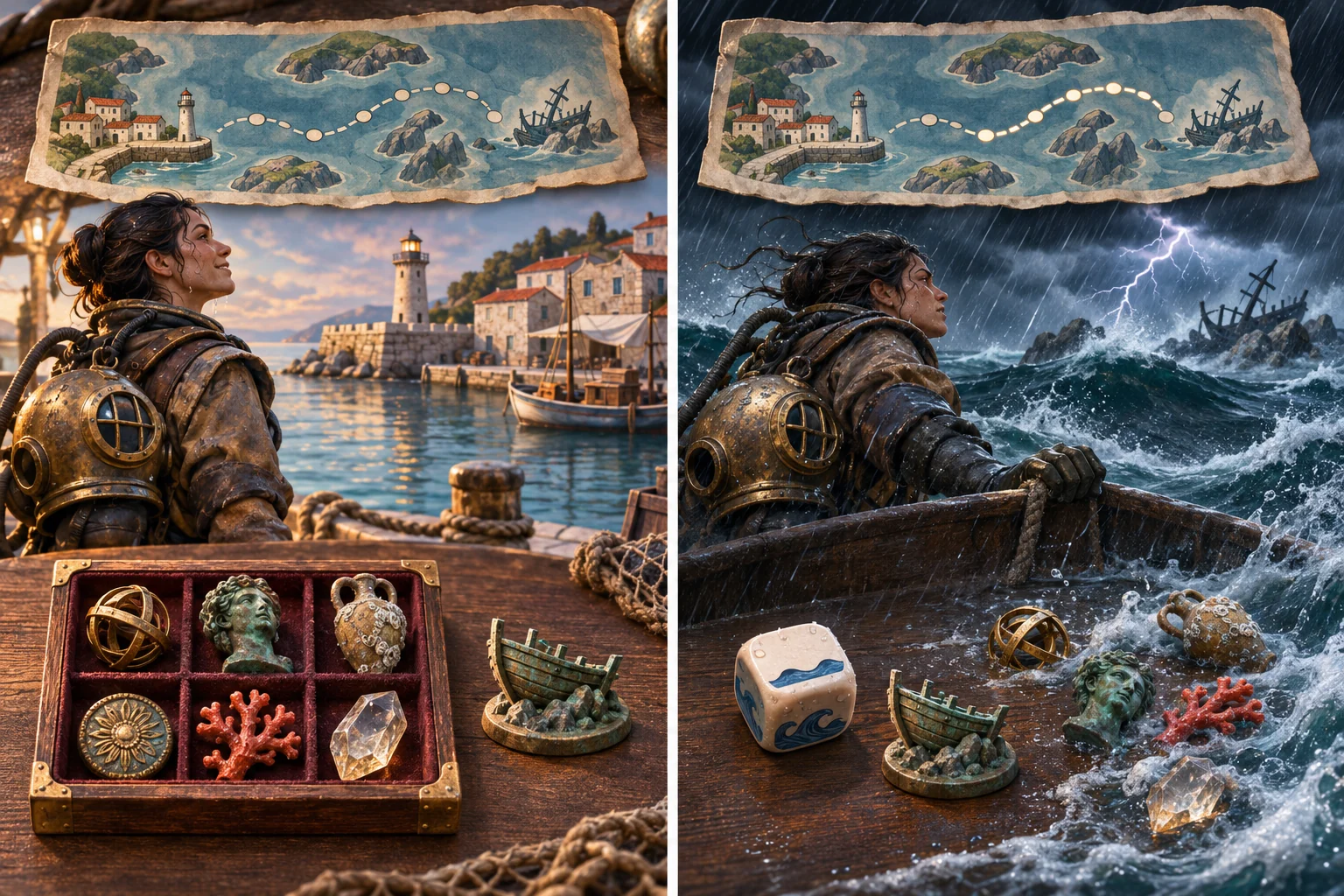
Start with 2 hull and 0 cargo. Choose Reef Shelf: it gives 2 salvage and shows 1 storm icon. Tide 2 is greater than 1, so the diver takes no damage and now carries 2 unbanked cargo with 2 hull. At the next exit, choose Wreck Hall for 4 salvage and 3 storm icons. Tide 2 is at or below 3, so lose one hull. The state is now 6 unbanked cargo and 1 hull.
Returning now banks all 6 cargo. If the player pushes into a revealed next room with 2 storm icons and draws Tide 1, the final hull is lost and the unbanked 6 cargo disappears. The example is a paper simulation from the rules, not a measured run. In playtests, record rooms explored, cargo banked, hull lost and retreat timing. If players always retreat after one hit, tune room rewards or hull recovery rather than concealing the risk.
Prototype route placement before adding a large card pool
Build a small route deck, doorway matching, one Tide draw, hull, unbanked cargo and a return-to-port action. Add a resettable run with two fixed route offers so the same choices can be replayed. Show card rotation, legal placement, storm threshold and cargo-at-risk before entry. Add new room types only after players can explain why they continued or retreated.
Create Saltwake, a solo push-your-luck dive game whose map is built from route cards during each run. At every open doorway, reveal two cards, choose one, rotate it to connect a matching door and place it; each card shows salvage and storm icons. After entering, draw Tide 1–6; if the result is at or below storm icons, lose 1 hull. Cargo is unbanked until return to port. At 0 hull, lose all unbanked cargo but keep previously banked cargo. After each room, allow return or another route choice. Show the growing map, legal placements, storm threshold, hull and cargo at risk. Include a resettable example and track rooms, banked cargo, hull lost and retreat timing.
SEELE's official page describes a general workflow: generate a playable first version from a prompt, test it in a browser and refine it with follow-up prompts. Use it to inspect card placement, storm previews and retreat decisions; Saltwake and its rules are fictional design guidance.
Build the route-card push-your-luck game in SEELE
Frequently asked questions
How can cards build a map during a push-your-luck run?
Let each selected route card attach to an open doorway and leave new doors as future exits. The growing map then reflects the player’s choices. Show legal rotations and matching doors before placement so route building stays understandable. This keeps each route choice visible and testable.
How do you make a retreat decision meaningful?
Keep current hull, unbanked cargo, room danger and return-to-port option visible together. A player should know what is secured by leaving and what can be lost by continuing. Escalating rewards can tempt another room without hiding its risk. Keep that tradeoff on screen throughout the run.
What should I track in a card-built map game test?
Replay the same route offers and record rooms explored, cargo banked, hull lost and the point at which players retreat. Compare runs with one reward or storm value changed. If players always leave early or risk everything, adjust rewards, hull or room thresholds.