Introduction
Cooperative logistics games work when players share a goal but cannot all do the same thing at once. They need to notice information, make a quick plan, and see how their choices affect the next leg of the journey. Unrailed! is officially described as a co-op game about building track together across procedurally generated worlds. That broad teamwork-and-route problem can inspire a new project, but the train, track-building details, art, characters and presentation should remain specific to Unrailed!. Its official Steam listing supports that high-level description.
For an original example, imagine Tideglass Delivery, a fictional game about two couriers steering a balloon gondola between floating gardens. One courier reads wind patterns; the other adjusts the gondola's colored sails and moves supplies. Together they decide which island to reach, how much lantern charge to spend, and whether to take a safer route or attempt a shortcut. This hypothetical loop keeps cooperation and route planning but uses a different movement and resource system. It has not been built or playtested.
To make a game like Unrailed! with AI while keeping it original, specify the shared goal, each player's useful information, the resources that constrain choices, and the feedback after a decision. A prompt that names only “co-op chaos” is too vague to evaluate. A small loop with complementary jobs gives you something concrete to prototype and inspect.
Borrow the teamwork problem, invent the movement rule
Start by describing what players must coordinate rather than copying visible objects. The general problem might be “keep a shared journey moving while conditions change.” Your game can solve that problem through a different world, movement rule, resource and visual language. Tideglass Delivery uses wind as route information, sails as a team adjustment, and lantern charge as a shared cost. It does not lay rails or move a train.
| Design layer | Broad cooperative goal | Tideglass Delivery's original choice |
|---|---|---|
| Shared objective | Keep a journey moving | Deliver a weather lantern to the next floating garden |
| Player information | Coordinate around changing conditions | One courier reads the wind; the other sees sail tension and supplies |
| Main action | Prepare a route together | Reconfigure sails and select a wind corridor |
| Shared resource | Decide what to spend | Lantern charge powers a route beacon or is saved for later |
| Consequence | Make the team's choice visible | The gondola reaches a different island and the map updates |
This translation makes the design easier to review. If your pitch still depends on a train, a track segment or a recognizable scene from the reference, go back to the player problem and choose a new solution. A useful originality test is to explain the loop without naming the game that inspired it.
Give teammates different but connected jobs
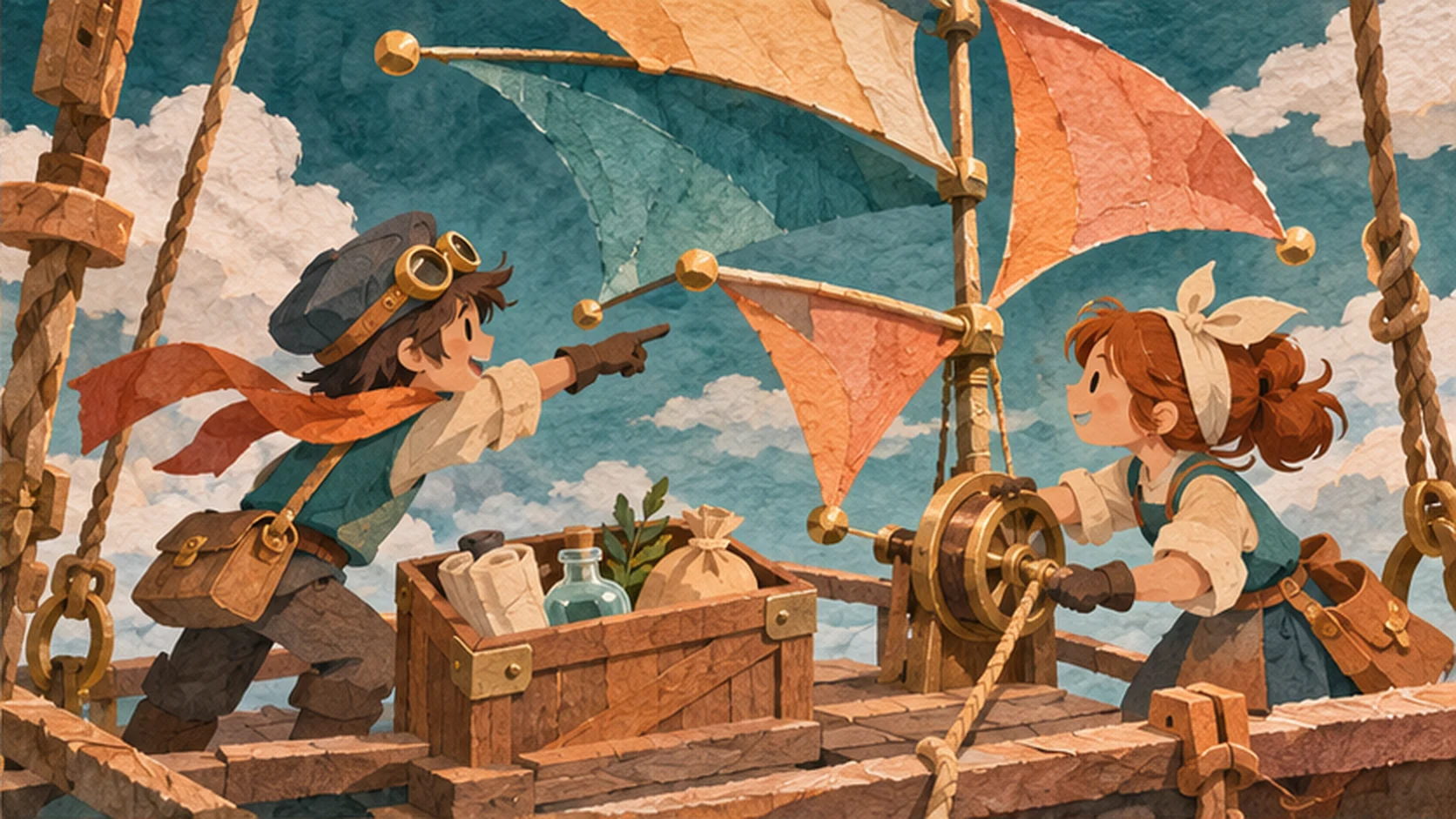
Complementary roles create useful conversation when each player has information that matters to a shared action. Avoid making one role the “real player” while the other waits. In the fictional example, the wind reader can call a direction and forecast a gust, while the sail handler can adjust two fabric panels and report whether the gondola is stable. Either courier can propose the route; both need to communicate before committing the shared lantern charge.
The jobs should connect in a short sequence: observe, call, adjust, choose, and confirm. A role is meaningful when its information changes the other player's decision. If the wind reader's forecast never affects sail choice, it is just extra text. If the sail handler can set every value alone, the wind role contributes little. Start with one piece of information each and one point where they must combine it.
| Moment | Wind reader | Sail handler | Shared result |
|---|---|---|---|
| Read conditions | Calls the strongest crosswind | Checks which sail can be loosened | Team identifies a risky direction |
| Prepare gondola | Estimates the next gust | Moves one sail control | Gondola becomes steady or drifts |
| Choose route | Compares two wind corridors | Checks lantern charge | Team commits to one island |
| Enter new area | Watches for a changed signal | Rebalances the sails | Map and destination state update |
The table is a design proposal, not a claim that a working game exists. It shows where each player contributes. Keep the information visible enough that communication feels useful rather than like a memory test. In an early mockup, a clear icon or spoken label can be enough to show the wind direction.
Make the shared resource explain the tradeoff
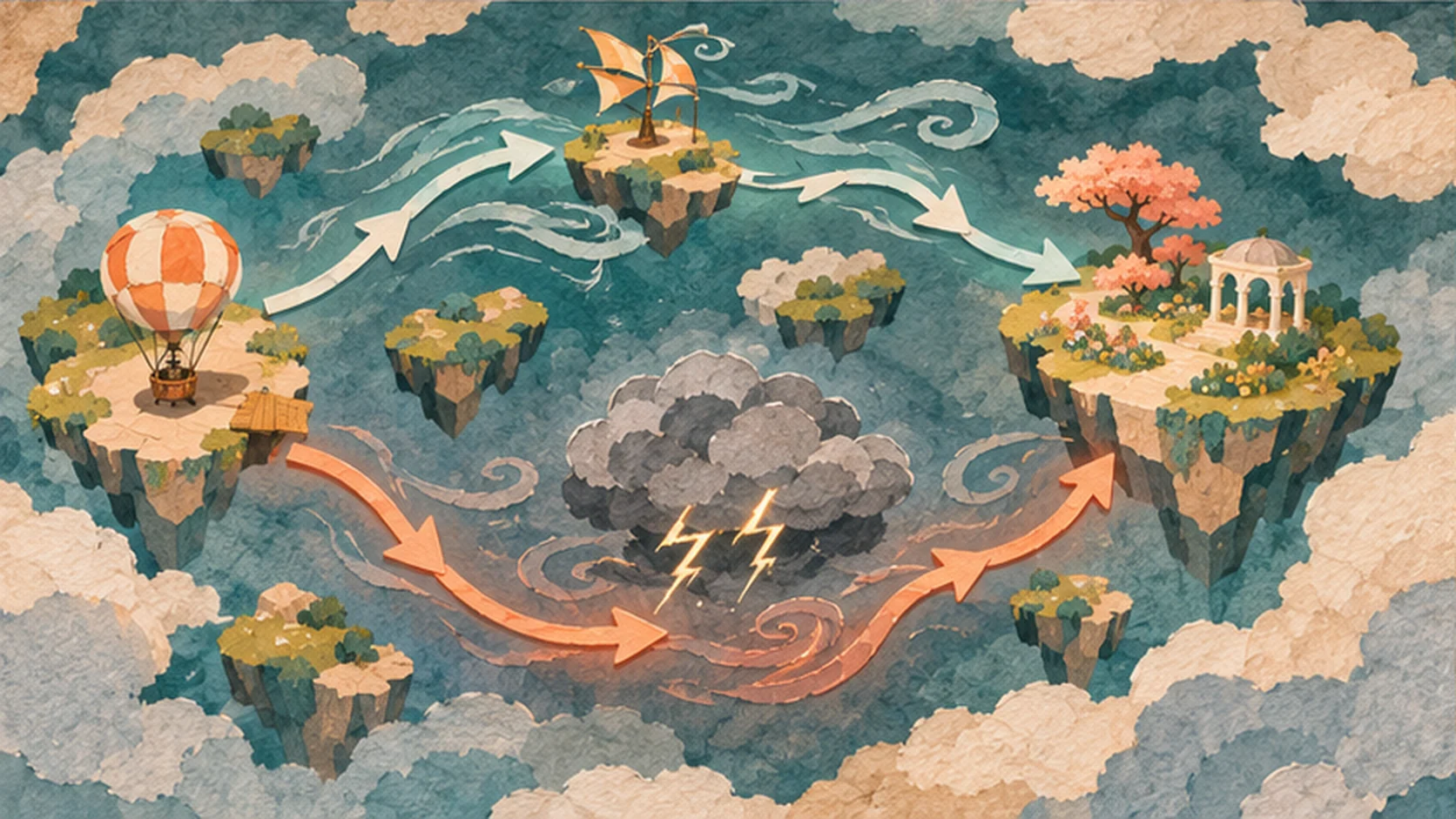
A shared resource turns route choice into a team decision when its cost is understandable. If the lantern has three charge marks, spending one to illuminate a foggy corridor should produce a visible benefit, while saving it leaves more help for a later route. Do not hide the cost until after the choice. Show the resource before the team commits and confirm what will change.
Give routes different kinds of value instead of making one obviously correct. The safe path might preserve supplies but require an extra stop; the shortcut might reach the garden sooner while exposing the gondola to a stronger gust. Both outcomes should keep the session moving. A choice can be consequential without being a trap.
| Route option | Immediate signal | Possible tradeoff in the fictional example |
|---|---|---|
| Cloud shelf | Faint wind, steady lantern beacon | Slower travel, lower chance of losing supplies |
| Sun gap | Strong upward current, weak beacon | Faster arrival, more sail adjustments needed |
| Save charge | Beacon remains dim | Keep a resource for a later island, accept less route information now |
Use this as a menu of design questions, not a tested balance chart. Decide what the player can know, what remains uncertain, and how the game communicates the result. If every route has identical cost and risk, the choice is cosmetic. If one route is always superior, players may stop discussing it.
Scope a short cooperative prototype
A first prototype can be one journey with two players, one wind change, two route options and one shared resource. It does not need a large map, multiple biomes, upgrades or a progression system. The first question is whether the two roles make a decision together and understand what happened afterward.
A paper or local mockup can represent the gondola, a wind arrow, two sail states, a lantern meter and a destination map. Use explicit prompts for the players: “What information do you have?”, “What should we adjust?”, and “What are we spending?” The goal is to reveal missing information and unclear consequences, not to pretend a mockup proves balance or fun.
| Prototype component | First version | Defer until the loop is clear |
|---|---|---|
| Journey | One departure and one arrival | Several connected regions |
| Conditions | One wind shift | Multiple weather types |
| Team roles | Reader and sail handler | More roles with overlapping powers |
| Routes | One safe and one risky option | Branching map and hidden routes |
| Resource | A small lantern charge counter | Upgrades, currency and crafting |
This small scope makes coordination easier to observe. If one player can complete every action alone, make the other player's information more relevant or reduce the solo player's control. If nobody knows why the gondola drifted, make the wind-to-sail relationship clearer before adding more hazards.
Prompt for a distinct starting point
A useful prompt states the world, shared goal, role information, action loop, resource tradeoff and originality boundary. For example:
Propose an original cooperative logistics game prototype called Tideglass Delivery. Two couriers guide a balloon gondola between floating gardens. One courier reads wind direction and forecasts a gust; the other adjusts two colored sails and tracks the gondola's stability. Together they choose between a steady cloud shelf and a faster sun gap, then decide whether to spend one lantern charge for route information or save it. Show the signal each player sees, the shared decision, the immediate consequence and a retry or recovery option. Use original characters, art, setting, writing and interface. Do not copy trains, tracks, scenes or assets from existing games. This is a proposed design starting point, not a tested build.
SEELE's catalog describes prompt-led game creation, which can help a creator explore a specific starting idea like this. It does not establish that Tideglass Delivery has been generated or tested. Start from the Free AI game maker, then inspect whether the roles, wind signal and resource choice are understandable in the result. If they are not, revise one relationship at a time.
Evaluate communication before adding more chaos
A cooperative game can be energetic without making every signal urgent. Give players enough time to understand what changed, and make the most important information readable during action. Before adding more hazards, review one repeatable sequence from departure to arrival.
These questions are proposed review prompts, not playtest findings:
- Can each player explain the information they own?
- Does the wind signal change a decision the team makes?
- Can both players contribute before the route is committed?
- Is the cost of spending lantern charge visible first?
- Does the arrival state confirm the route choice?
- If a mistake happens, can the team identify what to adjust next?
If testing with people later, ask them to describe the decision in their own words rather than asking whether the game was “fun” after one attempt. A player who cannot explain the wind or charge rule may need clearer cues. A player who understands the rule but does not care about the route may need a more visible consequence. Do not treat these proposed questions as evidence until a real session has been run.
Troubleshoot coordination problems

| What you notice in review | Possible design issue | First adjustment to try |
|---|---|---|
| One player makes every decision | Role information is not needed | Give the other role a unique clue that affects route or sail choice |
| Players talk but cannot act | Too many controls or unclear turn order | Reduce adjustments and show when the team commits |
| The route choice feels random | Wind signal does not explain likely outcomes | Make the route preview show a concrete cost or condition |
| Shared charge is spent without discussion | Cost or future value is hidden | Show current charge and one upcoming use before confirmation |
| A mistake causes a confusing failure | Feedback does not connect action to outcome | Reveal the wind, sail state and resulting drift together |
These are hypotheses for diagnosis, not guaranteed solutions. Change one cue or rule, then review the same sequence again. Adding more players, routes or time pressure before the core communication works can make the source of confusion harder to see.
Conclusion
To make a game like Unrailed! with AI while keeping it original, start with the cooperative problem—coordinate around changing route conditions—and invent a new movement system. Tideglass Delivery uses wind signals, sail adjustments, a balloon gondola and a shared lantern resource to create a fictional team decision. Prototype one short journey, make each role useful, and show how the team's choice changes the destination. This is a design proposal, not a tested game.
FAQ
How do I make a game like Unrailed! without copying it?
Use a broad goal such as coordinating a team during a journey, then invent a different setting, movement system, roles, resources, art and feedback. Tideglass Delivery's balloon-and-wind example is fictional and distinct from the reference.
What makes a co-op logistics game work?
Players need a shared goal, useful information to exchange, decisions that depend on coordination, and feedback that helps them understand the result. Start with one short loop before adding more hazards.
How many roles should a first co-op prototype include?
There is no universal number. This article's two-role example is a small design suggestion so each role's information and contribution can be reviewed clearly.
Can AI make and test a cooperative game automatically?
A prompt can describe a starting concept, but Tideglass Delivery has not been built or tested. Check the rules and run real play sessions before claiming that a mechanic works.
How can I stop one player from doing everything?
Give the other player information or a control that changes the team's decision, then make the shared action require both contributions. Review whether either role can be ignored without changing the outcome.