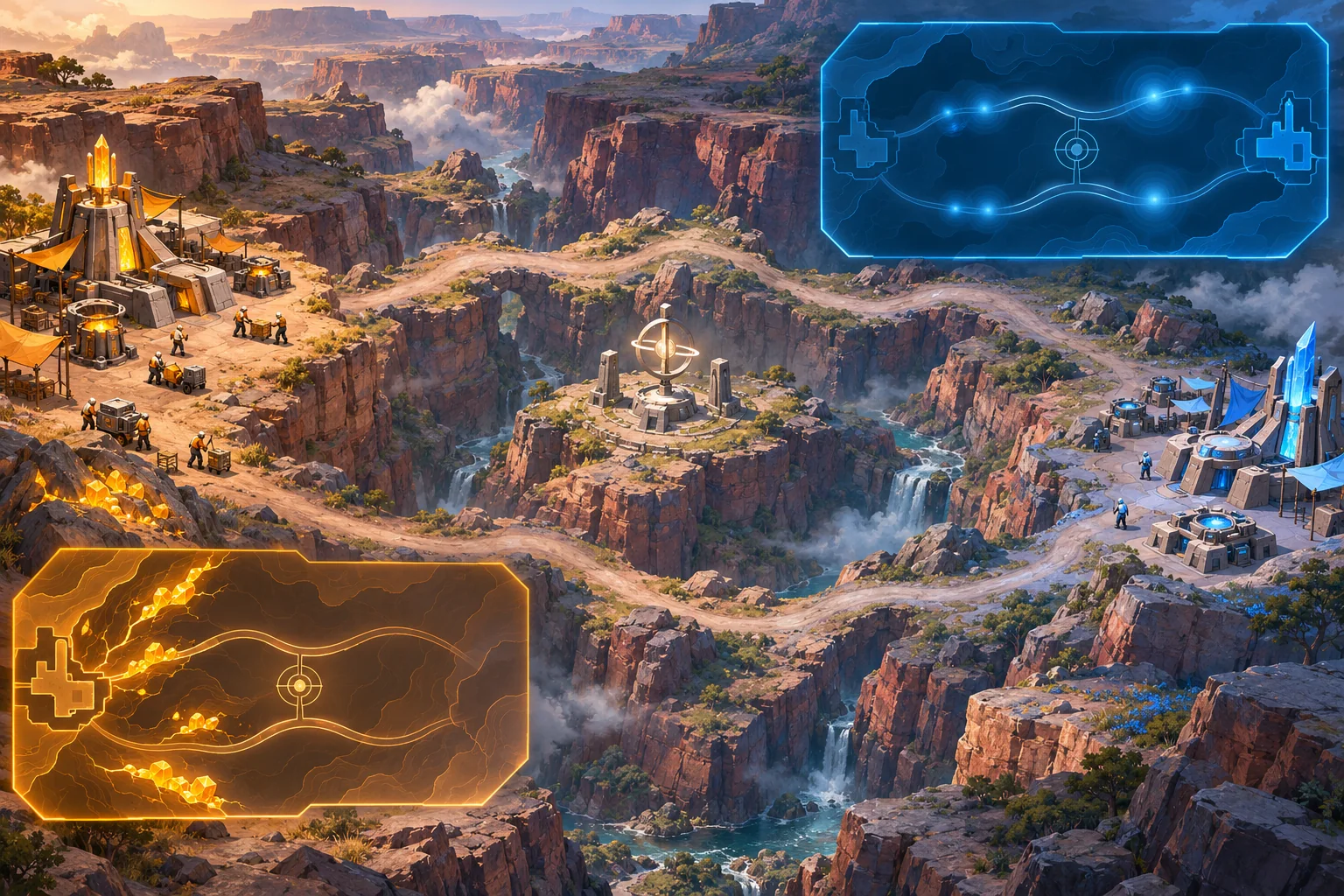
An RTS map can be fair without showing both teams the same information. In Chalk and Echo, Amber has a survey chart that marks ore seams exactly. Blue has an Echo Charter that reports approximate, aging movement pings along two lanes. Neither chart shows the whole battlefield. Both sides still use ordinary unit vision to see nearby terrain and enemies, and both can contest a neutral relay that combines local clues.
This asymmetry changes the opening build order. Amber can send a worker directly to a known seam, but has no warning when Blue crosses a lane. Blue can react to a signal, but must spend scouting time to find ore. Each choice has a counter: scouts reveal the real map in their sight radius, a stale ping loses precision over time, and a captured relay provides mixed intelligence only around itself. The opponent never reads the other team's private map cache.
Make the two starting map charts different
Use a 10×10 canyon grid. Amber's command core starts at (1,5), Blue's at (8,5), and the neutral relay is at (5,5). Four ore seams sit at (2,2), (4,6), (7,2), and (8,8). Each side starts with two workers, one scout, and eight ore. A refinery costs five ore and must touch a seam; a barracks costs eight; a scout costs three. Amber's Survey Charter marks all four ore seams but never enemy movement. Blue's Echo Charter starts with one report centered at (6,3), labelled 20 seconds old and approximate within a two-cell square; it shows no exact unit or ore. Ordinary unit vision reveals cells within two grid steps of a scout and one of a worker, and current enemy units in those cells. When a unit leaves, its last confirmed enemy position remains for 60 seconds and then fades. Neither team may read the rival's private chart. A team with a worker or scout alone on the relay for 20 seconds gets a local mixed chart within two orthogonal cells of the relay: nearby ore seams and the latest enemy ping. Refresh the report every five seconds while control remains; a contested relay produces no report. Victory comes from destroying the rival command core or controlling the relay continuously for 90 seconds. Reset restores units, ore, structures, hidden cells, chart asymmetry, and timers.
| System | Expected behavior |
|---|---|
| Map and bases | 10×10 grid; Amber core (1,5), Blue core (8,5), neutral relay (5,5). |
| Starting intelligence | Amber sees four exact ore seams. Blue sees a 20-second-old approximate ping around (6,3), no ore markers. |
| Normal vision | Scout reveals within two cells; worker reveals within one. Enemy locations become stale for 60 seconds after leaving vision. |
| Economy | Two workers, one scout, eight starting ore per team; refinery 5, barracks 8, scout 3; a refinery must touch an ore seam. |
| Relay | One uncontested worker or scout holds for 20 seconds; reveals ore and latest ping within two orthogonal cells of the relay, refreshed every five seconds. |
| Privacy | Each side reads only its own intel cache; the relay shares a local mixed chart with its holder, never the opponent. |
| Victory and reset | Destroy the rival core or hold the relay for 90 seconds. Reset all units, resources, buildings, fog, intel, and timers. |
Define what vision, signals, and relay reveal
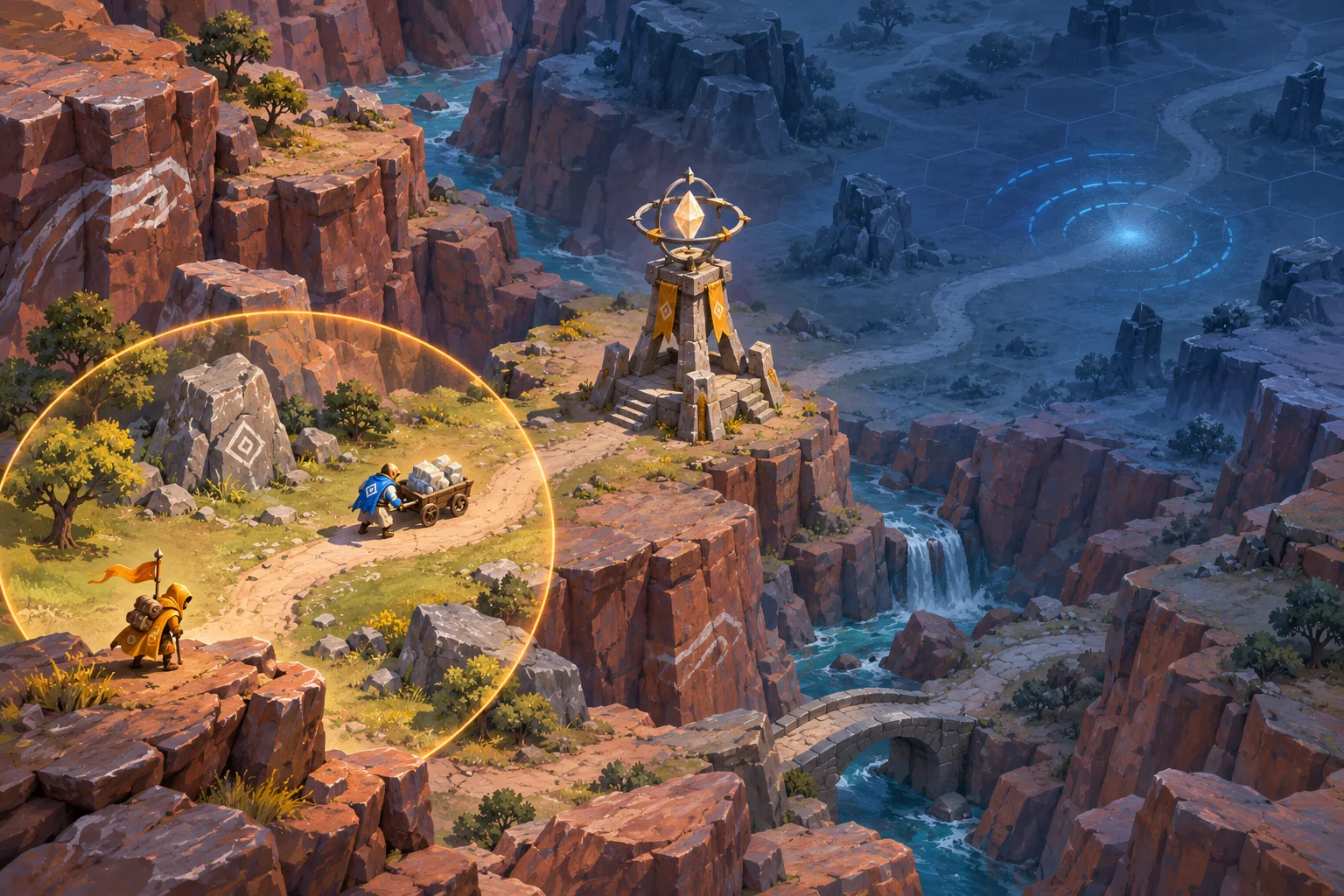
At the start, Amber's chart marks ore at (2,2), (4,6), (7,2), and (8,8). It contains no Blue movement pings. Blue's Echo report marks a two-cell area around (6,3), timestamped 20 seconds earlier; it does not identify a unit or reveal ore. Amber's worker travels from its base sector to the known seam at (4,6) and builds the five-ore refinery beside it. Blue sends its scout through the reported lane toward (5,5); within two orthogonal cells it sees the Amber worker and replaces the old echo with a confirmed location and timestamp. Amber sends its scout from (3,5) onto the relay at (5,5), where it sees Blue's scout. If Amber alone holds the relay for 20 seconds, its map gains the local seam at (4,6) and the latest Blue sighting within two orthogonal cells of the tower, refreshing every five seconds. Blue's private map remains unchanged. This is an authored map-state trace, not a playable test.
| Check | Expected result |
|---|---|
| Open Amber's map | Show the four exact ore seams; hide enemy pings and units outside vision. |
| Open Blue's map | Show only the stale approximate Echo report; do not mark ore or an exact enemy unit. |
| Scout enters the reported lane | Reveal actual terrain and enemy units within two cells; update Blue's last-known record. |
| Enemy leaves direct vision | Keep its last position for 60 seconds, then fade the record. |
| Hold the neutral relay for 20 seconds | Show local ore and latest ping within two orthogonal cells of the relay to the holder; refresh every five seconds. |
| Contest the relay | Stop intel refresh until one team alone holds the point again. |
| Reset the scenario | Restore both starting charts, hidden state, units, ore, buildings, and timers. |
Trace two openings from the same hidden map
Ask SEELE to build a small RTS where each side owns a separate map-intelligence state. The gameplay map is shared, but a team can only use its charter, direct vision, and intel from a relay it currently holds.
Create a local base-building RTS prototype called Chalk and Echo on a 10-by-10 canyon grid. Amber's command core starts at (1,5), Blue's at (8,5), neutral relay at (5,5). Place real ore seams at (2,2), (4,6), (7,2), and (8,8). Each team begins with two workers, one scout, and eight ore. A refinery costs five ore and must touch a real seam; a barracks costs eight; a scout costs three. Give Amber a Survey Charter that marks all four ore seams exactly but shows no enemy movement. Give Blue an Echo Charter that marks an approximate two-cell area centered at (6,3) with timestamp 20 seconds old; it identifies neither a unit nor ore. Store Amber and Blue intel separately and never let one team read the other's chart. Ordinary unit vision reveals terrain and actual enemy units within two grid steps of a scout or one of a worker. When an enemy leaves vision, keep its last confirmed position for 60 seconds, then fade it. A single worker or scout holding the uncontested relay for 20 seconds gets a local mixed chart of nearby ore seams and the latest enemy ping within two orthogonal cells of the relay; refresh every five seconds while held. A contested relay grants no report. Victory is destroying the other command core or holding the relay continuously for 90 seconds. Show map source and age for each clue so players can distinguish chart data, current vision, and stale reports. Reset units, resources, buildings, hidden cells, private charts, and timers. Use deterministic gathering and movement for the first trace; do not reveal hidden state in a shared global map, add random ore, or claim this written example was tested in a running game.Ask AI to keep team intel private
The first draft stored every reveal in one global map. Blue then learned Amber's ore chart without scouting, removing the reason to build the Echo team. Keep separate team caches and tag each marker with its source: charter, direct sight, or relay. A relay grants only its local mix to the current holder. This correction follows a written information trace, not an observed game run.
Replay the opening with one map view per side. Confirm that Amber sees exact ore but no ping, Blue sees only an old fuzzy signal, and a scout converts that clue into a current confirmed sighting. Check the 60-second expiry, contested-relay pause, five-second refresh, and 90-second victory timer. A player should never mistake an old signal for a live unit.
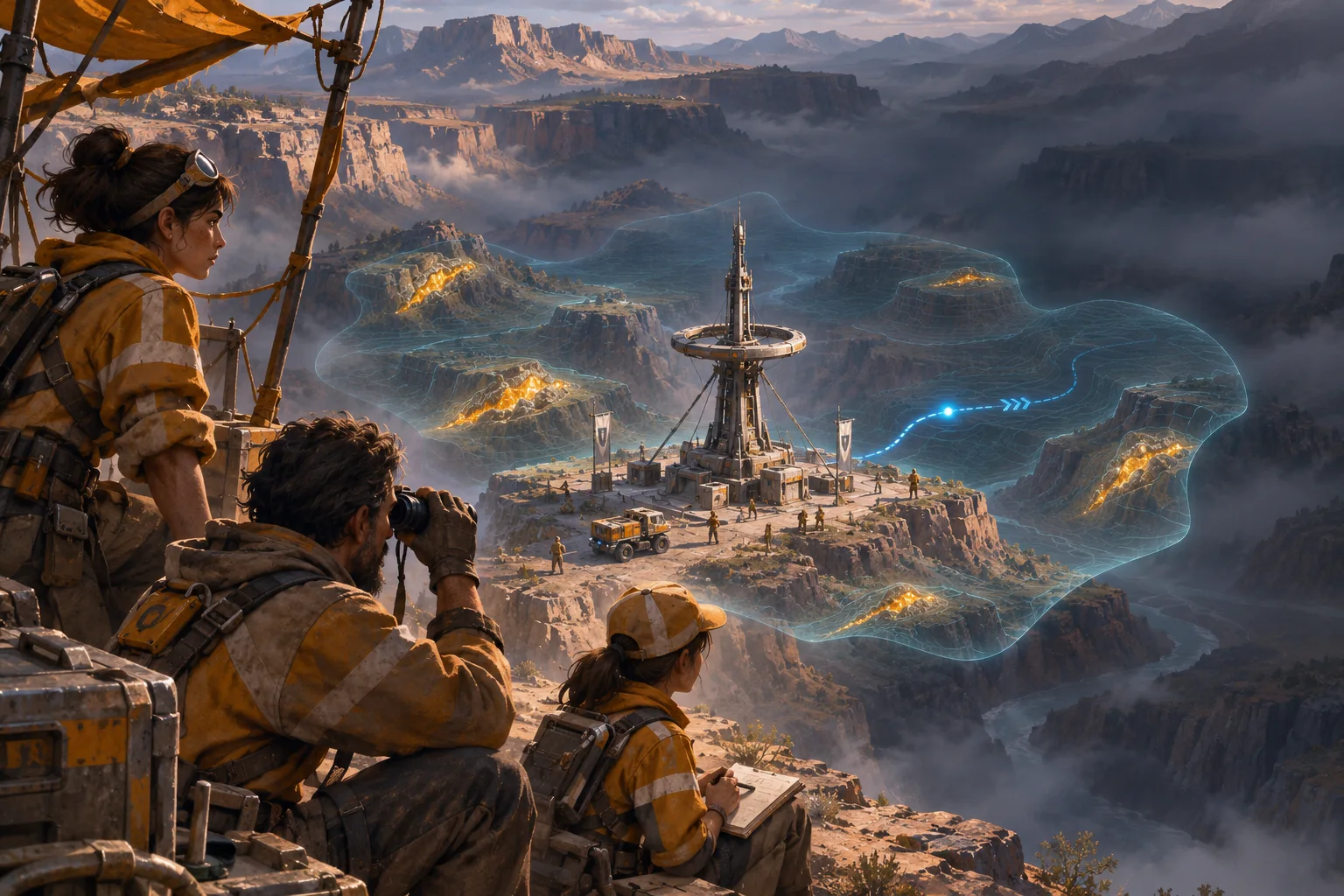
Revise the relay rule before expanding the map
Keep the first map to two bases, four seams, one scout per team, and one neutral relay. Make the map legend show whether a clue comes from a charter, current vision, a stale report, or a relay. After both sides can exploit and challenge their information advantage, add a second relay or more terrain types. The shared world can stay the same while the teams' knowledge remains distinct.
Read the base-building RTS guide.
Explore SEELE's campaign strategy workflow.
Frequently asked questions
How can two RTS teams have different map information?
Give each team a separate starting chart and separate intel cache. One might know exact resource locations while another sees approximate movement traces. Direct scouting and neutral objectives can add information, but they should update only the team that earned it.
How do I keep map asymmetry fair?
Give each information advantage a useful response. Exact ore locations save one team scouting time, while movement pings help the other anticipate a threat. Let both teams build scouts and contest an intel relay, and keep the relay's reveal local rather than global.
Read Godot's AStarGrid2D documentation.
Should old enemy pings remain visible?
Keep a last-known position briefly and show its age. In this example, a sighting expires after 60 seconds and a relay report refreshes every five seconds while held. The interface should distinguish a confirmed unit from a fuzzy or stale signal.
What should a captured relay reveal?
Reveal a bounded mix of nearby ore and recent movement data to its current holder. Pause the feed when both teams contest the point. A local report gives players a reason to fight over the relay without exposing the entire map or the other team's private chart.