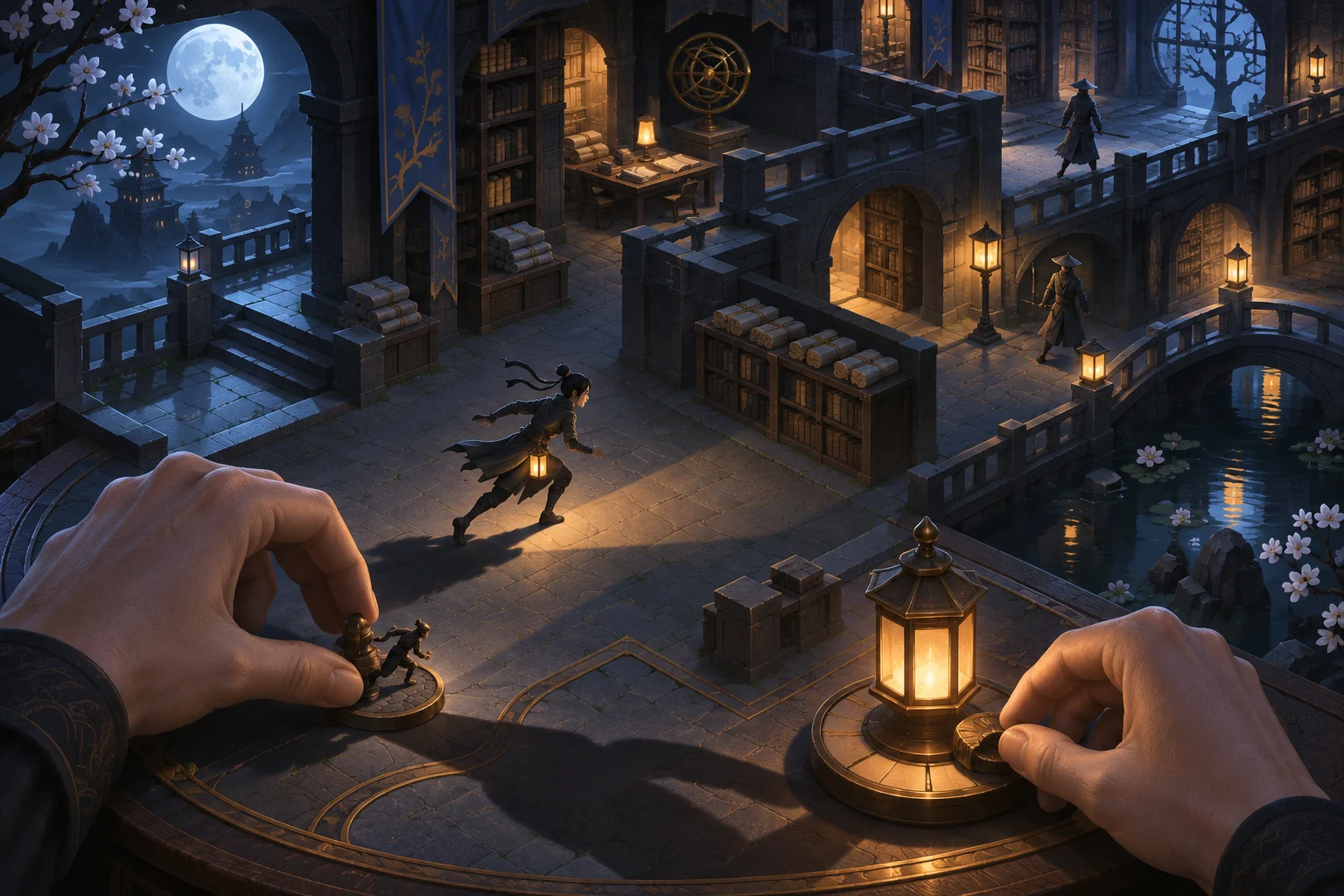
One courier enters a dark archive. One player controls movement while the other turns the lantern. The body can only move one way at a time, so cooperation needs a clear rule for simultaneous commands. Start with a short route and one guard patrol.
Give the shared body one readable goal
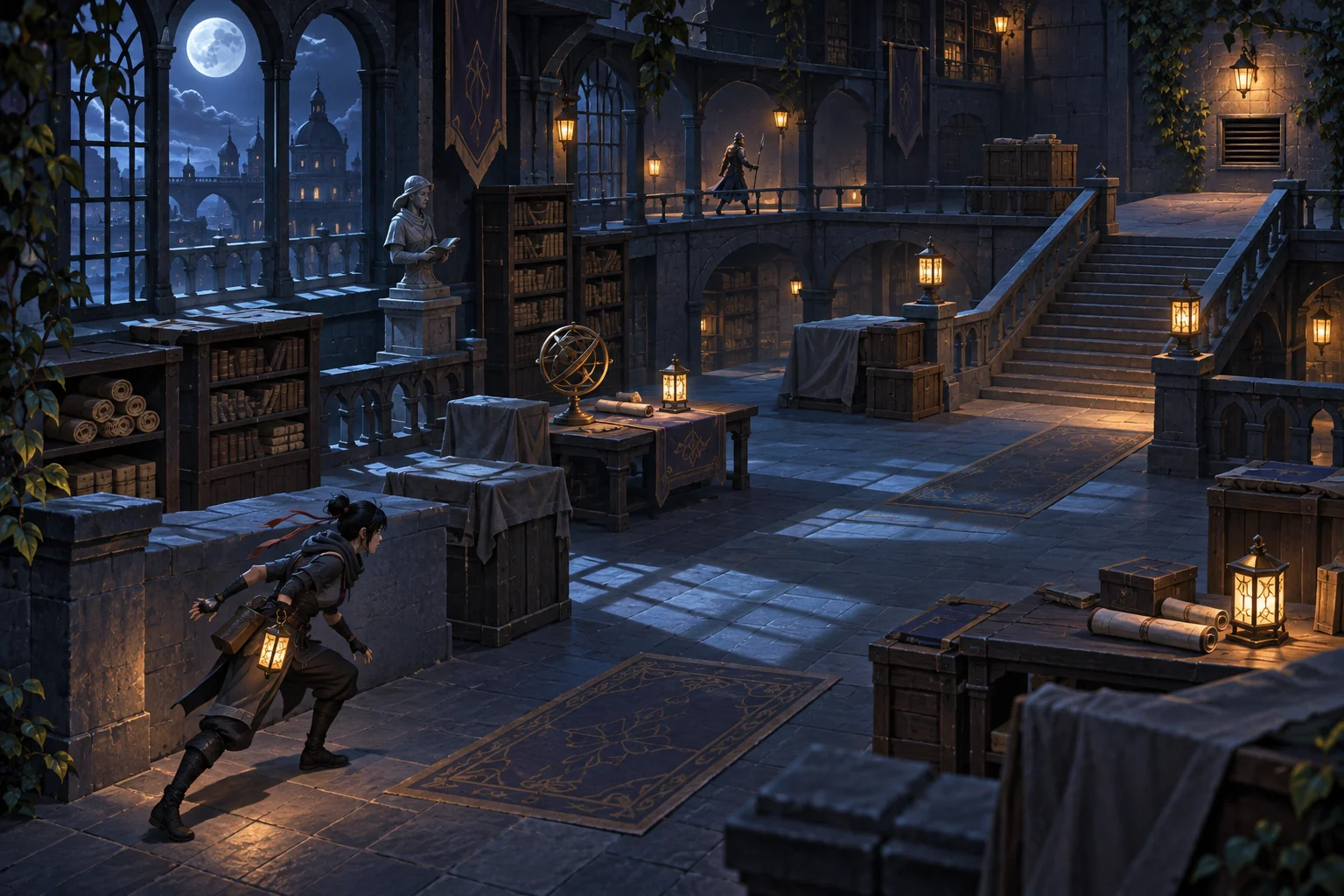
Place the vent at the end of a short aisle. The courier must crouch, cross a pool of light and reach its cover. A guard walks three marked lanes. Keep the lane and vent visible so both players can plan around the same space.
Player A controls direction and crouch. Player B aims the lantern and chooses a quiet or loud action. Show both command states near the character. Give the players a short command window, then resolve their inputs together.
Resolve movement and light in one action window
If both players issue compatible commands, apply them in the same tick. If they conflict, keep the last safe movement and show which command was held. A loud action commits the body for one tick. The lantern still changes, so Player B can guide the guard while Player A waits for control to return.
This lets the players plan a combined move without pretending one character can act twice. Make the commitment visible with a brief held stance. A reset should restore position, guard lane and lantern state together.
Check the timing before adding more guards
A local deterministic replay checks a short sequence of movement, lantern turn and a loud committed action. Use the same sequence to inspect what remains available while the character is committed. Add a second guard only after one patrol and the vent route are readable.
In a future playtest, observe whether the players can agree on a crossing without speaking over each other. The command replay checks resolution. Human testing is needed to judge whether the split feels cooperative.

Prompt AI for one shared-body encounter
Keep the first route short enough to replay. Test compatible commands, a conflict and a loud action before adding more rooms.
Create one cooperative stealth encounter for two players controlling one courier. Player A moves and crouches. Player B aims a lantern and chooses a quiet or loud action. Resolve compatible input on a shared tick. Hold the body for one tick after a loud action. Show both commands and a reset. Add one guard with three patrol lanes and a reachable floor vent.
SEELE’s free AI game maker describes starting from a text prompt and refining a first version with follow-up requests. Use the encounter above and check command resolution before extending the patrol.
Start the shared-body stealth prototype in SEELE
Frequently asked questions
What if both players choose a different direction?
Show both inputs briefly, then apply the priority rule chosen for that turn. Keep the courier in the last safe position and explain which command was deferred. If the conflict could send the character toward the guard, offer a reset that restores the courier, guard lane, lantern and pending command together. This makes the result readable and recoverable.
Should Player B be able to move the lantern while committed?
That can make the pause meaningful. Lock movement for the committed tick while allowing the lantern to turn, and show those two states separately. Player B can still influence the guard without moving the body. Keep the rule consistent across loud actions so players can predict what remains available while the courier recovers.
How do I know if the control split is fair?
Give each player a distinct job with enough time and feedback to use it. In a human playtest, switch seats and ask each person which action they could influence. Watch for one role waiting without a useful choice or being unable to respond to the other player. Adjust the command window or action options based on those observations.