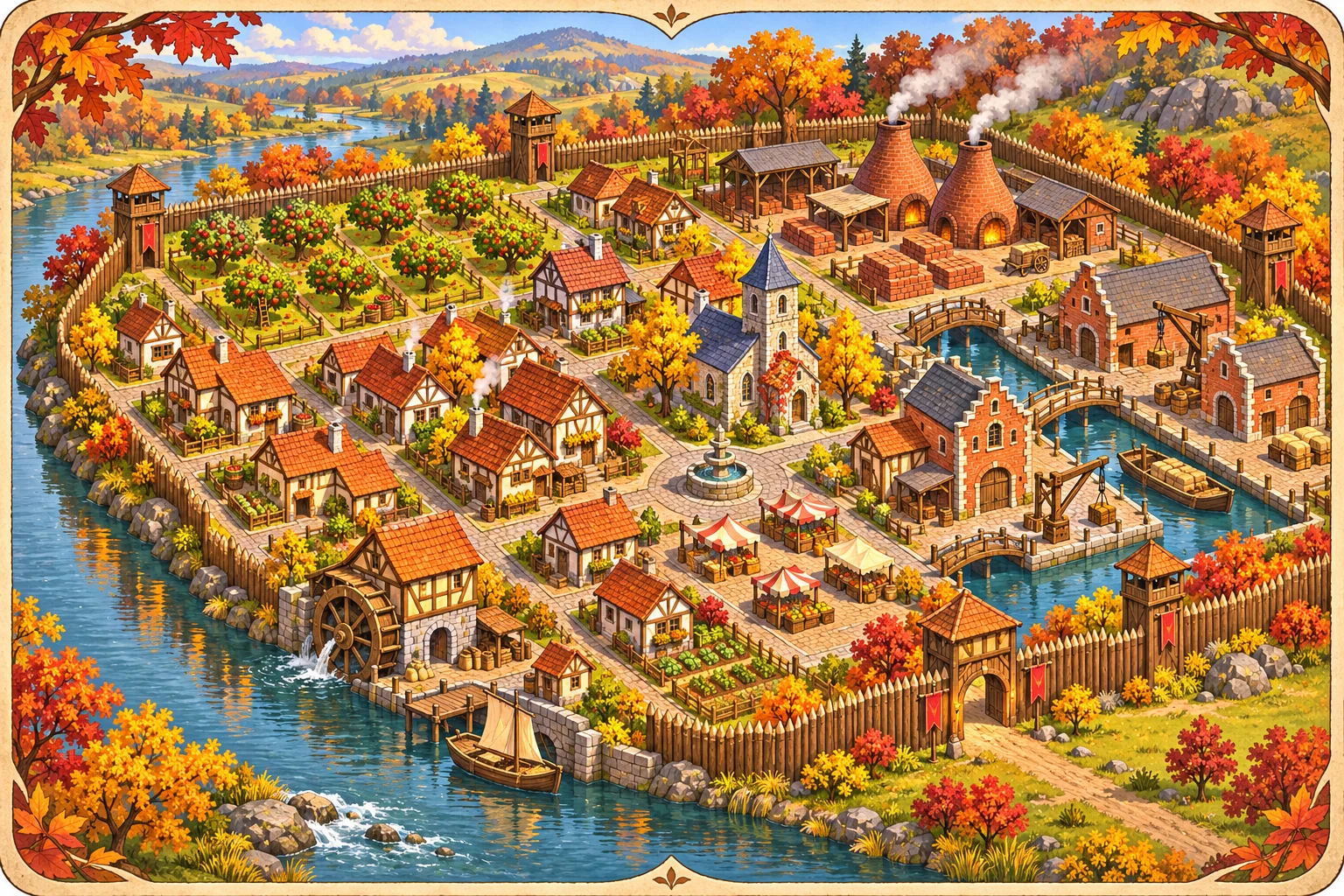
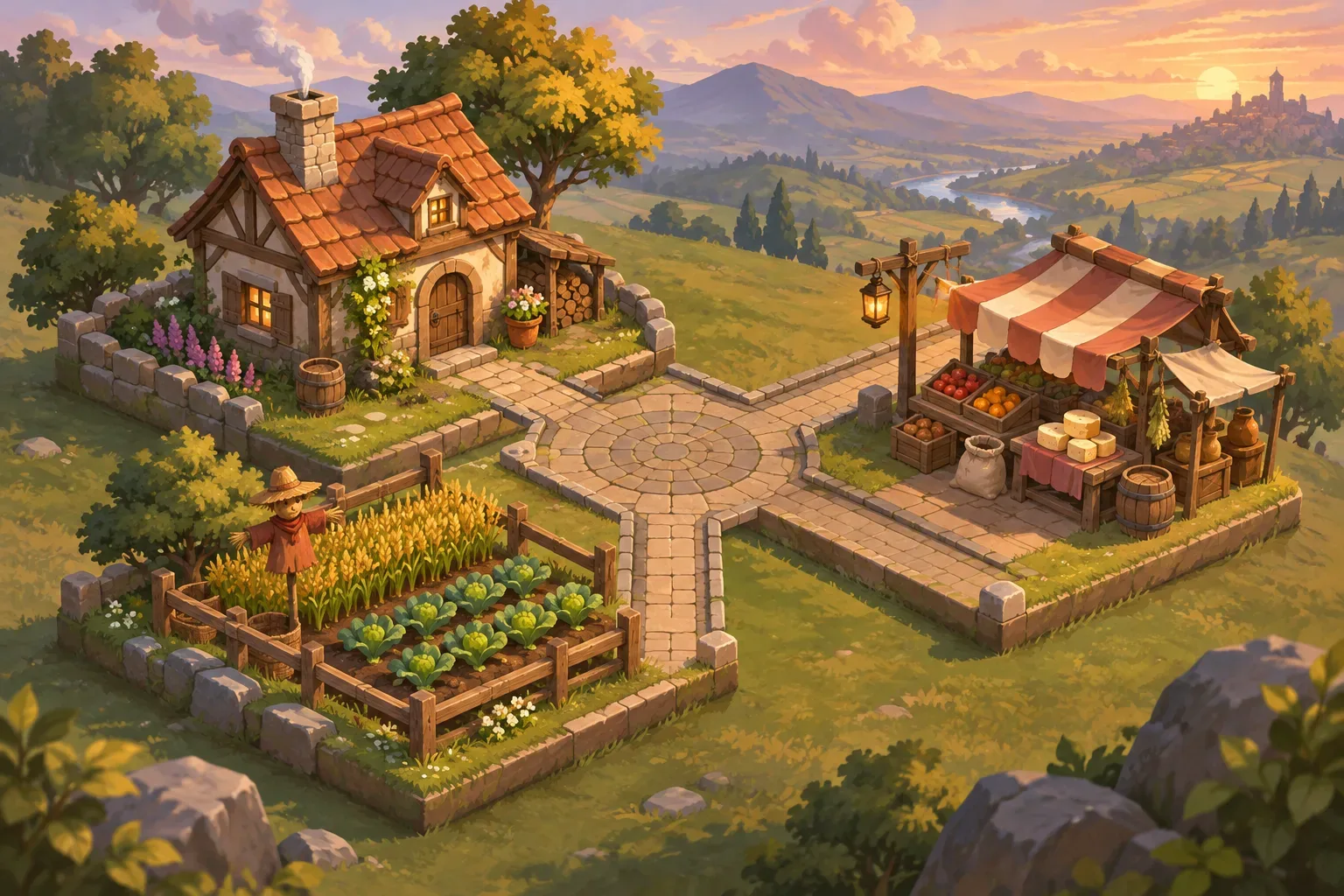
A city builder can make its card hand part of the story. In Chronicle Blocks, the player develops a small town over three chapters, placing two building cards in each chapter. A farm beside a cottage signals a Harvest Promise and brings markets and mills into the next card pool. A town that builds around the river instead makes a River Charter, adding a ferry and bridge while removing market cards from future draws.
The rule is visible: each placement occupies a plot beside the central plaza, and the chapter-end check looks for one specific neighborhood pattern. The pattern does not just award points; it changes what the player can draw next. That creates a link between the map and the story without adding a large dialogue system or random events.
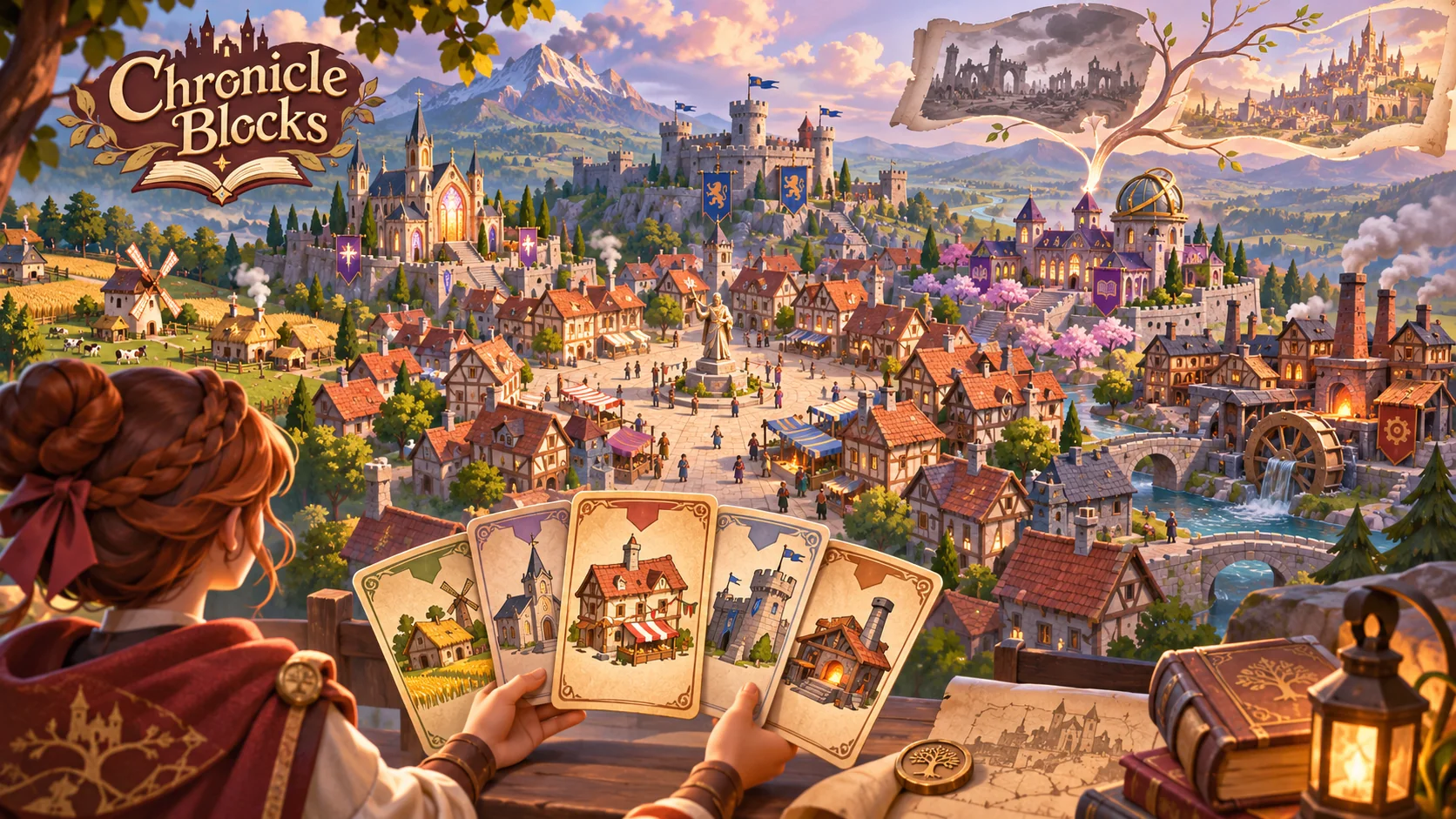
Make card placement change the story
Use a 3-by-3 town grid with the central plaza fixed in the middle. The player places exactly two building cards per chapter for three chapters, for six placements total. A card can be placed only on an empty plot orthogonally adjacent to the plaza or to an existing building; diagonal contact does not count. The starting pool contains Farm, Cottage, Well, Workshop, Orchard, and Watchtower cards. Four branch cards—Market, Mill, Ferry, and Bridge—begin in a reserve outside the draw pool. Each card is unique and can be placed once. Cottage adds two residents; Farm, Well, Workshop, Orchard and Watchtower each add one town development point. At the end of chapter one, check whether a Farm and Cottage occupy orthogonally adjacent plots. If yes, record Harvest Promise, add Market and Mill to the chapter-two pool, and remove Ferry and Bridge from the future pool. If no, record River Charter, add Ferry and Bridge, and remove Market and Mill from the future pool. Do not evaluate the check before both chapter-one placements are complete. Chapter two has two placements from the branch-specific pool plus any remaining starting cards. At the end of chapter two, add one story card to the pool based on the branch: Harvest Record for Harvest Promise or River Ledger for River Charter. Chapter three contains two final placements. Victory requires at least four residents from cottages and at least one branch-specific story card placed by the end of chapter three. A town with fewer than four residents or no story card ends as an unfinished chronicle, not a failure screen. There are no resource shortages, random draws, duplicate cards, demolition actions, or hidden adjacency rules. The draw hand shows three cards from the current pool in fixed order; after a card is chosen, the next card refills the hand. Return unchosen cards to the bottom of the pool. Reset restores the starting pool, empty plots, plaza, chapter counter and story state. The chapter branch persists through the remaining turns and controls both the available cards and the closing narration.
| System | Expected behavior |
|---|---|
| Board | 3×3 grid with fixed center plaza; place cards on empty orthogonally adjacent plots only. |
| Turn limit | Exactly two placements per chapter across three chapters; six total placements. |
| Starting pool | Farm, Cottage, Well, Workshop, Orchard and Watchtower start in the pool; Market, Mill, Ferry and Bridge are reserved. |
| Branch check | After chapter-one placement two, adjacent Farm+Cottage means Harvest Promise; otherwise River Charter. |
| Harvest pool | Add Market and Mill; remove Ferry and Bridge from future pool. |
| River pool | Add Ferry and Bridge; remove Market and Mill from future pool. |
| Story and victory | Add Harvest Record or River Ledger in chapter 3 pool. Win with ≥4 residents and one matching story card placed. |
| Reset | Restore plaza, initial pool, empty plots, chapter and story state. |
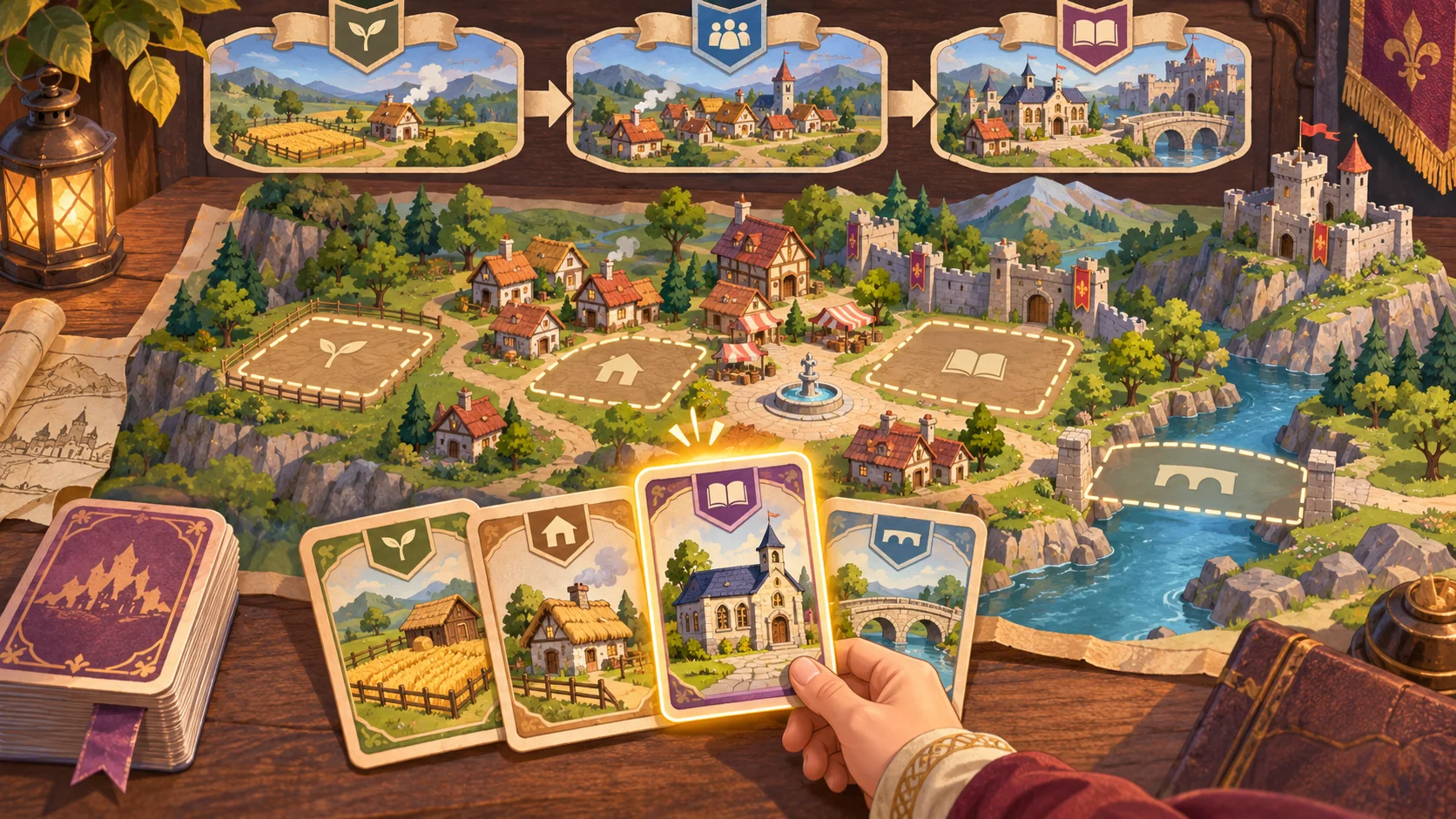
Define the starting and branch card pools
Start with the plaza at the center and the six starting cards. In chapter one, place Farm directly north of the plaza, then place Cottage in the north-east plot, which shares an edge with Farm. The pair qualifies for Harvest Promise. At chapter end, Market and Mill move from reserve into the chapter-two pool; Ferry and Bridge stay excluded. In chapter two, place a second Cottage on an empty legal plot and choose one other card. The branch remains Harvest Promise. At the end of chapter two, Harvest Record enters the chapter-three pool. Place it on an open legal plot in chapter three and use the other turn for a legal card. The two Cottage cards provide four residents, so the town meets the ending requirements: four residents plus the matching Harvest Record. This is a written placement trace, not a playable or user test.
| Step | Expected state |
|---|---|
| Setup | 3×3 board, center plaza, six unique starting cards, three-card hand. |
| Chapter 1, placement 1 | Place Farm orthogonally adjacent to plaza. |
| Chapter 1, placement 2 | Place Cottage so it touches Farm orthogonally to earn Harvest Promise; a diagonal-only pair does not qualify. |
| Resolve branch | Harvest adds Market and Mill; Ferry and Bridge are absent from future pool. |
| Chapter 2 | Choose two legal cards from the Harvest pool and remaining starters. |
| Chapter 3 pool | Harvest Record becomes available. |
| Final placements | Place matching story card and enough Cottage cards for at least four residents. |
| Ending | Win only if 4+ residents and matching story card are on board after chapter 3. |
Trace a chapter choice into future draws
Tell the generator exactly when to evaluate the neighborhood pattern and how each branch changes the pool. Use a fixed draw order and a small board so you can check the story transition without hidden randomness.
Create a card-based city builder called Chronicle Blocks with a 3 by 3 grid and a fixed center plaza. The game lasts 3 chapters with exactly 2 building placements per chapter. A card can be placed on an empty cell orthogonally adjacent to the plaza or any placed building; diagonal adjacency never counts. Starting pool has unique Farm, Cottage, Well, Workshop, Orchard and Watchtower cards. Keep Market, Mill, Ferry and Bridge in a reserve outside the draw pool. Cottage adds 2 residents; all other starters add 1 town development point. At the end of chapter 1 only, check whether Farm and Cottage are orthogonally adjacent. If so set Harvest Promise, move Market and Mill from reserve into chapter 2 pool; keep Ferry and Bridge in reserve. Otherwise set River Charter, move Ferry and Bridge from reserve into chapter 2 pool; keep Market and Mill in reserve. Do not check before both placements. Keep the branch fixed for the rest of the story. At chapter 3, add Harvest Record for Harvest Promise or River Ledger for River Charter. Show a hand of 3 cards drawn in fixed order from the current pool; chosen cards leave the pool and unchosen cards return to its bottom. Victory after chapter 3 requires at least 4 residents from Cottage cards and one placed story card matching the branch. If the requirements are missing, show an unfinished chronicle without a failure screen. Display the branch name and the exact card-pool changes. No random draws, resources, shortages, duplicates, demolition or hidden placement rules. Reset clears the board, restores the plaza, starter pool and chapter state.Prompt AI for one city-building loop
The first branch draft checked adjacency before the second placement, which made it impossible for the second card to influence the story. The final rule evaluates only after both chapter-one cards are placed.
A diagonal Farm–Cottage pair initially counted as a neighborhood. Changing the check to orthogonal adjacency makes the branch visible on the 3×3 grid and lets the trace show a qualifying pair separately from a near miss.

Revise the branch check
Prototype the board placement validator and chapter-one pool change before adding more story cards. Show the branch result, cards added, cards excluded, and the final placement requirement. The trace is an authored rule check; it does not establish a playable or user-tested build.
Read the related card city-builder design guide.
Try the SEELE AI game maker workflow.
Frequently asked questions
When does the story branch get selected?
Only after the two chapter-one placements are complete. The game then checks whether Farm and Cottage touch by an edge. A diagonal-only pair does not qualify, and once selected the branch remains fixed for the rest of the chronicle. The check runs once, at a defined chapter boundary.
How does a placement change the future card pool?
A Harvest Promise adds Market and Mill while excluding Ferry and Bridge. A River Charter adds Ferry and Bridge while excluding Market and Mill. The matching story card enters the chapter-three pool, making the board layout affect later choices. This makes story state affect later drafting, not just the ending.
Check Godot's official Resource reference.
Can the player draw random cards?
No. The prototype uses a fixed card order and a three-card hand. The chosen card leaves the pool, while unchosen cards return to the bottom. This keeps the branch and hand transitions reproducible while the placement rules are being prototyped.
Has this city-builder loop been tested in a playable game?
No. The chapter rules, card pools and placement trace are an authored local design brief. They have not been implemented in a playable game, tested with users, or verified in a browser. The sequence is a written check for a future prototype, not an observed result.