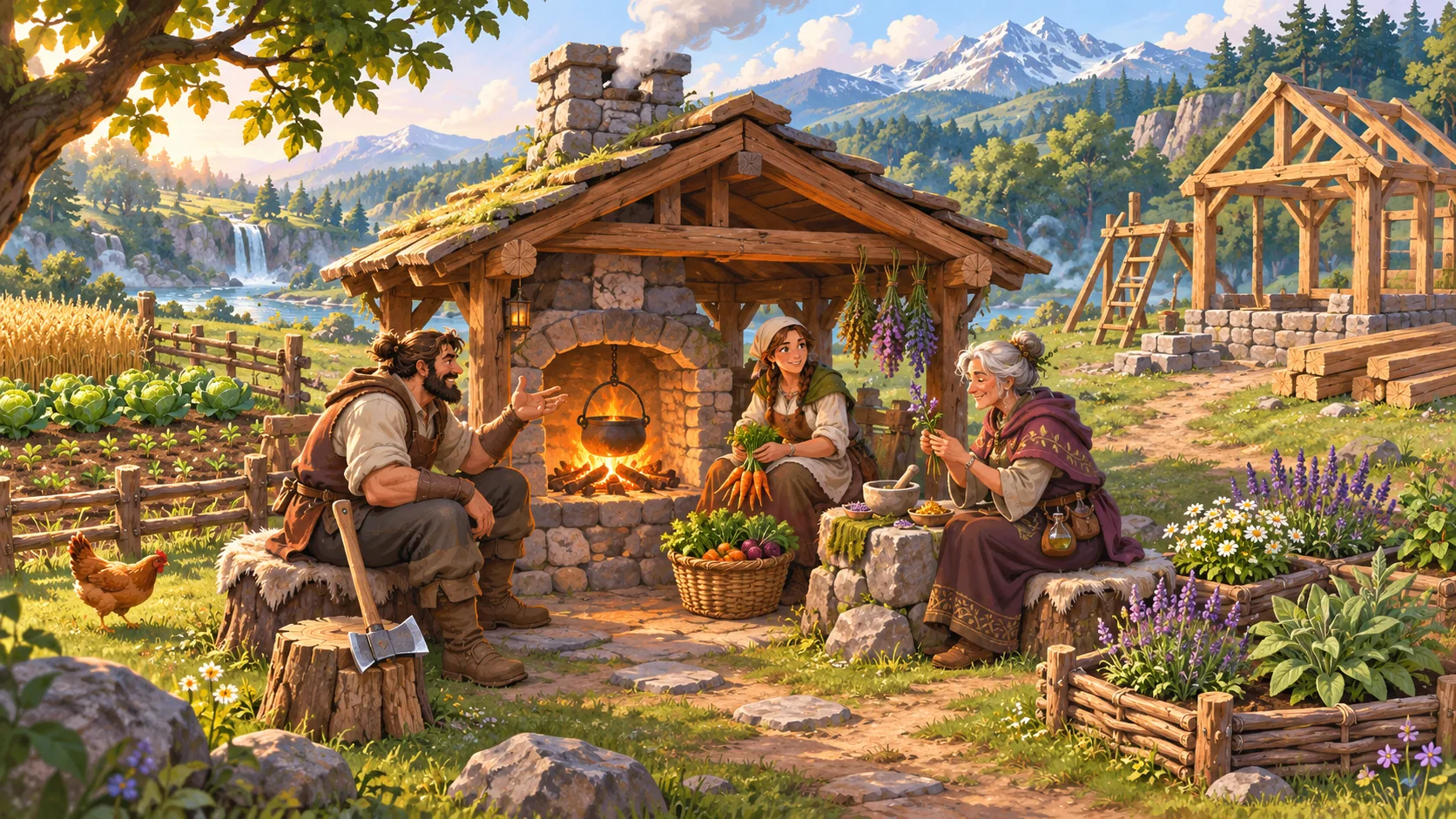
A cozy mystery can reward attention without turning neighbors into suspects. In The Last Routine, a harbor village prepares for its annual lantern walk, but the old tide bell is missing from the public square. Players explore public paths, notice ordinary tasks, and rebuild three residents’ routines from time-stamped clues. The answer is not a theft: the bell was moved to the lighthouse storehouse before a storm, and the villagers quietly organized a safer route for an elder who uses a cane.
The core loop connects observation to a timeline. Each in-game day has morning, noon, and dusk blocks. Players can revisit the market, garden, square, and harbor during each block. A clue records its place and time; the routine board accepts one clue per resident per block. When the timeline forms a consistent sequence, the player may ask a resident an optional, non-leading question. The resident chooses whether to share the reason. No home entry, accusation, relationship penalty, or timed failure is required.
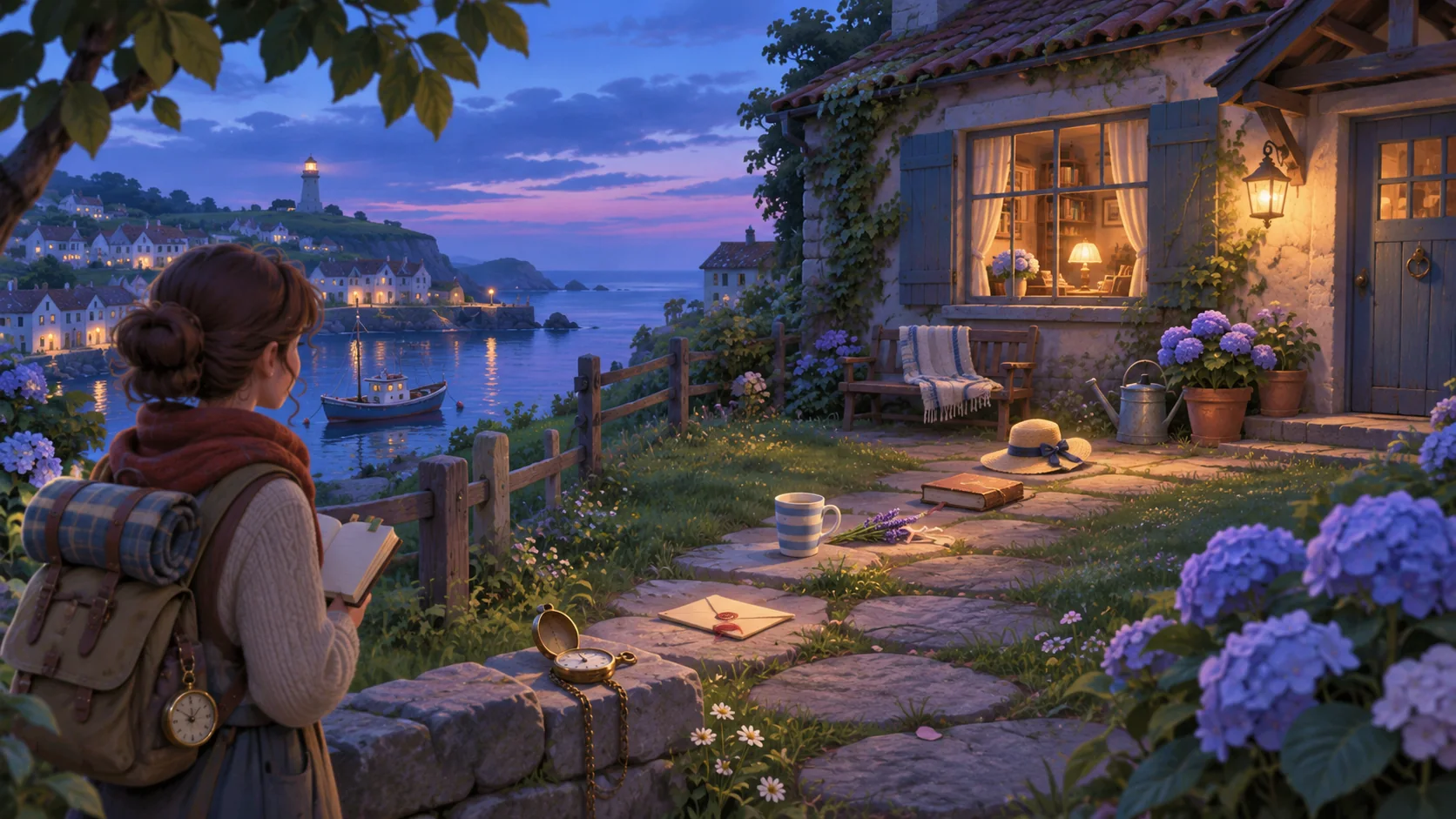
Turn repeated daily actions into clues
Set the story in Harborlight, a fictional village with four public locations: market, garden, square, and harbor. The play day has three fixed blocks—morning, noon, dusk—and repeats for three days. Each day, three residents each perform one visible routine at a scheduled place and time: Mira opens the market at morning, Sol waters the public garden at noon, and Ren lights the square lanterns at dusk. Their activities repeat unless a clue establishes a specific exception. The missing tide bell is found in the lighthouse storehouse, a public building. The player never enters private homes or follows residents into hidden spaces. Place twelve clues across the three days: one receipt, tool, or public notice per resident per time block, each with a stable clue ID, location, and time. The timeline board has three resident rows and three time columns. A slot accepts only a clue whose observed location and time match that routine; it cannot accept two clues. A routine is complete when all three slots contain valid clues. Completing all three routines unlocks an optional conversation prompt at the square. The player may ask one open question—“Would you like to tell me why the bell moved?”—or leave without asking. The resident can share that the village moved the bell before a storm after an elder requested a step-free lantern route; declining to share does not block progress. The story concludes when the player places the final clue showing the new public route on the board. There are no deductions from appearance, no accusation screen, no relationship meter, no penalties for wrong guesses, no hidden-house access, and no real-time deadlines. Reset returns to day one and clears placed clues while keeping the tutorial hint.
| System | Expected behavior |
|---|---|
| Schedule | Three residents, three time blocks per day, repeated over three days; routines are visible in public areas. |
| Locations | Market, public garden, square and harbor. The lighthouse storehouse is accessible; homes are not. |
| Clue record | Twelve clues have stable IDs plus observed time and location; each routine board slot accepts one matching clue. |
| Routine board | Three rows by three time columns; only a matching observed location/time can fill a slot. |
| Conversation | All routines unlock one optional open question; declining or leaving never blocks the ending. |
| Mystery answer | The bell was moved to the public storehouse before a storm to create a step-free route requested by an elder. |
| Failure and reset | No accusations, relationship penalties, timers or hidden access. Reset clears clue placements and returns to day one. |
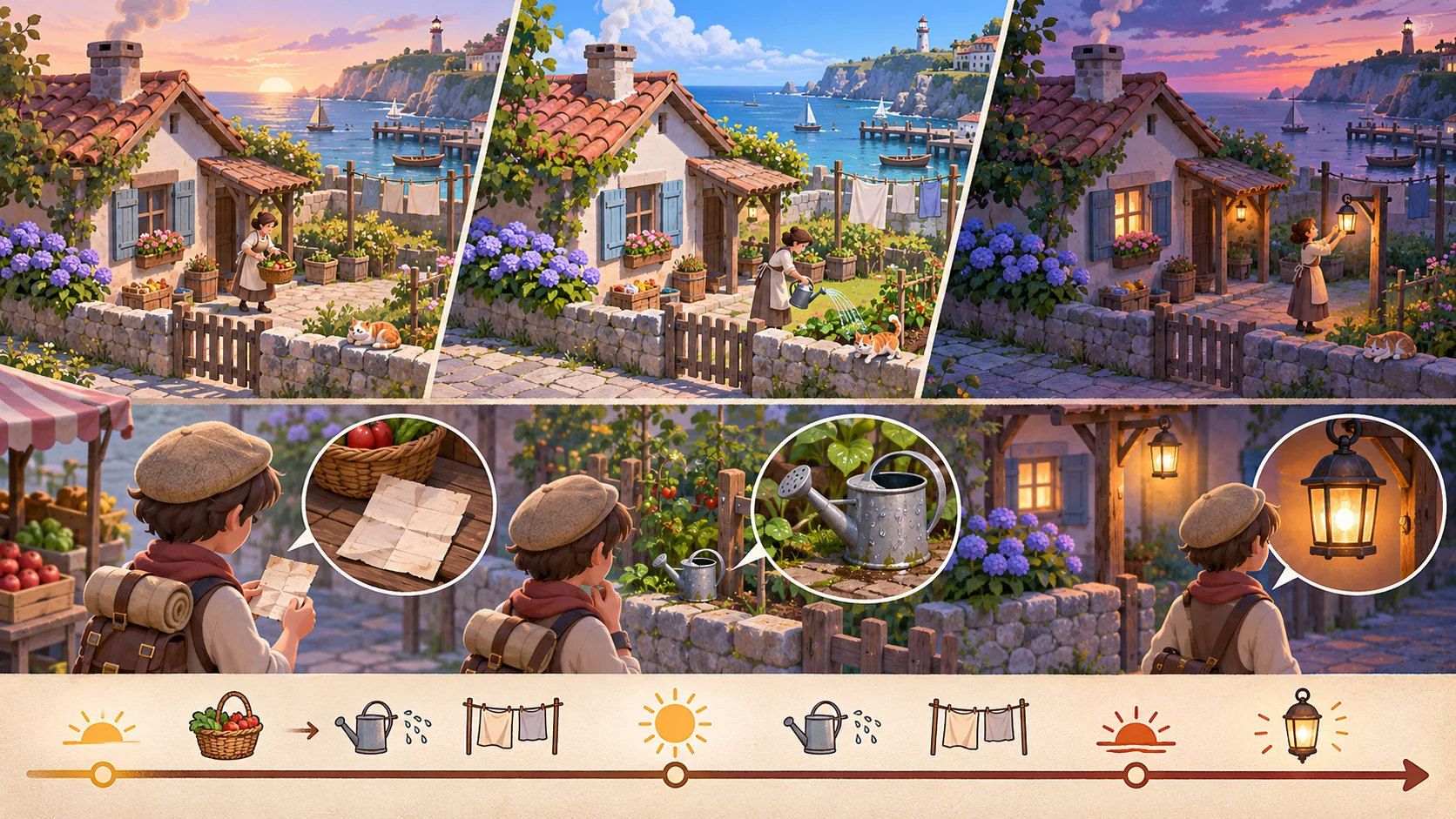
Build a routine board with clear constraints
On day one at morning, the player sees Mira open the market and records clue C01: a dated receipt showing the bell rope was inspected. At noon, a public garden tool rack holds Sol’s watering can beside a note with the harbor maintenance schedule; the player records C05. At dusk, Ren lights the square lanterns, and a public notice mentions a storm forecast; the player records C09. The player places each clue in the correct row and time column. On day two, the player finds a noon market notice about moving heavy items before the storm and an evening harbor marker showing the step-free route. These details establish that the bell’s absence is a planned move, not evidence of theft. After all three residents’ nine routine slots are complete, the square conversation becomes available. The player asks the optional open question. Ren shares that the group moved the bell to the lighthouse storehouse and changed the lantern walk for an elder who requested a step-free path. The player adds the public route map as the final clue and completes the mystery. This is a written state trace, not a playable or user test.
| Step | Expected state |
|---|---|
| Morning, day one | Observe Mira open market; record C01 with time=morning and location=market. |
| Noon, day one | Find Sol’s watering can and public schedule; record C05. |
| Dusk, day one | Observe Ren light square lanterns; record C09 and storm notice. |
| Place clues | Each clue fills only a matching resident and time slot; no duplicate slot. |
| Day two public clues | Storm preparations and step-free route map support a planned bell move. |
| Complete three routines | Optional open conversation prompt appears at square. |
| Ask or leave | Resident may share; either choice allows the player to finish with the public route map. |
| Finish | Place route map as final clue; no penalty or accusation state is created. |
Trace the missing bell mystery
Keep the schedule deterministic and the investigation respectful. Specify which locations are public, what each clue stores, how the board validates a routine, and why the conversation is optional.
Create a cozy third-person exploration mystery prototype called The Last Routine in a fictional seaside village named Harborlight. Use a single-player character and four public locations: market, garden, square, harbor. Include a public lighthouse storehouse; do not allow entry to private homes. The game has three days, each with morning, noon and dusk blocks. Three residents have visible deterministic routines: Mira opens the market in the morning, Sol waters the public garden at noon, and Ren lights the square lanterns at dusk. Show the current day and time block. Place twelve stable-ID clues across the schedule; every clue stores its observed location and time. Build a timeline board with three resident rows and three time columns. Accept at most one clue per slot, and only when its observed time and location match that routine. Completing all three routines unlocks an optional open question at the square: “Would you like to tell me why the bell moved?” The resident can explain that the village moved the public tide bell to the lighthouse storehouse before a storm to make a step-free lantern route for an elder who requested one. The player never accuses anyone, enters a private home, or receives a relationship penalty. Leaving the conversation must not block the ending. No timers, hidden following, appearance-based deduction, or failure on an incorrect guess. The final public route map is the last clue. Reset returns to day one and clears placed clue slots but keeps the tutorial hint. Keep the world calm, clues readable, and time changes explicit. Do not add combat, stealing, private surveillance or a villain reveal.Prompt AI for a gentle exploration prototype
An early idea let the player enter homes to search for the bell. That made a low-pressure mystery depend on privacy violations. The final rule keeps every clue in a public space and makes the lighthouse storehouse accessible while private homes remain closed.
A first ending required an exact accusation. Replacing that with an optional open question and a public route map makes the reveal depend on reconstructed routines, not on punishing a wrong guess. A resident can decline to share and the player can still conclude the mystery.

Revise an intrusive investigation rule
Prototype the three-by-three routine board before adding more residents or days. Each clue should show its time and public location, and every valid slot should have one matching observation. Keep the resolution focused on a community decision and an accessible route. The written trace checks authored rules only; it does not demonstrate a playable or user-tested game.
Read the related cozy game design guide.
Try the SEELE AI game maker workflow.
Frequently asked questions
Is the bell actually stolen?
No. The villagers moved the public bell to a lighthouse storehouse before a storm. Routine clues reveal a community decision to make the annual lantern walk safer and step-free for an elder who requested an accessible route. The player confirms the timeline rather than accusing a suspect.
Can the player enter residents’ homes?
No. The mystery uses clues in public spaces such as the market, garden, square, harbor and lighthouse storehouse. Residents’ homes stay closed, and the player never follows anyone into a private area. Every routine can be reconstructed from observations available along shared paths.
Check Godot's official signals guide.
What happens if the player skips the conversation?
Nothing blocks progress. The open question is optional, and leaving without asking has no relationship penalty. The player can still complete the mystery by placing the public route map after filling the routine board. The story never requires a resident to disclose personal details.
Has this mystery been tested as a playable game?
No. The schedule, clue placements and ending form a written design trace for a local prototype brief. They have not been implemented as a playable game, tested with users, or verified in a browser. Treat the mechanics as authored rules that still need a real build.