A breakable wall should change the fight on both sides of it. Before you set its health, decide what the intact structure blocks, what opens when it breaks, and how the enemy answers the new line of fire. That turns destruction from a visual effect into a tactical choice: spend time opening the center lane, or move around the wall while it still protects you.
Faultline Yard is an original fictional design exercise for the examples below. No prompt was run, and there is no generated or playtested game to report. Treat its numbers as a contract to inspect in your own build, not measured results.
Make the cover block both lines of fire
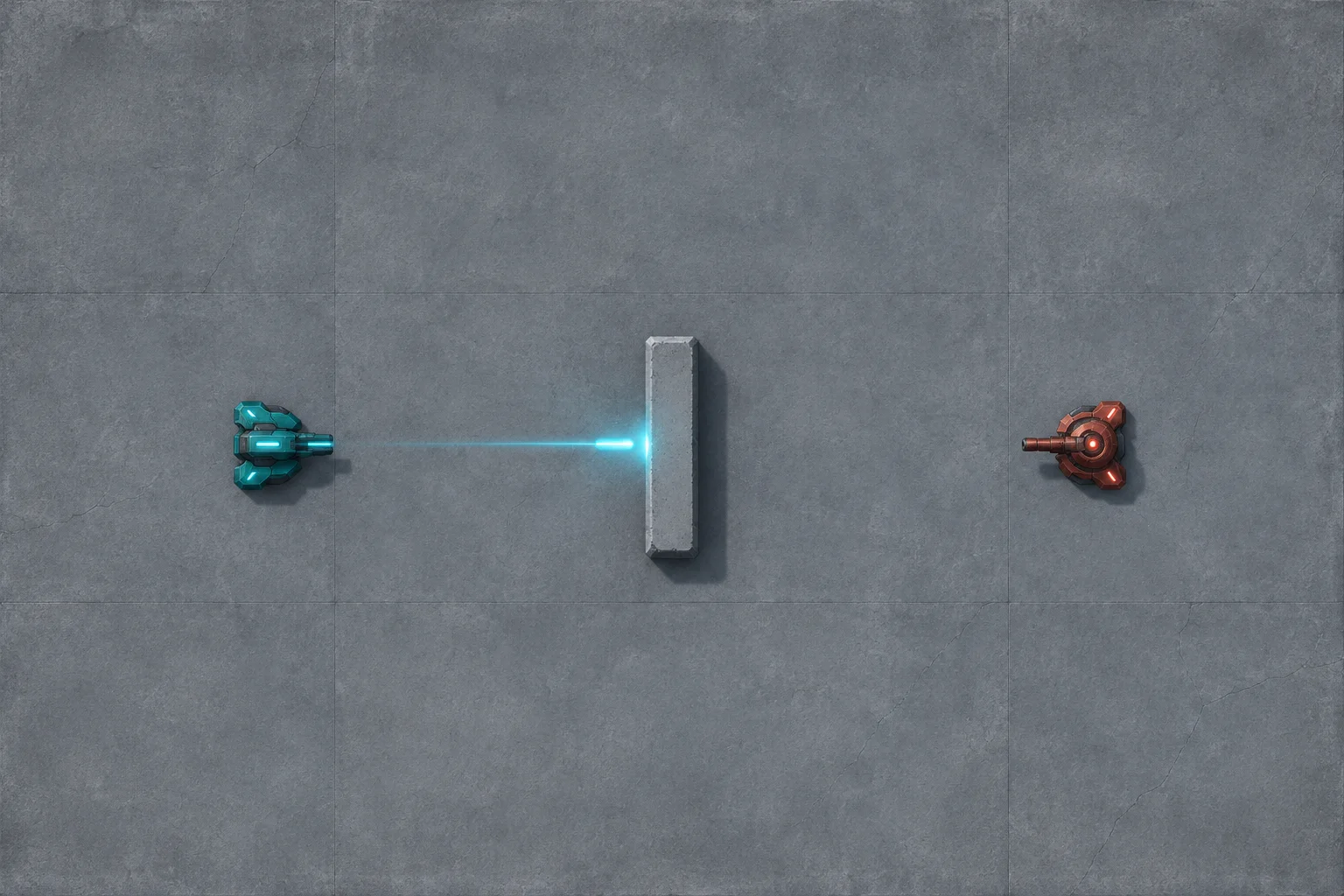
Start with a small top-down arena and one breakable object. Faultline Yard uses a 640-by-480-unit rectangle. The player begins at (80, 240) with three health; a stationary Copper Sentry waits at (560, 240) with three health. Between them, a concrete barricade fills x=300–340 and y=160–320. The centerline runs straight through the wall, so neither side can shoot through it while it remains intact.
The player moves with WASD at 180 units per second and aims with the pointer. Space fires a straight cyan pulse at 600 units per second, with a 0.40-second cooldown and one damage on the first target it contacts. The pulse reaches at most 600 units, stops at a wall or sentry, and never pierces. The sentry’s amber bolt follows the same first-contact rule. That shared collision rule matters: if the player's pulse stops at cover but the enemy's bolt passes through, the wall is not giving both sides the same tactical information.
| Object or action | Rule in Faultline Yard | Decision it creates |
|---|---|---|
| Concrete barricade | Two integrity; each player pulse removes one. It blocks both pulse and bolt until it breaks. | Spend two shots opening the direct lane, or leave the wall intact and flank. |
| Player pulse | 600 units per second, 0.40-second cooldown, one damage to the first target. | Choose whether a shot should damage the wall or be saved for the sentry. |
| Copper Sentry | Three health; fires a locked-line bolt after its warning. | Watch the tell and move before the lane becomes dangerous. |
| Outer route | Move around the north or south edge only when the player center clears the wall's y-range. | Trade a longer route for the protection of the intact structure. |
Define rubble too. When the second pulse breaks the wall, the remaining chunks in this contract are visual only: they no longer block movement or shots. If rubble still collides, the new lane is not actually open. Write that rule beside the wall's integrity so a future build can be checked from the same starting position.
Choose between breaking and flanking
Neither route should be an automatic answer. Breaking the wall costs two player shots and turns a protected centerline into an exposed one. Flanking costs movement time and forces the player to leave the direct route, but the barricade continues to consume bolts. The tradeoff is useful only if the wall blocks the sentry as well as the player and if the open lane changes what either side can hit.
| Route choice | What the player spends | What changes | When to inspect it |
|---|---|---|---|
| Break the center wall | Two pulse contacts and the time needed for each shot to arrive. | Both sides gain a direct line; the player can damage the sentry but must dodge its reply. | Check that the first hit leaves cover standing and only the second opens the lane. |
| Flank north or south | Travel distance and time away from the centerline. | The player can line up a shot around the wall without removing the sentry's central protection. | Check that the angle clears the wall and that the sentry can still be attacked from outside its y-span. |
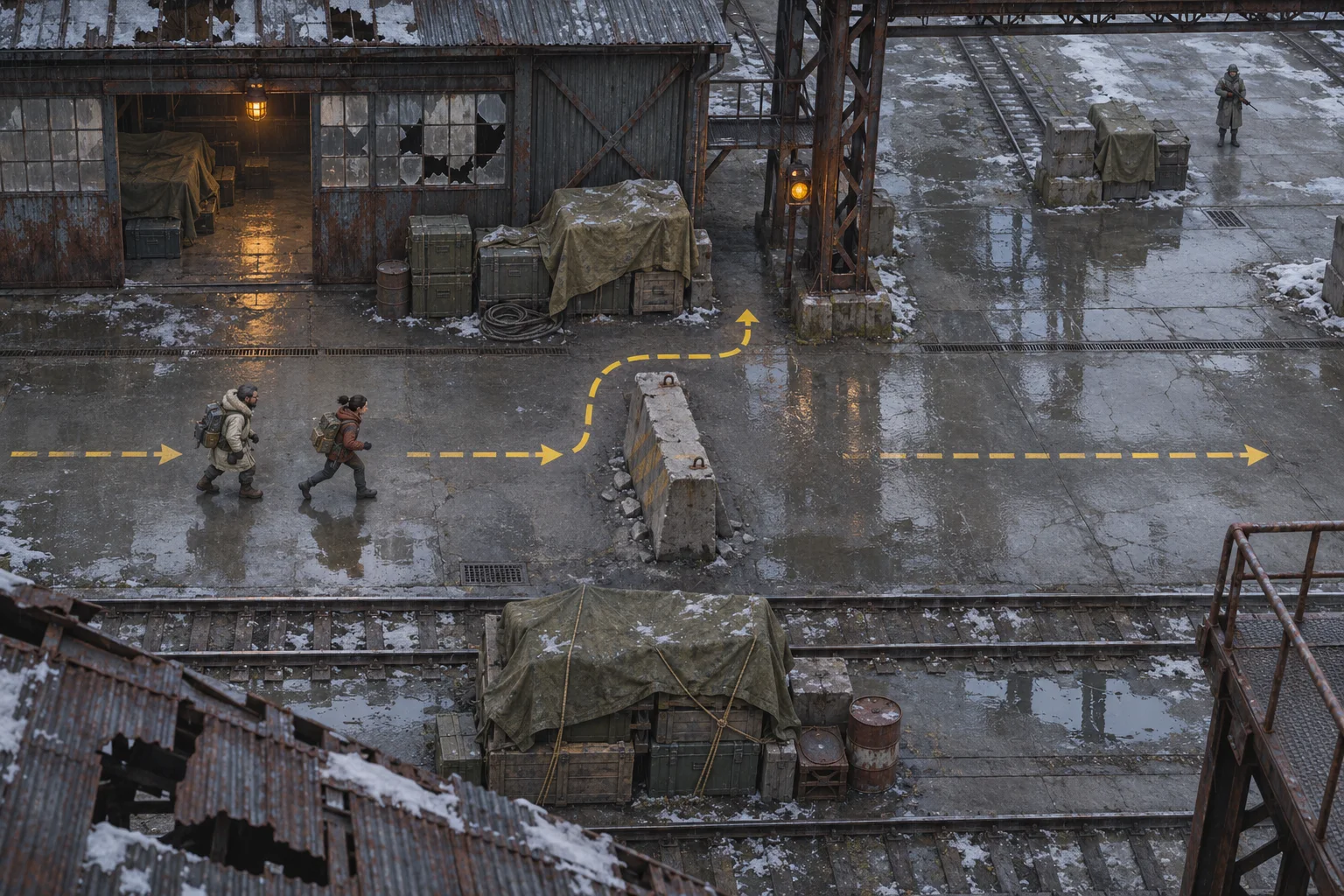
For the flank to work, the player’s center must move above y=160 or below y=320 before aiming across the arena. A diagonal shot that still intersects the wall should stop there. This gives you a clean comparison: the wall stays up and blocks a direct pulse, while a route around its edge creates a different firing angle without changing the object itself.
Choose when to open the lane
Only break the wall when opening the lane is worth the counterfire risk. In the mechanism illustration, the wall is already gone, the sentry’s bolt is committed to the player’s earlier position, and the player has stepped laterally out of that locked line. The scene combines three states that the article keeps separate in its rules: destruction opens shots, the sentry does not retarget a bolt already in flight, and a sideways dodge changes whether the bolt reaches the player.
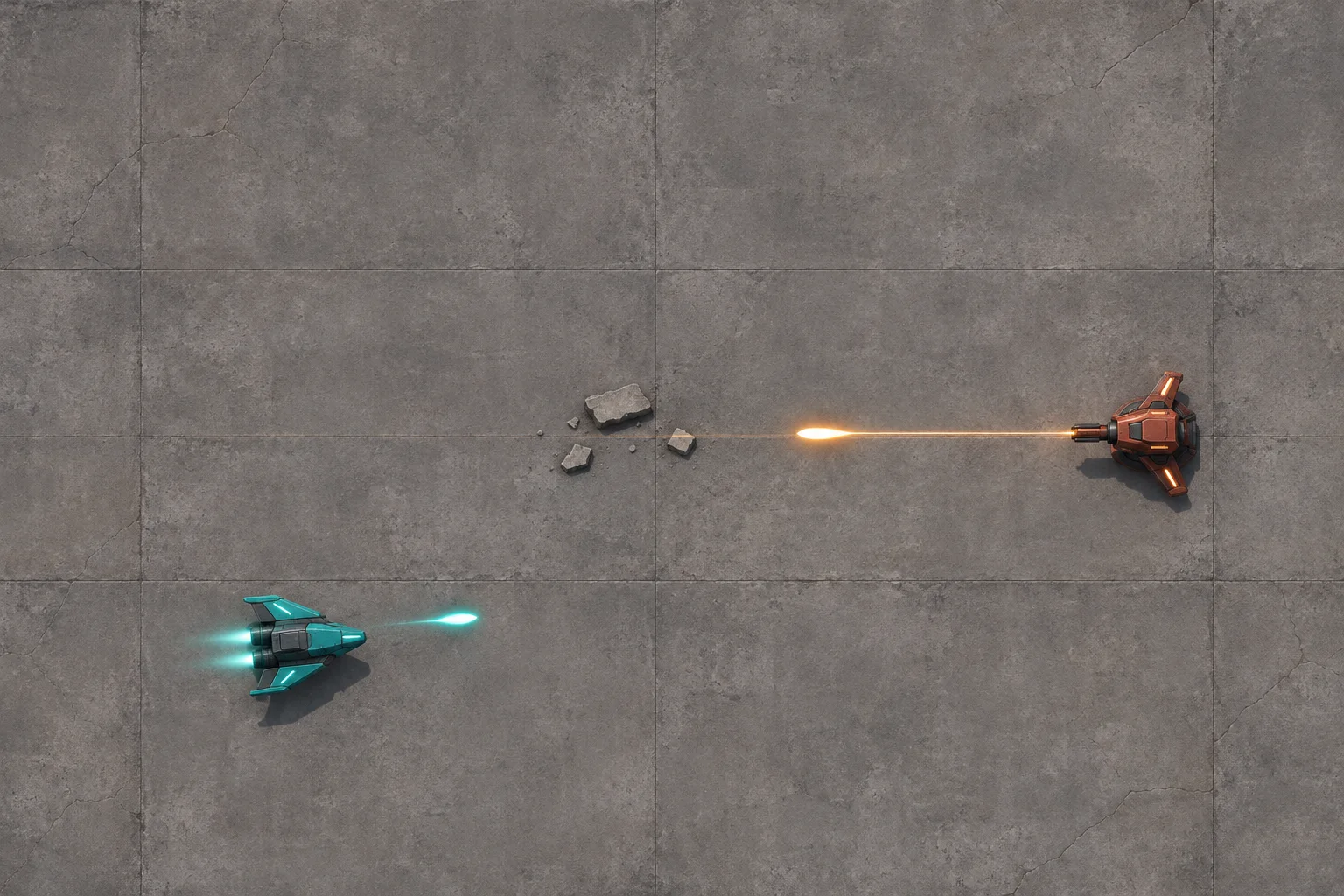
Use the open lane and dodge the reply
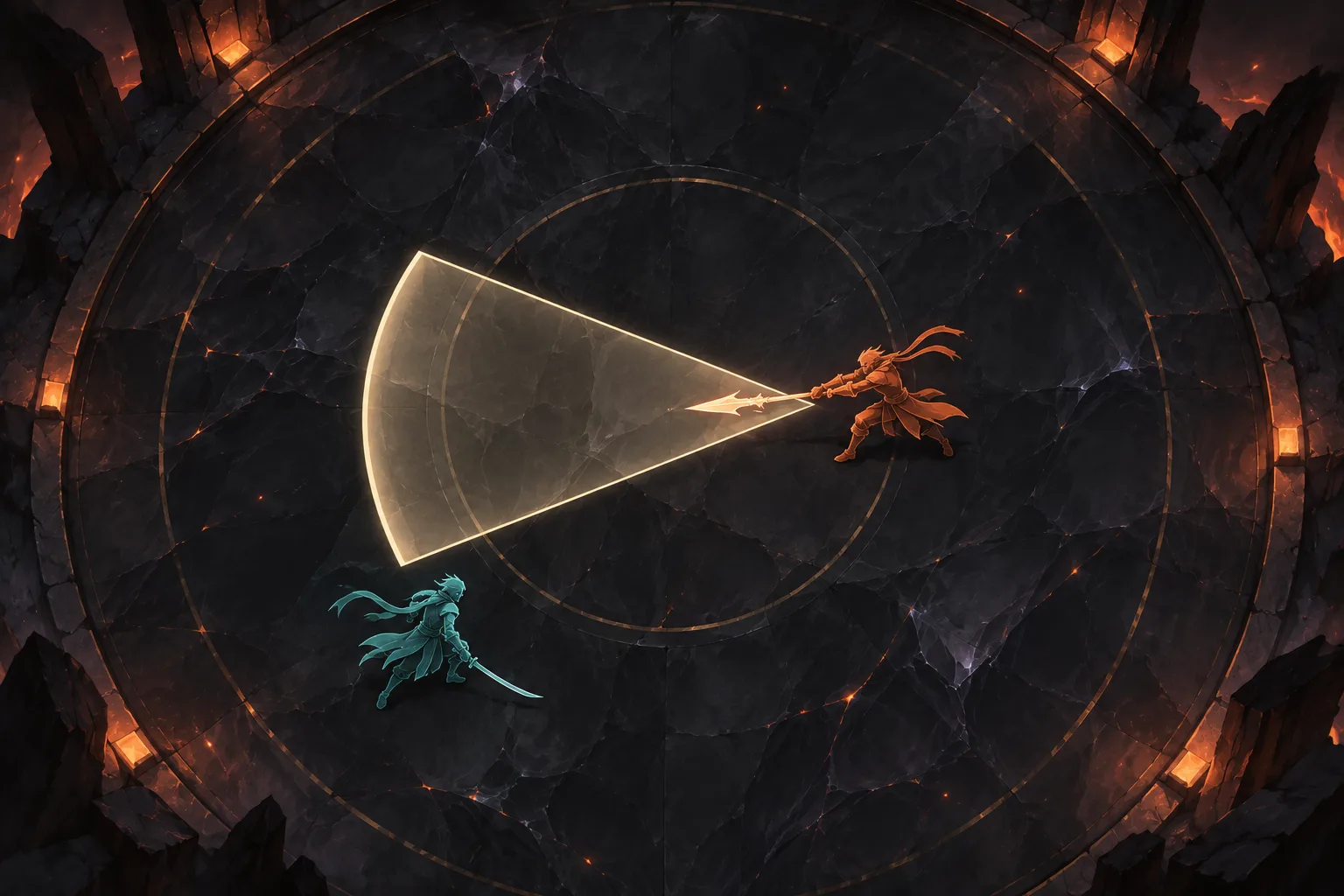
The first warning begins 1.00 seconds after the room starts; later warnings begin every 2.40 seconds. Each tell shows a pale cone 180 units long and 20 degrees wide, aimed at the player's center and locked there for 0.40 seconds. The sentry then launches one non-homing amber bolt at 240 units per second along that line. It does not steer the bolt after launch.
Give the shapes a collision rule, not just a color. In Faultline Yard, the bolt radius is four units and the player radius is twelve, so their centers collide within sixteen units. An intact barricade consumes the bolt without harming the player or losing wall integrity. In an open lane, move the player center at least seventeen units perpendicular to the locked line before contact to clear that collision margin. A bolt that reaches the arena edge disappears. These are paper rules, not evidence of how forgiving a real controller will feel.
A bolt that hits the player removes exactly one of the player's three health points and is consumed. If the player reaches zero health, the run is lost; if the sentry reaches zero health, the player wins immediately and any active bolt clears. Restart returns the player to (80,240) with three health, facing east and pulse cooldown ready; restores the sentry at (560,240) with three health and the barricade at two integrity; resets the attack clock to zero; and clears all bolts.
Test the map change after the break
After destruction, test both the new offense and the new risk. A pulse aimed through the gap should reach the sentry; a bolt on the same line should threaten the player. If the player leaves that line before the bolt arrives, the shot should pass the old position. The outcome illustration shows this authored state: a cyan pulse reaches the sentry through broken cover while the amber bolt misses behind the sidestepping player. It is a planned game state, not a result observed in a build.
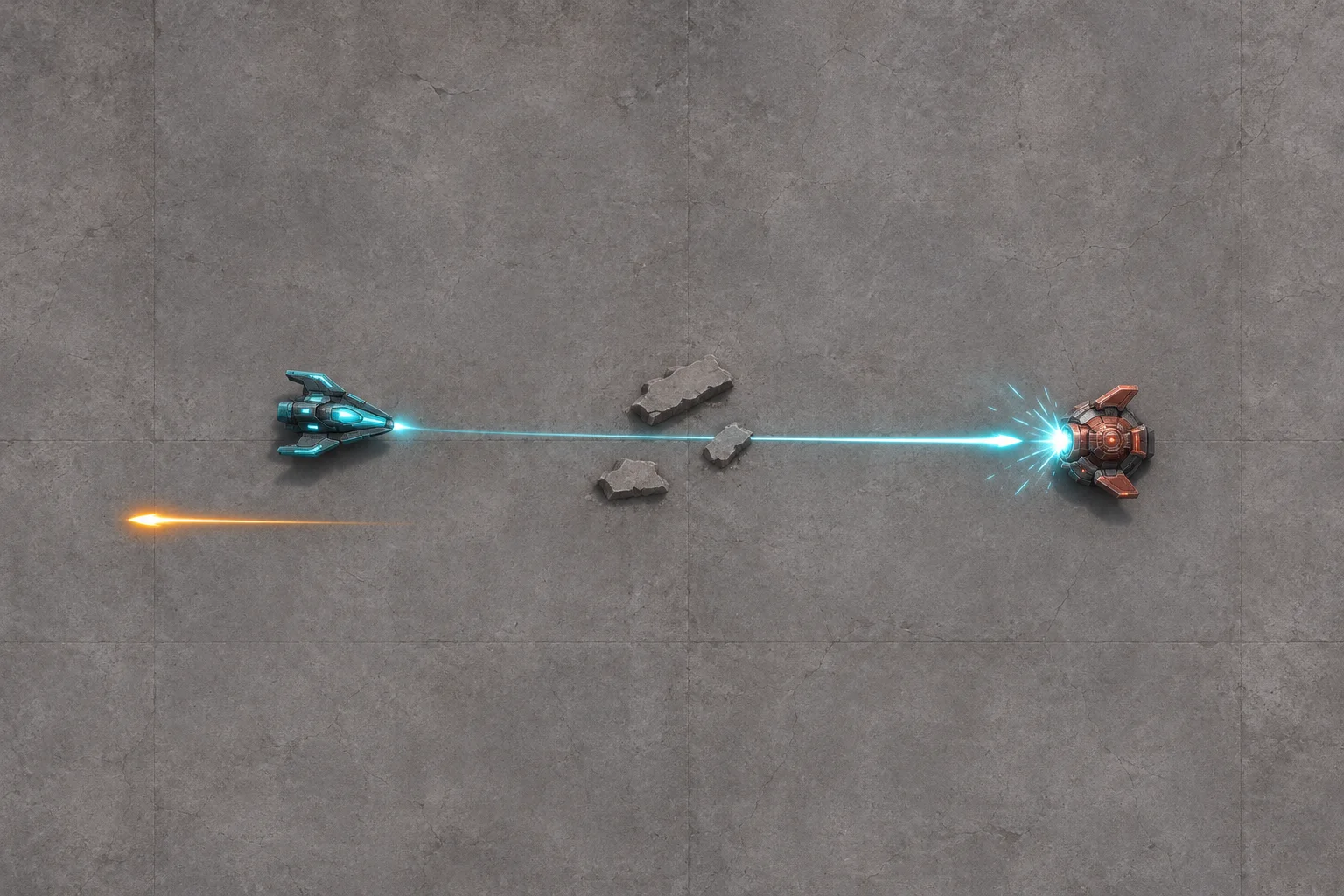
Keep the hitboxes and timeline consistent across the example. The sentry cannot be damaged through intact concrete, a first wall hit does not remove the wall, and breaking it does not make a bolt home toward the player. If a future build behaves differently, record the actual state first; do not quietly change the written contract to make an unexpected result look intentional.
Revise one structural value with paper math
A small calculation can catch an inconsistent revision before you ask anyone to play it. In fictional v0, the barricade has one integrity. The player starts at x=80, and the wall begins at x=300, so the first pulse covers 220 units. At 600 units per second, it reaches the wall after 220 ÷ 600 ≈ 0.367 seconds. With one integrity, that contact opens the lane immediately.
In fictional v1, change only wall integrity from one to two. The first contact leaves one integrity and keeps both firing lines blocked. The weapon can fire again after 0.40 seconds; that second pulse travels the same 220 units in about 0.367 seconds, arriving at roughly 0.40 + 0.367 = 0.767 seconds. Only then does the center lane open. The sentry's first tell begins at 1.00 seconds, so the change also alters how long the player has to decide before the first attack sequence.
This is a hand calculation over fictional settings. It is not a measured iteration and does not prove that v1 feels better. In a real build, hold the map, weapon and sentry schedule constant and compare how often players choose the center break versus a north/south flank. Record route choice, damage taken, and whether the wall opens before the first tell. If you change cover health, player damage and enemy timing together, the comparison will not show which change caused the result.
| Paper version | Wall integrity | First contact | Lane opens | What remains unknown |
|---|---|---|---|---|
| v0 | 1 | About 0.367 seconds after firing. | On the first hit. | Whether the immediate opening makes the choice too easy. |
| v1 | 2 | About 0.367 seconds; wall stays at one integrity. | About 0.767 seconds after the first shot. | Whether the extra wait creates a meaningful risk or only busywork. |
For an actual comparison, reuse one starting position and one route. Note the version, first action, time the wall breaks, route selected, bolt contact and player health. Leave the observation fields blank until you run a real build; a designed example cannot fill in player choices or a measured outcome.
Check the result in your own build
Start by describing the arena, player action, breakable object and desired combat change in plain English. SEELE’s official Free AI Game Maker page describes a general path for expressing a game idea, reviewing a playable 2D or 3D result, and iterating in Workspace. That wording does not establish that a specific wall, projectile or collision rule will be implemented. Inspect any result against the contract: fire at intact cover, verify what both sides can hit, break it, then check the newly open lane and the sentry’s response. Before submitting, review the selected AI model, available Koin balance, and displayed generation cost in Workspace.
When you are ready to plan your own bounded arena, open the Free AI game maker. Bring the wall’s footprint, integrity, collision rules and one clear post-break check. Treat the output as something to inspect and revise; this article does not claim that Faultline Yard was generated.
Frequently asked questions
How much cover should break?
Choose the smallest number of contacts that creates the decision you want. Faultline Yard uses two because one shot visibly weakens the wall without opening the lane, and a second shot changes both players’ lines of fire. That is a fictional starting value. In a real build, check whether the extra contact makes players weigh demolition against the flank rather than simply firing automatically.
Should projectiles pass through rubble?
State that explicitly. In this example, the wall disappears at zero integrity and the remaining chunks are visual, so shots and movement pass through. If your rubble should still block a shot, draw and test its collision shape as a new rule. Do not let the image imply a clear lane while hidden collision keeps the player pulse or sentry bolt blocked.
Why does breaking the wall also increase risk?
The intact barricade blocks both the player pulse and the enemy bolt. Destroying it removes protection for both sides, so the player gains a direct shot and must respond to the sentry’s warning. If the wall only protects the player or only blocks one weapon, describe that asymmetry and test it; it changes the tactical choice.
How can I compare flanking with demolition?
Keep the arena, weapon and enemy schedule fixed. Record whether the player broke the wall or moved above or below its y-range, how long the route took, whether the sentry bolt hit, and the remaining health. These observations belong to an actual play session. The 0.367- and 0.767-second values in this article are calculated travel times, not observed player behavior.
Has Faultline Yard been generated or playtested?
No. Faultline Yard is an original fictional design exercise, and the one-to-two-integrity change is hand-calculated from the written values. No game-generation prompt was submitted, no playable build was generated, and no measured iteration or playtest is claimed. The illustrations show planned game states, not screenshots or evidence of a product result.