Start with one readable attack
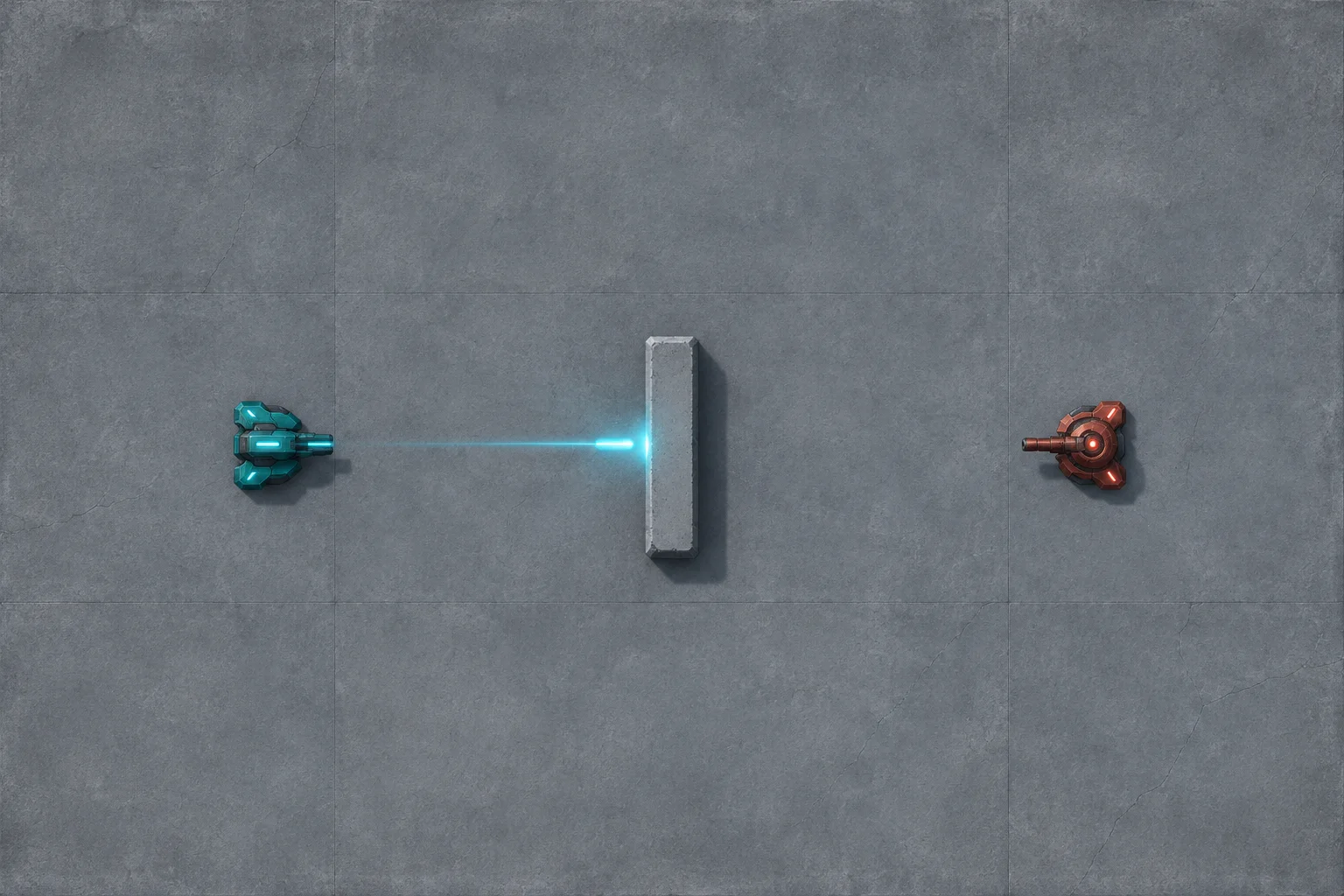
Make an arena fighter readable before you add a moveset: give one attack a visible warning, a clear dodge route, and a recovery window the other fighter can punish. Ashline Ring is a fictional, hand-planned duel that shows how to define those states. Its timings are a design rehearsal, not a generated game or measured playtest.
Design a duel before you design a moveset
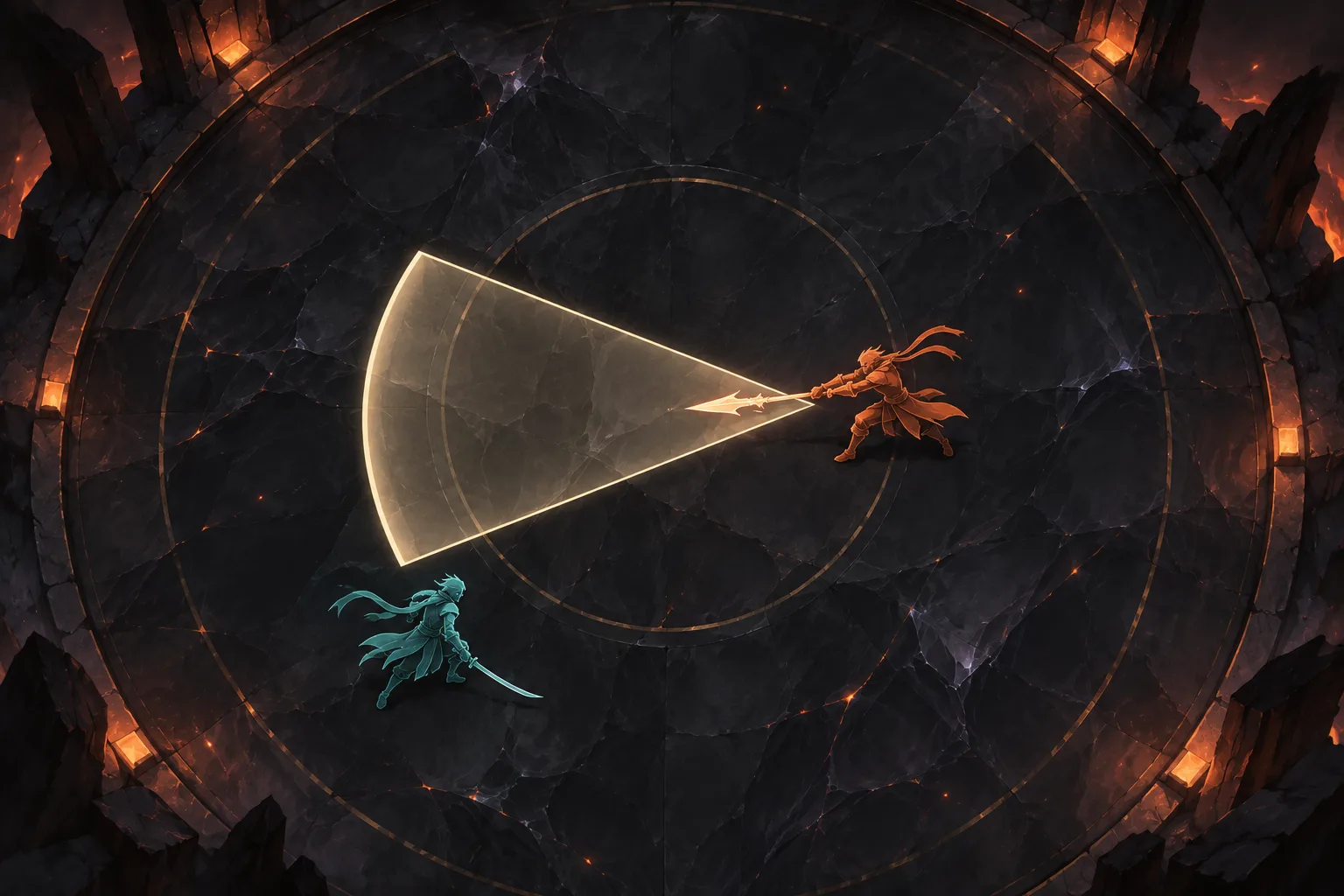
A small arena can teach more about counterplay than a long list of attacks. Ashline Ring uses one top-down circular floor inside an 800 × 500 view. The teal player starts at (240,250), facing east; the copper rival starts at (560,250), facing west. The arena edge blocks both fighters. There are no obstacles, hazards, projectiles, blocks, combos, or resource meters to distract from the central question: can a player read one attack, move out of its path, and answer during recovery?
WASD moves the player at 180 units per second. Facing follows the last non-zero movement direction, with east as the initial facing. Pressing J begins one quick strike in that direction. The strike has a 0.15-second startup, a 0.10-second active window, and 0.45 seconds of recovery. It reaches 46 units in a 60-degree forward arc and removes one rival health point once per attack. The player cannot move during the active window and can move again during recovery. Each fighter starts with four health. At zero, show the winner and a Restart action; the duel has no timer or round score.
| Design choice | Ashline Ring rule | Why it belongs in the first slice |
|---|---|---|
| Starting positions | Player (240,250), rival (560,250), facing toward each other | A repeatable opening makes timing comparisons meaningful |
| Player action | J strike; 46-unit range, 60-degree forward arc, one hit | The player can test distance and facing without combo rules |
| Opponent action | One telegraphed forward lunge and one strike | The warning and impact have a single cause |
| Match end | Four health each; zero health ends the duel and enables Restart | A result is observable without a timer or score system |
This is a focused combat design, not an arena-building tutorial or a catalog of copy-ready AI prompts. Keep geometry fixed while you learn whether the attack is legible. Adding a course or several attacks would introduce new decisions before the warning, dodge, and punish loop has a stable baseline.
Make the attack readable in three states
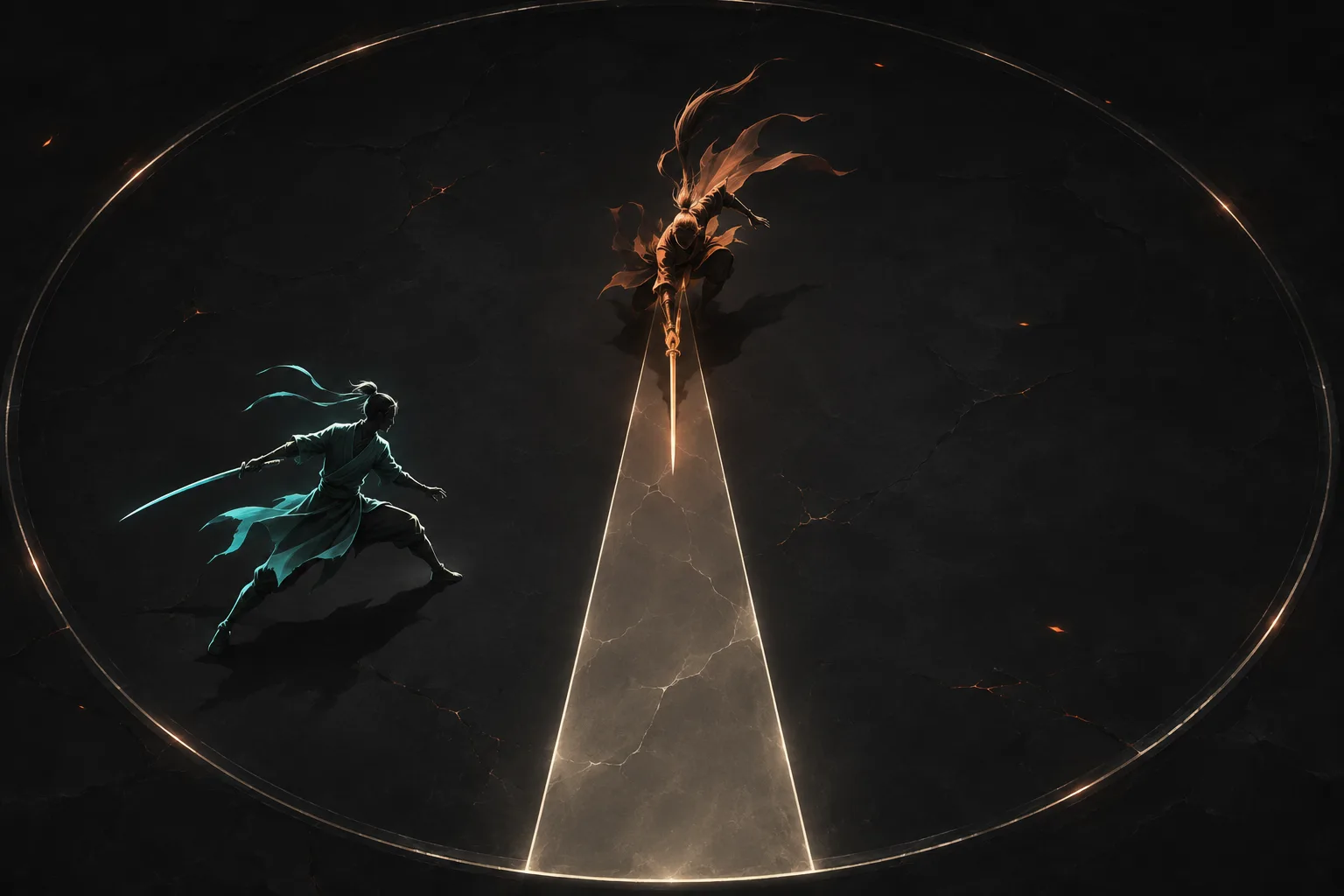
The rival waits until 2.5 seconds after the round begins, then shows a bright forward wedge for 0.8 seconds. At the moment the tell begins, it faces toward the player’s position and locks that direction. It does not track the player afterward. The player’s job during this tell is to recognize the lane and move outside it before the rival strikes.
When the warning ends, the rival lunges 70 units along the locked direction over 0.25 seconds and strikes once at the end. If the player is within the rival’s 50-unit forward arc at impact, the player loses one health. The rival cannot be damaged during the tell or lunge. After the lunge, it enters a 0.9-second recovery window in which one well-placed player strike can punish it. Then it is guarded again and waits 1.6 seconds before starting the next tell. From the opening round, the next tell therefore begins at 6.05 seconds: 2.50 + 0.80 + 0.25 + 0.90 + 1.60.
| State | Rival behavior | Player read |
|---|---|---|
| Tell: 0.80 seconds | Show a forward wedge toward the player’s position, then lock its direction | Notice the marked lane and step outside it |
| Lunge: 0.25 seconds | Move 70 units along the locked direction; strike once at the end | Stay clear of the 50-unit forward arc at impact |
| Recovery: 0.90 seconds | Become vulnerable; do not add another attack | Face and approach, then try one 46-unit strike |
| Guarded wait: 1.60 seconds | After recovery, guard until the next tell begins | Return to a readable spacing before the next cycle |
The player’s own strike totals 0.70 seconds across startup, active time, and recovery. Its 0.15-second startup and 0.10-second active window fit inside the rival’s 0.90-second vulnerable period if the player is already positioned and facing correctly. That timing makes a punish possible to design and inspect; it does not guarantee that every attempt connects. Keep attack direction, distance, and damage feedback visible so the player can tell whether a miss came from range, facing, or timing.
Build and inspect the first prototype
Turn the contract into one bounded creation request rather than asking for a full fighting game. The prompt below defines the arena, the player strike, the rival’s one attack cycle, the health rule, and the restart state. It asks for visible cues that a person can inspect, while leaving implementation details open where the design does not specify them.
Build a small top-down 2D arena-fighting prototype called Ashline Ring in an 800 × 500 view. Use a circular charcoal arena with no obstacles or hazards. Start the teal player at (240,250), facing east, and the copper rival at (560,250), facing west. WASD moves the player at 180 units/second; facing follows the last non-zero movement direction. J starts one quick strike in the current facing direction: 0.15-second startup, 0.10-second active window, 0.45-second recovery, 46-unit range, 60-degree forward arc, and one damage event per attack. Do not allow player movement during the active window; movement is available again during recovery. Give both fighters 4 health. The rival waits until 2.5 seconds after round start, shows a clear forward wedge for 0.8 seconds facing the player's position at tell start, then locks that direction and lunges 70 units over 0.25 seconds, striking once at the end. Its 50-unit forward arc deals 1 damage if the player is inside at impact. The rival is invulnerable during tell and lunge, vulnerable for 0.9 seconds after the lunge, then guarded while it waits 1.6 seconds before the next tell. Do not track after the tell begins or add more attacks. At 0 health show the winner and a Restart action; do not add a timer or score. Keep the telegraph, impact feedback, recovery state, health loss, and reset visible. Do not claim the result is correct until someone checks it.For a future build, check one rule at a time. Confirm the opening positions and facings first. Stand outside the player’s 60-degree arc and press J, then repeat from within range and in front; a single attack should remove at most one rival health point. During the rival tell, move sideways and verify its direction remains locked. Then compare an evaded strike with one in which the player stays inside the forward arc. Finally, wait through recovery, try one punish, and restart to confirm health, positions, facing, and the attack schedule return to the opening state.
The CSV asks for an iteration, but no Ashline Ring build or playtest evidence was supplied. The timing example below is a hypothetical design rehearsal, not a result. The sample counts are a suggested way for a reader to organize a future playtest; they are not data collected here.
Run a repeatable counterplay test
When you have a real playable result, keep the opening positions and controls fixed. Start one set with a 0.8-second tell, then repeat the same attack cycle six times. On each cycle, record whether the tester noticed the warning before the lunge, moved outside the marked lane by impact, took damage, and landed a strike during the rival’s recovery. Note input timing or confusion in plain language. Do not turn a short sample into a universal claim about fairness; it is a local comparison that can identify what to inspect next.
| Tell setting | Cycle | Tell noticed before lunge? | Outside lane at impact? | Player took damage? | Recovery punish landed? | Observed note |
|---|---|---|---|---|---|---|
| 0.8 s | 1 | — | — | — | — | Record only what you observed |
| 0.8 s | 2 | — | — | — | — | Record only what you observed |
| 0.8 s | 3 | — | — | — | — | Record only what you observed |
| 0.8 s | 4 | — | — | — | — | Record only what you observed |
| 0.8 s | 5 | — | — | — | — | Record only what you observed |
| 0.8 s | 6 | — | — | — | — | Record only what you observed |
| 1.0 s | 1 | — | — | — | — | Record only what you observed |
| 1.0 s | 2 | — | — | — | — | Record only what you observed |
| 1.0 s | 3 | — | — | — | — | Record only what you observed |
| 1.0 s | 4 | — | — | — | — | Record only what you observed |
| 1.0 s | 5 | — | — | — | — | Record only what you observed |
| 1.0 s | 6 | — | — | — | — | Record only what you observed |
One hypothetical hypothesis is: “If testers do not notice the current 0.8-second warning before the lunge, lengthen only the tell to 1.0 seconds and repeat the same six-cycle protocol.” Hold the arena, starting positions, movement speed, attack arc, lunge distance, and recovery window constant. Compare the observations before deciding what to change. No result here shows that 1.0 seconds is clearer or better; that conclusion belongs to a future recorded test.
If a future observation disagrees with the expected state, write down the exact starting position, tell direction, player input, and health before requesting a change. Change one rule, then repeat the cases that depend on it. A brief test log is more useful than a broad instruction to “make combat feel better,” because it connects one visible mismatch to one editable value.
Refine one number without faking a result
A timing change should be framed as a question, not as a result you already know. In the rehearsal above, the only proposed change is tell duration from 0.8 to 1.0 seconds. Do not also widen the warning, slow the lunge, increase health, or change movement speed in the same comparison; if the outcome shifts, you would not know which change mattered.
Keep the comparison sheet blank until someone has played a real build. Six cycles at each value are a simple starting protocol, not proof of statistical reliability. If the first set shows mixed reactions, preserve the notes and inspect the specific moments: did the player see the wedge, understand its direction, have enough room to move, and recognize the recovery afterward? A longer warning could improve readability, but it could also make the attack feel less urgent. Only observations from the intended players can help decide which trade-off fits the game.
When you ask for a revision, state the current rule, the observed mismatch, and the one proposed adjustment. For example: “Keep the arena, attack direction, lunge, damage, and recovery unchanged. In the repeated test, record whether players notice the tell before impact. Compare a 0.8-second and a 1.0-second tell from the same starting positions; do not claim either value passes until the runs are recorded.” This is a hypothetical request template, not a report of a test performed here.
Review your own build
The official Free AI game maker page describes plain-English prompts, a playable 2D or 3D first result that can be tested in the browser, and follow-up prompts for iteration. Before submitting, review the selected model, available Koin balance, and displayed generation cost. Use those general steps to inspect your own prototype; they do not show that Ashline Ring’s timings have been implemented. If you build a duel, compare the warning, lunge, hit, recovery, and reset states to your test notes before adding more moves.
Frequently asked questions
What makes an arena attack readable?
Give the attack a distinct warning, a direction that stays stable long enough to understand, a clear impact moment, and feedback that shows whether the player was hit. In Ashline Ring, the rival’s forward wedge lasts 0.8 seconds before its lunge. The player can move outside that lane, then check whether the strike still reaches them at impact.
Why should a fighter have recovery time?
Recovery creates a decision after an attack rather than letting every move flow into another without a response. Ashline Ring makes the rival vulnerable for 0.9 seconds after its lunge, so the player has a defined opportunity to answer. The window matters only if the player can reach the rival and land a strike within range.
How can I tune a telegraph without changing the whole fight?
Keep the arena, starting positions, movement, attack arc, lunge distance, and recovery fixed. If a real observation suggests the 0.8-second tell is hard to notice, compare it with a 1.0-second tell using the same repeated protocol. Treat the adjustment as a hypothesis until the runs are recorded; this article reports no measured outcome.
What should I record during a counterplay test?
For each attack cycle, note whether the player noticed the tell before the lunge, moved outside its lane by impact, took damage, and landed a punish during recovery. Record the starting state and any confusing input or cue. Keep each cycle separate so the first mismatch remains traceable to a specific moment.
Is Ashline Ring an existing playable game?
No. Ashline Ring is a fictional design rehearsal, its timings are hand-planned, and the prompts in this article are not recorded as model runs. No playable build or playtest was supplied. Use the rule contract and blank test log as a plan for a future prototype, then describe only behavior you actually observe.