Give two players a question that one reading cannot answer. Let one choose the test mode and the other choose where to listen. Record both choices with the reading. When the team compares the log with its reference table, they should be able to explain why a candidate is still possible or why it can be ruled out.
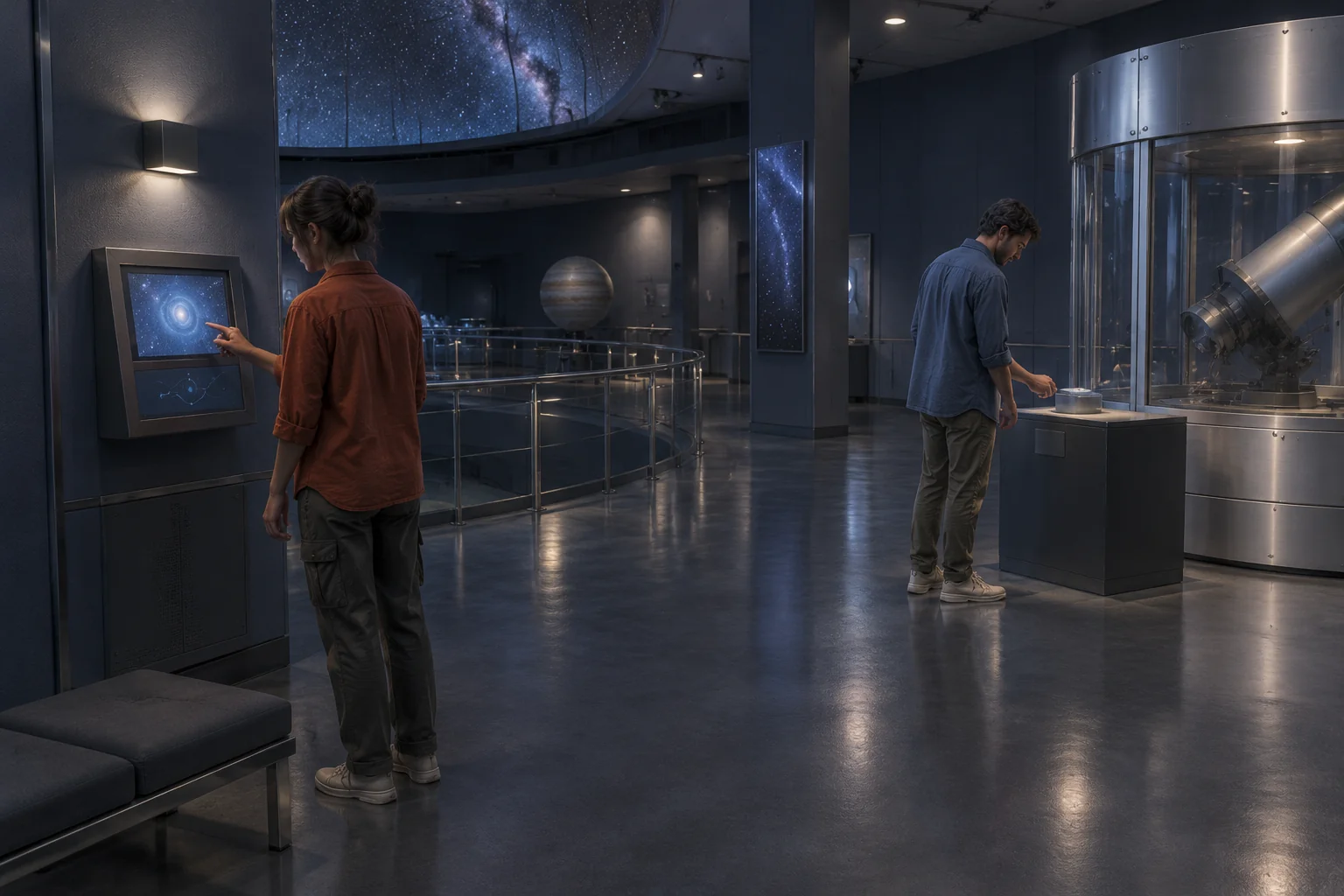
In the fictional Afterlight Annex, two staff investigate an echo in a closed planetarium. They have three sample slots and a shared board with three possible causes. The case becomes clear when they take two complementary readings. Repeating the same reading can leave it open.
Give two players one shared test
Kinetic Games describes Phasmophobia as co-op psychological horror in which players gather evidence using specialized equipment. The official Steam listing credits Kinetic Games and confirms the tool-led premise. Take the idea of making an observation with a tool into a different setting. The planetarium, causes, rules and equipment below are original.
The Operator sets Quiet or Pulse. The Recorder chooses Gallery or Reference. Both can see the selections, and each can revise their own choice before committing. The same screen can hold the two panels, the readings and the current candidate list. The first prototype can test the shared decision before adding a networked session.
Record the condition with the reading
Commit Test spends one slot only when both choices are ready. It records the mode, location and reading, then clears the choices. Start each run with three slots and an empty log. Use Glass Echo as the hidden fixture for this replay and keep all three signatures visible.
| Test | Clock Echo | Glass Echo | Chime Echo |
|---|---|---|---|
| Gallery, Quiet | Single | Single | Double |
| Gallery, Pulse | Single | Double | Double |
| Reference, Quiet | Steady | Steady | Steady |
| Reference, Pulse | Steady | Steady | Steady |

Keep every candidate that matches the usable readings. A reading of Single under Gallery Quiet leaves Clock and Glass. A Double under Gallery Pulse would leave Glass and Chime on its own. Together the readings leave Glass. A Steady reading from Reference agrees with all three signatures.
Compare complementary and repeated tests
| Test plan | Readings and remaining candidates | Report |
|---|---|---|
| Gallery Quiet, then Gallery Pulse | Single leaves Clock and Glass, with two slots. Double leaves Glass, with one slot. | Report Glass to complete. |
| Gallery Quiet twice, then Reference Pulse | The first Single leaves Clock and Glass. The second repeats that constraint. Steady leaves both candidates with zero slots. | Close Unresolved. |
Try arming Quiet alone and committing. The game should reject the test without using a slot or adding a log entry. Now choose Gallery and commit. The first Single should still leave two slots. Require exactly one matching candidate for a complete report. If the final test isolates it, the team can report with zero slots left.
Give AI one investigation to check
Give the SEELE workspace the written fixture and ask for a same-screen browser draft. Keep the visible signature table, both controls and the candidate list together. Check the log after each test and compare the two routes before adding another cause.
Build an original same-screen investigation called Afterlight Annex.
Operator selects Quiet or Pulse. Recorder selects Gallery or Reference.
Both choices, the signature table, log and candidates are shared.

Start with 3 samples and no selections. Set the hidden cause to Glass.
In Gallery Quiet, Clock and Glass are Single, Chime is Double.
In Gallery Pulse, Clock is Single, Glass and Chime are Double.
Both Reference modes are Steady for all causes.

Commit only when both inputs are selected and a slot remains.
Spend 1, record location, mode and result, then clear both inputs.
Invalid commits do not spend a slot or record a result.
Recompute candidates from all usable log entries after each sample.

Accept a report only when the selection matches the sole candidate.
Permit it with zero slots. At zero with multiple candidates,
allow Close Unresolved. Freeze either ending.
Reset the hidden fixture, choices, log, candidates and sample count.
Use original props and interface.
Require one matching control
Change only when Gallery Pulse counts toward the candidate list. Record its reading as before, but keep it provisional until the log also contains a Steady reading from Reference Pulse. Recheck the whole log after every sample so a later control can qualify an earlier reading.
Replay Gallery Quiet, Gallery Pulse and Reference Pulse. In baseline, the Double from the second test isolates Glass. With the control rule, Clock and Glass both remain at that point. The third test qualifies the earlier Double. Glass becomes the sole candidate, and the team can report with zero slots.

A Quiet reading from Reference would still say Steady but would leave the Gallery Pulse result provisional. Keep the hidden cause and every reading fixed while you compare the two versions. Use the guide to revising one rule at a time to isolate the admissibility change.
Finish one case with a clear report
Start your original co-op investigation with SEELE’s AI Game Maker. Write one signature table, record the conditions beside each reading, and check that both players can explain why a case is solved or still unresolved.
Frequently asked questions
How can two roles share all the information?
Give each role a different input into the same test. The Operator sets the mode and the Recorder selects the location. Both can see the choice and result. Their work fits together because the reading depends on both inputs, without private instructions.
Should repeating a reading narrow the candidates?
Only if the repeat adds information that the first observation could not provide. This fixture always returns the same result under the same conditions. A repeat uses a slot and adds a log entry, but it leaves the candidate list unchanged.
Why show a provisional reading?
A provisional label tells the team that the observation is recorded and says what it still needs. In the revised fixture, Gallery Pulse waits for Reference Pulse. After the control qualifies it, the same reading can be used without taking another sample.
When should I add a new candidate?
Add one after the team can trace each remaining candidate back to the observations. Give the new cause at least one distinct signature and a useful test to distinguish it. Replay the original case so the extra candidate does not make the first solution ambiguous.