Build an original card-combination game around a small deadline. In the fictional Beacon Table, a gardener needs to grow a flower and turn it into a lantern before the end of the third tick. Each recipe has a precise set of cards, a duration and a result.
Start with four cards and two recipes. A successful and a late schedule make it possible to check card ownership, consumption and timing before adding a larger deck.
Start with a small card table
Sokpop Collective describes Stacklands as a village builder where stacked cards produce resources and structures. Use that broad interaction as a starting point for an original set of cards, rules and goals.
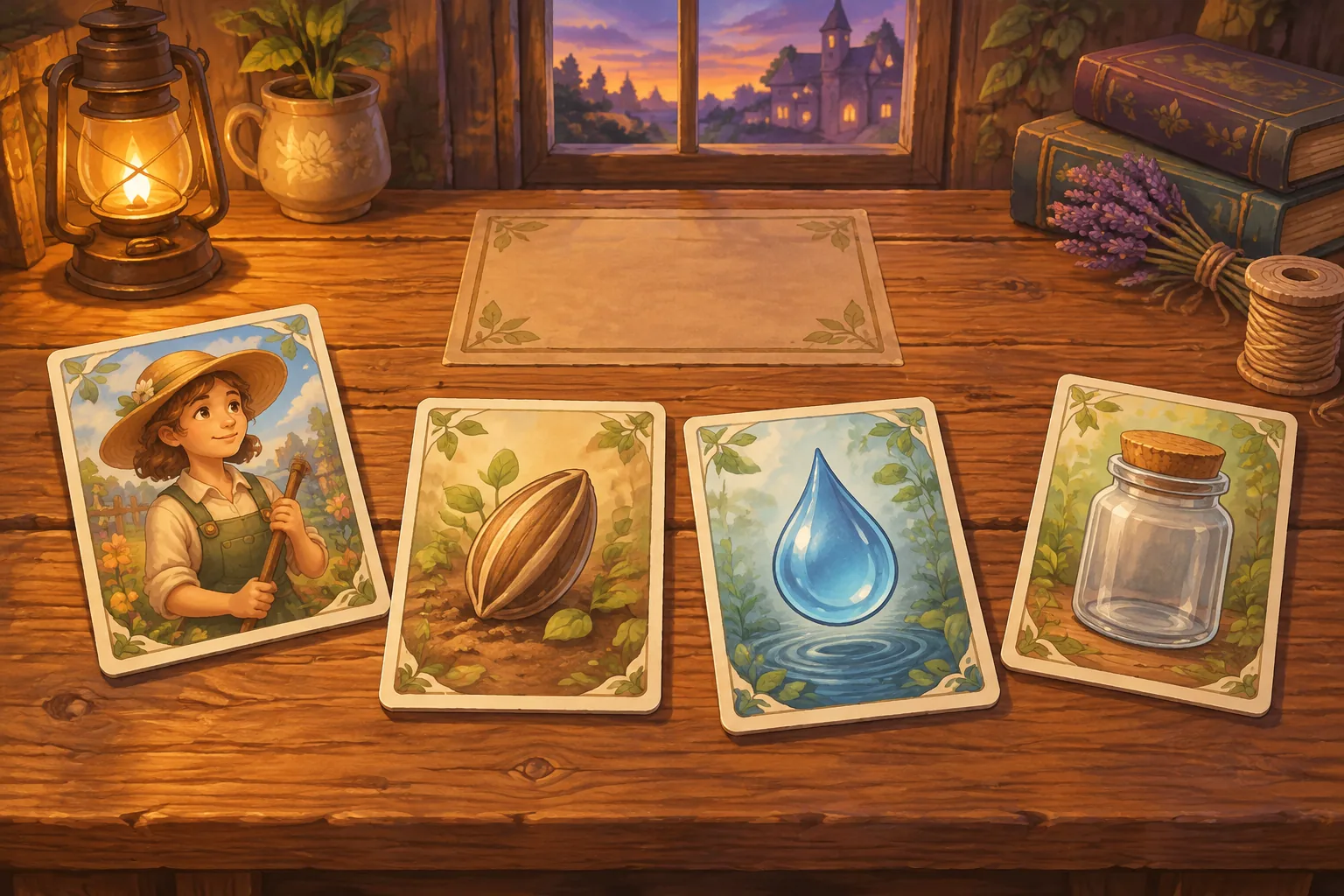
Place Gardener G, Seed S, Water W and Jar J separately on the table. The player can arrange cards at a workstation before advancing time. A card can belong to only one stack. The goal is to create Beacon B by the end of tick three.
Define recipes and card ownership
| Recipe | Exact stack | Duration | Completion |
|---|---|---|---|
| Grow | G + S + W | 2 ticks | Consume S and W, release unchanged G, create Flower F. |
| Lantern | F + J | 1 tick | Consume F and J, create Beacon B. |
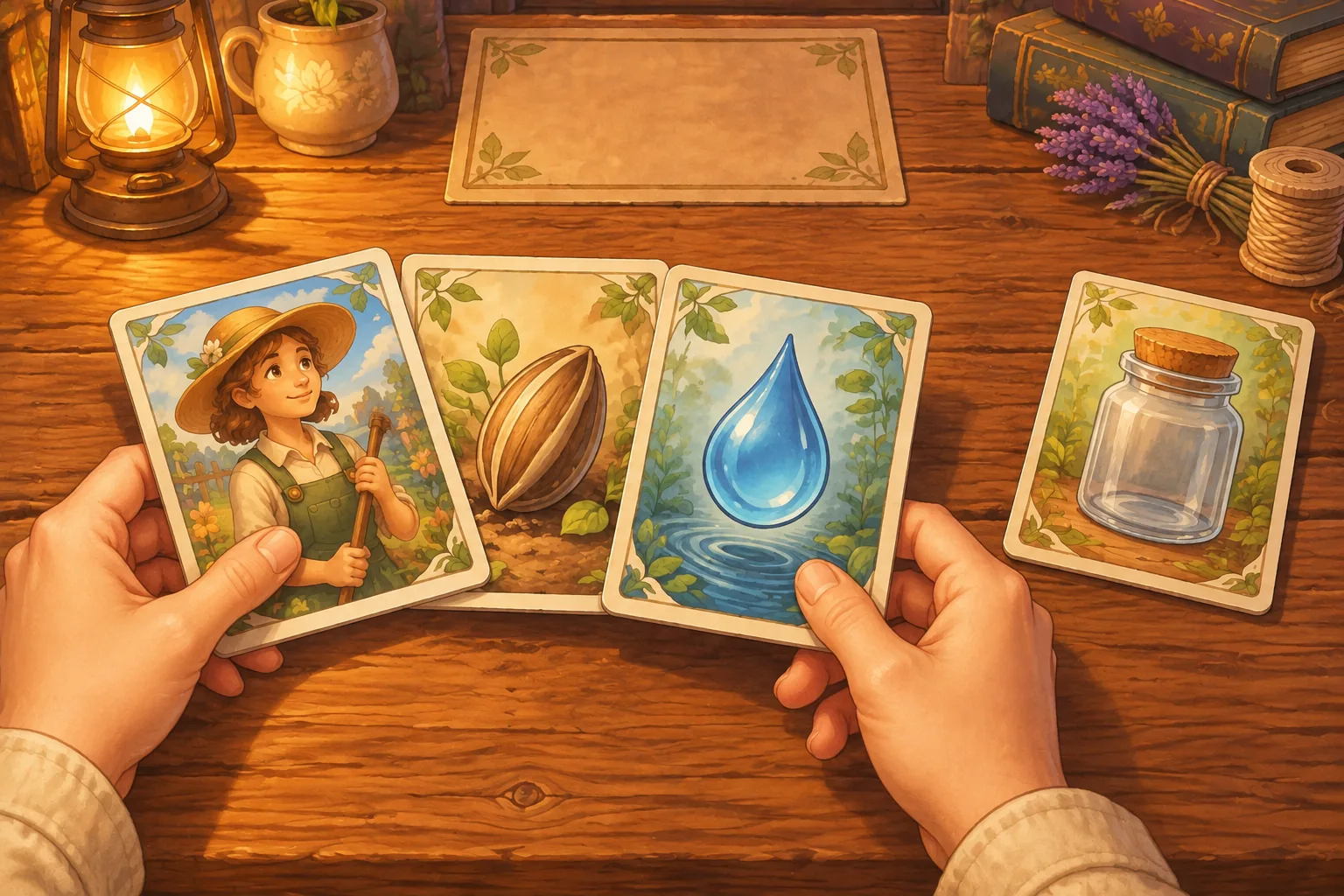
Only one recipe can run at a time. Starting a matching recipe reserves its cards until completion. Reject an unmatched stack without consuming or locking anything. When Grow finishes, release the Gardener separately from the new Flower so the player can see which card remains usable.
Each tick advances the active recipe by one unit, resolves any completion and then checks the deadline. If Beacon B exists by the end of tick three, the player wins. Otherwise the run ends as a missed deadline. The completion-first order allows a Lantern finishing on tick three to count.
Compare a successful and late schedule
| Time | Start Grow before tick 1 | Wait through tick 1 |
|---|---|---|
| Tick 1 | Grow reaches 1 of 2. | Idle. No recipe progress. |
| Tick 2 | Grow completes. G is released and F appears. | Grow reaches 1 of 2. |
| Tick 3 | Lantern completes and B wins. | Grow completes and F appears. The deadline is missed before Lantern can start. |

In the successful path, start Lantern after tick two and before tick three. In the late path, the flower exists at the deadline but the required Beacon does not. A timer display should distinguish a completed intermediate card from the final win condition.
Give AI the complete card fixture
Give the builder the initial cards, ownership rules and the order in which completion and the deadline are checked.
Build an original browser card game called Beacon Table.
Start at tick 0 with four separate cards: Gardener G, Seed S, Water W and Jar J.
A card belongs to at most one stack. Provide one workstation and allow one active recipe at a time.
Grow requires exactly G + S + W and takes 2 tick advances.
Reserve its cards. On completion consume S and W, release unchanged G and create Flower F.
Lantern requires exactly F + J and takes 1 tick advance. Consume F and J and create Beacon B.
Reject unmatched stacks without consuming or locking cards. Locked recipe cards cannot move until completion.
Let the player arrange and start a valid recipe before advancing a tick.
At each tick advance the active recipe, resolve completion, then check the deadline.
If B exists by the end of tick 3, win immediately. Otherwise end in a missed-deadline state.
Successful test: start Grow; tick 1 progress 1/2; tick 2 create F and release G; start Lantern; tick 3 create B and win.
Late test: tick 1 idle; start Grow; tick 2 progress 1/2; tick 3 create F and miss the deadline before Lantern starts.
Give every start and tick event an ID. Ignore a duplicate ID.
Reset restores all four original cards, an empty workstation and tick 0.
Show each card's location, recipe progress, tick, result and accessible labeled controls.
Use original tabletop card art.
Replay both schedules from reset. Try an incomplete stack and a repeated tick ID. If the tick-three Lantern finishes but the game reports failure, inspect whether the deadline check ran before recipe completion.
Use the first-build guide to adapt the fixture. Build Beacon Table in SEELE AI Game Maker and check both schedules before expanding the deck.
Frequently asked questions
How many recipes should a first card game have?
Start with two recipes that share a clear goal. The fictional Beacon Table turns a seed into a flower and then a beacon. A small chain lets you test ingredients, card ownership and timing completely before adding a larger deck.
How should a game handle an invalid stack?
Reject the start without consuming or locking any of the cards. Explain which ingredient or condition is missing, and let the player rearrange the stack. This keeps experimentation reversible and makes the valid recipe easier to understand. For example, reject it and leave every card in place.
Why distinguish consumed and released cards?
A recipe may use an ingredient while returning a worker unchanged. Show both outcomes separately so the player knows which cards remain available. In this fixture, Grow consumes Seed and Water, releases Gardener and creates Flower when its timer completes.
What happens when a recipe finishes at the deadline?
Define a fixed order for completion and the deadline check. Beacon Table resolves completion first, so a Lantern finishing on tick three wins. If the required Beacon still does not exist after that completion phase, the run ends as a missed deadline.