A fruit-merging puzzle needs a clear answer to one design question: what happens after two matching pieces meet? In this fictional prototype, Lantern Grove resolves the answer with three vertical lanes, a fixed fruit queue and a repeatable merge chain. The small board makes the rules easy to test before you add animation or more fruit types.
The goal is to create a Lantern Fruit without letting a lane overflow. The names, fruit ladder, score values and sample runs below are original design choices, not rules from Suika Game or a tested commercial game.
Set a small lane-based goal
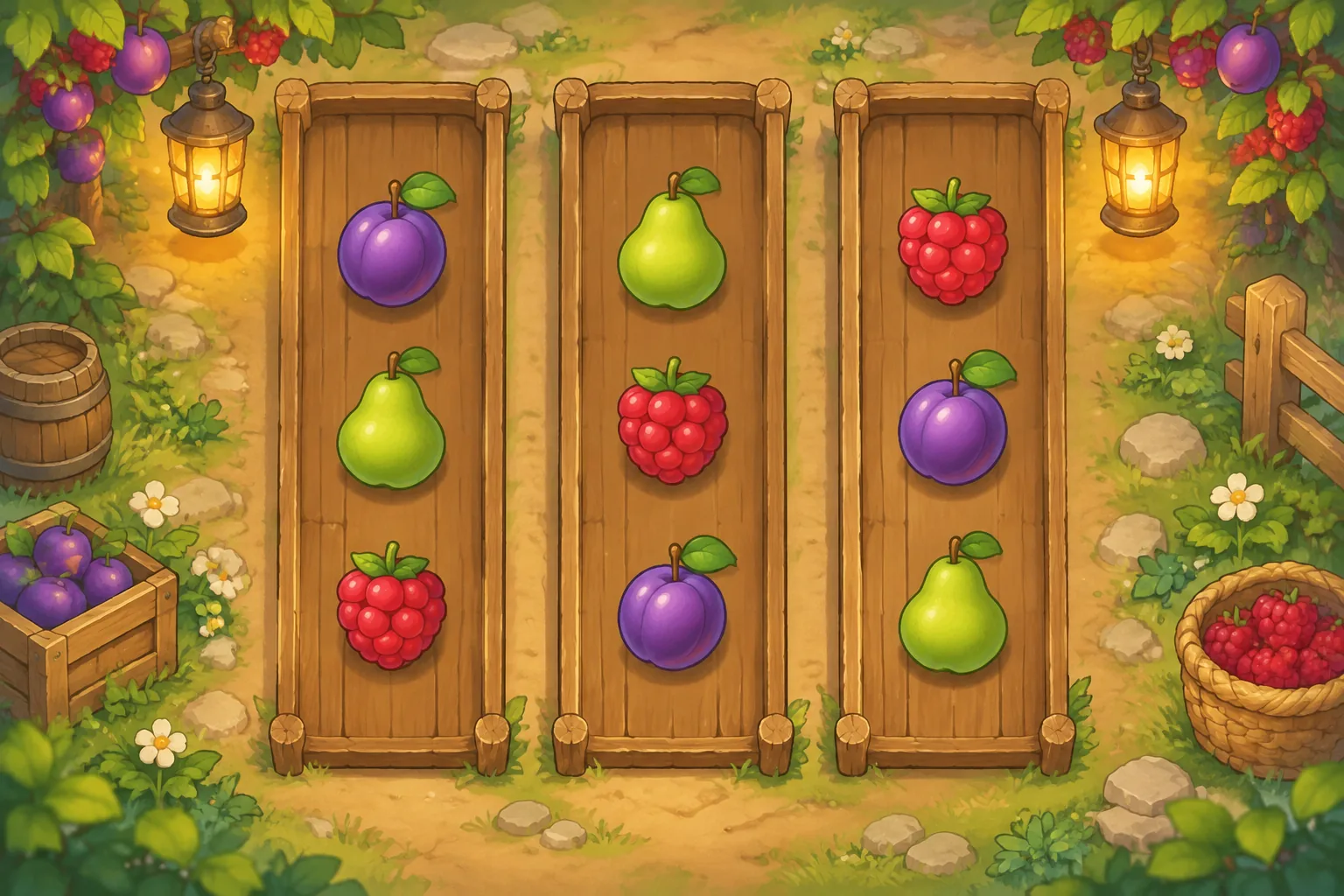
Aladdin X’s official Suika Game page describes combining identical fruits so they evolve, while keeping them from overflowing the box. That broad merge-and-capacity tension is a useful starting point for a new puzzle. Lantern Grove uses stacked lanes and its own resolution rule rather than copying the reference game’s visuals or interface.
Start with three empty lanes. Each lane holds at most four pieces, ordered from bottom to top. The fixed queue is Pear, Plum, Plum, Berry, Berry, Melon, Plum. On each turn, the player chooses a lane and the queued fruit lands on top. Preview the next piece, show every lane’s height, and record each merge in a short log so a player can see why the board changed.
Resolve matches from the top
Use this tier ladder: Berry (1), Plum (2), Pear (3), Melon (4), Lantern Fruit (5). When a new piece matches the top piece in its lane, replace the pair with one piece of the next tier in the same top position. Then compare that result with the piece directly beneath it. If those tiers match, merge them too. Repeat until the top two pieces differ or no lower piece remains.
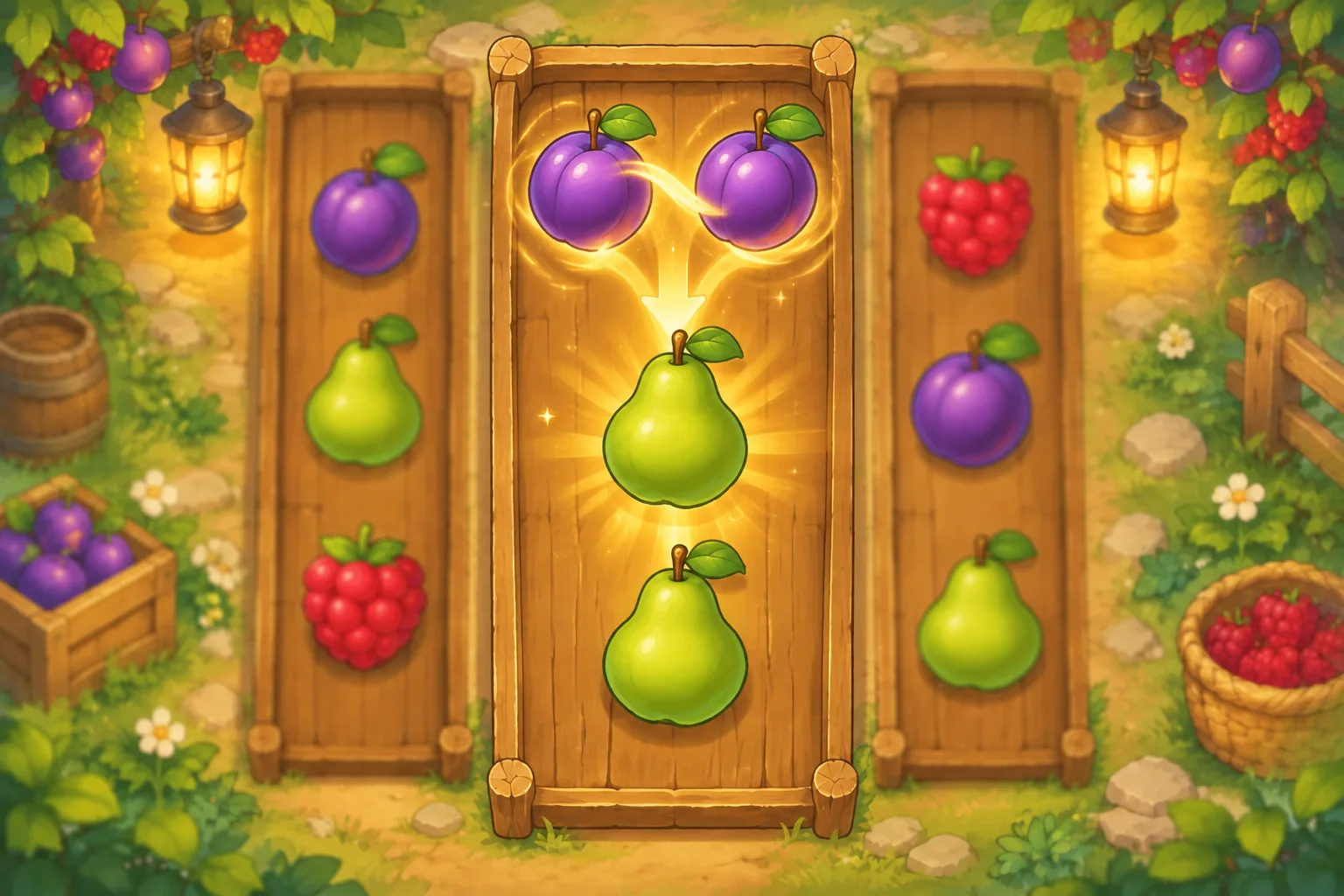
For a worked chain, play Pear, Plum, Plum into lane A. After the first two turns the lane is [Pear, Plum]. The third Plum combines with the top Plum to make a Pear; that new Pear matches the existing Pear beneath it, so the pair becomes a Melon. The final lane is [Melon]. Award 10 points for each resulting tier: 30 for the Pear merge plus 40 for the Melon merge, or 70 points total.
| Decision | Rule | Visible result |
|---|---|---|
| Top pair matches | Replace the pair with the next tier, then check below it. | One merge-log entry and 10 × result tier points. |
| Chain reaches tier 5 | Stop the run as soon as a Lantern Fruit is created. | Show the win state and final score. |
| Drop would exceed four pieces | Resolve any merge first; if five pieces remain, lose without committing the drop. | Keep the prior board and explain the full lane. |
Test the score and a safe lane
Continue the fixed queue after the three-piece chain. Drop Berry into lane B, then another Berry there. The pair becomes a Plum for 20 points, bringing the run total to 90. The next pieces are Melon and Plum; place them in lane C to create [Melon, Plum] without a merge. These separate lanes make the score trace and board state easy to inspect.
For a capacity test, prepare lane C as [Berry, Plum, Pear, Melon] and drop a Berry there. The top does not match, so the lane would contain five pieces. End the run as a loss and leave the original four-piece lane intact. In a second test, fill a lane with four pieces whose top matches the incoming piece. Resolve that merge before checking capacity; do not declare a loss just because the pre-merge lane was full.
Write a complete builder prompt
A prototype needs the tier order, the precise merge sequence and the failure rule as explicit inputs. Paste this fixture into an AI game builder, then compare the generated behavior with the acceptance steps before adding visual polish.
Build an original browser puzzle called Lantern Grove. Use original fruit art and a simple board with three vertical lanes. Each lane holds up to four fruit pieces, bottom to top. Start with empty lanes, score 0 and the fixed queue: Pear, Plum, Plum, Berry, Berry, Melon, Plum. Preview the next fruit. The player selects a lane for each drop; the piece lands on top. Fruit tiers are Berry 1, Plum 2, Pear 3, Melon 4, Lantern Fruit 5. If the incoming piece matches the top piece, replace that pair with one piece of the next tier in the same top position. After each merge, compare the new top with the piece directly beneath it and continue merging if their tiers match. Stop when they differ or no lower piece remains. Add 10 points multiplied by the resulting tier for each merge. Resolve all merges before checking lane capacity. If five pieces remain in the chosen lane, end the run as a loss and do not commit that drop. A full lane is playable if the incoming piece merges before the capacity check. Creating a Lantern Fruit ends the run as a win. Show score, lane heights, next-piece preview, merge log and win/loss reason. Reset restores the exact starting queue, empty lanes and score 0. Acceptance checks: Pear, Plum, Plum in lane A ends with [Melon] and 70 points (30 + 40); Berry, Berry in lane B ends with [Plum] and 20 more points; a full [Berry, Plum, Pear, Melon] lane rejects a Berry drop as a loss without changing the lane; a full lane whose top matches the incoming fruit resolves the merge before overflow. Test reset and both terminal states.After generating a first build, check the board transitions against the log and reset the run to repeat each test. The first-build guide covers how to shape a focused prompt. Build Lantern Grove with SEELE AI Game Maker, then verify the merge chain and overflow behavior in your own generated prototype.
Frequently asked questions
How do you make a fruit merge chain predictable?
Write the merge order as a sequence of checks. Lantern Grove first compares the incoming fruit with the top piece, replaces a matching pair with the next tier, and then checks only the new top against the piece directly below. Repeating this rule until the tiers differ makes the Plum-to-Pear-to-Melon example deterministic and easy to inspect in a merge log.
When should a merge game check for overflow?
Resolve merges before checking the lane limit. A four-piece lane can accept an incoming matching fruit if the pair merges and the resulting stack stays within capacity. If five pieces remain after all possible chain merges, end the run as a loss and leave the previous board unchanged so the rejected drop cannot create an ambiguous state.
How is the Lantern Grove score calculated?
The fictional rule awards 10 points multiplied by the resulting tier for each merge. Two Plums create a Pear at tier 3 for 30 points; that Pear can then merge with a Pear beneath it to create a Melon at tier 4 for 40 points. Together the chain scores 70. These values are authored for the sample fixture, not facts about Suika Game.
Why use a fixed fruit queue in a prototype?
A fixed queue lets a creator replay the same decisions and compare board states after each drop. Lantern Grove uses Pear, Plum, Plum to test its two-merge chain, then Berry, Berry to test a second score event. Once those acceptance checks pass, the builder can add a randomized queue while keeping a seed or replay log for debugging.