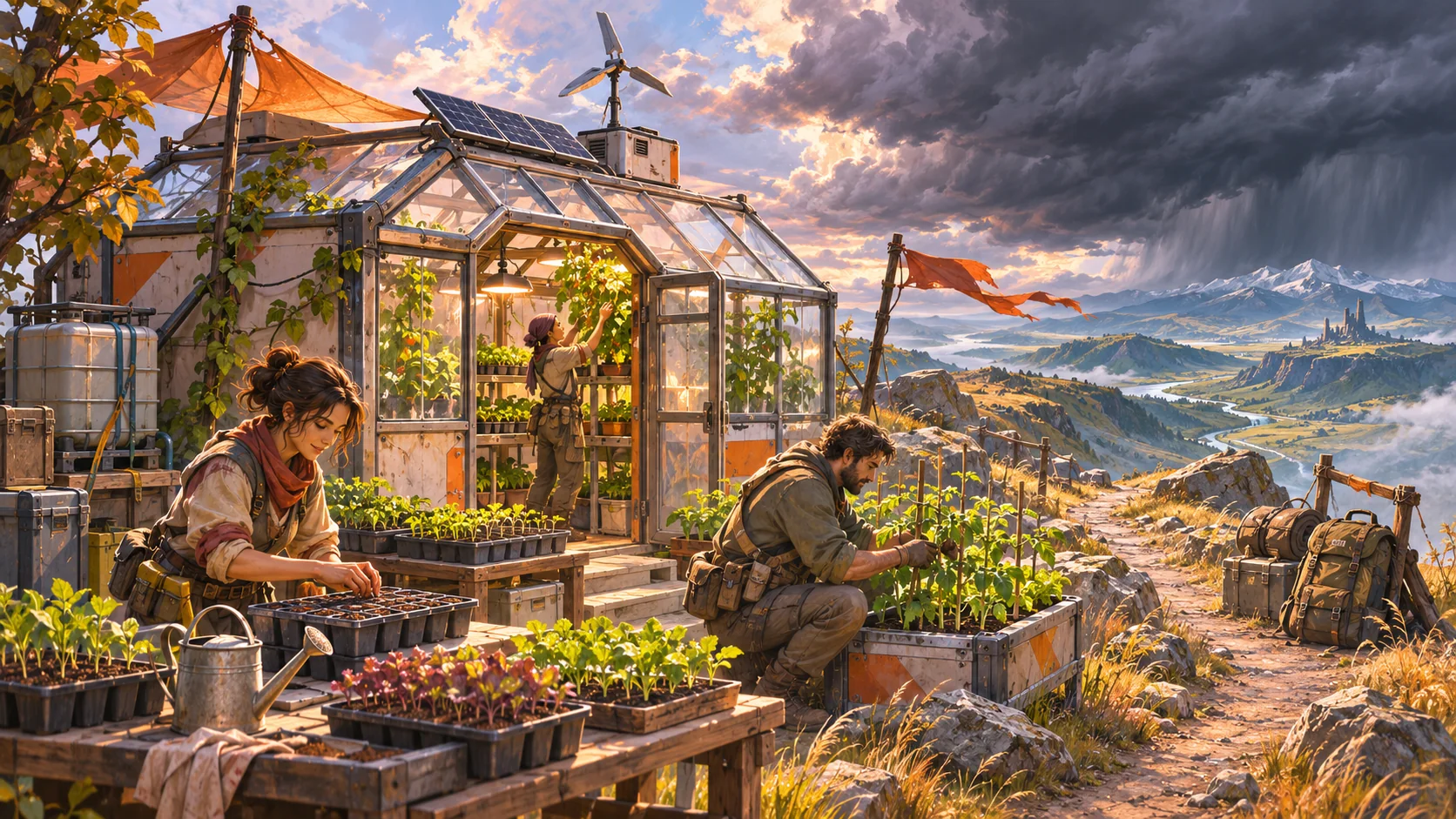
In Verdant Cartography, the greenhouse is both the player’s home and a kit that must be dismantled before leaving camp. Its frame, glass, water tank and grow bed occupy a limited carrier. Crops keep growing only while the greenhouse is assembled, so an expedition trades another harvest cycle for access to a new site.
The player tends one crop bed, chooses when to harvest, packs all four modules in a single teardown action, and spends a travel day reaching the next camp. Rebuilding reopens the growing loop, but uses the expedition’s first work action. The base therefore creates a recurring decision: stay one more day for produce or move while the route and supplies are favorable.
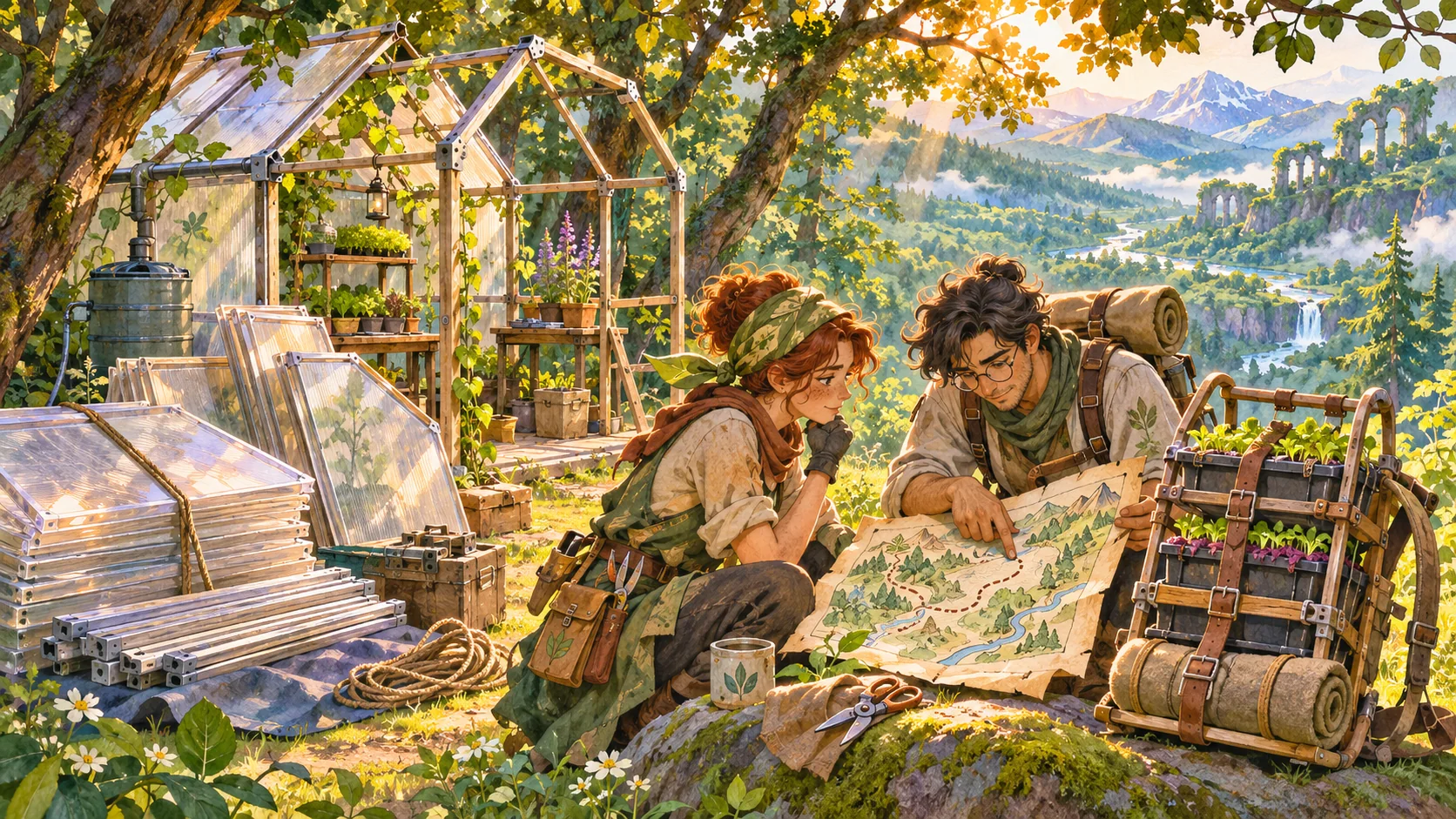
Turn the greenhouse into a portable base
Create Verdant Cartography as a small greenhouse and expedition simulation. The player owns one greenhouse made of four modules: Frame, Glass Shell, Water Tank and Grow Bed. When assembled at a camp, the greenhouse supports one crop bed. The carrier holds exactly 4 module slots, one per module; other collected items use a separate 2-slot pouch. A teardown action is available only after the crop is harvested or composted. Teardown packs all four modules at once and stops crop growth. Rebuild at any discovered site costs one work action and restores the greenhouse; modules cannot be lost or duplicated. The tank holds up to 3 water units. At each stationary day start, use 1 water on the bed or skip watering. A watered crop advances one stage if temperature is 18–24°C; otherwise it stays at its current stage. The starting crop, Moonmint, begins at stage 1 and is ready to harvest at stage 2; harvest costs one work action and gives 2 herbs. A day has 2 work actions. Travel to a neighboring site costs one full day and does not advance crop growth. The starting greenhouse has 3 water, and the first expedition target is the Ridge Camp, one route step away, where a rare seed pouch can be collected with one action. The player must pack the greenhouse to travel. Rebuilding consumes one work action at the destination; the player may then plant the rare seed if a Grow Bed is assembled. A crop planted at a new site starts at stage 0 and needs two successful watering days to reach harvest. No greenhouse modules are consumed by travel; do not allow growth while packed or while the party is on the road. Show crop stage, temperature, water, module locations, action count, current site, route options and pouch capacity after every action.
| System | Prototype rule |
|---|---|
| Greenhouse modules | Frame, Glass Shell, Water Tank and Grow Bed; one instance of each. |
| Carrier | Exactly 4 module slots, one per greenhouse module; separate expedition pouch holds 2 small items. |
| Teardown | One action packs all four modules; allowed only after harvest or compost; crop growth stops while packed. |
| Rebuild | One work action at any discovered site; restores the bed and enables growing there. |
| Water | Tank capacity 3; watering one assembled bed consumes 1 water at stationary day start. |
| Growth | A watered crop advances one stage per day only at 18–24°C; outside that band it pauses. |
| Moonmint | Starts at stage 1, harvest-ready at stage 2; harvest costs one action and yields 2 herbs. |
| Workday | 2 work actions; travel to an adjacent site costs a full day and pauses crop growth. |
| Expedition | Ridge Camp is one travel day away and contains a rare seed pouch that costs one action to collect. |
| New crop | Rare seed starts at stage 0; needs two successful watering days to reach harvest. |
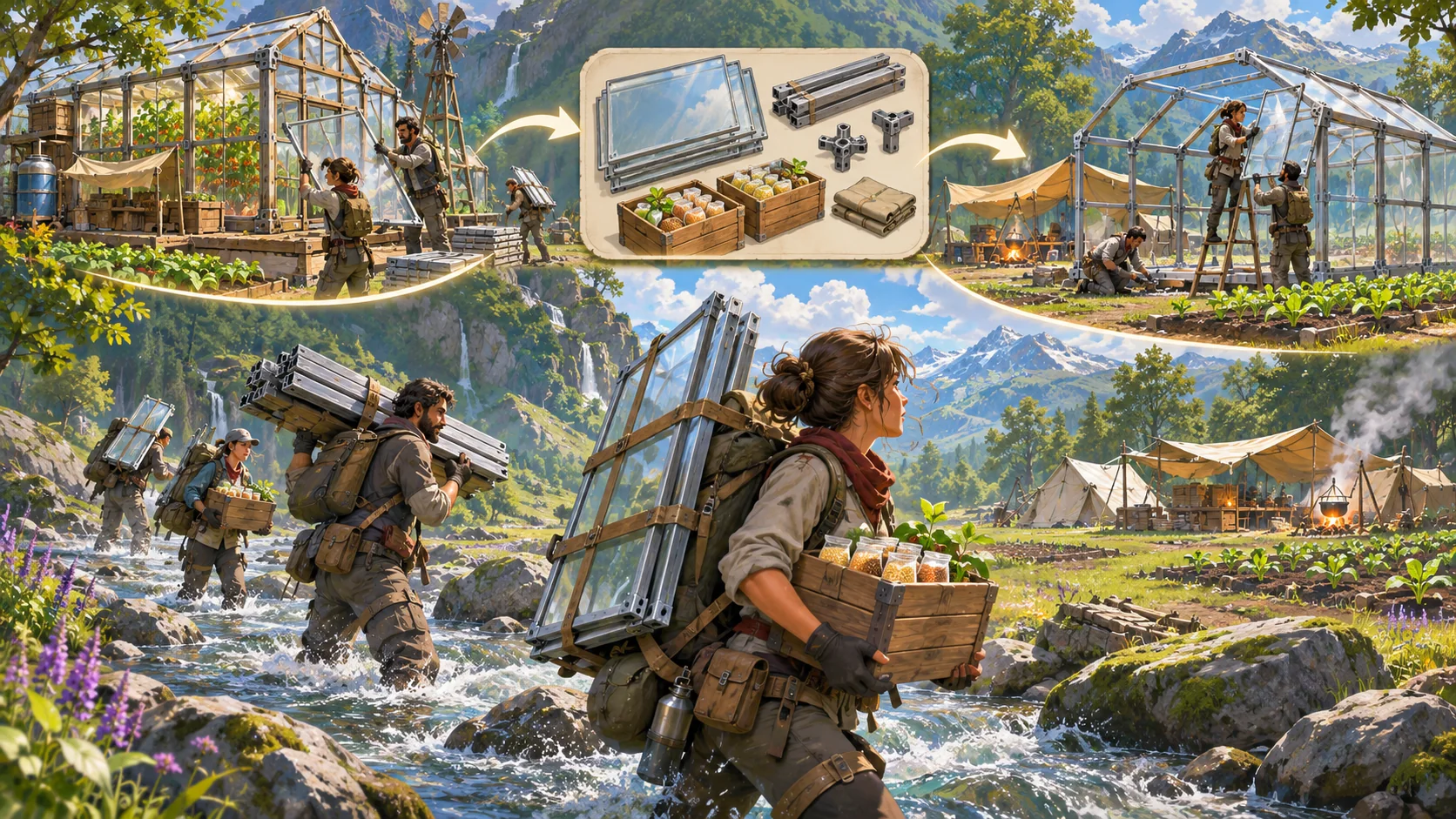
Set packing, water and crop growth rules
At the home camp, Moonmint is stage 1, the greenhouse is assembled and the tank has 3 water. On day 1 the player waters the bed; because the temperature is 21°C, Moonmint reaches stage 2. The player spends the first work action harvesting 2 herbs, leaving one action. The crop is now empty, so teardown is legal. The player spends the second action packing Frame, Glass Shell, Water Tank and Grow Bed into the four-slot carrier. On day 2, travel to Ridge Camp consumes the whole day; growth stays paused and the 3 water remains in the tank. At Ridge Camp, the player uses one work action to collect the rare seed pouch and one action to rebuild the greenhouse. The seed is not planted automatically. The next stationary day begins with the greenhouse assembled; spending one action to plant the seed uses the remaining action to water it if water is available. A 21°C day advances it from stage 0 to stage 1. The example shows harvest timing, module capacity and travel pause. These state transitions are authored examples, not a playable or user test.
| Event | Expected state |
|---|---|
| Home start | Greenhouse assembled; Moonmint stage 1; tank has 3 water; carrier empty. |
| Day 1 water | Water falls to 2; at 21°C crop advances to stage 2. |
| Harvest | One work action yields 2 herbs; bed becomes empty. |
| Teardown | Second work action packs the 4 modules; growth is paused. |
| Travel to Ridge Camp | Consumes one full day; crop does not advance; water remains 2. |
| Collect rare seed pouch | One work action fills one pouch slot. |
| Rebuild greenhouse | One work action restores all four modules at Ridge Camp. |
| Plant and water rare seed | On the next stationary day, seed advances from stage 0 to 1 if temperature is in range and water is spent. |
Trace one harvest through an expedition
Tell the generator to model the base as a set of modules with a clear pack action. Define exactly when crop time advances, which state is frozen during travel and how the destination uses the same module set.
Create a compact greenhouse simulation called Verdant Cartography. The greenhouse has four unique modules: Frame, Glass Shell, Water Tank and Grow Bed. The carrier has four module slots, one per module, and a separate two-slot pouch for small items. The greenhouse grows one crop only while assembled. Teardown is one action that packs all four modules; it is allowed only after the crop is harvested or composted. Rebuild at a discovered camp costs one work action and restores the bed. The tank holds up to 3 water. At each stationary day start, the player may water the assembled bed for 1 water; a watered crop advances one stage if temperature is 18–24°C and otherwise pauses. Do not advance growth while modules are packed or during travel. Start with Moonmint at stage 1, harvest-ready at stage 2; harvesting costs one action and yields 2 herbs. Each workday has 2 actions. Travel to an adjacent site consumes a full day. Ridge Camp is one travel day away and has a rare seed pouch that costs one action to collect. The player must harvest or compost the crop, then pack the modules, before traveling. Rebuilding at Ridge Camp takes one action. A newly planted rare seed begins at stage 0 and requires two successful watering days to reach harvest. Show module locations, crop, stage, temperature, water, action count, site, route and pouch capacity after every action. Prevent duplicate modules, growth while packed, travel with an unharvested crop and rebuild without all four modules. This is an authored design specification, not a claim of a playable test.Prompt AI to build the greenhouse loop
An early draft let crops keep growing in transit, which made the choice to move costless. The revised rule pauses growth whenever the greenhouse is packed or the player is traveling. That forces a harvest-versus-expedition decision instead of rewarding every action at once.
The module inventory also needed a fixed capacity. The carrier now has exactly four slots, one for each unique greenhouse part, while small expedition finds use a separate two-slot pouch. Teardown and rebuild each happen as one action, so the main loop can be tested before adding construction mini-games.
Revise a timing ambiguity
Prototype one crop, four greenhouse modules and two connected sites first. Confirm the bed must be empty before teardown, the modules fit exactly in the carrier, and travel pauses crop progress. Then add destination temperatures and a second crop. The values and traces here are authored design inputs, not observed balance results or user tests.
Read the related greenhouse simulation guide.
Try the SEELE AI game maker workflow.
Frequently asked questions
Why must the greenhouse be dismantled for an expedition?
The player moves the same four modules between camps, so packing frees the base to travel while pausing crop growth. The decision to harvest before leaving becomes part of route planning rather than a separate cosmetic animation. This makes relocation a real tradeoff between more local production and reaching another resource site.
Can crops grow while the greenhouse is packed?
No. Crop growth pauses when the modules are packed or while the player travels. Water is not consumed during travel, and the crop resumes only after the greenhouse is rebuilt at a discovered site. The water value remains stored in the packed tank until the player rebuilds and chooses to water the bed again.
Check Godot's official Resource reference.
What happens if a crop is still growing when I want to leave?
The player must wait, harvest when ready, or compost the crop before teardown. The rule prevents the base from moving while leaving an active bed behind, and makes the timing decision visible. Keeping the rule explicit prevents the player from carrying an active growing bed between locations without paying its time cost.
Has this greenhouse loop been tested in a game?
No. Verdant Cartography, its module set, crop stages, temperatures, travel timing and state trace are authored design material. This package does not claim a playable build, browser test, user test or measured balance result. The module inventory, growth timing and route costs still need implementation and real playtesting before balance can be assessed.