A marble auto-battler can make weather part of the strategy when it changes the board state after collisions. Players set a formation and choose a hero ability, then the round resolves without direct steering. A dry arena and a rain-slick arena can turn the same collision into different landing positions. Start with one lane, two marbles and a small goal pocket so players can see the effect.
Preview the weather before choosing a formation
Use an attacker marble with speed 3, a stationary defender and a goal pocket two tiles beyond the defender. In this prototype, a collision transfers the attacker's speed to the defender. Dry stone has a grip factor of one half, so the defender rolls three tiles and passes the pocket by one. Wet stone has a grip factor of one, so it rolls six tiles and passes by four. Show the forecast beside the lane before the player locks the formation.
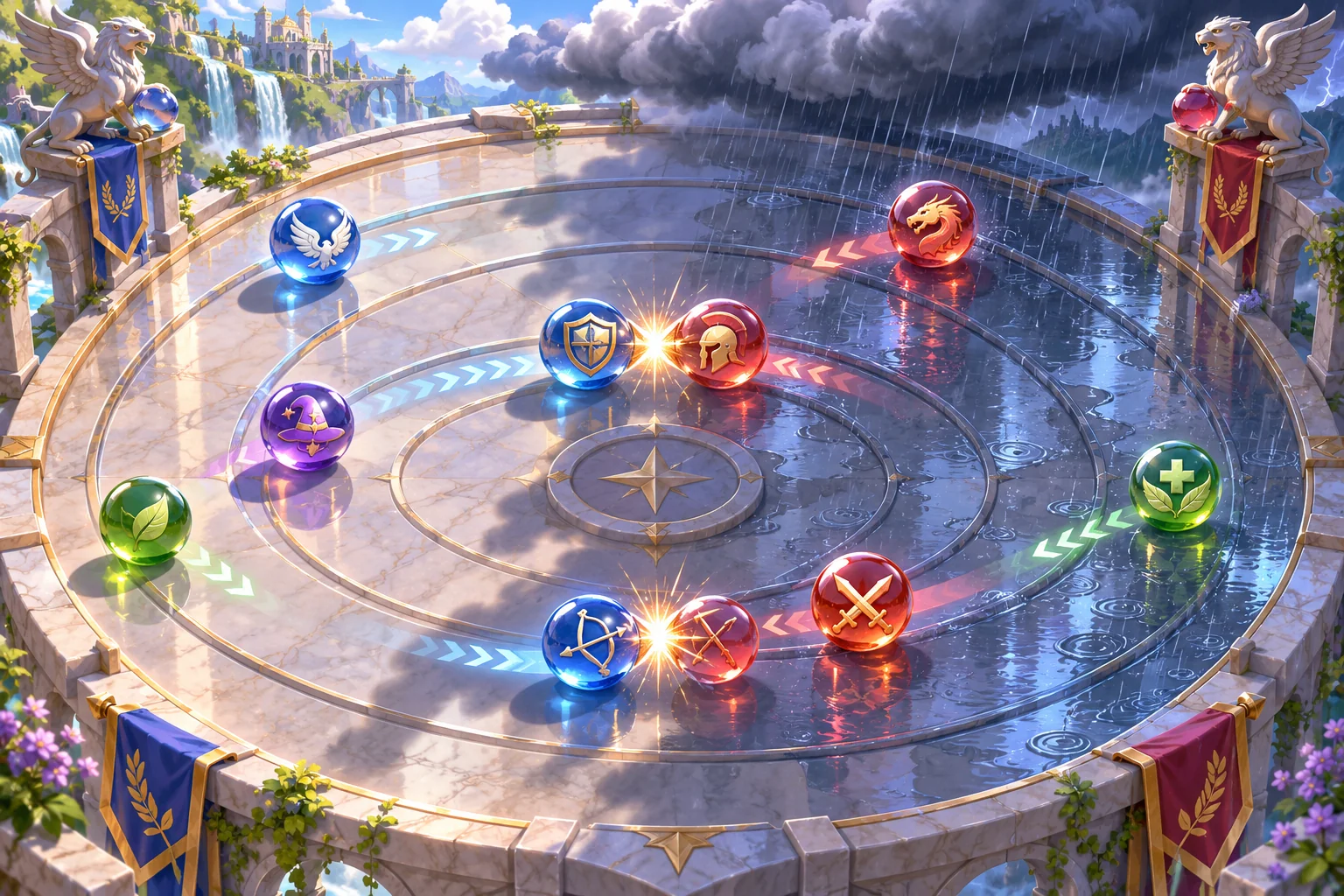
Keep the first board simple: a straight lane, one collision, one target pocket and two weather states. Treat the numbers as fictional rules for a readable prototype, not realistic physics. When players can predict the landing, they can decide whether to change formation or save an ability.
Give the hero ability a clear weather counter
The anchor ability halves the defender's wet roll once per round. In rain, the collision still transfers speed 3, but the ability reduces the six-tile roll to three. That places the defender in the pocket. The hero does not cancel weather; it converts a dangerous long roll into a predictable landing. Show the ability cost and resulting landing tile before resolution.

Let weather change the board in a way that persists through the round. Avoid changing speed, grip and ability strength all at once. If the player misses the pocket, report the final tile and whether the cause was weather, collision position or an unused ability. Keep the same seed and starting positions on reset.
Replay the same collision in each weather
The local rules replay uses speed 3 and a pocket two tiles beyond the stationary defender. It applies the same collision, then calculates roll distance using the weather factor. Dry stone produces a three-tile roll. Wet stone produces a six-tile roll and overshoots. Applying the anchor ability to the wet case halves that distance to three and reaches the pocket.
| Case | Weather | Roll | Ability | Landing |
|---|---|---|---|---|
| Baseline | Dry, grip 1/2 | 3 tiles | None | 1 past pocket |
| Weather shift | Wet, grip 1 | 6 tiles | None | 4 past pocket |
| Counterplay | Wet, grip 1 | 3 tiles | Anchor halves roll | In pocket |
This deterministic arithmetic checks only collision distance and the ability modifier. It does not simulate rolling friction continuously, spin, curved tracks, multiple collisions or a full auto-battler. Add those systems after players understand the weather preview and landing decision.
Build one weather lane before adding a roster
Ask an AI game maker for a small marble auto-battler with a straight lane, a visible goal pocket, dry and wet forecasts, two marbles and an anchor ability. Resolve the round automatically and show the collision, roll distance and landing tile. Add a reset so the exact same positions and weather can be replayed.
After the lane is readable, add a second weather state or hero ability one at a time. Replay the same setup after each change. This reveals whether the new rule creates a counterplay choice or makes outcomes difficult to understand.
Create a marble auto-battler prototype on one straight arena lane. Set an attacker marble speed to 3 and place a stationary defender with a goal pocket two tiles beyond it. On collision, transfer the attacker's speed to the defender. Dry weather uses grip factor 1/2 and yields a three-tile roll; wet weather uses grip factor 1 and yields a six-tile roll. Add a once-per-round anchor ability that halves the defender's wet roll to three tiles, landing in the pocket. Preview weather and landing before the round, show each collision and add a reset for the same setup. Label these as prototype rules, not realistic physics. Do not add multiple collisions or opponent AI yet.
Start a marble auto-battler prototype in SEELE
Frequently asked questions
How can weather change an auto-battler without direct controls?
Weather can alter the arena rule used after each automatic collision. A grip change affects the roll distance, which changes where pieces finish and what formations are useful next. Preview the rule before the round so players can plan without steering every marble.
What does the anchor ability do?
It halves one defender's wet roll once in the round. In the sample, a six-tile roll becomes three and reaches the goal pocket. Show the ability's target and landing result before it is committed. Preview the reduced distance and landing before spending it.
Is this a realistic marble physics model?
No. The example uses fixed grip factors and a simple collision transfer to test a design idea. It does not establish realistic friction, spin, collision angles or game balance. Build the readable rule first, then replace it with fuller physics if needed.